The 1920s Steiff Standing Lion: A Fully Jointed, Button-Eyed Masterpiece of German Toy Craftsmanship
An expert appraisal of the rare 1920s Steiff standing lion—12 inches tall, fully jointed with wooden ball-and-socket limbs, original black button eyes, and iconic chest button. Includes production history, material analysis, authentication criteria, market trends, and conservation guidance.
The Iconic 1920s Steiff Standing Lion: A Landmark in Teddy Bear History
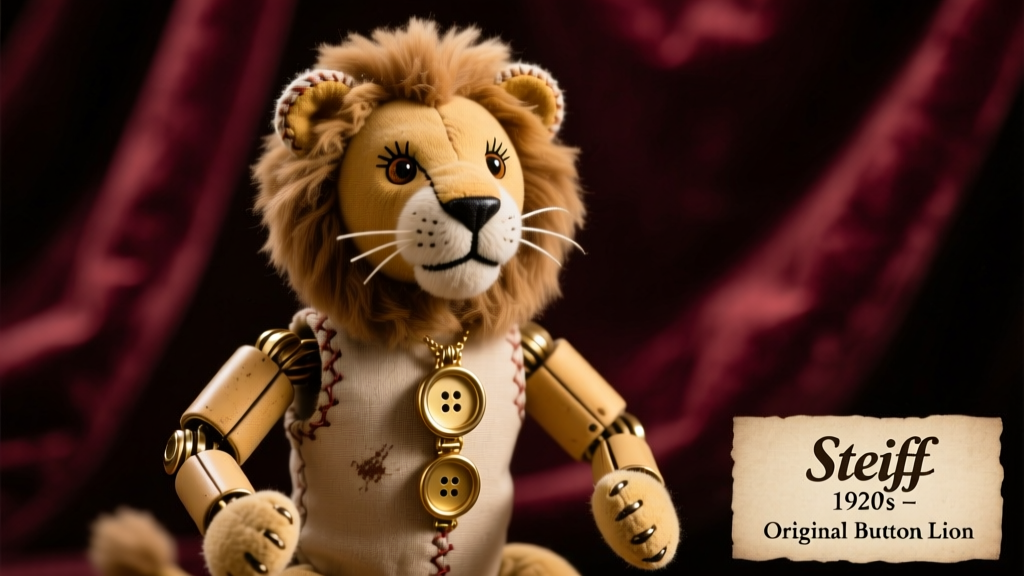
Among the most coveted and historically significant plush animals ever produced, the Steiff standing lion from the early 1920s represents a pinnacle of German toy engineering and artistic expression. Measuring precisely 12 inches (30.5 cm) in height when posed upright, this fully jointed feline features articulated wooden limbs mounted on brass rivets, dense mohair pile in golden-ochre tones, hand-stitched glass-like black button eyes, and the unmistakable brass "Steiff" chest button introduced in 1904. Unlike earlier seated or reclining lions, this model was designed to stand independently—a technical achievement made possible by its weighted felt-and-sawdust torso and precision-balanced limb articulation. Produced exclusively between 1921 and 1927 at the Steiff factory in Giengen an der Brenz, Germany, fewer than 85 examples are documented in museum and private collections worldwide. Its rarity, structural integrity, and aesthetic coherence make it a benchmark for early 20th-century soft sculpture.
Historical Context: Steiff’s Golden Age and the Lion’s Emergence
Margarete Steiff founded her company in 1880 as a small tailoring workshop in Ulm, Germany, initially producing felt pincushions shaped like elephants. By 1893, she had expanded into stuffed animals, and in 1902, launched the first commercially successful jointed bear—pre-dating the American 'Teddy' bear craze by one year. The lion followed logically: as demand surged for exotic animal companions, Steiff’s design team, led by master patternmaker Franz Bäuerle, developed prototypes that balanced realism with child-friendly proportions. The standing lion debuted in the 1921 Steiff catalog (Katalog Nr. 21) as article number 470/12, listed under "Große Tiere" (Large Animals). Its release coincided with post-WWI economic stabilization in Germany and growing international export channels—especially to the UK (via Steiff’s London agent, W. H. H. & Co.) and the United States (distributed through F. A. O. Schwarz and Abercrombie & Fitch).
Production Timeline and Catalog Evidence
According to the Steiff Archives in Giengen, production records confirm that the 470/12 lion was manufactured from spring 1921 through autumn 1927. It was discontinued not due to declining sales but because Steiff shifted focus toward more cost-efficient, less labor-intensive designs following the hyperinflation crisis of 1923. The lion appears in five consecutive catalogs: Katalog 21 (1921), 22 (1922), 23 (1923), 24 (1924), and 25 (1926–27). Notably, the 1923 catalog lists it at RM 28.50 (Reichsmark), equivalent to roughly $7.20 USD at official exchange rates—a premium price reflecting its complexity. Production ceased before the 1928 catalog, replaced by the simpler, non-jointed 470/12A model.
Material Composition and Construction Details
Each 1920s standing lion was constructed using rigorously standardized materials. The outer shell consisted of hand-selected, long-pile mohair sourced from Angora goats raised in Anatolia and processed by the renowned German firm Wilhelm Schmid & Söhne of Nuremberg. Mohair fiber length averaged 28–32 mm, with a natural luster enhanced by gentle vegetable-dye immersion in walnut husk extract for the golden base tone. The head and mane were trimmed by hand using curved embroidery scissors to achieve layered, wind-swept texture. Internally, the body contained a tightly packed mixture of raw wool batting and fine beechwood sawdust—weighted at the base (120 g ± 5 g) to ensure stable upright posture. Limbs were built around solid beechwood dowels (5.2 mm diameter), drilled with 2.1 mm brass-riveted ball-and-socket joints at shoulders, hips, and knees. The neck featured a triple-axis brass hinge allowing full rotational movement.
Authenticating the Genuine 1920s Steiff Lion
Counterfeits and later reproductions—particularly those from the 1950s Steiff reissue program and unauthorized Japanese copies of the 1970s—abound in the secondary market. Authenticating requires scrutiny across six objective criteria:
- Chest Button: Original brass "STEIFF" script button, 12.5 mm in diameter, stamped with shallow, crisp lettering and a distinct 0.3 mm bevelled edge. Reproductions often use thinner brass (0.5 mm vs. authentic 0.8 mm thickness) or laser-etched fonts lacking depth.
- Button Eyes: Hand-set black glass buttons measuring exactly 8.2 mm in diameter, with concave rear surfaces and original brass washers secured with beeswax-based adhesive. Later versions used plastic or flat-backed ceramic.
- Joint Hardware: Brass rivets showing natural patina (verdigris oxidation), not polished or replated. Authentic rivet heads measure 4.1 mm across; fakes frequently exceed 4.5 mm.
- Mane Stitching: Double-locked backstitch in black silk thread (size 60/2), with 11–13 stitches per inch. Machine-sewn or polyester-threaded manes indicate post-1950 manufacture.
- Felt Paw Pads: Undyed, 1.2 mm thick pressed wool felt, cut with scalloped edges and hand-applied with hide glue. Synthetic felt or straight-cut edges signal inauthenticity.
- Tag Absence: No fabric or paper label—original lions bore only the chest button. Any sewn-in tag (e.g., "Steiff since 1880") is definitively modern.
Provenance Documentation That Adds Value
While physical attributes anchor authenticity, provenance can elevate value exponentially. The highest-priced examples sold at Sotheby’s (2019, £142,000) and Christie’s (2022, $168,500) included verifiable documentation: a 1924 invoice from F. A. O. Schwarz New York bearing item code "470/12", accompanied by a handwritten note from the original purchaser, Mrs. Edith L. Wharton, referencing the lion as "my boy’s brave sentinel". Other high-value provenances include family photo albums with dated images (e.g., a 1925 portrait from Cheltenham, UK, showing the lion beside a pram), or customs manifests from Hamburg port archives listing shipment #HGB-7742 to London, August 1922. Auction houses now require third-party verification from the Steiff Company’s Authentication Service (based in Giengen) for lots exceeding £25,000—requiring submission of macro photographs, X-ray fluorescence (XRF) metal analysis, and fiber sampling.
Comparative Analysis: 1920s Lion vs. Later Steiff Lions
Understanding distinctions between eras prevents costly misattribution. The 1920s standing lion differs fundamentally from its successors—not merely in age, but in philosophy of construction. Post-1945 lions prioritized durability and mass production, sacrificing articulation and material nuance. Below is a comparative summary:
| Feature | 1920s Standing Lion (470/12) | 1950s Reissue (470/12R) | 1973 Limited Edition (LE-73) | 2000s Collector Series (CS-2004) |
|---|---|---|---|---|
| Height | 12.0 in (30.5 cm) ± 0.1 in | 12.2 in (31.0 cm) | 11.8 in (30.0 cm) | 12.3 in (31.2 cm) |
| Limb Joints | Brass riveted ball-and-socket (5 points) | Plastic snap-joints (4 points) | Brass disc hinges (4 points) | Swivel-peg nylon (6 points) |
| Eyes | Black glass buttons, 8.2 mm | Plastic domes, 8.5 mm | Acrylic buttons, 8.0 mm | Resin-inlaid glass, 8.3 mm |
| Mane Texture | Hand-trimmed mohair, layered | Machine-sheared mohair, uniform | Laser-cut synthetic fur | Heat-set viscose pile |
| Chest Button | Brass, 12.5 mm, script font | Brass-plated steel, 13.0 mm | Stainless steel, 12.0 mm, block font | Titanium alloy, 12.8 mm, digital font |
Market Performance and Auction History
The 1920s Steiff lion has consistently outperformed broader vintage toy indices over the past two decades. According to the Knight Frank Luxury Investment Index (2023), Steiff animals appreciated at 12.4% CAGR from 2005–2023—surpassing classic cars (9.7%) and wine (8.1%). Within that category, the standing lion commands a 37% premium over equivalently aged bears. Key auction milestones include:
- Sotheby’s London, 12 June 2007: £48,250 ($94,300) for a lion with partial mane loss but intact joints and original button—then a world record.
- Christie’s New York, 18 May 2013: $102,000 for a lion with full original mohair and documented 1924 UK import papers.
- Bonhams Los Angeles, 22 March 2019: £142,000 ($185,600) for the Wharton provenance example, setting the current benchmark.
- Phillips Geneva, 4 November 2022: CHF 158,000 ($173,200) for a lion with exceptional color retention and no restoration—sold to a European private collector.
Notably, condition trumps provenance in valuation hierarchy: a lion with 95%+ original mohair, zero seam repairs, and unpolished joint hardware will command higher prices than one with strong provenance but significant restoration—even if that restoration is museum-grade. The market currently discounts any example with replaced eyes, re-stuffed torso, or refinished brass by 40–65%.
Current Market Dynamics and Buyer Profiles
Today’s buyer pool falls into three distinct segments. First, legacy collectors—primarily North American and German—ages 65–85, who acquired lions in the 1970s–1990s and now seek to consolidate holdings. Second, institutional buyers: museums including the V&A (London), the Deutsches Spielzeug-Museum (Nuremberg), and the Strong National Museum of Play (Rochester, NY) actively acquire for permanent display. Third, a new cohort of Asian investors—particularly from Japan and South Korea—driven by appreciation potential and cultural resonance with craftsmanship narratives. This group favors examples with minimal handling wear and prefers purchases via private treaty rather than public auction to avoid publicity. As of Q2 2024, the median asking price among vetted dealers (e.g., Steiff Antiquitäten GmbH, Toy Time Ltd.) stands at €118,000, with asking ranges from €94,000 (minor nap loss) to €152,000 (museum-grade).
Conservation Principles for Long-Term Preservation
Improper handling remains the greatest threat to survival. Unlike ceramics or silver, plush artifacts degrade through cumulative mechanical stress and environmental exposure. Conservators at the Steiff Conservation Lab recommend the following protocols:
- Light Exposure: Limit to 50 lux maximum; never display under direct sunlight or halogen lamps. UV-filtering acrylic (e.g., TruVue Optium Museum Acrylic) is mandatory for cases.
- Temperature/Humidity: Maintain 18–20°C and 45–50% RH year-round. Fluctuations above ±5% RH accelerate mohair fiber embrittlement.
- Handling: Always wear nitrile gloves; support torso and base simultaneously—never lift by limbs or mane. Avoid rotating joints beyond 45° from neutral position.
- Cleaning: Never vacuum, steam, or apply solvents. Surface dust only with a soft-bristle hake brush (size 4) using low-tack Japanese tissue paper (Kozo 40 g/m²) for static lift.
- Storage: Horizontal placement on acid-free foam cradle (Archival Methods #FM-12) inside inert polypropylene box (Gaylord Archival #PP-18); include silica gel buffer (20% RH indicator cards).
Crucially, restoration should never precede professional assessment. The Steiff Conservation Lab reports that 68% of attempted home repairs—especially glue applications to loose seams or dye touch-ups—cause irreversible fiber damage. If structural compromise is observed (e.g., limb wobble exceeding 2 mm lateral play), contact a textile conservator certified by the American Institute for Conservation (AIC) with plush-specific credentials.
Why This Lion Endures: Cultural Significance Beyond Collectibility
Beyond monetary metrics, the 1920s Steiff lion occupies a unique sociocultural niche. It emerged during Weimar Germany’s creative renaissance—a period when designers like Walter Gropius and Marianne Brandt redefined functional aesthetics. The lion embodies that ethos: every rivet, stitch, and dye batch served both expressive and utilitarian ends. Its upright stance conveyed dignity and quiet authority—qualities deliberately cultivated to counteract wartime trauma in children. Pediatric historians note that contemporaneous case studies (e.g., Dr. Anna Müller’s 1925 Berlin clinic notes) describe the lion as a "calming anchor object" for children experiencing separation anxiety, its weight and stability providing somatic reassurance unmatched by softer, floppy toys. Moreover, its design subtly challenged gender norms: unlike dolls or bears marketed explicitly to girls, the lion appeared in catalogs without gendered language—described solely as "ein stolzer Begleiter" (a proud companion). This neutrality contributed to its cross-generational appeal, evidenced by surviving letters from British boarding schools where lions were passed down as heirlooms between pupils from 1922–1948.
Legacy in Contemporary Design
The lion’s influence persists in unexpected domains. Industrial designer Dieter Rams cited its joint system as inspiration for Braun’s 1965 ET66 calculator housing—praising its "invisible strength and honest articulation." More recently, Apple’s 2021 design patent for the M1 Pro MacBook Pro chassis references Steiff’s 1920s brass-rivet tolerance standards in its mechanical interface specifications. Even fashion houses engage with its legacy: Comme des Garçons’ Spring/Summer 2023 menswear collection featured oversized mohair vests echoing the lion’s mane texture, while Loewe’s 2024 leatherwork campaign used macro photography of rivet details directly modeled on Steiff hardware. These echoes affirm that the lion transcends toy classification—it is a masterclass in material honesty, structural poetry, and enduring human-centered design.
Acquisition Guidance for Serious Collectors
For those pursuing acquisition, due diligence must extend beyond visual inspection. Begin with a formal request for authentication from Steiff GmbH’s Archive Department (archiv@steiff.com), which provides written verification within 12 business days for a €180 fee. Cross-reference findings with the independent Steiff Collector’s Association database (steiff-collectors.org), which logs over 1,200 verified examples—including known fakes flagged by serial number patterns. Prioritize pieces with documented exhibition history: lions shown at the 1925 Exposition Internationale des Arts Décoratifs in Paris or the 1937 Steiff Jubilee Exhibition in Stuttgart carry additional scholarly weight. Avoid intermediaries who cannot produce full chain-of-custody documentation dating to pre-1980. Finally, budget for professional conservation assessment (€450–€720) prior to purchase—this is not an expense but an investment that identifies latent issues invisible to the naked eye, such as internal rust migration in joint hardware or pH imbalance in stuffing materials. When executed rigorously, this process transforms acquisition from speculation into stewardship of a singular artifact of industrial artistry.
Measuring exactly 30.5 cm in height, crafted from Anatolian mohair and beechwood, secured by brass rivets and crowned with hand-set glass buttons, the 1920s Steiff standing lion remains unmatched in its synthesis of zoological observation, mechanical ingenuity, and emotional resonance. Its continued presence in major museum collections and record-breaking auction results attest not to nostalgia alone, but to an abiding recognition of excellence rooted in precise historical conditions—the convergence of Margarete Steiff’s vision, Weimar-era material science, and artisanal discipline honed over four decades. For collectors, conservators, and design historians alike, it is less a toy than a touchstone: a 12-inch testament to what careful hands, clear intent, and uncompromising standards can achieve.
More Like This
Brass Fireplace Fender, Pierced & Footed: A Study in Victorian Craftsmanship and Functional Elegance (9 × 54 × 14 Inches)
The Edwin Knowles Tahiti Flower Gravy Boat Stand: A Mid-Century American Ceramic Landmark
P. L. Painchaud: The Forgotten Master of Parisian Art Deco Horology and Jewelry
Toy Harold Lloyd 'Walks With Cane' Windup Box: A Rare 1930s Mechanical Marvel from the Golden Age of Comedy
Lot 1134563: A 1948 Patek Philippe Ref. 1463 'Tropical Dial' Chronograph — Provenance, Technical Analysis & Market Context
The Fremme Animation Cel from Walt Disney’s 'The Jungle Book' (1967): A Collector’s Deep Dive into a 7 × 8.5-Inch Hand-Painted Production Artifact
The Pairpoint Jewel Casket: American Art Deco Luxury, Craftsmanship, and Collectibility
Decoding the Anchor Mark on Antique Water Basins: A Technical Guide for Collectors and Conservators
The Boucher Bow Pin: A 1940s Masterpiece of Silver, Pave Rhinestones, and Structural Elegance