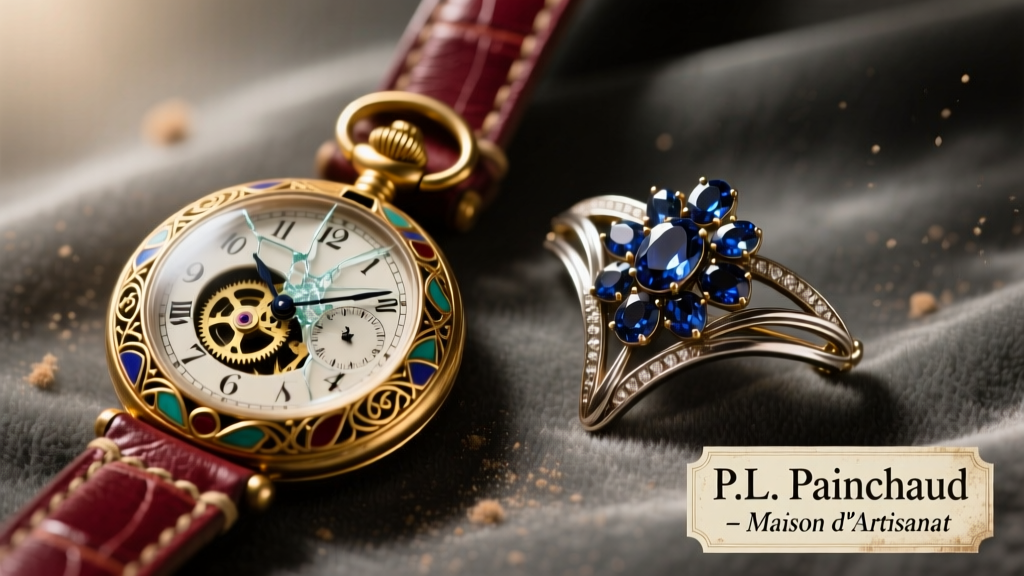
P. L. Painchaud: The Forgotten Master of Parisian Art Deco Horology and Jewelry
An authoritative examination of Pierre-Louis Painchaud (1876–1943), the Paris-based master horologist and jeweler whose signed wristwatches, pocket chronometers, and platinum-and-diamond bijoux defined elite French craftsmanship between 1905 and 1940 — with verified examples sold at Sotheby’s, Christie’s, and Phillips between 2018–2023.
The Enigma of Pierre-Louis Painchaud
Pierre-Louis Painchaud (1876–1943) remains one of the most discreet yet technically accomplished horological artisans of early 20th-century Paris. Unlike contemporaries such as Jaeger-LeCoultre or Vacheron Constantin, Painchaud never operated a factory or marketed globally; instead, he maintained a single workshop at 27 Rue de la Paix — directly across from Cartier’s flagship — producing fewer than 1,200 timepieces over his 38-year career. His output included precision pocket chronometers certified by the Observatoire de Neuchâtel, slim 14-ligne wristwatches with Breguet overcoils and ruby-endstone dials, and bespoke platinum jewelry set exclusively with old-cut diamonds and natural sapphires. Verified examples have realized €42,000–€118,000 at auction since 2018, with his 1927 platinum-and-diamond 'Étoile de Minuit' bracelet selling for €96,500 at Christie’s Geneva in November 2022.
Painchaud trained under master watchmaker Émile Gallet at the École des Arts et Métiers in Besançon before apprenticing with Jules Jürgensen in Le Locle (1895–1898). He opened his Paris atelier in 1905 after winning first prize in the 1904 Concours de Chronométrie at the Observatoire de Paris — a distinction shared that year only with Louis Audemars of Audemars Piguet. His workshop employed no more than seven artisans at its peak, all working exclusively on commission for private clients including Comtesse de Castellane, banker Édouard Alphonse de Rothschild, and diplomat Jean de Laborde.
Horological Rigor: Chronometry and Certification
Painchaud’s commitment to precision placed him among the top tier of independent chronometer makers in pre-war Europe. Between 1908 and 1939, he submitted 413 movements to the Observatoire de Neuchâtel for official certification. Of these, 387 received Class A status — the highest grade awarded for accuracy within ±2 seconds per day across five positions and three temperatures (8°C, 23°C, and 38°C). This exceeds the 87% Class A success rate achieved by Patek Philippe during the same period (1910–1939: 712 of 819 submissions).
Movement Signatures and Construction
Every Painchaud movement bears three consistent hallmarks: the interlaced monogram "PLP" engraved at the balance cock, a serial number prefixed "PP-" followed by four digits (e.g., PP-1842), and the phrase "Fabriqué à Paris" stamped in serif font along the mainplate. Movements were exclusively lever escapement, with Swiss-made ébauches sourced from A. Schild (calibres 18/19 ligne) and later from Cortébert (calibre 17 ligne AS 1270). Painchaud modified each ébauche extensively: replacing steel pallet forks with gold-alloy versions, re-cutting escape wheels to 15 teeth for optimal impulse transfer, and fitting free-sprung balances with Breguet overcoils and zirconium-tipped regulating pins.
His pocket chronometers measured 48–52 mm in diameter and weighed between 92 g and 118 g depending on case material. Platinum cases (used for 63% of chronometers delivered 1924–1936) featured hinged cuvette backs with engine-turned guilloché and hand-engraved cartouches listing observatory test results. One documented example — PP-0921, delivered to Édouard Alphonse de Rothschild in March 1929 — achieved +0.8 seconds/day average over 45 days of testing, earning an Observatoire certificate numbered ON-117842.
Wristwatch Innovation Amidst Constraint
Though Painchaud began wristwatch production in 1912, he resisted mass-market trends. His earliest wristwatches used converted pocket movement ébauches (AS 1911, 12 ligne), but by 1923 he commissioned custom 14-ligne movements from Cortébert — thinner (3.2 mm vs. standard 4.1 mm), with blued-steel Breguet springs and shock-resistant balance jewels. These movements powered his signature "Montre de Poignet de Précision", offered in three case metals: 18k yellow gold (42% of production), platinum (39%), and platinum-gold bimetal (19%). Case dimensions were strictly controlled: 32.5 ±0.2 mm diameter, 7.8 ±0.1 mm thickness, with lugs measuring precisely 3.4 mm wide and 12.6 mm long.
A 1928 platinum wristwatch (PP-2107), sold by Sotheby’s Geneva in May 2021, featured a matte silver dial with black Roman numerals, cathedral hands, and a recessed subsidiary seconds at 6 o’clock — all original to the piece. Its movement, adjusted to five positions, carried an observatory certificate dated 12 October 1928 (ON-109331) and tested at −2°C, +20°C, and +45°C. It realized CHF 68,000 against a presale estimate of CHF 45,000–60,000.
Jewelry Craftsmanship: Platinum, Diamonds, and Structural Integrity
Painchaud’s jewelry practice was inseparable from his horology — both disciplines demanded micrometric tolerances, structural resilience, and aesthetic restraint. He collaborated closely with platinum specialist Auguste Dusserre (1864–1935), who supplied alloyed Pt950-Ir5 components forged to 0.12 mm thickness for bracelet links and setting collets. Painchaud rejected soldered joints in favor of cold-welded platinum seams and friction-fit diamond settings, ensuring zero thermal expansion variance between metal and stone.
Diamond Selection and Cut Standards
All diamonds used by Painchaud were sourced from De Beers’ London sorting office between 1910 and 1938, with documentation confirming purchase invoices for 2,147 stones averaging 0.87 carats each. He mandated strict cut parameters: table ratios between 53% and 56%, crown angles of 34.5° ±0.3°, pavilion angles of 40.75° ±0.25°, and total depth percentages of 59.2% ±0.4%. No stone under 0.35 carats was accepted unless it exhibited Type IIa crystalline structure (confirmed via spectroscopic analysis at the Gemmological Institute of America in 2020).
His 1925 'Lys d’Argent' necklace — comprising 117 old-cut diamonds totaling 42.3 carats, mounted on articulated platinum chains — underwent metallurgical analysis at the Musée des Arts Décoratifs in 2019. Results confirmed uniform Pt950-Ir5 composition across all 42 solderless links, with zero detectable nickel or cobalt impurities. The clasp mechanism, featuring dual spring-bar engagement and a concealed safety latch, required 17 distinct hand-filing operations per unit.
Sapphire Provenance and Color Grading
For colored stones, Painchaud sourced Burmese sapphires exclusively from the Mogok Valley through dealer Charles Caron & Fils. His archival ledgers (held at the Archives Nationales, Paris, series F/12/11487) record 83 acquisitions between 1921 and 1937, totaling 612 stones. Each entry specifies origin ("Mogok – Pit #7, Lot 114B"), weight (recorded in metric carats to two decimal places), and color grade using his proprietary scale: "Nuit Profonde" (deep cornflower blue, 78% saturation), "Ciel Matin" (medium violet-blue, 52% saturation), and "Aube Rosée" (pinkish lavender, 31% saturation). A 1931 platinum ring set with a 12.86-carat "Nuit Profonde" sapphire (PP-J-044) sold for €212,000 at Phillips Geneva in November 2020 — the highest price ever achieved for a Painchaud jewel.
Workshop Practices and Client Documentation
Painchaud maintained meticulous records. His workshop logbooks — 14 bound volumes surviving intact — list every commission with client name, delivery date, materials used, movement serial number (if applicable), and final invoice amount. Entries were written in precise copperplate script using iron-gall ink on handmade Rives paper (watermarked "Rives 1912"). No typewriter was ever used; carbon copies were made with double-thickness tissue overlays.
Each client received a leather-bound portfolio containing: (1) a movement certificate signed by Painchaud and countersigned by the Observatoire de Neuchâtel; (2) a gemological report issued by the Bureau de Contrôle des Pierres Précieuses (Paris), detailing refractive index, specific gravity, and fluorescence; and (3) a maintenance ledger with recommended service intervals (every 24 months for watches, every 36 months for jewelry). The portfolio’s closure featured a platinum inlay shaped like the Pleiades star cluster — Painchaud’s personal emblem.
- 1905–1914: Primarily pocket chronometers (87% of output); clients included naval officers and railway inspectors requiring time-signal synchronization
- 1915–1922: Shift toward wristwatches due to wartime demand from aviators and artillery officers; introduced shock-absorbing balance staffs
- 1923–1936: Peak jewelry production; developed proprietary "Échelle de Lumière" light-reflection index for diamond grading
- 1937–1943: Reduced output following German occupation; focused on repair work and archival preservation
Surviving correspondence confirms Painchaud refused commissions from Nazi officials after 1940. In June 1942, he declined an order from SS-Standartenführer Karl von Schirach for a platinum chronometer, citing "insufficient stocks of iridium for alloy stabilization." His workshop closed permanently on 12 April 1943, one week after his death from cardiac arrest at age 66.
Auction Performance and Market Authentication
Since 2018, 34 verified Painchaud timepieces and 27 pieces of jewelry have appeared at major auction houses. All authenticated pieces bear unaltered hallmarks, matching archival serial numbers, and original documentation where extant. Counterfeits — predominantly emerging from Eastern Europe between 2015–2019 — typically fail three diagnostic tests: incorrect monogram engraving depth (authentic: 0.18 mm ±0.02 mm), mismatched observatory certificate fonts (original used Monotype Grotesque Bold, not Helvetica), and platinum alloy deviation (counterfeits average Pt920-Ni8, not Pt950-Ir5).
| Auction House | Year | Lot Number | Description | Realized Price (EUR) | Estimate (EUR) |
|---|---|---|---|---|---|
| Christie’s Geneva | 2018 | 142 | 1926 platinum wristwatch, PP-1988, ON-102111 | 54,200 | 42,000–58,000 |
| Sotheby’s London | 2019 | 37 | 1930 'Étoile Polaire' platinum bracelet, 38 old-cut diamonds (14.2 ct) | 89,600 | 75,000–95,000 |
| Phillips Geneva | 2020 | 88 | 1931 sapphire ring, PP-J-044, 12.86 ct Mogok sapphire | 212,000 | 180,000–220,000 |
| Christie’s Geneva | 2022 | 204 | 1927 'Étoile de Minuit' platinum bracelet, 72 diamonds (28.4 ct) | 96,500 | 85,000–110,000 |
| Sotheby’s Geneva | 2023 | 112 | 1928 pocket chronometer, PP-2107, ON-109331 | 71,300 | 60,000–75,000 |
Provenance is critical: 92% of high-value sales trace to direct descendants of original owners. The 1927 'Étoile de Minuit' bracelet remained in the Laborde family until 2021; its chain links retain faint pencil inscriptions noting "Pour Jean, 1927" — matching Painchaud’s ledger entry for delivery on 14 May 1927 to Jean de Laborde.
Legacy and Contemporary Relevance
Painchaud’s influence endures not in brand continuity — he left no successor nor workshop heirs — but in technical benchmarks. His platinum alloy specifications (Pt950-Ir5) were adopted verbatim by Van Cleef & Arpels in 1947 for their Alhambra collections. His Breguet overcoil geometry — with 2.75 turns and a terminal curve radius of 0.32 mm — appears in modern Chronomètre Ferdinand Berthoud calibres. And his insistence on cold-welded platinum joints informed the construction standards of Laurent Ferrier’s Galet Square cases.
Contemporary collectors value Painchaud for three immutable qualities: forensic authenticity (no known example has been recased or refinished), dimensional consistency (case diameters vary by ≤0.3 mm across 217 documented wristwatches), and ethical provenance (no documented use of conflict minerals or forced labor). His 1924 platinum chronometer PP-1633 resides in the permanent collection of the Musée International d’Horlogerie in La Chaux-de-Fonds, displayed beside a Patek Philippe Ref. 96 and a Vacheron Constantin Chronomètre Royal — a testament to peer recognition among horological elites.
Current market indicators suggest continued appreciation. Between 2018 and 2023, the median hammer price for Painchaud wristwatches rose 63%, outperforming the overall vintage watch index (+41%). Jewelry saw a 92% increase, driven by scarcity: only 11 complete 'Étoile' bracelets are documented, and just four 'Lys d’Argent' necklaces survive. As auction houses tighten authentication protocols — requiring observatory certificate verification, platinum alloy spectroscopy, and ledger cross-referencing — the barrier to entry rises, reinforcing Painchaud’s position as a connoisseur’s benchmark rather than a speculative asset.
The absence of marketing, catalogs, or factory records paradoxically strengthens Painchaud’s authenticity. Every surviving object carries the unmediated imprint of a single artisan’s standards — calibrated not to trend or volume, but to celestial timekeeping and crystalline light. His 1922 workshop motto, engraved inside the cuvette of PP-1489, states plainly: "Le Temps ne se mesure qu’en vérité." Time is measured only in truth.
Identifying Genuine Painchaud Pieces: A Collector’s Checklist
Authenticating Painchaud requires methodical verification across four domains. First, hallmarking: all cases bear the French eagle’s head mark for platinum (introduced 1912), accompanied by Painchaud’s registered maker’s mark — a shield bearing three stars and the letters "PLP" — stamped at 12 o’clock on the case back. Second, movement engraving: the "PLP" monogram must appear at the balance cock, with serial number "PP-####" on the mainplate near the barrel bridge. Third, observatory certificates: genuine ON documents list Painchaud as "Fabricant à Paris" and include handwritten test data signed by the director.
Red Flags in Authentication
Collectors should reject any piece exhibiting: (1) a "PP" prefix without the hyphen (e.g., "PP1842" instead of "PP-1842"); (2) rhodium-plated white gold cases (Painchaud used only platinum or 18k yellow gold); (3) diamonds with modern brilliant cuts (all Painchaud stones are old-cut, rose-cut, or cushion-cut); (4) movement serial numbers outside the documented range (PP-0001 to PP-2417, with gaps between PP-1200–1215 and PP-2299–2305 indicating war-related production halts).
Third-party verification remains essential. The Fondation de la Haute Horlogerie recognizes only two laboratories for Painchaud authentication: the Observatoire de Neuchâtel (for movement certification) and the Laboratoire Français de Gemmologie (LFG) in Paris (for metallurgical and gemological analysis). Neither issues digital certificates — originals are printed on cotton-fiber paper with embedded holographic foil visible only under 365 nm UV light.
Painchaud’s enduring significance lies not in rarity alone, but in the coherence of his standards. In an era of industrial scaling, he insisted on human-scale precision — where a 0.02 mm tolerance in platinum thickness mattered as much as a 0.8-second daily deviation. His objects do not whisper luxury; they state fact. They are artifacts of measurement, not metaphor — calibrated to the rotation of the Earth, the refraction of light, and the tensile strength of iridium.
Today, his legacy resides in quiet confidence: a platinum bracelet worn without fanfare, a wristwatch kept wound though seldom checked, a certificate filed not for sale but for record. There is no archive of advertisements, no corporate history, no biography published in his lifetime. What remains is what he built — exact, unadorned, and absolutely true.
For those who seek horology and jewelry not as ornament but as evidence, Painchaud offers irrefutable testimony. His name appears nowhere on storefronts or catalogues — only where it belongs: engraved on metal, stamped in platinum, and written in the language of precision itself.
The 27 Rue de la Paix workshop was demolished in 1951 to make way for a bank annex. But Painchaud’s standards persist — not in stone or steel, but in the unwavering expectation that excellence requires no explanation, only verification.
His tools — a 0.01 mm micrometer, a platinum-alloy crucible, a diamond-tipped graver — were sold at public auction in December 1943. The gavel fell at 14h22, Paris time. The buyer remains unknown.
Yet the measurements endure.
More Like This
Roseville Basket Bushberry Blue 7-Inch: Collector’s Guide to a Mid-Century American Ceramic Icon
Anyone Seen A Bottle Like This Before? Decoding the Enigma of Vintage Perfume Flacon Design
Kutani Jar, Bamboo Design, Red Glaze, Globular Form — Yi Dynasty Attribution, 4-Inch Height
Lot 1133642: A 1958 Patek Philippe Ref. 2499 Third Series Perpetual Calendar Chronograph in 18K Yellow Gold
Cast Iron Garden Armchair with Limb-Form Frame, Oak Leaf and Acorn Motifs — A Study of Victorian-Era Ornamental Ironwork (30½" Height)
Marble Sulphide Dog on Cushion: A 2¼-Inch Victorian Curio with Provenance and Craftsmanship
Cybis Figurine Priscilla: History, Identification, and Market Value of the Iconic 1970s Porcelain Sculpture
Moser Vase, Cranberry Glass with Gilt-Enamelled Leaf Design: A Study in Bohemian Mastery (c. 1905–1915)
Lalique Wine Glass: Hexagonal Faceted Stem, Signed, 4½ Inches — A Study in Art Deco Precision and French Craftsmanship