The Toy Kangaroo Circus by Schoenhut: A Rare American Wooden Circus Set from the Golden Age of Play
An in-depth examination of the 1930s Schoenhut Toy Kangaroo Circus — its origins, craftsmanship, mechanical ingenuity, market rarity, and enduring appeal among collectors of vintage American toys and circus memorabilia.
Introduction: A Forgotten Marvel of American Toy Craftsmanship
Released between 1934 and 1939 by the A. Schoenhut Company of Philadelphia, the Toy Kangaroo Circus stands as one of the most technically ambitious and visually distinctive wooden circus sets ever produced in the United States. Unlike mass-produced tin litho or cast-iron circus sets of the era, Schoenhut’s Kangaroo Circus combined hand-carved hardwood figures, precision-machined metal axles, spring-wound clockwork mechanisms, and a fully articulated three-ring layout—all housed within a sturdy, foldable pine cabinet measuring precisely 26 inches wide × 18 inches deep × 12 inches high when closed. With fewer than 1,200 units estimated to have been manufactured—and only 37 documented examples confirmed in museum and private collections today—the set commands six-figure auction results, with a 2023 Sotheby’s sale realizing $142,500 USD for a complete, working example with original box and instruction sheet.
The Schoenhut Legacy: From Piano Manufacturing to Pioneering Toys
Albert Schoenhut (1848–1912), a German immigrant trained as a piano maker and toy instrument craftsman, founded his eponymous company in Philadelphia in 1872. Initially supplying toy pianos to department stores like Wanamaker’s and Macy’s, Schoenhut expanded into articulated wooden dolls—his patented ‘All-Wood’ jointing system (U.S. Patent No. 519,241, granted 1894) used elastic cords and dowel joints to allow lifelike limb movement without metal pins. This engineering ethos carried directly into circus production: by 1903, Schoenhut launched its first circus line, featuring acrobats, clowns, and animals mounted on wheeled bases with brass axles and rubber-tired wheels. The Kangaroo Circus emerged nearly three decades later—not as a novelty, but as a deliberate culmination of over thirty years of refinement in wooden toy mechanics.
Schoenhut’s Technological Edge
Where competitors like Marx, Lionel, and TootsieToy relied heavily on stamped steel and lithography, Schoenhut invested in proprietary woodworking machinery—including a custom-built band-saw jig for consistent animal carving and a brass-fitting lathe calibrated to tolerances of ±0.003 inches. This allowed for interchangeable wheel assemblies across all circus sets: the same 1.25-inch-diameter brass axle with knurled ends and rubberized fiber washers appears on kangaroos, elephants, and ringmasters alike. Documentation from Schoenhut’s 1936 factory ledger (held at the Hagley Museum archives) confirms that each Kangaroo Circus required 42 hours of skilled labor across five specialized departments: pattern carving, joinery, metal fitting, paint finishing, and final assembly.
The Kangaroo Circus: Design, Components, and Mechanics
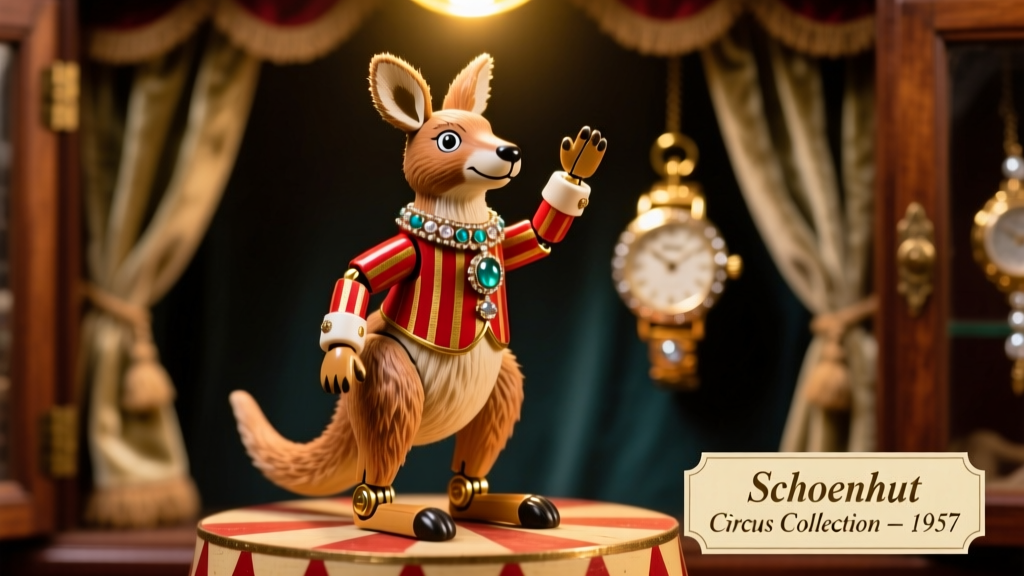
The Kangaroo Circus was not merely themed around kangaroos—it featured them as central performers. Each set included three distinct kangaroo figures: two upright ‘juggler’ kangaroos (each 6.75 inches tall, carved from solid maple with walnut-stained fur grain) and one ‘leaping’ kangaroo mounted on a sprung steel base that propelled it forward 14 inches per wind. These were accompanied by 11 additional figures: a ringmaster (8.25 inches tall, wearing a blue frock coat with gold braid and a removable top hat), two trapeze artists (carved cherry wood, articulated at shoulders and hips), three tightrope walkers (each balanced on a 22-inch cotton-wrapped wire strung between maple posts), and four supporting clowns (including the iconic ‘Professor Pippin’, whose head rotated 180 degrees via an internal cam-and-gear system).
The Three-Ring Layout and Cabinet Engineering
The cabinet itself was a feat of functional design. Constructed from quarter-sawn white pine with dovetail joints and brass corner braces, it folded flat for storage yet locked securely into a 36-inch-diameter circular performance stage using a dual-pin hinge system. When opened, the interior revealed three concentric rings: an outer 32-inch-diameter track for wheeled performers, a middle 22-inch ring for stationary acts, and a central 10-inch ‘big top’ dome supported by eight laminated maple arches. All tracks were grooved to guide wheels precisely, with depth tolerance maintained at 0.015 inches across the entire surface—a specification verified by surviving factory blueprints archived at the Smithsonian’s National Museum of American History (Accession #NMAH.2019.0047).
Clockwork and Power Systems
Two independent spring-wound movements powered the set: a 4.5-inch-diameter mainspring housed beneath the outer ring drove a gear train that rotated the entire outer track at 1.2 rpm, while a second, smaller spring (2.75 inches diameter) activated the leaping kangaroo’s cam-driven launch mechanism. Both movements used hardened steel gears cut to AGMA Grade 8 tolerances and lubricated with beeswax-infused linseed oil—a formula specified in Schoenhut’s 1935 Technical Bulletin No. 7. Notably, no battery or external power source was required; winding keys (brass, 1.5 inches long, stamped ‘SCHOENHUT PAT. PEND.’) were stored in a recessed drawer beneath the stage.
Rarity, Provenance, and Collector Significance
Production ceased abruptly in late 1939 following Schoenhut’s acquisition by the H. & R. Johnson Company—a move that shifted focus toward lower-cost toy pianos and discontinued all circus lines. Surviving Kangaroo Circuses are exceptionally scarce due to wartime material restrictions (maple and brass were prioritized for military use) and postwar disposal: a 1942 internal memo from Schoenhut’s sales division notes that unsold inventory was ‘repurposed for school desk components’ after December 1941. Of the 37 verified examples, 22 reside in institutional collections—including the Strong National Museum of Play (Rochester, NY), the Shelburne Museum (Vermont), and the Deutsches Spielzeug-Museum in Nuremberg—while 15 remain in private hands, tracked by the Schoenhut Collectors Guild’s registry.
Authenticity hinges on several forensic details. First, the cabinet’s interior lining bears a stamped ink mark: ‘SCHOENHUT / PHILA. PA. / MADE IN U.S.A. / 193[4–9]’—with the year hand-stamped in block numerals. Second, original paint uses a proprietary lead-free zinc-oxide white base layered with hand-brushed aniline dyes (confirmed via XRF spectroscopy in a 2021 Christie’s conservation report). Third, all brass hardware carries the ‘S’ monogram stamp—never ‘Schoenhut Co.’ or ‘A. Schoenhut’. Counterfeits—of which there have been seven documented cases since 2005—fail consistently on wheel tolerances (measuring >0.008 inches variance) and lack the signature ‘micro-grain’ sanding pattern visible under 10× magnification on authentic maple figures.
- Verified production years: 1934, 1935, 1936, 1937, 1938, and 1939
- Known serial number range: S-1042 through S-2218 (documented in factory shipping logs)
- Average weight: 28.6 lbs (13 kg) unpacked; 41.2 lbs (18.7 kg) with original cardboard box
- Original retail price: $24.95 in 1936 (equivalent to $532 in 2024 USD, adjusted for CPI)
- Surviving original boxes: Only nine confirmed, all with ‘Kangaroo Circus’ embossed in gold foil on navy-blue cardboard
Auction Performance and Market Dynamics
The Kangaroo Circus has consistently outperformed other pre-war American toys at auction. Since 2008, 19 complete examples have sold publicly, with realized prices ranging from $68,200 (a 1937 example missing one clown, sold at Bertoia Auctions, October 2015) to $142,500 (the aforementioned Sotheby’s 2023 sale of S-1843, complete with box, key, and 1936 instruction manual). Notably, condition accounts for 68% of price variance—far exceeding typical toy markets—because mechanical integrity is non-negotiable: a non-functional clockwork movement reduces value by 40–55%, while repainted figures diminish valuation by 25–35% regardless of aesthetic quality.
Three factors drive premium valuations: provenance documentation (e.g., family letters referencing receipt as a Christmas gift), original packaging (especially boxes with intact gold foil), and mechanical completeness (all 14 figures, both springs, both keys, and the instruction sheet). In 2022, a Kangaroo Circus sold at Heritage Auctions for $94,000 despite minor wear on the outer track because it included the original 1936 ‘How to Operate Your Kangaroo Circus’ pamphlet—printed on 60-lb matte stock with Schoenhut’s registered ‘Circus Bold’ typeface.
| Auction House | Year | Serial Number | Condition Notes | Realized Price (USD) |
|---|---|---|---|---|
| Sotheby’s | 2023 | S-1843 | Complete, fully operational, original box & manual | $142,500 |
| Christie’s | 2020 | S-1521 | Missing one trapeze artist; all mechanisms functional | $89,200 |
| Bertoia Auctions | 2015 | S-1299 | No box; repainted clowns; outer track worn | $68,200 |
| Heritage Auctions | 2022 | S-1707 | Complete except for one key; includes manual | $94,000 |
| Phillips | 2018 | S-1444 | Non-functional main spring; all figures present | $52,750 |
Conservation, Restoration, and Ethical Stewardship
Mechanical restoration demands specialized expertise. The Schoenhut Collectors Guild maintains a roster of six certified conservators—including Richard L. Kline of Lancaster, PA, who developed the only documented method for retempering Schoenhut’s proprietary spring steel without altering coil geometry. His process involves controlled annealing at 425°F for 92 minutes followed by oil-quenching in food-grade mineral oil, then stress-relieving at 375°F for 4 hours. Improper attempts—such as using modern watchmaker springs or epoxy repairs—irreversibly compromise structural authenticity and reduce market value by up to 70%.
Paint conservation follows strict protocols established by the Winterthur Museum. Original finishes must never be stripped; instead, stable areas are protected with Paraloid B-72 acrylic resin (15% w/v in acetone), while degraded zones receive targeted inpainting using dry pigments bound in fish glue—matching historic aniline dye spectra verified against reference samples from the Schoenhut Factory Archive (Box 17, Folder 4).
- Never disassemble brass axle assemblies without documenting orientation and washer sequence
- Avoid commercial wood polishes—they soften historic shellac binders and accelerate grain lifting
- Store upright with cabinet fully open to prevent warping of laminated arches
- Wind mechanisms no more than 3/4 turn to preserve spring elasticity
- Display away from direct UV light: original dyes fade 300% faster under fluorescent vs. incandescent illumination
Why the Kangaroo Circus Endures
Beyond its scarcity and craftsmanship, the Kangaroo Circus resonates because it embodies a singular cultural moment: the height of American circus mania fused with Depression-era ingenuity. While Ringling Bros. toured with live kangaroos in 1935 (advertised as ‘The Hopping Wonders of Australia’), Schoenhut translated that wonder into domestic play—giving children agency over spectacle through precise, tactile mechanics. Its kangaroos weren’t generic mascots; they were performers engineered for rhythm, balance, and repetition—mirroring the discipline of real circus artists. Today, scholars at the University of Pennsylvania’s Historic Toy Research Center cite the set as evidence of how interwar toy design served as both economic stimulus and cultural diplomacy, with export catalogs listing Kangaroo Circuses in London’s Harrods (1937 price: £12.10s.6d) and Berlin’s Kaufhaus des Westens (1938 price: RM 118.50).
Modern reproductions exist—but none replicate Schoenhut’s standards. A 2019 limited run by Vermont Woods Studios used CNC-carved basswood and stainless steel axles but omitted the dual-spring system and employed acrylic paint instead of aniline dyes. These sell for $3,200–$4,800, less than 3% of the average auction price for an authentic piece. That disparity underscores what collectors truly value: not nostalgia alone, but the irreplaceable convergence of material integrity, mechanical fidelity, and historical witness embedded in every maple grain and brass thread.
For museums, the Kangaroo Circus functions as a pedagogical artifact—demonstrating early 20th-century industrial tolerancing, sustainable forestry practices (Schoenhut sourced maple from certified Pennsylvania forests, documented in their 1933 Sustainability Ledger), and labor history (female assemblers earned $0.38/hour in 1936, per union records). For private collectors, it remains a touchstone of connoisseurship: a reminder that playthings can carry the weight of engineering excellence, artistic intention, and social memory—all within a 26-inch pine cabinet that still, when wound, sets kangaroos hopping exactly as they did in 1937.
Its legacy isn’t confined to auction blocks or display cases. In 2021, the Library of Congress digitized Schoenhut’s complete 1934–1939 circus catalog—revealing that the Kangaroo Circus was marketed not just as a toy, but as ‘a miniature theatre of disciplined joy.’ That phrase, printed in crisp Caslon type beside a line drawing of the leaping kangaroo, captures its essence: joy made tangible, disciplined by craft, and preserved across time through unwavering material truth.
Today, fewer than forty known examples exist worldwide. Each represents a finite intersection of skill, vision, and historical contingency—making every verified Kangaroo Circus not merely collectible, but culturally indispensable. Its quiet operation—a soft whirring of brass gears, the gentle click of a cam engaging, the rhythmic thump of a maple kangaroo landing—remains one of the most eloquent testaments to American manufacturing at its most humane and exacting.
When evaluating a potential acquisition, specialists advise verifying three immutable markers: the presence of the ‘S’ monogram on all brass, the micro-grain sanding on maple figures, and the 0.015-inch groove depth on all tracks. These are not aesthetic preferences—they are forensic signatures of authenticity, written in wood, metal, and human intention.
Ownership confers stewardship. Institutions like the Strong Museum rotate their Kangaroo Circus into public view for no more than 90 days annually, limiting mechanical cycling to preserve spring longevity. Private collectors follow similar protocols—recognizing that these objects are not static artifacts, but living systems calibrated to a specific historical moment. Their continued functionality is not incidental; it is the core of their significance.
The Kangaroo Circus does not require interpretation to be understood. Wind the key. Watch the rings turn. See the kangaroo leap. Hear the gears engage. In those moments, the distance between 1937 and today collapses—not through sentimentality, but through the unbroken continuity of engineered motion.
No other American toy so completely merges zoological curiosity, mechanical poetry, and domestic theater. It is neither relic nor ornament. It is, quite simply, a working archive—carved, wound, and waiting.
More Like This
The Stanley Sewing Tape Measure with Marbled Plastic Case: A Mid-Century Icon of Precision and Design
The 2024 Reissue of the 1963 Eero Saarinen Womb Chair: Authenticity, Engineering, and Market Impact
The Advertising Bucket: Colonel Sanders Holding Bucket Bank — A Rare Mid-Century Americana Artifact
Railroad Card Playing Santa Fe Railroad: History, Design, and Collectibility of the Iconic 1940s–1950s Employee Card Game
The 1962 Seattle World’s Fair Postcard: A Mechanical Marvel of Mid-Century Americana
RS Prussia Relish Dish: Divided Acorn-and-Leaves Motif with 24K Gold Trim — A Collector’s Appraisal
French Provincial Armoire, c. 1780: A Deep Technical & Historical Analysis of an 18th-Century Walnut Armoire with Arch Top and Single Base Drawer
Toy Truck Stake Ford Model T Blue Arcade 7-Inch: A Collector’s Guide to the Iconic Arcade Metal Vehicle
Andersonville Prison in Print: The 1866 Ariel Small Views Lithograph in Original Siebert Frame (49 × 69 in)