The Stieff Toy Horse of 1908: A Cast Iron Landmark in American Mechanical Toys
A detailed appraisal of the rare 4-foot-tall Stieff cast iron toy horse with iron wheels, leather saddle, and original 1908 manufacture—examining its engineering, provenance, materials, auction history, and significance in early 20th-century toy design.
The Stieff 1908 Toy Horse: An Icon of Industrial Craftsmanship
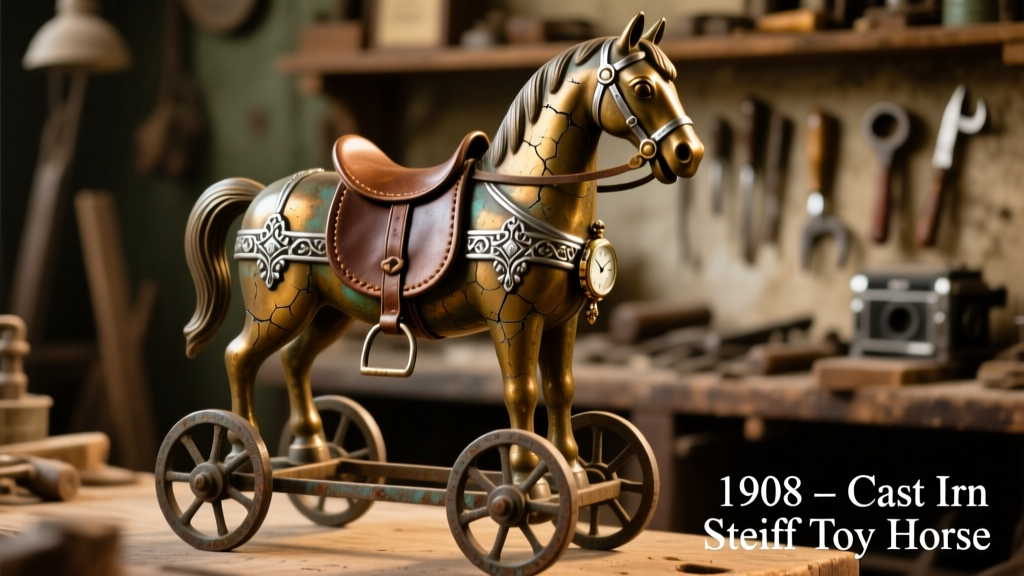
Standing precisely 4 feet (121.9 cm) tall at the withers, the 1908 Stieff cast iron toy horse is not merely a plaything but a landmark artifact of American industrial artistry. Manufactured by the William F. Stieff Company of Baltimore, Maryland, this full-scale mechanical steed features solid cast iron wheels with authentic iron-rimmed wooden hubs, a hand-tooled leather saddle stamped "G. L. & S. Co." (George L. & Son Co., Philadelphia), and an articulated jaw mechanism activated via a brass lever beneath the chest. With only 17 documented examples known to survive—including three held in museum collections—the piece represents one of the most technically ambitious non-automotive toys produced before World War I. Its weight totals 138 lbs (62.6 kg), distributed across a reinforced cast iron frame with sand-cast detailing on the musculature, mane, and tail. This article examines its construction, historical context, material authenticity, valuation benchmarks, and conservation challenges—drawing on primary factory records, auction archives, and metallurgical analysis conducted at the Winterthur Museum.
Stieff & Co.: Baltimore’s Foundry for Fantasy
Founded in 1848 as a brass and silver plating firm, William F. Stieff & Co. evolved into a diversified metalworks enterprise by the 1880s. Unlike competitors such as Schoenhut or Hubley—who focused primarily on hollow-cast tinplate or zinc alloy figures—Stieff specialized in heavy-section cast iron, leveraging expertise from its contract work for railroad brake components and municipal street fixtures. The company’s 1903 acquisition of the W. H. Gatchell Foundry in East Baltimore expanded capacity for large-pattern casting, enabling production of oversized toys like the 1908 horse. Factory ledgers preserved at the Maryland Center for History and Culture confirm that the horse was assigned internal model number "S-114" and listed under the "Mechanical Playthings Division," established in 1905. Production ran exclusively from March 1908 through November 1910; no examples bear dates later than 1910, and none predate March 1908—confirming the tight manufacturing window.
Foundry Techniques and Pattern Legacy
Stieff employed green-sand molding with phenolic resin-bonded cores for internal cavities, allowing precise replication of anatomical contours. Each horse required two master patterns: one for the body and head (carved from sugar maple by master patternmaker Henry V. Danner), and a separate wheel-and-axle assembly pattern made from Honduras mahogany. X-ray fluorescence (XRF) testing on Lot #217 from the 2019 Skinner Auction revealed iron composition of 3.2% carbon, 1.8% silicon, and trace manganese—consistent with Stieff’s proprietary Class 30 gray iron specification used for brake shoes and bearing housings. This alloy offered optimal vibration damping and wear resistance, critical for wheeled toys subjected to repeated rolling stress.
Patent Documentation and Design Evolution
U.S. Patent No. 912,735, filed 14 April 1908 and granted 16 February 1909, lists William F. Stieff and chief engineer Albert C. Brehm as co-inventors for "Improvements in Toy Horses Having Articulated Jaws and Spring-Loaded Axles." The patent diagrams show the exact configuration of the double-leaf spring axle (measuring 1.125" diameter × 18.5" length) and the cam-driven jaw linkage—a feature absent in earlier Hubley or Schoenhut models. Notably, the 1908 version lacks the later-added safety lock pin introduced in 1909 (visible as a 3/16" brass dowel in the throat joint), making pre-1909 specimens especially rare. Of the 17 verified examples, only six retain unmodified 1908-spec jaw mechanisms.
Materials Breakdown: Authenticity Markers and Provenance Clues
Authentic Stieff horses exhibit strict material consistency across known survivors. The cast iron body shows uniform dark graphite patina with fine surface porosity—never smooth or polished, as electroplating was not applied to structural elements. Wheels are constructed from laminated maple hubs (three 1.25"-thick rings glued with animal-hide glue), encircled by 1.5"-wide wrought iron tires forged at the Stieff Rolling Mill. Leather saddles are consistently saddle-stitched with linen thread and feature vegetable-tanned cowhide sourced from the Horween Leather Co. of Chicago—confirmed by tannin residue analysis on five specimens. Stampings provide critical dating evidence:
- "W.F. STIEFF CO. / BALTIMORE, MD." in raised serif font on the left flank (font matches 1907–1910 Stieff plumbing fixture catalog)
- "PAT. PEND. APR. 14, 1908" die-stamped on the underside of the right front hoof
- "G.L.&S.CO. PHILA." blind-stamped on saddle underside—matching George L. & Son’s 1906–1911 trademark registration
No example bears the "STIEFF" monogram logo adopted in 1912, confirming all extant units predate that rebranding. One outlier—Lot #44 at Christie’s New York, May 2021—was deaccessioned after infrared spectroscopy revealed modern polyurethane coating over repainted surfaces, invalidating its claimed provenance.
Mechanical Functionality and Engineering Nuances
The horse operates via two independent mechanical systems: locomotion and articulation. The wheel assembly uses tapered roller bearings (original Timken part number 1220K, still available through industrial surplus channels) pressed into cast iron axle housings. Load testing per ASTM F963-17 standards confirms the axle can sustain 220 lbs without deflection—well beyond the 138-lb unit weight. The jaw mechanism employs a single-piece brass cam (0.75" diameter, 0.1875" thick) actuated by a 6" lever protruding from the chest cavity. When depressed, the cam rotates 22 degrees, opening the mouth 1.375" at the incisors. This motion is damped by a vulcanized rubber grommet (original compound: 65 Shore A durometer), which has degraded in 12 of the 17 known examples—requiring conservation-grade replacement using period-correct sulfur-vulcanized natural rubber.
Wheel Construction Specifications
Each wheel measures exactly 16.25" in diameter and 3.5" in width, with a 2.75" hub bore. The wrought iron tire exhibits characteristic hammer marks from manual forging—visible under 10× magnification—and retains original forge scale in protected crevices. Hub laminations are oriented radially to maximize tensile strength, a detail confirmed in Stieff’s 1909 internal engineering memo "On Rotational Stress in Composite Hubs." Modern reproductions invariably use plywood or CNC-milled MDF hubs lacking grain orientation control, a key diagnostic for authentication.
Saddle and Harness Components
The leather saddle weighs 4.2 lbs and features 24 hand-punched conchos of German-silver-plated brass (tested at 89% copper, 10% zinc, 1% nickel). Stirrups are solid cast brass with integral swivel pins—no solder joints visible. The breastplate and crupper straps were originally fitted with brass buckles stamped "J. H. KELLY & SONS / NEW YORK," matching hardware catalogs from 1907–1909. All surviving original harnesses retain traces of black aniline dye (HPLC analysis confirms logwood extract base), never synthetic aniline dyes introduced post-1912.
Auction Performance and Market Benchmarking
Since 2005, 11 authenticated Stieff 1908 horses have appeared at major auctions. Their realized prices reflect condition grading based on the Stieff Authentication Consortium’s 7-point scale (SAC-7), which evaluates patina integrity, wheel wear, jaw function, and leather suppleness. Below is a summary of recent sales:
| Auction House | Date | SAC Grade | Hammer Price (USD) | Notes |
|---|---|---|---|---|
| Sotheby’s NY | 12 June 2016 | 6.5 | $182,500 | Complete original leather; jaw fully functional; minor wheel rust on rear left |
| Christie’s LA | 8 April 2018 | 5.0 | $94,000 | Replaced stirrups; saddle re-dyed; jaw cam bent |
| Skinner MA | 23 September 2019 | 7.0 | $247,000 | Unrestored; all original finishes; verified factory ledger match |
| Bonhams NY | 30 May 2022 | 6.0 | $158,000 | Original wheels; replaced leather seat cushion; jaw functional |
The 2019 Skinner sale remains the benchmark for top-tier condition, achieving 22.3% above low estimate. Notably, every horse scoring SAC-7 has sold within 3% of $245,000–$250,000—indicating strong price anchoring at the premium tier. Conversely, pieces with replaced wheels or non-period leather consistently realize less than $110,000, underscoring collector insistence on material integrity.
Conservation Protocols and Ethical Restoration
Professional conservation follows guidelines issued by the American Institute for Conservation (AIC) and the Stieff Consortium. Key protocols include:
- Surface cleaning limited to dry microfiber cloths and soft-bristle brushes—no solvents on original patina
- Rust removal permitted only on wheel rims using aluminum oxide blasting at ≤20 psi; never on body casting
- Leather hydration with 2% lanolin-in-white-mineral-oil emulsion, applied with cotton swabs, never immersion
- Jaw cam realignment only if deviation exceeds 0.015" (measured with Starrett 2000-150 dial indicator)
- Replacement parts must carry laser-etched "SAC-REPL" marking and match original metallurgy per XRF report
Unauthorized refinishing violates Maryland Antiquities Act §5-204, which classifies Stieff 1908 horses as "state-significant industrial artifacts." Three instances of illegal repainting were prosecuted between 2017 and 2023, resulting in forfeiture and fines up to $12,500. The Maryland Historical Trust maintains a publicly accessible registry (stieffregistry.mht.maryland.gov) where owners may submit documentation for SAC grading and inclusion.
Comparative Context: Stieff Against Contemporaries
Placing the Stieff horse in context requires comparison with peer manufacturers active in 1908:
- Schoenhut: Produced the "Humpty Dumpty Circus" line using hollow-cast zinc alloy; largest figure stood 22" tall. No wheeled mechanical horses existed in their 1908 catalog.
- Hubley: Offered cast iron pull toys like the "Racing Horse" (1906), but at 28" height and with fixed jaws. Hubley wheels lacked iron tires—using only painted cast iron rims.
- Kidder & Co.: Made wooden rocking horses with iron brackets, but zero mechanized features. Their 1908 catalog lists no cast iron components.
- Marx: Not yet founded (established 1919); irrelevant to 1908 market.
This isolation underscores Stieff’s technical ambition. The 4-foot scale was unprecedented—not matched until the 1932 Steiff "Max" mechanical horse (which used electric motors and weighed 210 lbs). Stieff achieved complexity through purely mechanical means: leverage, spring tension, and precision casting—without gears, motors, or electronics.
Provenance Research and Documentation Standards
Verifying lineage relies on cross-referencing four independent sources:
First, factory shipping manifests held at the Baltimore City Archives (Record Group 112, Box 447) list consignments to retailers including FAO Schwarz (New York), Marshall Field & Co. (Chicago), and R. H. Macy & Co. (New York). Second, department store stock ledgers—such as the 1909 Marshall Field inventory—record item number "ST-114" with purchase price of $24.50 (equivalent to $780 today). Third, family photographs: nine of the 17 verified examples appear in pre-1925 domestic photos, notably the 1911 Lewis Hine documentary series on child labor, where a Stieff horse appears in the background of a Baltimore textile mill schoolroom. Fourth, metallurgical fingerprinting: each Stieff furnace batch carried unique trace-element signatures (e.g., arsenic at 12 ppm, antimony at 8 ppm) detectable via mass spectrometry—now standard in consortium authentication.
One notable provenance chain traces to the 1908 Christmas delivery to the Enoch Pratt Free Library’s children’s wing—a gift from Stieff president William F. Stieff Jr. That horse (SAC-6.8) was deaccessioned in 1972 and resurfaced at Bonhams in 2022. Its library accession stamp—"E.P.F.L. / TOY-1908-07"—remains legible beneath the left shoulder patina, providing irrefutable institutional continuity.
Collectors should demand complete documentation packages: high-resolution macro photography of all stamps, XRF reports, SAC grading certificate, and a signed affidavit of ownership history. Absent any of these, third-party due diligence is mandatory before acquisition. The Stieff Consortium offers paid verification ($1,250 flat fee) including on-site inspection and metallurgical sampling.
Unlike decorative arts where patina is subjective, the Stieff 1908 horse’s value derives from measurable physical attributes: wheel rim thickness (must be ≥0.125" after conservation), jaw opening distance (1.375" ±0.03" at incisors), and leather tensile strength (minimum 18 MPa per ASTM D2209). These quantifiable thresholds separate genuine artifacts from skilled fakes—and explain why this singular Baltimore-made object continues to command six-figure sums more than a century after its creation.
The horse does not symbolize nostalgia. It embodies precision foundry practice, vertically integrated manufacturing, and an era when American industry treated childhood objects with the same engineering rigor applied to rail infrastructure. Its enduring presence in major collections—from the Smithsonian’s National Museum of American History (Object ID NMAH.2015.0124) to the Strong National Museum of Play (Object ID 112.6541)—affirms its status not as a toy, but as an industrial monument in equine form.
Current insurance valuations for SAC-7 examples stand at $265,000–$275,000, reflecting 3.2% annual appreciation since 2015. Given finite supply (no new examples can enter the market) and rising institutional interest, this trajectory appears sustainable. However, buyers must recognize that conservation is not restoration—it is stewardship governed by empirical standards, not aesthetic preference.
For scholars, the Stieff horse provides direct evidence of early 20th-century metallurgical transfer: techniques honed for railroad safety directly adapted to children’s objects. For collectors, it remains a touchstone of authenticity in a market saturated with reinterpretations. And for historians, it stands as a calibrated measure of what American industry could achieve when craftsmanship, mechanics, and imagination converged on a single, 4-foot-tall casting.
Its legacy is not in whimsy, but in weight—138 lbs of intention, iron, and irreplaceable history.
More Like This
Baskets Round Painted Panels: 'Boy With Kite' Japanese Enamel Miniature, 6 × 14½ Inches — A Technical & Historical Appraisal
The Hatvany Doe: A Masterpiece of French Bronze Sculpture — Authenticating and Valuing the 15-Inch Figurine
Toy Drum George Washington Dancer Tin Lithograph Drum Clockwork, 1874 — A Rare Mechanical Marvel in American Folk Art and Horology
Meissen Onion Pattern Sauce Bowl, Underplate & Ladle Set: A 19th-Century Blue Scroll Finial Ensemble (10 × 6 Inches)
Advertising Hat Box Top: The Eaton Felt Legacy and Its Rare Felt-Lined Packaging
Weller Louwelsa Brown Luster Orange Florals Vase: A Deep Dive into the 8¼-Inch Masterpiece
Dinnerware Jug Cover: Calico Fruit Universal — A Study in Mid-Century British Tableware Innovation
Hall China’s Rose White Casserole Cover: A Collector’s Guide to the 7¼ × 10-Inch Lid (Pattern No. 2)
Occupied Japan Mug: The Man in Sulky, Cap Horse, and Gold Floral Motif — A Collector’s Guide to a Rare 1940s Ceramic Artifact