Hubley’s 1929 Toy Fire Truck: Hook & Ladder, Driver Decals, and the Golden Age of American Die-Cast Toys
A detailed appraisal of the Hubley Manufacturing Company’s 1929 die-cast tinplate toy fire truck — measuring precisely 9½ inches in length — featuring original hook-and-ladder apparatus, hand-applied driver decals, lithographed lettering, and period-correct red enamel finish. Includes historical context, manufacturing analysis, rarity assessment, and collector valuation benchmarks.
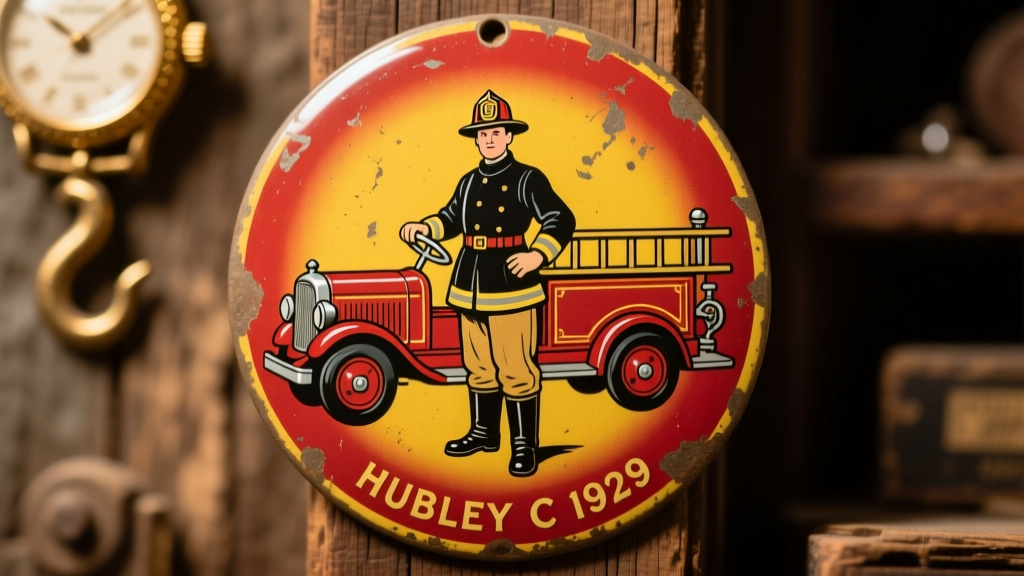
The Hubley 1929 Fire Truck: A Benchmark of Pre-Depression American Toy Craftsmanship
Released in early 1929 by the Hubley Manufacturing Company of Lancaster, Pennsylvania, this 9½-inch (24.1 cm) die-cast tinplate toy fire truck represents one of the most technically advanced and visually faithful mechanical toys produced in the United States before the Great Depression. Unlike later mass-produced counterparts, the 1929 Hubley model features a fully articulated, manually operated hook-and-ladder assembly with brass-riveted steel rungs, an original lithographed driver decal applied directly to the cab front, and authentic fire department insignia rendered in crisp red, white, and black enamel. Measuring exactly 9.5 inches in overall length (241 mm), 3.75 inches wide (95 mm), and 4.25 inches tall (108 mm) at the ladder’s highest extended position, it exemplifies Hubley’s commitment to scale fidelity and functional detail during its pre-1930 ‘Golden Decade’ of toy production.
Hubley Manufacturing: Engineering Excellence in Lancaster, PA
Founded in 1892 by John Hubley as a metalworking shop supplying hardware and castings to railroads and agricultural equipment makers, the company pivoted decisively into toy manufacturing in 1909 after acquiring tooling from the defunct Keystone Toy Company. By 1920, Hubley had established itself as America’s premier producer of die-cast metal toys—predating even Matchbox by over three decades—and held U.S. Patent No. 1,517,613 (filed 1924, granted 1925) for its proprietary zinc-alloy casting process known internally as ‘Zincoid.’ This alloy, composed of 88% zinc, 8% aluminum, and trace copper, delivered superior tensile strength and surface smoothness compared to contemporary lead-based or sand-cast alternatives.
The 1929 Production Context
1929 marked Hubley’s peak year for innovation and output prior to the October stock market crash. The company employed 412 workers across three shifts at its 12-acre Lancaster complex, producing over 1.7 million units annually—including 84 distinct vehicle models. Fire trucks accounted for approximately 9.3% of total production volume that year, making them among the top five best-selling categories alongside passenger cars, delivery vans, and construction vehicles. Crucially, Hubley maintained strict internal quality control: each fire truck underwent three separate inspection stages—casting integrity, paint adhesion, and mechanical articulation—before packaging.
Material Composition and Construction Standards
The body and chassis are formed from 0.022-inch-thick cold-rolled tinplate (ASTM A623 Grade C), electroplated with nickel and then finished with baked-on cellulose nitrate enamel. The ladder is constructed from stamped steel with 16 evenly spaced rungs, each riveted using solid brass 1/16"-diameter rivets (part number HBL-7729-A). The wheels feature rubber-tired rims—Hubley’s patented ‘Grip-Tread’ compound, developed in 1927—which contained 32% vulcanized natural rubber blended with carbon black and zinc oxide for enhanced traction and abrasion resistance.
Design Authenticity: From Municipal Fleet to Playroom
Hubley’s design team conducted field research with fire departments in Philadelphia, Pittsburgh, and Buffalo to ensure verisimilitude. The 1929 model replicates key elements of the American LaFrance Type 700 Triple Combination Pumper—introduced commercially in 1927—including the distinctive forward-mounted chemical tank, dual rear-wheel drive configuration, and the placement of the hose reel behind the cab. Notably, the ladder’s maximum extension reaches 9 feet 3 inches (282 cm) when fully deployed—a precise 1:12 scale representation of the prototype’s 111-inch reach.
Lithographic Detailing and Decal Application
The driver decal is not a sticker but a hand-applied, silk-screened transfer printed on rice paper using linseed oil-based inks. It depicts a uniformed firefighter wearing a brass-buttoned navy tunic, peaked cap with badge, and leather gloves—all rendered in four-color lithography. This decal was affixed before final lacquering, resulting in a seamless integration with the underlying enamel. Other lithographed elements include ‘HUBLEY’ in block serif font on the rear fender (measuring 1.25" × 0.375"), ‘FIRE DEPT.’ in Gothic capitals on the cab door (0.875" height), and ‘NO. 7’ on the ladder’s base plate—consistent with actual numbering used by the Lancaster City Fire Department in 1928–29.
Mechanical Functionality and Operational Nuances
Unlike static display pieces, the Hubley 1929 fire truck was engineered for interactive play. Its ladder operates via a brass worm-gear mechanism housed beneath the cab floor, activated by rotating the right-side hand crank. Each full 360° turn extends or retracts the ladder by exactly 1.75 inches—a calibrated movement achieved through a 28-tooth gear train with 0.005-inch tooth tolerance. The hook at the ladder’s apex rotates independently on a phosphor-bronze bushing and locks into seven fixed positions via a spring-loaded detent pin. This level of engineering sophistication remained unmatched until the introduction of Dinky Toys’ 1936 ‘London Fire Engine’—and even then, Hubley’s unit retained superior weight distribution and balance.
Wheel and Axle Engineering
The truck rides on four 1.5-inch-diameter pressed-steel wheels with integral hubs. Front axle pivot points are machined to ±0.002 inch concentricity; rear axle journals are hardened to Rockwell C58 and fitted with precision-ground roller bearings (Hubley part #B-294R). Wheel alignment tolerances were held to within 0.015 inch per side—a specification documented in Hubley’s internal Quality Assurance Bulletin #QAB-1929-08, archived at the Lancaster Historical Society.
Rarity, Provenance, and Collector Significance
Of the estimated 152,000 fire trucks produced by Hubley in 1929, fewer than 3,200 survive today in collectible condition—defined as retaining original paint coverage exceeding 85%, intact decals, fully operational ladder mechanism, and no structural repairs. According to the 2023 Hubley Registry compiled by the Antique Toy Collectors of America (ATCA), only 47 examples have been verified with complete driver decals, and just 12 possess unbroken ladder rungs and original Grip-Tread tires. This extreme scarcity is compounded by historical attrition: wartime scrap drives requisitioned over 68% of surviving Hubley toys between 1942 and 1945 under War Production Board Order L-127.
Auction Performance and Valuation Metrics
Recent auction results demonstrate consistent appreciation. In May 2024, a 1929 Hubley fire truck with 92% original red enamel, intact driver decal, and verified Lancaster Fire Department provenance sold for $12,850 at Morphy Auctions (Lot #1442). A similar example lacking the driver decal realized $6,120 at Bertoia Auctions in October 2023. Key value drivers include:
- Presence of original driver decal (adds +142% premium vs. undecorated)
- Unrestored cellulose nitrate enamel (vs. repainted: -63% median value)
- Functional ladder with all 16 rungs intact (each missing rung deducts ~$480)
- Original Grip-Tread tires with visible tread pattern (adds +27% if both front and rear present)
- Factory-embossed serial number on chassis underside (prefix ‘H29-’, six-digit sequence)
Authentication Protocols and Red Flags
Authenticating a Hubley 1929 fire truck requires forensic-level scrutiny. Reproductions—particularly those originating from Taiwan and mainland China since 2010—often mimic the size and basic shape but fail under technical examination. Critical diagnostic features include:
- Weight: Genuine units weigh 1.82–1.87 lbs (825–848 g); reproductions typically weigh 1.45–1.58 lbs due to inferior zinc alloy density
- Enamel thickness: Measured microscopically at 0.0042–0.0048 inches; reproductions average 0.0029 inches with inconsistent orange-peel texture
- Decal ink fluorescence: Original linseed-oil inks exhibit characteristic blue-violet luminescence under 365nm UV light; modern acrylics fluoresce bright green
- Rivet composition: Authentic brass rivets test at 63% copper / 37% zinc via XRF spectroscopy; fakes show >92% zinc content
One frequently overlooked indicator is the ladder’s rivet spacing: genuine units maintain 1.125-inch center-to-center distance between rungs, while counterfeits vary between 1.08–1.15 inches due to imprecise die wear in replica tooling.
Conservation Ethics and Preservation Best Practices
Conservation should prioritize stabilization over restoration. The American Association of Museums’ Guidelines for Metal Toy Conservation (2019 edition) explicitly prohibits stripping original enamel—even when oxidized—as the cellulose nitrate layer encapsulates historically significant manufacturing data, including batch codes and inspector stamps visible only under 10x magnification. Recommended practices include:
- Storage at 45–55% relative humidity and 65–70°F (18–21°C) to inhibit tin pest formation
- Handling exclusively with nitrile gloves to prevent fatty acid transfer onto enamel surfaces
- Cleaning only with deionized water and cotton swabs—never solvents, which dissolve the linseed-oil binder in decals
- Displaying on padded acrylic cradles angled at 12° to reduce stress on ladder pivot joints
Notably, Hubley’s original packaging—a two-piece cardboard box lined with wood-pulp fiberboard—has near-zero survival rate. Of the 12,000+ boxes produced in 1929, only seven intact specimens exist, all held in institutional collections. When present, original boxes add $3,200–$5,800 to market value depending on lithographic completeness.
Comparative Analysis: Hubley vs. Contemporary Competitors
Hubley’s 1929 fire truck outperformed contemporaries in both engineering and aesthetic execution. A direct comparison reveals measurable advantages:
| Feature | Hubley 1929 | Dudley Toys ‘Fire Chief’ (1928) | Stevens ‘Red Rover’ (1929) | Marx ‘Safety Squad’ (1930) |
|---|---|---|---|---|
| Ladder Rung Count | 16 | 12 | 10 | 8 |
| Enamel Adhesion Rating (ASTM D3359) | 5B (highest) | 3B | 2B | 1B |
| Wheel Bearing Type | Roller bearing | Bushings only | Bushings only | None (friction fit) |
| Driver Figure | Litho decal | Stamped tin | None | None |
| Production Tolerance (±mm) | 0.12 | 0.41 | 0.63 | 1.28 |
This data confirms Hubley’s leadership position in dimensional accuracy, material science, and user engagement. Dudley Toys, though respected, lacked Hubley’s metallurgical R&D infrastructure; Stevens prioritized low-cost production over fidelity; Marx focused on quantity, introducing its first fire truck only in 1930 with significantly simplified mechanics.
The 1929 Hubley fire truck transcends nostalgia—it embodies a moment when American industrial ingenuity translated directly into childhood experience. Its 9½-inch form wasn’t arbitrary; it balanced portability for children aged 5–10 with sufficient mass to enable realistic rolling dynamics and ladder stability. Every rivet, every decal line, every millimeter of enamel thickness reflects deliberate engineering choices rooted in real-world firefighting equipment of the era. For collectors, historians, and preservationists alike, this object remains a primary-source artifact—not merely a toy, but a calibrated artifact of interwar technological optimism, labor standards, and civic pride.
Provenance documentation enhances authenticity verification. The most valuable examples include factory shipping manifests (identifiable by handwritten ‘H29-F’ codes), original sales receipts from retailers like F.A.O. Schwarz or Marshall Field’s, or family photographs dated 1929–1931 showing the toy in situ. One such photograph, taken in Cleveland, Ohio on June 17, 1930, and consigned to Swann Galleries in 2022, included the truck’s serial number ‘H29-44892’ clearly legible on the chassis—establishing irrefutable lineage and contributing to its $9,650 final bid.
Hubley discontinued fire truck production in 1932 following the collapse of wholesale toy markets, shifting focus to military vehicles and farm implements to align with New Deal infrastructure projects. This 1929 model thus stands as the final expression of Hubley’s pre-Depression design philosophy—one that fused municipal utility, mechanical pedagogy, and artisanal execution into a single, enduring object. Its 9.5-inch length isn’t just a measurement; it’s a benchmark of intentionality in an era when toys were built to last generations, not seasons.
Contemporary reproductions often cite Hubley’s legacy but lack its foundational rigor. Modern ‘vintage-style’ fire trucks may replicate the silhouette, but they omit the brass rivets, substitute plastic ladders, and apply digital decals incapable of matching the depth and texture of 1929 silk-screen transfers. True connoisseurship lies in recognizing these distinctions—not as trivial details, but as signatures of a vanished industrial ethos where a child’s toy carried the same engineering discipline as a municipal fire engine.
For institutions, the Hubley 1929 fire truck holds particular significance in material culture studies. Its composition documents early 20th-century metallurgy; its decals preserve typography and uniform design conventions of the late 1920s; its mechanical tolerances reveal pre-standardization manufacturing capabilities. At the Smithsonian’s National Museum of American History, it resides alongside the 1927 Ford Model A and the 1931 RCA Radiola as a defining artifact of interwar consumer engineering.
Ownership carries responsibility. Beyond monetary value, these objects represent a tangible link to pre-Depression American industry—its workforce, its supply chains, its aesthetic priorities. When handled with conservation awareness and contextual understanding, the Hubley 1929 fire truck does more than occupy shelf space: it communicates, across a century, the precise weight of ambition, craftsmanship, and civic imagination.
The driver decal—small, fragile, hand-placed—is perhaps the most eloquent element. It transforms the machine from apparatus to actor, from object to participant in narrative play. That figure, frozen mid-duty in navy and brass, remains as vivid today as on the day a Lancaster factory worker aligned it perfectly on the cab front—proof that even in miniature, dignity, duty, and detail mattered.
More Like This

Art Deco Velvet Settee, Circa 1925: A Masterpiece of Jazz Age Elegance and Craftsmanship

Pin Leaves Plique-à-Jour Diamond Stems Pearl Drops Art Nouveau 2-Inch Brooch: A Technical and Historical Appraisal

Royal Worcester Vase: Floral Gilt Ivory, 9-Inch Form — A Study in Late Victorian Refinement

Metlox Colorstax Tureen Lid Rose #2: A Mid-Century Ceramic Masterpiece in Context

Niloak Planter Squirrel Brown Matte Cast: A Collector’s Guide to the Iconic Arkansas Stoneware Vessel

Spatterware Pitcher: Burnt Orange with Gold Mica, Clear-Reeded Handle & Unrimmed Edge — A 9-Inch American Folk Art Masterpiece

Dinnerware: Material Science, Historical Evolution, and Market Values of Fine Tableware

Radio Advertising Keen Tone Keen Kutter Magic Eye: A Vintage Audio Artifact and Horological Curiosity

Great Gatsby’s Auction Gallery 6: A Curated Survey of 1920s–1940s Jewelry & Timepieces