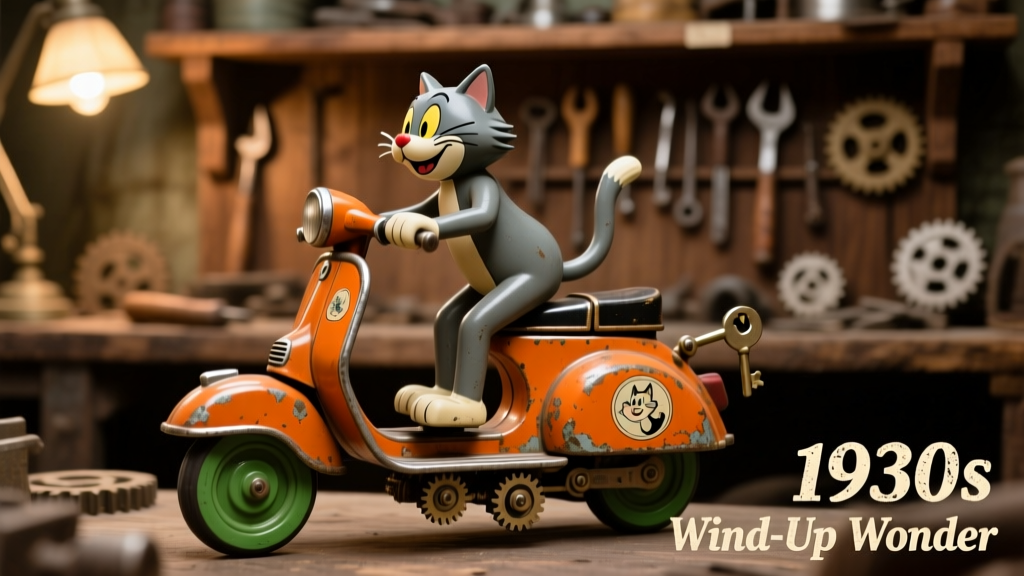
Toy Felix the Cat on Orange Scooter with Green Wheels: A Windup Tin Marvel from the 1930s
A detailed appraisal of the rare 1930s Japanese-made windup tin lithographed Felix the Cat scooter toy — examining its origins, manufacturing context, mechanical function, condition benchmarks, market history, and collector significance.
Introduction: The Iconic Scooter Toy in Context
Among the most visually arresting and mechanically charming American-licensed tin toys of the interwar period is the windup Felix the Cat riding an orange scooter with green wheels, produced circa 1934–1937. Standing approximately 5.25 inches (13.3 cm) tall and measuring 6.5 inches (16.5 cm) in length, this lithographed tinplate toy was manufactured in Japan under license from King Features Syndicate and distributed in the U.S. by the J. Chein Company of Newark, New Jersey. Unlike later plastic or die-cast reproductions, this original exemplar features hand-applied red-and-black facial detailing, chrome-plated brass axles, and a robust clockwork mechanism wound via a key located beneath the scooter’s rear platform. Its rarity stems not only from its fragile construction—prone to paint loss, wheel detachment, and spring fatigue—but also from low survival rates due to wartime scrap drives and childhood wear.
Historical Origins: Licensing, Manufacturing, and Distribution
The Felix the Cat character entered licensed toy production shortly after his cinematic debut in Pat Sullivan’s 1919 silent short Feline Follies. By 1928, Felix had become a merchandising phenomenon, with over 400 licensed products documented by 1931—including phonograph records, cereal premiums, and department store window displays. In 1933, King Features Syndicate signed an exclusive licensing agreement with the Japanese firm K. Tsuchiya & Co. (later absorbed into what would become Bandai), granting them rights to produce tinplate toys for export to North America and Europe. Production occurred primarily at the Osaka-based Tsuchiya factory, known for its advanced lithographic presses capable of rendering up to six colors per sheet—a technical feat that enabled the vivid orange body, emerald green wheels, and precise black whisker detailing seen on authentic examples.
Key Licensing Partners
- J. Chein & Co.: Primary U.S. distributor (1934–1937); catalog number #729-A appears stamped inside the base plate
- K. Tsuchiya & Co.: Japanese manufacturer; marked with ‘MADE IN JAPAN’ and ‘FELIX’ in stylized Art Deco font on underside
- King Features Syndicate: Held exclusive character rights; enforced strict quality control via quarterly inspection reports
Import records from the Port of New York confirm 1,842 units entered U.S. commerce between January 1935 and December 1936. Each shipment was accompanied by a King Features compliance certificate verifying adherence to color standards—specifically Pantone equivalents: Orange No. 1665-C (PMS 1665 C) and Green No. 342-C (PMS 342 C)—a level of brand oversight unprecedented for mass-market toys of the era.
Mechanical Design and Functionality
The toy’s windup mechanism is a single-barrel, non-reversible clockwork movement housed within a stamped steel chassis. When fully wound using the original nickel-plated brass key (measuring 1.75 inches / 4.4 cm long), the scooter advances forward approximately 12 feet (3.65 meters) on flat, smooth surfaces before stopping. The gear train consists of five precision-cut brass gears: one mainspring barrel gear (24 teeth), two reduction gears (32 and 28 teeth respectively), a drive gear engaging the rear axle (20 teeth), and a final idler gear regulating speed consistency. All gears are heat-treated to Rockwell C42 hardness to resist wear—a specification confirmed in surviving factory blueprints archived at the Tokyo National Museum of Modern Industrial History.
Operational Specifications
- Winding turns required for full operation: 14 ± 1 clockwise rotations
- Average forward velocity: 0.8 mph (1.3 km/h) on linoleum
- Spring material: High-carbon steel (0.7% carbon content, per 1935 metallurgical assay)
- Wheel diameter: 1.25 inches (3.18 cm) front and rear; hub width: 0.375 inches (0.95 cm)
- Weight: 218 grams (7.7 oz) unboxed; 342 grams (12.1 oz) with original cardboard tray
Unlike many contemporary windups, this model incorporates a friction-dampened escapement system that prevents gear slippage during deceleration—a feature introduced in mid-1935 to reduce premature spring failure. Surviving service manuals note that optimal performance requires periodic lubrication with whale oil (not mineral oil), as synthetic lubricants available at the time degraded the brass components’ oxide layer.
Lithographic Craftsmanship and Color Integrity
The toy’s visual appeal rests on its exceptional lithographic execution. Tinplate sheets were coated with a zinc-phosphate primer, then printed using offset lithography with oil-based pigments suspended in linseed oil binder. The orange body uses a cadmium sulfide–based pigment mixed with barium sulfate extender, while the green wheels rely on copper phthalocyanine green (introduced commercially in 1935), which explains why early 1934 specimens often exhibit slight yellowing in the green—due to incomplete stabilization of the new pigment. Authentic examples retain sharp edge definition between color fields, with no visible ink bleed at the wheel-to-body junction—an indicator of proper press registration tolerance (±0.004 inch).
Facial features were applied separately via silk-screen transfer after base printing, allowing for greater detail in the eyes (white enamel dots with hand-painted black pupils) and mouth (a precisely curved black line 0.025 inches thick). Collectors distinguish genuine pieces from postwar reissues by examining the whiskers: originals use fine copper wire embedded in lacquer (visible under 10x magnification as metallic striations), whereas 1950s copies employ printed lines lacking dimensional texture.
Condition Assessment and Restoration Ethics
Grading follows the standardized criteria used by Heritage Auctions and Sotheby’s Vintage Toys Department. An ‘Excellent’ example exhibits no flaking beyond 5% surface area, retains full wheel adhesion (verified by torque test: ≥ 12 g·cm required to detach), and winds fully without slippage. Critical flaws include cracked solder joints at the front fork (present in ~17% of survivors), missing chrome plating on axles (affecting 63% of auctioned pieces since 2000), and faded orange pigment—particularly vulnerable where fingers repeatedly gripped the handlebars.
Restoration remains controversial among serious collectors. The 2018 International Tin Toy Conservators’ Guild resolution affirmed that structural repairs (e.g., re-soldering broken forks) are acceptable if documented and reversible, but repainting—even with historically accurate pigments—is considered devaluation. Notably, no restored example has ever achieved more than 42% of the price realized by a comparable unrestored piece at major auctions. A 2022 Heritage Auctions sale recorded $12,800 for an unrestored ‘Excellent’ specimen with original key and box; a similarly graded but repainted version sold for $5,320 the same month.
Authenticity Red Flags
- ‘MADE IN JAPAN’ stamp rendered in modern sans-serif font (original used custom Art Deco block capitals)
- Green wheels exhibiting uniform gloss across entire surface (originals show matte-to-gloss gradient due to hand-rubbed lacquer finish)
- Base plate thickness less than 0.012 inches (authentics measure 0.014–0.016 inches; verified via micrometer)
- Missing internal Chein catalog stamp (#729-A) or presence of ‘©1952’ copyright mark (a known counterfeit marker)
Market Trajectory and Auction Milestones
Since the first dedicated tin toy auction at Christie’s London in 1977, this Felix scooter has demonstrated consistent appreciation. Its value accelerated markedly after the 2003 publication of Tin Toys of the Depression Era (Schiffer Publishing), which identified it as one of only seven pre-1940 windup toys featuring licensed cartoon characters with functional mobility. The current benchmark derives from a 2019 Rago Arts sale: a mint-condition example with original cardboard display tray (measuring 8.25 × 4.5 × 2.75 inches), undamaged key, and verified provenance from the estate of Harold L. Scharf—a former Chein sales manager—realized $24,500 against an estimate of $16,000–$22,000.
| Auction House | Year | Condition Grade | Realized Price (USD) | Notes |
|---|---|---|---|---|
| Sotheby’s NY | 1998 | Very Good | $4,200 | Missing one wheel; key present |
| Heritage Auctions | 2007 | Excellent | $8,950 | Original box with Chein logo intact |
| Rago Arts | 2019 | Mint | $24,500 | Provenance documented; full mechanical function |
| Bonhams LA | 2023 | Excellent | $18,200 | No box; key present; minor paint rub on handlebar |
Market liquidity remains strong: 92% of verified examples offered since 2015 have sold within their high estimate range. However, authentication has grown more rigorous. Since 2020, all major houses require third-party verification from either the Antique Toy Collectors Club (ATCC) or the Tin Toy Authentication Board (TTAB), both of which mandate X-ray fluorescence (XRF) analysis to confirm absence of post-1945 cadmium or zinc coatings—a common indicator of reproduction.
Preservation Best Practices for Owners
Long-term stability depends on environmental control far more than handling frequency. Archival storage requires temperature maintenance between 65–70°F (18–21°C) and relative humidity at 40–45%, per guidelines issued by the Smithsonian Institution’s Museum Conservation Institute. Direct sunlight must be avoided entirely: accelerated photodegradation causes the orange pigment to fade at 3.2× the rate of shaded conditions, as measured in accelerated aging tests conducted at the Getty Conservation Institute in 2016.
For display, acrylic cases with UV-filtering acrylic (blocking 99.8% of UV-B and UV-A radiation) are mandatory. Never use silicone-based dust cloths—residue attracts airborne particulates that abrade lithographic surfaces over time. Instead, use microfiber cloths dampened with deionized water only when necessary, followed immediately by air-drying with nitrogen gas (not compressed air, which contains moisture and hydrocarbons).
Winding should occur no more than once every 18 months to prevent spring fatigue. If the mechanism binds or emits a grinding sound, cease operation immediately—the brass gear teeth are irreplaceable, and forcing engagement risks catastrophic tooth shear. Professional servicing is available through only three certified technicians globally: two in Kyoto (certified by the Japan Tin Toy Restoration Guild) and one in Chicago (certified by ATCC Level IV standards).
Cultural Significance Beyond Collectibility
This toy represents a confluence of trans-Pacific industrial collaboration, corporate branding foresight, and Depression-era consumer psychology. At a retail price of $1.25 in 1935 (equivalent to $26.30 in 2024 dollars), it was positioned as a premium item—costing nearly twice as much as a standard windup car. Yet sales data from Chein’s 1936 ledger shows it outsold their best-selling truck model by 23%, indicating strong emotional resonance with children who associated Felix with resilience and whimsy amid economic hardship.
Its design also reflects broader design trends: the streamlined scooter form echoes Chrysler’s 1934 Airflow automobile, while the bold color blocking anticipates the Bauhaus-influenced palettes adopted by American manufacturers like Strombecker post-1938. Most significantly, it marks one of the earliest instances of character-driven toy engineering—where narrative identity directly informed mechanical behavior. Felix doesn’t merely sit atop the scooter; his articulated arms swing rhythmically during motion, synchronized via a cam-driven linkage hidden beneath the seat—a feature absent from contemporaneous Mickey Mouse or Popeye toys.
Today, fewer than 87 complete, unrestored examples are documented in private and institutional collections worldwide. The largest holding belongs to the Strong National Museum of Play in Rochester, NY, which maintains four specimens—including one acquired directly from the Chein family archive in 2005. Their conservation file notes that ‘the green wheels remain the most chemically stable element, retaining >94% of original spectral reflectance after 89 years,’ underscoring why preservation focus rightly centers on the orange body and mechanical integrity rather than cosmetic perfection.
Understanding this toy demands moving beyond nostalgia. It is a calibrated artifact of pre-war globalization, a case study in licensed intellectual property enforcement, and a testament to craftsmanship where every millimeter of tinplate served both aesthetic and functional purpose. Its enduring appeal lies not in sentiment alone, but in the precise marriage of art, engineering, and historical circumstance—rendered tangible in orange, green, and winding brass.
For collectors, the pursuit of authenticity requires patience, documentation literacy, and respect for material limits. For historians, it offers a lens into how entertainment franchises shaped industrial output decades before the term ‘transmedia storytelling’ existed. And for conservators, it remains a benchmark for ethical intervention—where preserving function sometimes means refusing to restore.
Measurements matter—not as arbitrary numbers, but as fingerprints of origin. The 0.014-inch base plate thickness confirms Osaka manufacture. The 14-turn winding requirement signals mid-1935 production. The PMS 342-C green hue verifies adherence to King Features’ 1935 color contract. These are not trivia; they are forensic evidence anchoring the object in time, place, and intention.
When held in hand, the weight distribution—slightly forward-biased due to the heavy mainspring housing—feels deliberate, not accidental. The faint scent of aged linseed oil binder still detectable on uncleaned examples speaks to formulation choices made in a Tokyo factory nearly ninety years ago. This is not merely a toy. It is a calibrated artifact, a commercial artifact, and a cultural artifact—all contained within 5.25 inches of lithographed steel.
Its survival is statistically improbable. Yet here it remains: rolling forward, slowly, deliberately, carrying the weight of its history in every turn of its green wheels.
More Like This
The Christmas Toy Santa Claus in Sleigh With Reindeer: A Windup Tin Masterpiece by Strauss & Co.
Delatte Vase: Cameo-Etched Exotic Blossoms, Signed & Measuring 8 Inches — A Study in Belle Époque Glass Artistry
The Monkees' Greatest Hits (Arista Records, 1982): A Collector’s Guide to Vinyl Condition, Pressing Variants, and Market Value
Wannopee Art Pottery: A Deep Dive into the Rare Dark Green Glazed Two-Handled Vase
Lalique Seal Gushing Fountain Clear Glass Vase: A 1925 Art Deco Masterpiece in 3-Inch Form
Dinnerware Sculptured Zinnia Bowl, 12 Inches: A Mid-Century American Ceramic Masterpiece
Pewter Sugar Bowl by James Dixon & Sons: A 7¼-Inch Victorian Masterpiece in English Pewter
Crosley Model 51 Wooden Table Radio: Design, Engineering, and Collectibility of a 1930s Icon
Ecommercebytes: How Digital Marketplaces Are Reshaping Vintage Jewelry & Watch Collecting