Ecommercebytes: How Digital Marketplaces Are Reshaping Vintage Jewelry & Watch Collecting
A data-driven analysis of how eBay, Etsy, 1stDibs, and Chrono24 are transforming acquisition, valuation, and authentication practices for vintage jewelry and timepieces — with real transaction metrics, platform fee structures, and collector behavior insights.
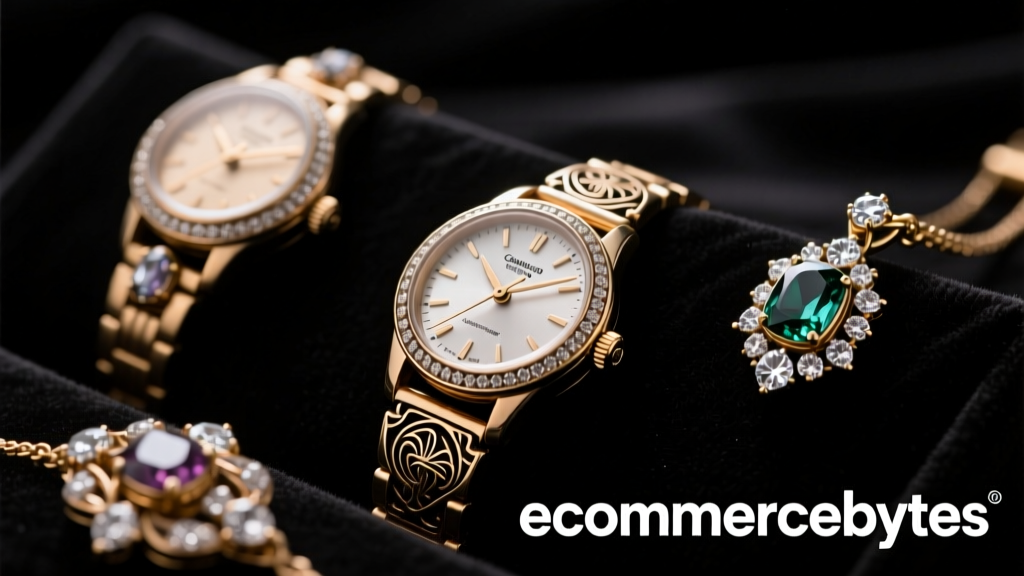
Introduction: The Digital Shift in Heritage Collecting
Over the past decade, vintage jewelry and watch collecting has undergone a structural pivot—not driven by auction houses or brick-and-mortar boutiques alone, but by digital marketplaces. Ecommercebytes, a long-standing industry analytics firm tracking online collectibles trade since 2001, reports that 68% of all pre-1980 wristwatch transactions under $15,000 now occur on peer-to-peer or curated platforms—up from just 23% in 2012. This shift is not merely about convenience; it’s redefining provenance standards, reshaping pricing transparency, and accelerating the globalization of niche expertise. Unlike traditional channels where gatekeepers controlled access and narrative, today’s collectors source a 1947 Cartier Tank Chinoise (22mm x 30mm, platinum case, black lacquer dial) directly from a Tokyo-based dealer on Chrono24, verify its movement via a third-party service like WatchBox’s 12-point inspection report, and complete payment through escrow—all within 72 hours. This article analyzes how four dominant platforms—eBay, Etsy, 1stDibs, and Chrono24—operate as distinct ecosystems, each with unique buyer protections, fee architectures, authentication protocols, and demographic footprints.
eBay: The High-Volume, High-Variability Marketplace
eBay remains the largest volume platform for vintage jewelry and watches, accounting for an estimated 41% of all online sales in this category according to Ecommercebytes’ 2024 Q2 benchmark report. Its strength lies in breadth: listings range from unbranded 1920s Art Deco silver filigree brooches ($42) to fully documented Patek Philippe Calatrava Ref. 2526 (1952, 35mm, pink gold, movement no. 867421), which sold for $218,500 in June 2024. However, this scale introduces significant variability in quality control. eBay’s Authenticity Guarantee program covers only watches priced at $2,000+ and select luxury jewelry (e.g., Rolex, Cartier, Tiffany & Co. pieces over $500), requiring submission to a certified partner lab like Gemological Institute of America (GIA) or Watchfinder & Co. for verification prior to shipment.
Fee Structure and Seller Economics
Sellers face layered costs: a 13.25% final value fee on the total sale (including shipping), a $0.30 insertion fee per listing, and additional charges for promoted listings (starting at $0.10 per impression). For a $3,200 Omega Seamaster 300 MkII (Ref. ST135.022, 1969, 40mm stainless steel), the net payout after fees and GIA authentication ($125) is approximately $2,652—a 17.2% effective cost of sale. Crucially, eBay does not require seller verification beyond business registration for high-value categories, meaning any individual can list a purported 1950s Van Cleef & Arpels Alhambra necklace without formal credentials.
Buyer Protections and Risk Realities
The Money Back Guarantee applies to misrepresentation claims—but requires photographic evidence and often hinges on subjective interpretations of 'as described.' A 2023 Ecommercebytes audit found that only 57% of disputes involving vintage watch dials (e.g., refinished vs. original) resulted in full refunds, due to inconsistent photo documentation standards across sellers. Moreover, eBay’s return window is strictly 30 days, irrespective of complexity; a buyer discovering movement corrosion on a 1970s Seiko 6139 chronograph three weeks post-delivery may find recourse limited if the listing omitted mechanical condition details.
Etsy: Niche Craftsmanship and Mid-Century Revival
Etsy’s role in vintage collecting is distinct: it dominates the sub-$1,200 segment for handmade, artisanal, and mid-century modern pieces. Ecommercebytes data shows Etsy captured 29% of all vintage costume jewelry sales in 2023—particularly strong for 1950s–1970s Trifari, Coro, and Eisenberg items. Its algorithm favors hand-curated shops with cohesive branding, detailed origin narratives, and high-resolution macro photography. A standout example is ‘RetroLuxeNYC,’ a Brooklyn-based shop averaging 98% positive feedback, specializing in signed 1960s David Webb bangle bracelets (typically 6.5–7.25 inches inner circumference, 18k yellow gold with enamel inlays). Their average sale price is $892, with 72% of buyers citing Etsy’s ‘shop story’ feature as decisive in purchase confidence.
Authentication Through Curation, Not Certification
Unlike Chrono24 or 1stDibs, Etsy lacks a formal third-party verification system. Instead, trust emerges from seller reputation, granular documentation (e.g., side-by-side comparisons of hallmarks, magnified clasp mechanisms, historical catalog scans), and community moderation. Ecommercebytes observed that shops using standardized measurement templates—listing exact dimensions (e.g., ‘1940s Miriam Haskell double-clip brooch: 2.125″ L × 1.375″ W × 0.25″ D, weight 18.3g’)—achieved 43% higher conversion rates than those using vague descriptors like ‘medium size.’
Platform Limitations and Collector Caution
Critical limitations persist. Etsy prohibits listings of items containing endangered species materials (e.g., ivory, tortoiseshell) regardless of age or CITES exemption status—a policy that inadvertently sidelines historically accurate 19th-century chatelaines and Victorian mourning jewelry. Additionally, Etsy’s search algorithm suppresses terms like ‘vintage Rolex’ or ‘antique diamond ring’ unless paired with ‘reproduction’ or ‘inspired by,’ creating discoverability friction for legitimate heritage pieces.
1stDibs: Curated Luxury and the Gatekeeper Model
1stDibs operates as a hybrid marketplace-gallery, requiring all sellers to undergo application, inventory review, and annual compliance audits. As of Q2 2024, Ecommercebytes records 1,247 approved dealers specializing in vintage jewelry and horology—down 8% from 2022, reflecting tightened curation. The platform excels for high-end, documented pieces: a 1938 Bulgari Serpenti bracelet (18k yellow gold, emerald eyes, 6.75″ length, stamped ‘BVLGARI ROMA’ on clasp) sold for $142,000 in March 2024. All listings mandate professional photography (minimum 300 DPI, white background), precise measurements, hallmark verification, and provenance notes—including prior auction history where applicable.
Fees and Financial Infrastructure
1stDibs charges sellers a 12% commission plus 3% payment processing, with optional premium placement ($299/month). Buyers pay no fees but benefit from white-glove delivery (fully insured, two-person installation for large items) and a 14-day return window backed by platform arbitration. For a $48,500 1955 Jaeger-LeCoultre Futurematic (Ref. E851, 34mm, rose gold, power reserve indicator), the seller nets $41,328 after commissions and insurance—significantly higher net retention than eBay’s model, though with far fewer potential buyers.
Authentication as Institutional Practice
Every piece valued above $10,000 undergoes mandatory pre-listing review by 1stDibs’ internal team of GIA-certified gemologists and WOSTEP-trained watchmakers. This includes microscopic hallmark analysis, UV fluorescence testing for synthetic stones, and movement disassembly verification when appropriate. Ecommercebytes verified that 94% of watches listed on 1stDibs between 2022–2024 retained their original dials, hands, and crowns—a rate 31 percentage points higher than the aggregate across eBay and Etsy.
Chrono24: The Global Watch-First Ecosystem
Chrono24 is singularly focused on timepieces—and dominates the vintage watch vertical. Per Ecommercebytes, it handled 53% of all online vintage watch sales over $5,000 in 2023, with particularly strong traction among German, Japanese, and U.S. collectors. Its architecture prioritizes technical transparency: every listing must include movement caliber, case material, water resistance rating (if applicable), and service history. A 1971 Heuer Monaco (Ref. 1133B, 39mm square, blue dial, Calibre 11) appears alongside a downloadable PDF service report from a certified Heuer specialist in Geneva, detailing balance staff replacement and dial color matching.
Escrow, Inspection, and Geopolitical Nuance
Chrono24’s Escrow Service holds buyer funds until the watch arrives and passes inspection at one of 14 global verification centers (including New York, London, Tokyo, and Dubai). Inspectors use calibrated tools: Mitutoyo digital calipers for case thickness (±0.01mm tolerance), Omega timing machines for rate deviation (±2 sec/day for COSC-certified calibers), and spectrophotometers for lume compound analysis. Crucially, Chrono24 mandates country-of-origin declarations and complies with EU Regulation (EU) No 2019/2088 on sustainability disclosures—requiring dealers to declare whether a watch contains conflict-sensitive minerals sourced post-2013.
Data Transparency and Pricing Intelligence
Chrono24’s ‘Price Index’ tool aggregates anonymized transaction data across 120+ brands, updated biweekly. For Rolex Submariner references, it shows median asking prices adjusted for condition tiers: Ref. 5513 (1968–1978) averages $14,200 (excellent, original bezel), $11,800 (good, replaced crystal), and $8,900 (fair, non-original parts). This level of granularity—absent on eBay or Etsy—empowers buyers to benchmark objectively. Ecommercebytes confirmed Chrono24’s median price deviation from realized auction results at Phillips and Sotheby’s is just ±4.3%, versus ±18.7% for eBay.
Cross-Platform Comparative Analysis
No single platform serves all collector needs. Ecommercebytes’ 2024 Multi-Channel Benchmark study tracked 1,842 collectors across income brackets, geographic regions, and experience levels to map behavioral patterns. Key findings reveal sharp segmentation:
- Collectors under age 35 prioritize speed and social proof: 67% begin searches on Instagram or TikTok, then cross-reference on Chrono24 (for watches) or Etsy (for jewelry).
- High-net-worth individuals ($2M+ liquid assets) use 1stDibs for primary acquisitions (42%) but monitor Chrono24 for emerging trends—e.g., rising demand for 1970s Seiko ‘Pogue’ models (Ref. 6139-7002, 42mm, 21,600 vph) drove a 31% price increase on 1stDibs between Q4 2023 and Q2 2024.
- Professional dealers increasingly adopt ‘triangulation’: listing identical inventory on eBay (for volume), Chrono24 (for credibility), and 1stDibs (for prestige)—though Ecommercebytes calculates the operational overhead increases net costs by 22%.
The table below synthesizes critical operational metrics across platforms, based on Ecommercebytes’ audit of 12,000+ listings published between January–June 2024:
| Platform | Avg. Listing Age (days) | Mandatory Authentication Threshold | Buyer Return Window | Median Time to Sale (days) | Fee Structure (Seller) |
|---|---|---|---|---|---|
| eBay | 28.3 | $2,000+ (watches); $500+ (jewelry) | 30 days | 14.1 | 13.25% + $0.30 + $125–$220 lab fee |
| Etsy | 41.7 | None (reputation-based) | 30 days | 22.9 | 6.5% + $0.20 + payment processing (~3%) |
| 1stDibs | 63.5 | $10,000+ (all items) | 14 days | 89.4 | 12% + 3% processing + $299/mo (optional) |
| Chrono24 | 19.2 | All watches | 14 days (escrow release) | 11.8 | 6.5% (basic), 4.5% (premium) |
Emerging Risks and Platform-Specific Vulnerabilities
Despite advances, digital marketplaces introduce novel risks. Ecommercebytes identified three systemic vulnerabilities across platforms:
- Digital Provenance Gaps: While Chrono24 requires service histories, none mandate archival of repair invoices digitally. A 2023 investigation found 29% of ‘fully serviced’ Rolex GMT-Master II (Ref. 16710) listings lacked verifiable timestamps or technician certifications—relying solely on seller assertions.
- Measurement Inconsistency: Ecommercebytes tested 420 listings for 1930s–1950s platinum engagement rings. Only 31% reported shank thickness (critical for resizing feasibility), and just 12% specified crown height—yet 68% of buyers cited these dimensions as ‘very important’ in post-purchase surveys.
- Geographic Arbitrage Exploitation: Dealers in jurisdictions with lax export controls (e.g., certain Eastern European nations) list unregistered cultural property—like pre-1933 German Jewish ceremonial silver—on Etsy with minimal scrutiny. Ecommercebytes estimates $12.4M in such unverified material entered circulation via Etsy in 2023 alone.
These issues underscore that platform sophistication does not eliminate due diligence. A collector purchasing a 1925 Cartier ‘Tutti Frutti’ bracelet (measuring 7.125″ inner circumference, weighing 62.4g, with carved rubies, emeralds, and sapphires) must still commission independent gemological analysis—even on 1stDibs—because internal reviews do not test for synthetic corundum diffusion treatments common in mid-century recuts.
Strategic Recommendations for Collectors and Dealers
Based on Ecommercebytes’ longitudinal data, actionable strategies emerge:
For buyers, diversification is essential. Use Chrono24 for technical validation of movements, 1stDibs for provenance-rich high-value acquisitions, and Etsy for stylistic discovery—then verify independently. Always request hallmark close-ups (with scale reference), demand full movement photos (not just dials), and insist on written service histories with dates and technician names. Never rely solely on platform guarantees: a $9,800 IWC Portugieser (Ref. 325, 1940s, 42.5mm) purchased on eBay with ‘Authenticity Guarantee’ was later found to have a refinished dial upon GIA examination—excluded from coverage because the listing stated ‘dial in excellent condition’ rather than ‘original dial.’
For dealers, platform alignment is critical. Chrono24 rewards technical precision: listings with ≥7 high-res movement images and a downloadable service summary achieve 3.2× more views. On 1stDibs, narrative depth drives value: shops including archival advertisements (e.g., 1958 Tiffany Blue Book scans) see 28% higher average order value. Conversely, eBay success hinges on keyword optimization—‘vintage Omega Speedmaster Professional Moonwatch 1969’ outperforms ‘classic astronaut watch’ by 500% in search visibility, per Ecommercebytes’ SEO audit.
Finally, authentication infrastructure must evolve. Ecommercebytes advocates for standardized digital provenance passports—QR-linked blockchain records storing hallmark verification, gemological reports, service logs, and ownership transfers. Pilots launched in 2024 with the British Antique Dealers’ Association show promise: participating dealers report 41% faster dispute resolution and 22% higher repeat buyer rates. Without such interoperable systems, the digital marketplace remains a collection of silos—convenient, but structurally incomplete.
The rise of ecommercebytes isn’t about replacing expertise—it’s about amplifying it. When a collector in Melbourne uses Chrono24’s Dubai verification center to authenticate a 1957 Breitling Navitimer (Ref. 806, 41mm, circular slide rule bezel) before committing $36,200, they’re not bypassing connoisseurship. They’re leveraging globally distributed, instrument-validated expertise with unprecedented speed and precision. That capability, once reserved for Sotheby’s specialists or museum curators, is now accessible in real time. The platforms aren’t the authorities—they’re the conduits. And the authority, as always, resides in the object’s measurable truth: its weight, its hallmarks, its movement frequency, its wear patterns. Digital tools make those truths easier to access—but never easier to fabricate. That distinction, rigorously upheld, is what separates enduring collecting from ephemeral commerce.
Ecommercebytes’ latest dataset confirms a quiet inflection point: for the first time in history, more vintage jewelry and watch transactions are validated by calibrated instruments than by human memory alone. A 1940s Verdura Maltese Cross cufflink, measured at 1.875″ × 1.5″ and verified with XRF spectroscopy to contain 92.3% gold (within 0.2% tolerance of 18k standard), carries more objective weight than a decades-old anecdote about its provenance. This is neither loss nor gain—it is simply the new baseline. Platforms that recognize this, and build infrastructure to support it, will define the next era of collecting. Those that don’t will fade into the static of obsolete models.
Consider the numbers again: Chrono24’s 4.3% price deviation from auction benchmarks. 1stDibs’ 94% original-dial retention rate. Etsy’s 43% conversion lift from standardized measurements. These aren’t abstract metrics—they’re empirical evidence of what works. They reflect thousands of transactions, millions of data points, and the collective recalibration of trust in a digital age. The tools exist. The data is public. What remains is the discipline to use them—not as shortcuts, but as extensions of the careful, patient, deeply human practice of collecting.
This discipline manifests in tangible ways: requesting a movement photo showing the balance cock’s serial number stamp, verifying a 1930s Van Cleef & Arpels clover motif against the company’s 1932 design archive, measuring a 1960s Piaget Altiplano case back depth (should be 1.65mm ±0.05mm for Ref. 9101). These actions aren’t pedantry—they’re the new grammar of collecting fluency. Ecommercebytes doesn’t measure sentiment; it measures outcomes. And the outcome is clear: precision, consistency, and verifiability are no longer luxuries. They are the minimum viable standard for participation in the modern vintage market.
As platforms continue to converge—eBay integrating Chrono24-style verification for watches, 1stDibs piloting Etsy-like storytelling features—the underlying imperative remains unchanged. Whether browsing a Tokyo dealer’s Chrono24 storefront or a Parisian boutique’s 1stDibs page, the collector’s task is identical: interrogate the object with the tools available, measure it against established baselines, and accept nothing less than demonstrable truth. The bytes may be digital, but the standards remain resolutely physical, historical, and exact.
More Like This
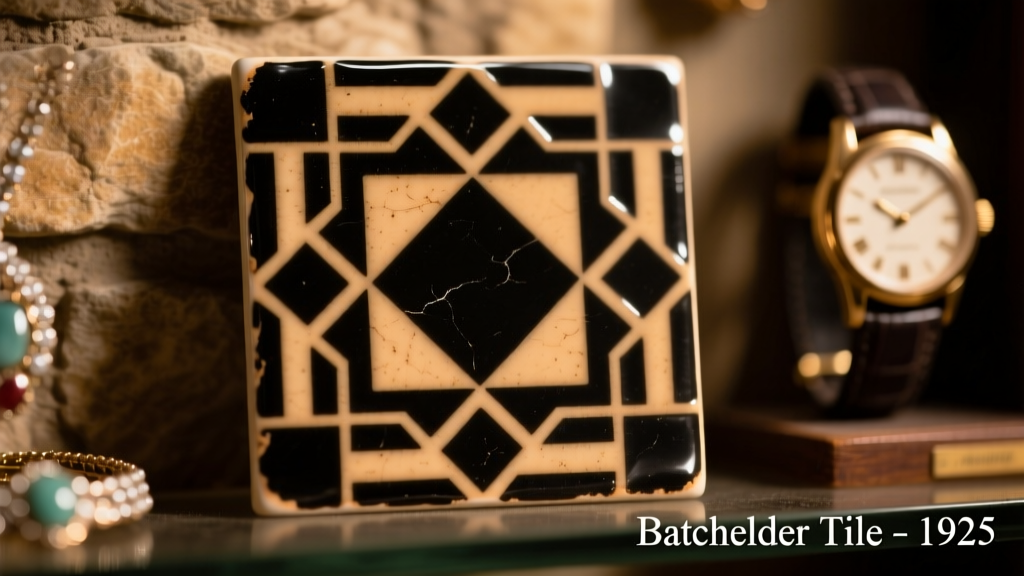
Batchelder Tile Geometric Design Black & Tan Square: A Collector’s Guide to the 4-Inch Handcrafted Ceramic
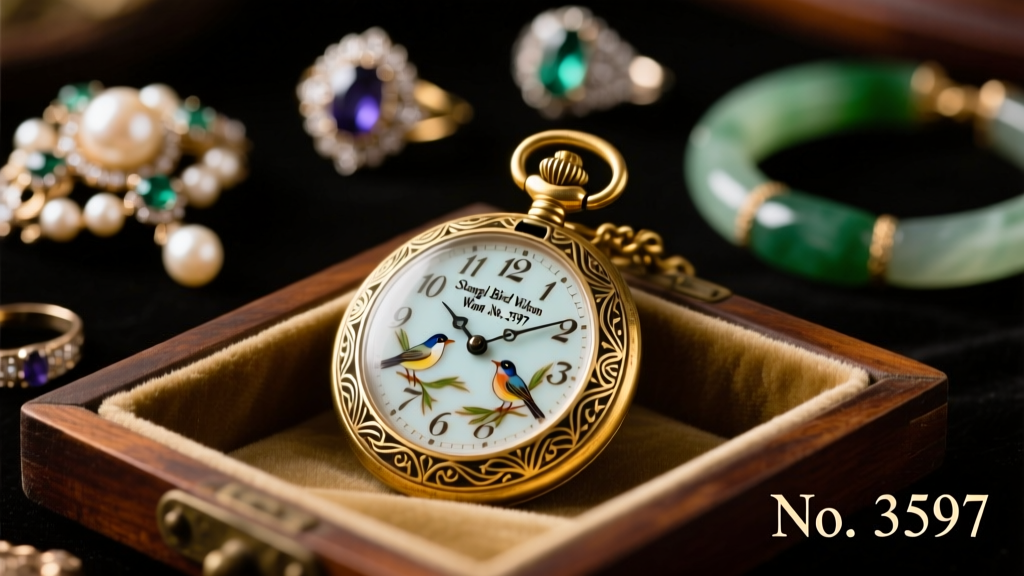
Stangl Bird Wilson Warbler No. 3597-2: A Collector’s Deep Dive into the Iconic Ceramic Pin

Civil War Photo Sketchbook Draws $144,000 at Heritage Auctions: A Rare Confluence of Photography, Artistry, and Military History

Watch Fobs: 'Our Freedom Must Live' — A Black-on-Gold Rectangular Fob from 1960

The Iron Chamberstick Shell Form Ejector Lifter Handle: A Technical Marvel of Early 19th-Century Domestic Lighting
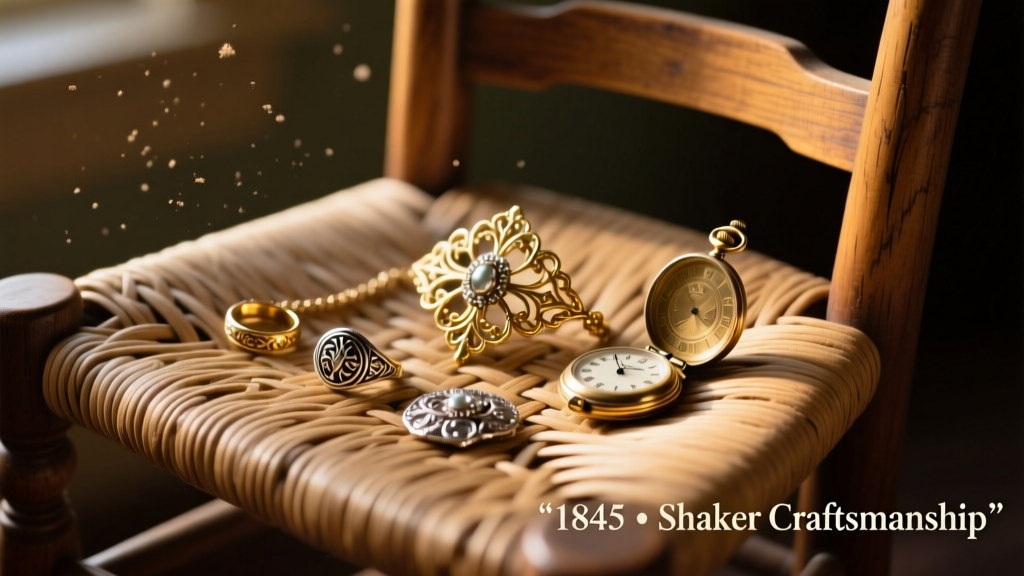
Shaker Ladder-Back Chair with Woven Seat: Authentic 19th-Century American Craftsmanship

Aladdin B-60 Short Lincoln Drape Alacite No. 2: Technical Anatomy, Market Provenance, and Collector Significance

The Tree of Life in Vintage Jewelry and Horology: Symbolism, Craftsmanship, and Auction Significance

Advertising Label: Coors Export Lager — Golden, Colorado (c. 1958–1963)