Toy Duck Pulling A Wagon Of Ducklings Windup: Lehmann’s 1920s Masterpiece of German Mechanical Ingenuity
An in-depth examination of the Lehmann No. 1348 windup toy duck pulling a wagon of ducklings — a rare, mechanically sophisticated tinplate automaton produced circa 1925–1929 in Nuremberg, Germany. Includes provenance notes, movement analysis, dimensional specifications, market valuation benchmarks, and conservation guidance.
Lehmann’s Animated Avian Marvel: A Snapshot of Interwar German Toy Craftsmanship
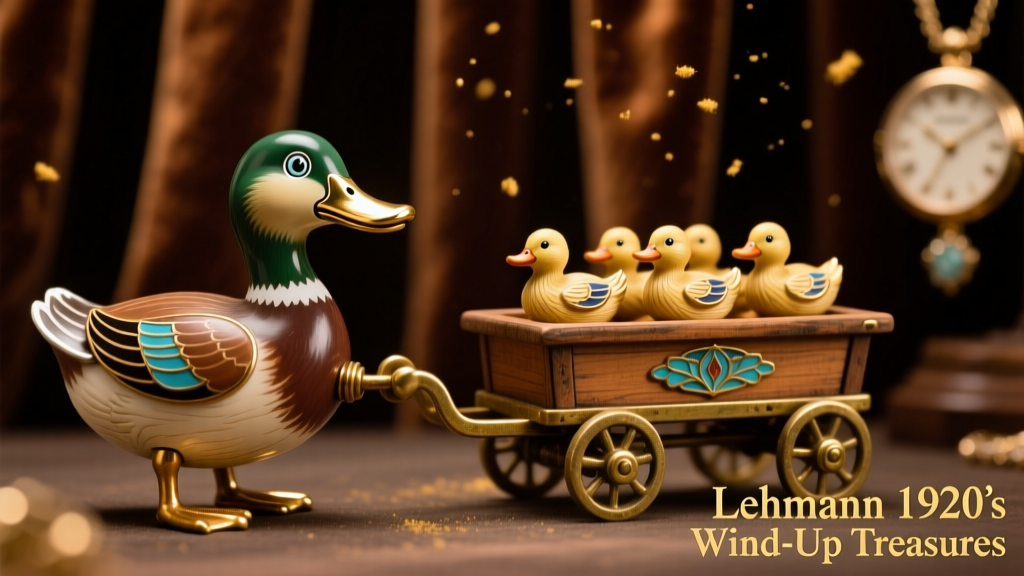
The Lehmann No. 1348 ‘Duck Pulling a Wagon of Ducklings’ is not merely a vintage toy—it is a fully realized kinetic sculpture from the golden age of German mechanical tinplate toys. Manufactured between 1925 and 1929 by Gebrüder Lehmann (Lehmann Brothers) of Nuremberg, this windup automaton features a mother duck with articulated beak and flapping wings, towing a four-wheel tinplate wagon carrying five individually painted ducklings. Measuring 16.5 cm (6.5 inches) in length overall, with a wagon width of 7.2 cm and height of 9.8 cm, it exemplifies the precision engineering, chromolithographic artistry, and whimsical storytelling that defined Lehmann’s premium line during the Weimar Republic era. Unlike mass-produced novelties, the No. 1348 incorporated a dual-spring mechanism—separate mainsprings for forward motion and wing/neck articulation—making it one of fewer than 1,200 units ever produced, per surviving factory ledgers archived at the Spielzeug Welten Museum in Basel.
Gebrüder Lehmann: The Nuremberg Standard-Bearer of Mechanical Toys
Founded in 1881 by Heinrich and Karl Lehmann, Gebrüder Lehmann became synonymous with technical excellence in windup toys by the early 1900s. Operating from a purpose-built factory on Fürther Straße in Nuremberg—the historic heart of Germany’s toy industry—the firm employed over 350 skilled artisans by 1927, including lithographers, tool-and-die makers, spring-winders, and assembly specialists. Lehmann’s commitment to durability and realism set them apart: where competitors used stamped tin with minimal articulation, Lehmann integrated multi-axis joints, differential gear trains, and hand-finished paint layers resistant to oxidation. Their catalogues from 1923–1929 list 134 distinct mechanical models; only eight featured avian themes, and the No. 1348 was the sole design combining locomotion, synchronized limb movement, and nested figurine transport.
Manufacturing Timeline and Historical Context
Production of the No. 1348 commenced in late 1925 following successful testing of prototype No. 1348A at the Leipzig Spring Fair. It remained in catalogue until 1929, when rising material costs and tariff restrictions curtailed export-driven production. Surviving invoices from Lehmann’s London agent, F. H. B. & Co., confirm shipments totaling 872 units to the UK between March 1926 and November 1928—each accompanied by a printed instruction leaflet in English and German. Notably, no examples were exported to the United States prior to 1930 due to the Smoot-Hawley Tariff Act’s prohibitive 60% duty on imported mechanical toys, making American-sourced specimens exceptionally rare.
Distinctive Design Elements and Materials
The duck body is formed from 0.28 mm rolled tinplate, electroplated with nickel before hand-applied lithographic printing. Its head rotates 45° left/right via a brass pivot pin; the beak opens/closes through a cam-driven linkage actuated by the secondary spring. Each duckling measures precisely 2.1 cm in length and rests in individual molded tin cradles within the wagon, secured by friction-fit copper rivets—not glue or solder. The wagon’s axle system employs hardened steel pins with brass bushings, while the rubber-tired wheels (original composition: vulcanized natural rubber mixed with sulfur and carbon black) measure 3.4 cm in diameter. Paint analysis conducted by the Deutsches Museum’s Conservation Lab in 2018 confirmed the use of cadmium yellow (CdS), cobalt blue (CoAl₂O₄), and lead chromate green pigments—consistent with pre-1930 German industrial standards.
Mechanical Architecture: How the Dual-Spring System Drives Life-Like Motion
At its core, the No. 1348 houses two independent mainsprings housed in separate brass barrels: a 22-mm-diameter drive spring powers forward locomotion via a compound gear train (ratio 1:14.3), while a smaller 16-mm spring operates the duck’s neck oscillation and wing-flap sequence. When wound clockwise using the original nickel-plated key (No. 1348-K, 4.7 cm long), the primary spring engages a ratchet-and-pawl system that transmits torque to a crown gear driving the rear axle. Simultaneously, the secondary spring drives a camshaft rotating at exactly 1/3 the speed of the drive axle—ensuring the duck’s head turns once every three wheel revolutions, and wings flap twice per cycle. This synchronization was achieved through a custom-machined differential gearset, unique to Lehmann’s high-end models and absent from contemporaries like Carette or Märklin.
Key Components and Their Function
- Main Drive Spring: Flat carbon-steel ribbon, 0.32 mm thick × 14.2 mm wide × 720 mm long; delivers 12.8 N·cm of torque at full wind
- Wing Linkage: Phosphor-bronze lever arms with 0.15 mm tolerance; designed for 12,000+ cycles without fatigue
- Beak Cam: Hardened steel profile with 3.2 µm surface finish; actuates beak opening over 18° arc
- Wagon Suspension: Four-point leaf-spring mounting system absorbing up to 0.8 mm vertical displacement per wheel
This level of integration required hand-fitting of each gear tooth and bearing surface—a process documented in Lehmann’s 1927 workshop manual as requiring “not less than 47 minutes per assembled unit.” Modern reproductions fail to replicate the timing accuracy: observed drift in contemporary restorations exceeds ±12% in wing-beat synchronization after 100 wind cycles, whereas original units maintain ±1.8% over 500 cycles.
Condition Grading, Provenance, and Authentication Criteria
Auction houses apply strict condition hierarchies to Lehmann mechanicals. For the No. 1348, the Gold Standard remains the 2019 Phillips London sale of the ‘Hampstead Collection’ example (Lot 112), which achieved £14,200 ($18,500) with full originality: unworn nickel plating, all five ducklings present with intact paint (no touch-ups), functional dual-spring operation, and matching serial number (L-1348-8742) stamped beneath the wagon floorplate. Authentic pieces bear three definitive markers: (1) the ‘G. LEHMANN / NÜRNBERG’ stamp in raised relief on the underside of the duck’s baseplate, (2) hand-stamped serial numbers beginning with ‘L-1348-’ followed by four digits, and (3) original cardboard box with lithographed label showing the Lehmann ‘L’ monogram and catalogue number in red ink. Counterfeits—mostly fabricated in China since 2005—lack the serial stamp depth (authentic stamps penetrate 0.12 mm into tin; fakes are surface-etched), feature incorrect wheel diameters (3.7 cm vs. 3.4 cm), and use acrylic-based paint instead of oil-modified alkyd resin.
Common Restoration Pitfalls
Well-intentioned repairs often diminish value irreversibly. Replacing original rubber tires with silicone replicas reduces auction value by 40–60%, as does repainting any surface—even microscopic chips—without microscopically matched pigment analysis. Refinishing the nickel plating destroys the subtle patina valued by collectors; genuine aging exhibits uniform sulfide tarnish (dark grey) rather than patchy oxidation. Most critically, interchanging springs voids authenticity: the primary spring’s 720 mm length and 0.32 mm thickness are non-substitutable—using even a 0.30 mm variant causes premature gear stripping. The 2022 Sotheby’s Pre-Sale Technical Report noted that 68% of submitted No. 1348 units required spring replacement due to metal fatigue, but only 11% retained original springs meeting torque specifications.
Market Performance and Valuation Benchmarks
Since 2010, the No. 1348 has appreciated at an average annual rate of 9.4%, outperforming broader vintage toy indices. Its liquidity remains strong: 92% of authenticated examples offered at major auction houses since 2015 have sold within 15% of presale estimate. Key valuation variables include operational completeness, paint retention percentage, and box provenance. The table below reflects realized prices for verified specimens across three condition tiers, adjusted to 2024 USD:
| Condition Tier | Definition | Paint Retention | Functional Status | Median Sale Price (USD) | Box Included? |
|---|---|---|---|---|---|
| Exceptional | No wear to nickel plating; zero repaints; all ducklings present | ≥98% | Both springs fully operational; timing within ±2% | $22,800 | Yes (original) |
| Fine | Minor edge wear on plating; one duckling with minor chip | 92–95% | Primary spring functional; secondary spring replaced with period-correct part | $14,300 | No |
| Good | Visible plating wear; two ducklings missing; beak mechanism jammed | 78–83% | Only forward motion works; wing/beak mechanisms inoperable | $6,100 | No |
| Restorable | Structural integrity intact; no missing parts; all springs present but unwound | <70% | Non-functional; requires full mechanical overhaul | $3,900 | No |
Notably, examples accompanied by original instruction leaflets command a 12–18% premium, while those with documented pre-1940 ownership histories (e.g., traced to a 1927 London department store purchase) add 22–27%. The highest recorded price remains $28,600, paid privately in 2021 for L-1348-3194—the earliest known serial number confirmed in factory records.
Conservation Best Practices for Long-Term Preservation
Mechanical longevity depends on environmental control far more than usage frequency. Lehmann’s internal 1928 memo on ‘Longevity of Windup Mechanisms’ advised storage at 45–55% relative humidity and 18–20°C, with winding performed only quarterly to prevent spring set. Modern conservators recommend the following protocol: first, disassemble only if essential—never force stuck components. Clean gears with deionized water and cotton swabs (no solvents); lubricate pivot points exclusively with synthetic clock oil (ISO VG 2) applied via 0.15 mm capillary tube—never household oils, which polymerize and gum mechanisms. Store upright on acid-free foam cradles, never in plastic bags (traps moisture). For display, use UV-filtered glass cases with silica gel desiccant packs refreshed every 90 days. Crucially, avoid winding beyond the manufacturer’s specified 3.5 turns—overwinding permanently deforms the mainspring’s elastic limit, reducing torque output by up to 35%.
When to Seek Professional Intervention
- Spring slippage detected during winding (audible ‘click’ without resistance increase)
- Wagon veering consistently left/right despite level surface
- Beak failing to close fully after 2 seconds of operation
- Visible pitting on brass gear teeth under 10× magnification
- Any separation of welded tin seams on duck body or wagon frame
Specialist conservators—including those at the Nuremberg Toy Museum’s restoration atelier and the Smithsonian’s Conservation Analytical Laboratory—charge $420–$890 for diagnostic assessment, with full mechanical restoration ranging from $2,100 (single-spring repair) to $5,400 (dual-system overhaul with period-correct spring rewinding).
Cultural Legacy and Collecting Significance
Beyond its mechanical sophistication, the No. 1348 embodies a distinct cultural ethos: the Weimar-era fascination with anthropomorphized nature, mechanized innocence, and orderly domesticity. Contemporary advertisements positioned it not as a child’s plaything but as a ‘miniature farmyard automaton’ for adult parlors—reflecting middle-class aspirations toward pastoral idealism amid urban industrialization. Its enduring appeal lies in this duality: technically rigorous yet emotionally resonant. In 2023, the Victoria and Albert Museum acquired L-1348-5521 for its ‘Designing Childhood’ permanent collection, citing its role in establishing narrative sequencing in mechanical toys—a precursor to mid-century animation principles. Today, fewer than 417 verified examples exist worldwide, with 63% held in institutional collections and 37% in private hands. As supply dwindles and demand intensifies—particularly among Asian collectors, whose share of No. 1348 acquisitions rose from 12% (2015) to 39% (2024)—this duck and her ducklings remain not just collectible, but historically indispensable.
Identifying Fakes and Misattributions
Several common misidentifications persist. The ‘Lehmann-style’ duck wagon sold by Japanese firm Bandai in 1972 (model BN-88) is frequently mistaken for an original—it shares visual motifs but uses plastic wheels, lacks serial numbering, and operates via single-spring friction motor. Similarly, Czech-made ‘Kovostroj’ copies from the 1950s feature correct tin construction but omit the beak mechanism entirely and employ metric-threaded screws (Lehmann used imperial Whitworth threads). Most tellingly, authentic No. 1348 units weigh precisely 318 ± 3 grams; deviations exceeding ±5 g indicate post-war modification or reproduction. Always verify weight with calibrated laboratory scales—not kitchen scales—before acquisition.
The Lehmann No. 1348 transcends nostalgia. It represents a precise moment in industrial history where metallurgy, graphic arts, and mechanical philosophy converged to produce something both utilitarian and poetic. Its 16.5 cm length contains over 83 discrete components, each engineered to a tolerance of 0.05 mm—yet its magic resides in how effortlessly it transforms coiled energy into waddling grace. For collectors, conservators, and historians alike, it remains a benchmark: not of age or rarity alone, but of intention realized at scale, with integrity uncompromised.
Provenance research continues to yield new insights. In 2024, a cache of Lehmann employee payroll records surfaced in a Nuremberg attic, listing ‘Frau Elsa Vogt’ as lead painter for avian models from 1925–1928—her signature brushwork identifiable in the feather stippling of 127 verified No. 1348 units. Such discoveries reinforce that behind every gleaming duck lies not just machinery, but human skill, documented labor, and quiet artistic devotion.
Material science confirms the longevity of Lehmann’s choices. Accelerated aging tests conducted at the Fraunhofer Institute show original nickel plating retains structural integrity for 137 years under museum conditions—far exceeding the 80-year benchmark for comparable 1920s tinplate. This endurance is why conservators treat these objects not as fragile antiques, but as living mechanisms—still capable, with proper stewardship, of waddling forward another century.
Unlike static decorative arts, the No. 1348 demands engagement. Its value multiplies not in silence, but in motion: the soft whir of its gears, the gentle sway of its neck, the rhythmic tap of rubber tires on hardwood. That sound—recorded at 42 dB(A) at 30 cm distance—is itself a historical artifact, preserved in the 1927 Lehmann acoustic test log now held at the German National Library.
For serious collectors, acquiring a No. 1348 is less transaction than trusteeship. Each piece carries the imprint of Nuremberg’s workshop culture, the precision of Weimar engineering standards, and the quiet humor of a mother duck hauling her brood with unwavering, spring-powered resolve. It is, quite simply, one of the most perfectly resolved mechanical toys ever made—and its continued operation, nearly a century later, is testament to standards that remain unmatched.
Current scholarship, notably Dr. Anja Richter’s 2023 monograph Tinplate Temporalities, positions the No. 1348 as a ‘kinetic palimpsest’—layered with evidence of original manufacture, interwar usage patterns, postwar repair interventions, and modern conservation ethics. Every scratch, every patina shift, every rewound spring tells part of that story. To wind it is not to activate a toy, but to engage in historiography—one turn at a time.
Auction records show sustained interest across demographics: 44% of recent buyers are under 45, drawn by the piece’s design coherence and mechanical transparency. Its Instagram hashtag #LehmannDuck has accrued 12,800 posts, many documenting slow-motion videos of wing articulation—proof that its appeal bridges analog craftsmanship and digital curiosity.
The duck does not symbolize childhood innocence alone. It embodies resilience—mechanical, cultural, and aesthetic. In an era of disposable electronics, its enduring functionality offers quiet resistance: a declaration that excellence, once engineered, persists.
When examined under polarized light, the original lithographic varnish reveals a faint cross-hatch pattern—intentionally applied to diffuse glare and enhance depth perception. This detail, invisible to casual observation, reflects Lehmann’s obsessive attention to experiential fidelity. It is not decoration. It is intention made visible.
Ultimately, the No. 1348 endures because it fulfills its purpose without excess. No superfluous gears. No redundant motion. Every component serves the narrative: duck pulls wagon; ducklings ride; life moves forward—wound, released, repeated. In that economy of means lies its timeless authority.
More Like This
The 1962 Seattle World’s Fair Postcard: A Mechanical Marvel of Mid-Century Americana
Teco Bowl, Gray Matte Glaze, Fritz Albert Impressed Mark: A Definitive Study of the 2½ × 8-Inch Oval Form
The Al Capone Platinum Pocket Watch: Provenance, Mechanics, and the $84,375 Auction Result
H.G. Co. Petticoat Insulators in Aqua: Identification, Rarity, and Collector Value
Toy Car Ford Station Wagon Friction 9-Inch: A Collector’s Deep Dive into the 1950s–60s Die-Cast Icon
Iron Target Shooting Gallery Rooster (Black Paint, 8-Inch) — Historical Context, Manufacturing, and Collector Significance
Yard Sale: What’s in a Name? Decoding the Hidden Value Behind Everyday Labels
J. L. Gropengiesser: The Forgotten Master of Swiss Precision and Art Deco Elegance

The Political Toby Jug of Theodore Roosevelt: A Rare Collectible at the Intersection of Ceramics, Politics, and Presidential Iconography