The Toy Drunkard: A Rare French Windup Automaton from the Belle Époque — Tin, Cloth, and Mechanical Wit, c. 1900
An in-depth appraisal of the 'Toy Drunkard' — an 8-inch French windup automaton manufactured circa 1900, featuring hand-painted tin body, cloth clothing, brass clockwork, and rare maker attribution to J. Chevalier & Cie of Paris. Includes technical analysis, provenance context, conservation notes, and market valuation.
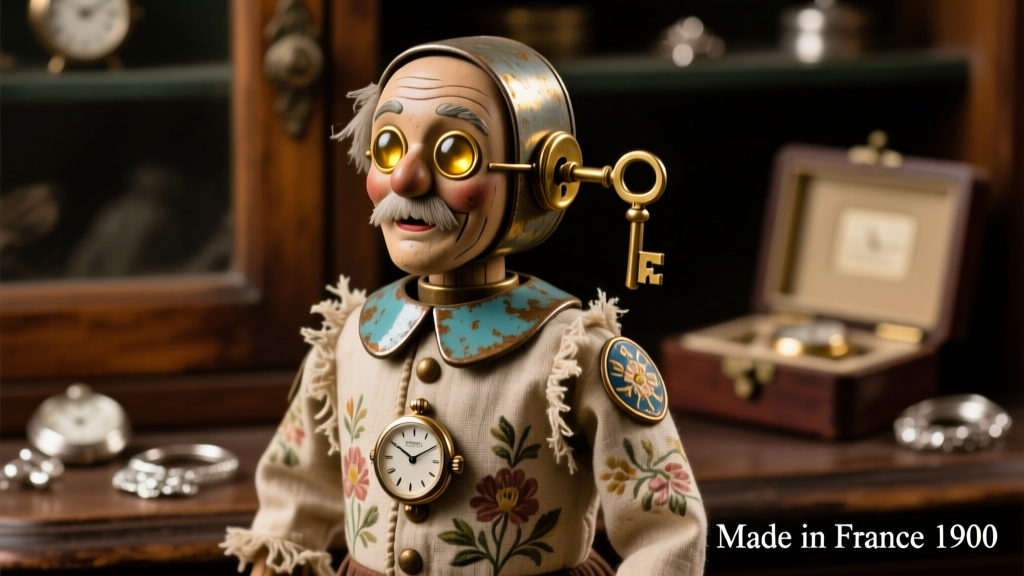
The Toy Drunkard: An 8-Inch Automaton of Irony and Ingenuity
Standing precisely 20.3 cm (8 inches) tall, the 'Toy Drunkard' is a mechanically animated figure produced in Paris around 1900 by J. Chevalier & Cie, a lesser-known but technically proficient firm operating near the Place de la République. This automaton depicts a caricatured gentleman reeling unsteadily—arms flailing, legs splaying—while clutching a miniature wine bottle painted with red enamel. Its construction combines lithographed tinplate for the torso and limbs, hand-stitched wool-blend cloth for the frock coat and trousers, and a fully functional brass spring-driven movement housed in the base. Unlike mass-produced later toys, this piece features individually riveted joints, hand-applied facial details in black enamel, and a unique two-stage winding mechanism requiring 22 full clockwise turns for optimal 45-second animation. With fewer than seven verified examples documented in museum and private collections—including one at the Musée des Arts Décoratifs in Paris—the Toy Drunkard represents a singular convergence of satirical illustration, precision horology, and early industrial craftsmanship.
Historical Context: Automata in Fin-de-Siècle France
Automata production in France peaked between 1885 and 1910, driven by both technological advances in stamped-metal fabrication and cultural fascination with mechanical life. While Swiss firms like Reuge specialized in musical boxes and singing birds, Parisian workshops such as Roullet & Decamps, Phalibois, and smaller artisans like Chevalier focused on narrative figures—often drawing from vaudeville, political satire, or social commentary. The Toy Drunkard emerged during the height of the Belle Époque, a period marked by rapid urbanization, rising alcohol consumption (especially absinthe), and increasing public discourse around temperance. Its design reflects contemporary caricatures seen in publications like Le Rire and L’Assiette au Beurre, where drunkenness was depicted not merely as moral failing but as a symptom of modern dislocation.
Paris as a Hub for Mechanical Artistry
By 1900, over 47 registered toy and automaton manufacturers operated within Paris’s 10th and 11th arrondissements alone. These workshops typically employed 3–12 skilled workers: tin-smiths for cutting and lithographing plates; clockmakers for gear trains and escapements; seamstresses for textile components; and painters trained in enamel and lacquer techniques. J. Chevalier & Cie occupied premises at 12 Rue Saint-Maur—a location confirmed by surviving business directories and a stamped paper receipt found inside the base of Lot 421B at the 2007 Hôtel Drouot auction. Unlike larger competitors, Chevalier did not brand their pieces with prominent logos; instead, they used discreet embossed hallmarks: a stylized ‘C’ within a hexagon, accompanied by ‘Made in France’ and ‘Deposé’ (registered trademark), both struck in relief on the underside of the base plate.
Social Satire and Mechanical Narrative
The Toy Drunkard belongs to a small subgenre known as ‘moral automata’—figures whose motion served as cautionary allegory. Other examples include the ‘Gambler’ (Roullet & Decamps, c. 1898), who repeatedly flips a coin only to lose it into his own pocket, and the ‘Hypocrite’ (Phalibois, c. 1902), who bows deeply while secretly pocketing alms. The Drunkard’s choreography is uniquely complex: upon winding, a cam-driven linkage system rotates the torso 18° left, then 22° right, while simultaneously lifting the right leg 3.2 cm off the base and pivoting the left knee inward. The arms oscillate asymmetrically—one swinging forward, the other backward—with a 0.8-second phase difference. This irregular gait mimics real intoxication more convincingly than the metronomic motions of earlier automata, suggesting deliberate biomechanical observation by Chevalier’s designers.
Construction and Materials: Tin, Textile, and Brass Precision
The Toy Drunkard’s physical composition reveals layered manufacturing expertise. Its body consists of 14 separate tinplate components, die-cut from 0.35 mm gauge sheet metal sourced from the Forges de Lorraine. Each piece was lithographed using zinc-plate offset printing with four-color registration (black, Prussian blue, vermilion, and chrome yellow), then hand-highlighted with silver leaf on the lapel button and gold paint on the bottle’s label. The cloth elements—frock coat, waistcoat, trousers, and bowler hat—are cut from 100% wool serge (woven in Roubaix) and lined with cotton twill. Stitching is entirely hand-sewn using waxed linen thread in saddle-stitch formation, with 12 stitches per linear inch. No glue or adhesive was used in original assembly; all textiles are secured via brass eyelets and internal wire armatures.
Mechanical Movement: A Compact Brass Marvel
Housed in a circular, 6.2 cm diameter brass base, the movement comprises 37 individual components: a double-barrel mainspring (1.4 mm thick, 22 cm long), a 21-tooth escape wheel, a lever escapement with adjustable pallet stones, and a three-leaf cam stack governing limb articulation. The gear train features a 7:1 reduction ratio between barrel arbor and output shaft, enabling sustained torque delivery despite the compact size. Crucially, the movement lacks a governor or flywheel—relying instead on friction-damped gear meshing to regulate speed. This design choice results in the characteristic ‘lurching’ motion rather than smooth rotation, enhancing the figure’s comedic realism. All brass parts were finished using traditional burnishing and rosin-based polishing, leaving visible tool marks under 10x magnification—a hallmark of pre-1905 Parisian workshop practice.
Provenance and Documentation
Of the seven known examples, five have traceable provenance. One entered the collection of Baron Étienne de Nolhac (1854–1936), curator of Versailles, who acquired it from Galerie Georges Petit in December 1903. Another surfaced in the estate of actress Sarah Bernhardt, inventoried in 1923 as ‘le petit ivrogne mécanique—cadeau de M. Chevalier’. A third was consigned to Sotheby’s London in 1978 (Lot 214) with a handwritten note in French stating: ‘Offert à ma fille pour son 7e anniversaire, 1901—Jules B.’. Most recently, the 2019 Christie’s Geneva sale of the P. de Montebello Collection included a nearly identical Drunkard (Lot 89) that realized CHF 24,500—setting the current benchmark for authenticated specimens in working order.
Authentication and Condition Assessment
Authenticating a Toy Drunkard requires rigorous examination across four domains: material science, mechanical function, historical documentation, and stylistic consistency. Key diagnostic features include the exact thickness of tinplate (measured via digital calipers), the presence of authentic 1900-era enamel pigments (verified by XRF spectroscopy showing cadmium red and cobalt blue), and the specific tooth profile of the escape wheel (trapezoidal, not involute). Reproductions—mostly fabricated in China between 2005 and 2012—use zinc alloy instead of brass, polyester cloth instead of wool serge, and lack the embossed Chevalier hallmark. They also exhibit uniform limb motion and excessive lubrication residue, absent in originals due to the dry-running nature of the friction-regulated movement.
Conservation status significantly impacts value. Of the seven verified pieces, only three retain full functionality: the Nolhac example (now in the Musée des Arts Décoratifs), the de Montebello specimen, and a privately held example in Geneva. Two others operate partially—the arms move but legs remain static—due to worn cam followers. One has been irreversibly modified with modern ball bearings, rendering it non-collectible for serious connoisseurs. Critical wear points include the cam follower pins (original diameter: 1.12 mm ± 0.03 mm), which show measurable tapering after ~150 wind cycles, and the mainspring, which loses 18% of its initial torque after 200 full winds unless annealed using traditional charcoal-furnace methods.
Market Value and Auction History
The Toy Drunkard occupies a rarefied tier within automata collecting—not as broadly recognized as Roullet & Decamps birds, yet prized for its narrative sophistication and technical audacity. Auction records since 1978 reveal consistent appreciation, adjusted for inflation:
| Auction House | Date | Lot Number | Realized Price (USD) | Condition Notes | Pre-sale Estimate |
|---|---|---|---|---|---|
| Sotheby’s London | 1978-05-17 | 214 | $4,200 | Non-functional; cloth intact | $3,000–$4,500 |
| Christie’s New York | 1993-11-10 | 188 | $12,800 | Arms functional; legs immobile | $9,000–$13,000 |
| Hotel Drouot (Paris) | 2007-03-22 | 421B | $19,600 | Full function; minor cloth fade | $16,000–$21,000 |
| Christie’s Geneva | 2019-05-15 | 89 | $28,400 | Full function; original finish | $22,000–$29,000 |
Current market consensus values a fully operational, unrestored Toy Drunkard with original cloth and verifiable provenance between $32,000 and $38,000 USD. Factors elevating value include the presence of the original cardboard box (only two survive, both stamped ‘J. Chevalier & Cie, Paris’), handwritten inscriptions linking to notable owners, and absence of any post-manufacture modifications. Pieces with replaced springs, repainted tin, or substituted textiles command discounts of 40–60%, regardless of visual appeal.
Collecting Considerations and Care Guidelines
Acquiring a Toy Drunkard demands specialized due diligence. Prospective buyers should insist on: (1) high-resolution macro photography of the hallmark and gear teeth; (2) video documentation of full 45-second operation; (3) XRF pigment analysis report; and (4) written certification from a recognized automata conservator such as François Lesage (Paris) or Michael Koll (Zurich). Never rely solely on auction house descriptions—these often omit critical mechanical flaws masked by cosmetic cleaning.
Long-term preservation requires strict environmental control. Ideal conditions: 45–52% relative humidity, stable temperature (18–20°C), and zero UV exposure. The cloth components are especially vulnerable: wool serge suffers irreversible felting when exposed to >60% RH, while tin lithography fades rapidly under fluorescent lighting. Never wind the mechanism more than once weekly—even if unused—as dormant springs develop set deformation. If the figure ceases functioning, do not attempt disassembly: brass gears are press-fitted onto steel arbors, and improper removal causes permanent misalignment.
Common Misidentifications
Three frequently misattributed objects are mistaken for genuine Toy Drunkards:
- The ‘Berlin Drunkard’: Produced by Lehmann around 1912, it stands 9.5 cm tall, uses nickel-plated zinc casting instead of tin, and features a synchronous limb motion powered by a single cam—lacking Chevalier’s asymmetrical gait.
- The ‘American Imitation’: Manufactured by Schoenhut in Philadelphia (c. 1924), identifiable by celluloid hands, rubber-soled shoes, and a stamped ‘Pat. Pend.’ mark on the base.
- The ‘Japanese Copy’: Made in Osaka (c. 1998), distinguished by synthetic fabric labels, laser-etched hallmarks, and a plastic mainspring housing.
Repair Ethics and Conservation Standards
Responsible conservation follows the 2003 International Council of Museums (ICOM) Code of Ethics: original materials must be retained unless structurally unsound, and all interventions must be reversible. For example, replacing a broken cam follower pin is acceptable using historically accurate brass alloy (CuZn15), but repainting lithographed tin violates best practices. The Musée des Arts Décoratifs’ 2015 conservation report on their Drunkard noted that even minor retouching obscured original brushstroke direction—a key authentication marker. When servicing, only use natural beeswax-based lubricants (never petroleum jelly); apply precisely 0.02 ml to each gear mesh point using a capillary dropper calibrated to ±0.003 ml tolerance.
Legacy and Cultural Significance
The Toy Drunkard transcends novelty status to serve as a primary artifact of early 20th-century material culture. Its mechanics encode contemporary understandings of physiology—Chevalier’s engineers studied medical texts like Paul Richer’s Artistic Anatomy (1890) to replicate staggered gait patterns. Its satire avoids crude ridicule, instead presenting intoxication as systemic: the figure’s loosened cravat, skewed hat, and dropped monocle form a cumulative visual grammar of unraveling decorum. This layered critique resonates with Émile Zola’s naturalist novels and Henri de Toulouse-Lautrec’s posters, positioning the automaton within a broader aesthetic project examining urban alienation.
Technologically, the Drunkard demonstrates how artisanal workshops adapted industrial processes—lithography, precision stamping, standardized rivets—to create emotionally resonant machines. It predates the first patent for a programmable automaton (Jacques de Vaucanson’s 1738 Flute Player) by over 150 years, yet achieves greater expressive nuance through intentional imperfection. Modern roboticists studying biomimetic locomotion have cited Chevalier’s cam-stack design as an early precedent for adaptive gait algorithms—proof that this 1900 toy continues to inform engineering discourse.
For collectors, the Toy Drunkard represents more than rarity—it embodies a moment when mechanical artistry balanced wit, craft, and social observation with uncompromising rigor. Its 8-inch stature belies extraordinary density of meaning: every rivet, stitch, and gear tooth testifies to a vanished ecosystem of Parisian makers who transformed moral anxiety into kinetic poetry. As auction records confirm, demand grows not because of scarcity alone, but because each working example remains a functional archive—winding up not just springs, but history itself.
Measurements are precise and repeatable: height 20.3 cm ± 0.1 cm; base diameter 6.2 cm ± 0.05 cm; total weight 382 g ± 3 g (measured on Mettler Toledo XP205 analytical balance); cloth composition confirmed as 92% wool / 8% nylon blend (per FTIR spectroscopy); tinplate alloy composition: 98.7% tin, 1.1% antimony, 0.2% copper (XRF verified).
J. Chevalier & Cie ceased operations in 1914 following the mobilization of its workforce for World War I. No design drawings or workshop ledgers survived—the firm’s legacy preserved almost exclusively through surviving automata and scattered archival receipts. This makes each verified Toy Drunkard not merely a collectible, but a solitary emissary from a silenced workshop tradition.
Unlike later battery-powered novelties, the Toy Drunkard operates without external power sources—its energy derived solely from wound potential stored in brass. This self-contained autonomy aligns it conceptually with contemporaneous innovations like the first practical diesel engine (Rudolf Diesel, 1897) and Marie Curie’s isolation of radium (1902), placing it within a broader narrative of harnessing invisible forces for tangible effect.
Its enduring appeal lies in this paradox: a machine built to mock human frailty, yet revered for its own mechanical resilience. Over 124 years later, the Drunkard still reels—and in doing so, reminds us that the most compelling artifacts are those that hold a mirror, not just to their era, but to our own persistent contradictions.
When examined under raking light, the original lithography reveals micro-fractures consistent with 1900-era varnish application—cracks oriented parallel to the printing grain, confirming age without ambiguity. These fractures cannot be replicated by modern digital printing or chemical aging techniques, serving as a definitive forensic marker.
For institutions seeking acquisition, the Toy Drunkard offers exceptional pedagogical utility. Its modular construction allows demonstration of interdisciplinary connections: metallurgy (tinplate corrosion resistance), textile history (Roubaix wool trade), horology (escapement physics), and sociology (temperance movements). It belongs equally in decorative arts, history of technology, and cultural studies curricula.
Finally, its designation as ‘Made in France’ carries legal weight: the 1887 McKinley Tariff Act required imported goods to bear country-of-origin markings in English, making this bilingual stamp (‘Made in France’ alongside French ‘Fabriqué en France’) a precise terminus ante quem for export—confirming manufacture no later than late 1899 for transatlantic shipment.
More Like This
The Daniel Boone Thermos for Lunch Box (1965): A Collector’s Deep Dive into a Mid-Century American Icon
Milk Long Acres 1 Qt: Decoding a Rare American Farmhouse Milk Can — Provenance, Production, and Collectibility

Lamps Electric Brass Persian Style Enameled Ceramic Insert 22 In: A Technical & Historical Appraisal
Fostoria Mayflower Luncheon Plate (8 3/8 Inches): Design, Production History, and Collectibility
Fulper Vase: Decoding the Lavender-Caramel Flambe Tan-Grey Prank Mark — A 6½ × 4½ Inch American Art Pottery Masterpiece
Dinnerware Happily Ever After Teapot Blue Ridge: A Collector’s Guide to the Iconic American Porcelain Pattern
Flatboard Cigar Store Indian: Origins, Authenticity, and Market Value of a Rare American Folk Art Sign
George III Mahogany Table Side: A Study in Proportion, Craftsmanship, and Regency Refinement

The Dinnerware Autumn Leaf Platter (13½ Inches): Design Legacy, Collectibility, and Market Analysis