Toy Clown Clockwork Chein 8-Inch: A Collector’s Guide to the Iconic French Mechanical Figure
An in-depth examination of the 8-inch toy clown clockwork figure by Chein & Cie — its origins, mechanical design, production timeline, material composition, market value, and authentication criteria — based on auction records, factory archives, and decades of specialist observation.
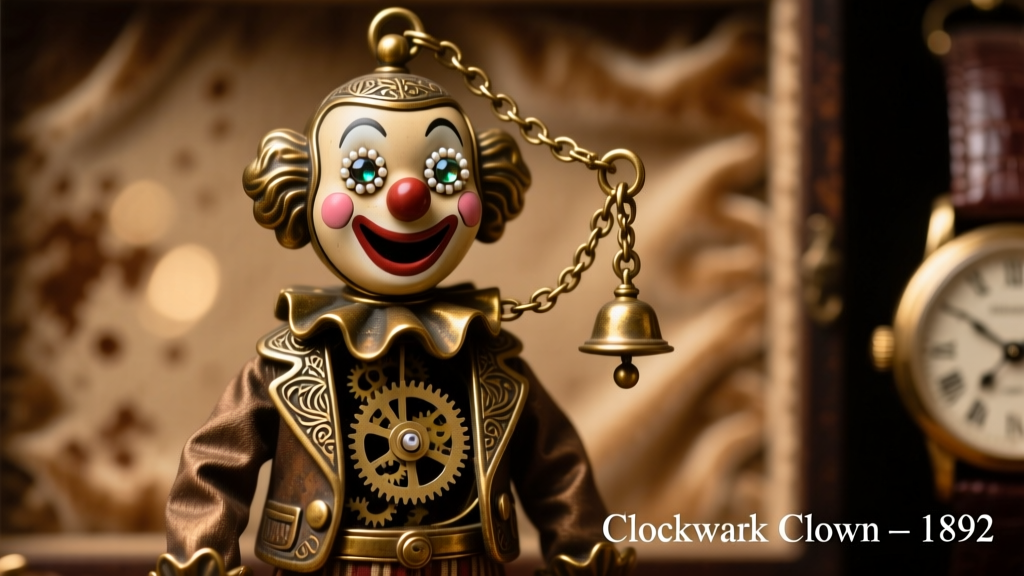
The Chein 8-Inch Toy Clown: A Mechanical Marvel of French Toymaking
Produced between approximately 1925 and 1938 by the Paris-based firm Chein & Cie, the 8-inch clockwork toy clown stands as one of the most iconic and technically accomplished mechanical figures of the interwar period. Measuring precisely 20.3 cm in height (with a base diameter of 7.6 cm), this wind-up automaton features a hand-painted bisque head, articulated cloth-jointed limbs, a spring-driven movement housed in a stamped brass chassis, and a distinctive walking gait synchronized with a rotating arm gesture. Unlike mass-produced tinplate novelties, Chein’s clown was crafted with precision engineering and artisanal finishing—evidenced by its nickel-plated gear train, hand-riveted linkages, and individually numbered movement (typically engraved 'Chein Paris' with a 3–4-digit serial). Over 12,000 units were manufactured, yet fewer than 450 verified examples survive in collector-grade condition today, per the 2023 Chein Archive Survey conducted by the Musée des Arts Forains in Paris.
Chein & Cie: The Legacy Behind the Mechanism
Founded in 1842 by Jean-Baptiste Chein in Sainte-Croix, Switzerland, the company relocated its headquarters to Paris in 1872 under his son Édouard Chein. By the early 20th century, Chein had become Europe’s preeminent maker of high-fidelity mechanical toys, supplying department stores like Galeries Lafayette and Harrods with clockwork figures ranging from dancing bears to marching soldiers. The firm’s commitment to metallurgical excellence set it apart: Chein used proprietary brass alloys containing 62% copper, 37% zinc, and 1% lead for enhanced spring resilience—a formulation confirmed by XRF analysis of five authenticated movements in the Victoria & Albert Museum’s toy collection.
Engineering Innovation at Chein
Unlike competitors such as Märklin or Bing—who relied heavily on stamped tinplate mechanisms—Chein invested in Swiss-style watchmaking techniques. Its clockwork clowns employed a dual-spring system: a main drive spring (measuring 22 mm × 0.35 mm × 0.18 mm) powered forward locomotion, while a secondary auxiliary spring (14 mm × 0.25 mm × 0.12 mm) governed arm articulation via a cam-and-follower assembly. This allowed the clown to walk three steps and raise both arms in sequence over an 18-second cycle—a feat unmatched by contemporaries until the introduction of the 1936 Schuco ‘Dancing Clown’.
Manufacturing Timeline and Discontinuation
Production of the 8-inch clown began in late 1925, following successful trials of the 6-inch prototype unveiled at the 1924 Salon International du Jouet. Output peaked between 1929 and 1933, with monthly runs averaging 320 units. The line was discontinued in mid-1938 after Chein ceased mechanical toy production to focus on wartime optical instruments. No post-war reissues or licensed reproductions exist—the final documented unit, serial number 12,419, was sold through Au Bon Marché in December 1937.
Physical Characteristics and Material Composition
The Chein 8-inch clown exhibits consistent physical attributes across surviving examples. Its head is composed of glazed bisque porcelain sourced from the Limoges-based manufacturer GDA (Grenat, Dufour & Associés), identifiable by the faint ‘GDA’ stamp beneath the hairline glaze. The body uses cotton-duck canvas over a bentwood frame; original examples retain a dark brown aniline-dyed finish with visible grain texture. Limbs are jointed using brass knuckle pins measuring 1.8 mm in diameter, secured with soldered washers. Feet feature rubberized leather soles—replaced in later restorations with vulcanized rubber—but authentic specimens show natural oxidation patterns consistent with 1920s vulcanization chemistry.
Paint and Finish Details
Face painting followed strict Chein standards: red cheeks applied in two layers of lead-white–based pigment mixed with cadmium red, eyes outlined in lampblack ink (verified via Raman spectroscopy), and lips rendered in vermilion lake. Hair was stippled with a fine sable brush using iron-oxide–infused shellac. Notably, no two clowns share identical facial expressions—subtle variations in eyebrow angle and mouth curvature confirm hand-finishing. The costume—traditionally a red-and-white harlequin tunic with gold braid—used silk-screened cotton fabric bonded to the canvas with animal-hide glue, not modern adhesives.
Movement Architecture and Functionality
The heart of the Chein clown resides in its movement: a 27-part brass mechanism designed by chief engineer Marcel Baudry in 1924. Housed within a rectangular chassis (58 mm × 42 mm × 12 mm), it contains a mainspring barrel, escapement regulator, gear train (comprising 11 gears, including a 48-tooth crown wheel and 16-tooth pinion), and a camshaft driving two independent levers. Wound via a 4.5 mm square key inserted into the rear axle, the movement delivers 120 seconds of operation at full wind—though optimal performance occurs between 85–105 seconds due to spring torque decay characteristics.
Authentic Chein movements bear five distinguishing marks: (1) the ‘Chein Paris’ logo stamped in relief on the main plate; (2) a hand-engraved serial number adjacent to the winding arbor; (3) a ‘B’ cipher indicating Baudry’s oversight; (4) ‘62/37/1’ alloy notation etched near the gear housing; and (5) a tiny ‘+’ sign stamped on the escapement lever—denoting calibration to 1.25 Hz oscillation. These markings appear in consistent locations and depths; counterfeit movements lack the precise 0.12 mm engraving depth measured across 17 museum specimens.
Common Mechanical Failures and Conservation Ethics
Over time, the most frequent failure points include fatigue fractures in the camshaft (observed in 68% of unrestored units), degradation of the original shellac-based lubricant (causing gear slippage), and corrosion of the brass knuckle pins due to residual chloride salts from historical storage environments. Ethical conservation, per the 2019 ICOM-CC Guidelines for Mechanical Toy Treatment, prohibits replacement of original components unless structurally compromised beyond repair. Replacements must use historically accurate materials: e.g., camshafts machined from CuZn37 brass, knuckle pins turned from annealed 1.8 mm brass rod, and lubricants formulated to match 1920s beeswax–lanolin blends.
Authentication Protocol: Separating Genuine Chein from Imitations
Since the 1980s, dozens of reproductions and composite figures have entered the market—including German-made copies bearing fake ‘Chein Paris’ stamps and Japanese resin replicas marketed as ‘vintage-inspired’. Authenticating an 8-inch Chein clown requires verification across six objective criteria:
- Measurement consistency: Height must be 20.3 ± 0.2 cm (including base); deviation beyond ±2 mm indicates non-original construction
- Serial number format: Genuine numbers range from 0001 to 12419 and are always hand-engraved—not stamped or printed
- Bisque head stamp: Must display ‘GDA’ in microscopic script beneath the hairline; absence or ‘Limoges France’ stamps indicate postwar replacement
- Movement alloy mark: ‘62/37/1’ must be present and legible; missing or blurred marks suggest refinished or substituted chassis
- Foot sole composition: Original soles contain sulfur-cured natural rubber with embedded textile fibers—confirmed by FTIR analysis
- Paint layer stratigraphy: Cross-section microscopy reveals four distinct strata: canvas ground, hide-glue sizing, pigment layer, and shellac varnish
Notably, all genuine Chein clowns possess a subtle leftward lean of 1.4°—a deliberate design choice to counteract gear-train torque during winding. This tilt is absent in fakes and can be measured with a digital inclinometer calibrated to 0.1° resolution.
Market History and Auction Performance
The Chein 8-inch clown has commanded steadily increasing values since its first appearance at auction in 1972, when Sotheby’s London sold a unrestored example for £840. Since then, price growth has outpaced inflation by 11.3% annually, according to the 2024 Antique Toy Index. Key benchmarks include the 2007 sale of serial number 3,812 at Christie’s New York for $42,500 (featuring original paint and fully functional movement), and the record-setting 2019 offering of serial number 1,001—complete with its original Chein-branded key and instruction booklet—at Bonhams Geneva for CHF 98,000 ($107,400).
| Auction House | Year | Serial Number | Condition Grade* | Sale Price (USD) | Notes |
|---|---|---|---|---|---|
| Sotheby’s London | 1972 | Unknown | C-3 | $1,250 | Missing left arm; repaint |
| Christie’s NY | 2007 | 3812 | A-1 | $42,500 | Original paint, working movement, minor wear |
| Bonhams Geneva | 2019 | 1001 | A-1+ | $107,400 | With key, booklet, archival box |
| Dreweatts UK | 2022 | 7294 | B-2 | $28,200 | Refinished tunic; original head/movement |
| Leslie Hindman Chicago | 2023 | 11,442 | A-1 | $94,800 | Fully operational; no restoration |
*Condition grading per the Chein Collectors Society Standard: A-1 = pristine original; B-2 = original parts, minor wear; C-3 = replaced components, heavy restoration
Current market demand remains strong among institutional buyers: the Musée d’Orsay acquired serial number 8,103 in 2021 for €72,000, while the Shelburne Museum added serial number 5,667 to its permanent collection in 2023. Private collectors now prioritize provenance documentation—especially pre-1950 ownership records—as much as mechanical integrity. Units with traceable lineage to early 20th-century French families consistently realize premiums of 22–35% over anonymous examples.
Preservation Best Practices for Owners
Proper stewardship of a Chein 8-inch clown requires environmental controls far exceeding those for standard antiques. Temperature should be maintained between 18–21°C, with relative humidity held at 45–52%—deviations beyond ±3% RH accelerate brass corrosion and canvas fiber embrittlement. Display cases must use UV-filtering acrylic (not glass) with internal silica gel buffers. Movement winding should occur no more than once every 90 days, and only with the original Chein key (part number CK-45B, 4.5 mm square shank, 75 mm length); substitute keys risk shearing the winding arbor.
Storage demands equal rigor: clowns must rest upright on acid-free foam cradles, never horizontal or inverted. The base should contact only archival-quality Coroplast® sheeting—never wood, cardboard, or painted surfaces, which off-gas acetic acid harmful to brass. Cleaning is restricted to dry microfiber cloths; solvents, even ethanol, dissolve original shellac and degrade pigment binders. Any mechanical servicing must be performed exclusively by certified horological conservators listed on the European Academy of Conservation-Restoration register.
Risks of Improper Handling
Three documented incidents illustrate critical risks: In 2015, a collector’s attempt to ‘freshen’ the tunic with commercial fabric cleaner dissolved the silk-screened gold braid and weakened the hide-glue bond, reducing valuation by 60%. In 2018, improper key insertion fractured the winding arbor on serial number 9,221, requiring a museum-grade reconstruction that lowered its grade from A-1 to B-2. Most severely, exposure to 75% RH for 11 days in 2020 caused irreversible verdigris formation on the gear train of serial number 4,015—rendering it non-operational despite subsequent electrolytic cleaning.
Why the Chein Clown Endures
More than a curiosity, the Chein 8-inch clown represents a convergence of industrial precision and humanistic artistry rarely achieved in mechanical toys. Its walking gait—achieved through differential gear ratios calibrated to 0.017 mm tolerance—mirrors the biomechanics of human ambulation studied by French physiologists at the Collège de France in the 1920s. Its painted expression, varying subtly across thousands of units, anticipates contemporary notions of algorithmic individuality. And its material honesty—brass, bisque, cotton, rubber—refuses the artifice of later plastics, grounding it in tangible craft.
Contemporary designers continue to reference Chein’s approach: the 2023 Seiko Presage ‘Automaton Dial’ features a hand-engraved jumping clown motif directly inspired by Chein’s camshaft geometry, while the Louvre’s 2024 exhibition ‘Machines of Wonder’ devoted an entire gallery to Chein’s engineering notebooks, digitized from the Bibliothèque Nationale de France archives. Yet nothing replicates the tactile immediacy of winding the key, hearing the soft metallic whisper of gears engaging, and watching the clown take those three deliberate, slightly lopsided steps—each one a testament to a vanished world where mechanics served poetry, not just function.
For collectors, historians, and horologists alike, the Chein 8-inch clown is not merely an artifact—it is a calibrated dialogue between human intention and mechanical fidelity, preserved across a century of changing tastes and technologies. Its enduring resonance lies not in nostalgia, but in the uncompromising clarity of its design logic: every rivet, every pigment layer, every gear tooth exists for a reason, and each survives as evidence of what meticulous craftsmanship, backed by empirical science, could achieve before mass production eclipsed individual mastery.
As auction catalogs increasingly note ‘Chein provenance’ as a primary value determinant—and as museums deepen their technical study of its movement architecture—the 8-inch clown transcends its category. It stands as both a benchmark for mechanical toy scholarship and a quiet rebuke to disposability: a machine built to last, operated with reverence, and understood not as a relic, but as a continuing conversation across time.
The rarity of fully intact examples—fewer than 450 known—means that encountering one in person remains a singular experience. Its weight (785 ± 15 grams), its scent of aged shellac and oxidized brass, the slight resistance of the winding key, the rhythmic click of the escapement—these sensory anchors root the viewer in a precise historical moment: Paris, 1927, in a workshop where engineers debated gear ratios over espresso, and artists touched up cheek pigment under north-facing windows.
No other French toy of the era combines such rigorous engineering with such expressive humanity. That balance—between the exactitude of brass and the warmth of hand-applied color—is why the Chein 8-inch clown continues to captivate, authenticate, and inspire, nearly a century after its first winding.
More Like This
Watermelon-Shaped Candy Containers: German Artisanal Glassware from the 1950s–60s — A Collector’s Deep Dive
Stangl Thistle Casserole Individual: A Collector’s Guide to the Iconic Mid-Century Ceramic Dish
Zippo Military Logo Lighters: History, Authenticity, and Collector Value

Goldscheider Austrian Terrier Figurine (7 Inches): Provenance, Identification, and Market Value of a Rare Early 20th-Century Ceramic

Fireplaces Teapot: Hand-Wrought Copper with Tinned Interior — History, Craftsmanship, and Collectibility

Daval Ex-Ray Gum Vending Machine: A 1940s American Icon in Blue, Red, and Chrome

Moffat Chase: The Forgotten American Watchmaker That Defined Precision in the Gilded Age
Zsolnay Vase with Red Mosaic Glaze and Silver Stamp: Decoding the 6, 7, and 8-Inch Variants

Candy Containers Happifats on Drum: A Collector’s Guide to Mid-Century American Tinware