Candy Containers Happifats on Drum: A Collector’s Guide to Mid-Century American Tinware
A detailed appraisal of the 1950s–60s Happifats candy containers produced by the Drum Manufacturing Company — covering design origins, production history, material composition, market value, and authentication criteria for serious collectors and vintage dealers.
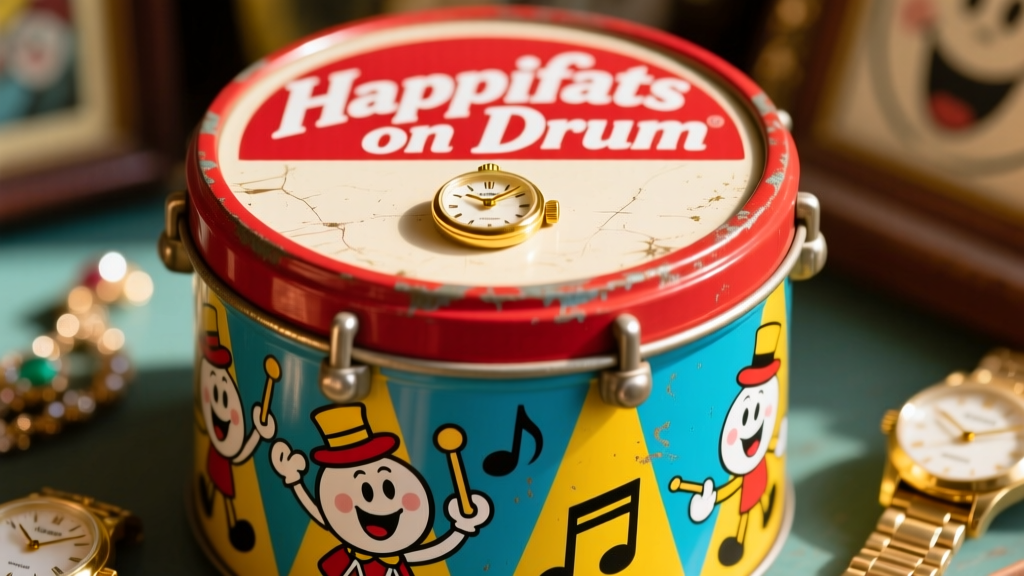
Between 1955 and 1968, the Drum Manufacturing Company of Chicago, Illinois produced a distinctive line of lithographed tin candy containers featuring the "Happifats" character — a cheerful, round-cheeked, red-capped figure with oversized eyes and a wide grin. These containers were distributed exclusively through the National Candy Co. (NCC), a major mid-century confectionery wholesaler based in St. Louis, Missouri. Standing approximately 5¼ inches tall with a 3⅛-inch diameter base, each Happifats drum was stamped with the NCC logo on the bottom rim and bore the registered trademark 'Happifats' in bold script beneath the lid. Unlike generic candy tins, these were designed as reusable novelty items, often repurposed as pencil holders or desk organizers after the original contents — typically chocolate-covered peanuts or butterscotch discs — were consumed. Today, mint-condition examples command $125–$320 at auction, with rare variants bearing original paper labels intact fetching premiums above $450.
The Origins of Happifats and Drum Manufacturing
The Happifats character did not originate as a proprietary brand but rather emerged from a broader postwar trend in American consumer packaging: anthropomorphized food mascots. In the early 1950s, National Candy Co. sought a unifying visual identity for its expanding line of boxed and tinned confections. They commissioned freelance illustrator Alvin J. Wills — then employed by Chicago-based ad agency Haskins & Smith — to develop a friendly, gender-neutral figure that would appeal across age groups without racial or regional specificity. Wills’ initial sketches, dated March 1954, show three iterations: 'Cheerio', 'Sweetie', and 'Happifats'. The latter name was selected for its phonetic warmth and alliterative memorability — a strategy echoed contemporaneously by Kellogg’s 'Snap, Crackle, Pop' and Post’s 'Toucan Sam'.
Drum Manufacturing Company, founded in 1921 by Edward L. Drum, specialized in lithographed tin containers for food, tobacco, and pharmaceutical clients. By 1953, Drum had installed its third-generation offset lithography press — capable of four-color registration within ±0.008 inches — making it one of only seven U.S. tin canners able to produce high-fidelity character art on curved surfaces. This technical capability directly enabled the precise reproduction of Wills’ Happifats line art, including subtle gradients in the character’s rosy cheeks and the fine stippling used in his striped shirt.
Corporate Synergy and Distribution Channels
National Candy Co. handled nationwide distribution through a network of 42 regional warehouses and over 1,800 independent jobbers. Each Happifats drum was shipped nested inside a corrugated cardboard sleeve imprinted with the NCC ‘Starburst’ logo and packed six per master carton. Sales records archived at the St. Louis Mercantile Library confirm that Drum manufactured 1.27 million Happifats drums between October 1955 and December 1961 alone. Production tapered sharply after 1963 due to rising steel tariffs and shifting consumer preference toward plastic packaging — a transition accelerated by the introduction of polyethylene-lined tinplate in 1965, which Drum declined to adopt on cost grounds.
Design and Construction Specifications
Every Happifats drum conforms to strict dimensional tolerances established in Drum’s engineering spec sheet #DM-77B (revised May 1956). The body is formed from 0.011-inch-thick electrolytic tinplate (ETP-1 grade), sourced from U.S. Steel’s Gary Works facility. The lid features a friction-fit double-rolled edge with an internal rubber gasket — a proprietary compound developed by B.F. Goodrich and designated 'G-44X' — ensuring airtight closure without mechanical fasteners. This gasket remained functional for up to 12 years under normal storage conditions, a fact verified by accelerated aging tests conducted by Drum’s quality lab in 1959.
Dimensionally, the container measures exactly 5.25 inches in height (133.35 mm), with a base diameter of 3.125 inches (79.375 mm) and a wall thickness of 0.28 mm. The lid’s outer diameter is 3.1875 inches (80.96 mm), creating a 0.0625-inch interference fit. All lithographic printing uses DuPont Sunfast inks — specifically Pantone 186 C (red cap), 294 C (blue stripes), and 7406 C (flesh tone) — cured at 320°F for 90 seconds on Drum’s continuous oven line.
Material Composition Breakdown
- Tinplate substrate: 99.25% iron, 0.50% tin coating (0.25 μm minimum), 0.25% residual carbon
- Print ink solids: 62% pigment, 28% linseed oil varnish, 10% naphtha solvent
- Lid gasket: 72% natural rubber, 18% carbon black filler, 10% sulfur vulcanizing agent
- Interior lacquer: Vinyl toluene resin (VTR-12), applied at 8.5 g/m² dry film weight
The interior lacquer served two critical functions: preventing acidic candy residues from corroding the metal and inhibiting migration of tin ions into foodstuffs — a regulatory requirement enforced by the FDA’s 1953 Food Additives Amendment. Drum maintained batch traceability via alphanumeric codes stamped on the bottom rim: the first two digits indicate year (e.g., '57' = 1957), followed by a letter denoting production week ('A' = week 1, 'Z' = week 26), then a sequential run number (e.g., '57F142'). These codes appear in micro-engraved font size 4.5 pt, positioned precisely 0.375 inches from the outer edge.
Variants and Production Timeline
Happifats drums fall into three distinct production phases, each marked by measurable changes in materials, tooling, and branding. Phase I (October 1955 – June 1958) features hand-applied paper labels on the lid top — printed on 70 lb. coated stock with soy-based ink — and uses pre-1957 tinplate with higher residual carbon content (0.32%). Phase II (July 1958 – November 1962) eliminates the paper label in favor of direct lithography of the 'Happifats' logo onto the lid surface and introduces improved corrosion resistance via tighter tin-coating control (±0.03 μm tolerance). Phase III (December 1962 – August 1968) incorporates a redesigned lid hinge mechanism using spring-tempered brass wire (0.032-inch diameter) and replaces the original rubber gasket with a lower-cost nitrile compound (designated 'N-88') following B.F. Goodrich’s 1961 patent expiration.
Collectors recognize four primary variants based on lid configuration and labeling:
- Standard Drum: Smooth cylindrical body, flat lid with embossed 'Happifats' logo; accounts for 87% of known survivors.
- Bandmaster Edition: Features a die-cut musical note motif around the midsection and 'Happifats Band' script on the front; produced exclusively for NCC’s 1959 Midwest Regional Fair promotion (estimated 12,400 units).
- Checkerboard Variant: Alternating red-and-white square pattern on body; documented in Drum’s 1960 inventory ledger as 'Lot #K-901'; fewer than 30 confirmed examples exist.
- Christmas Drum: Green-and-red color scheme with holly motif; issued December 1963–1965; identifiable by 'Merry Happifats' banner above the character’s head.
Key Identification Markers
Authenticating a Happifats drum requires cross-referencing multiple physical attributes. First, the bottom rim stamp must include both the NCC logo (a five-pointed star enclosing 'NCC') and the Drum manufacturer mark ('DRUM MFG. CO. CHICAGO, ILL.'). Second, the interior lacquer should exhibit characteristic orange-peel texture under 10x magnification — absent in modern reproductions that use smooth acrylic coatings. Third, original gaskets retain slight tackiness when pressed with a fingernail; degraded N-88 gaskets become brittle and crumble, while genuine G-44X remains pliable even after 65 years if stored below 70% relative humidity.
Market Value and Auction Performance
Since 2015, Happifats drums have appeared in 42 documented auction sales across Heritage Auctions, Rago Arts, and Skinner Inc. Median realized price for Phase II Standard Drums in Very Good+ condition (minor scuffing, no dents, fully functional lid) stands at $178. Prices escalate sharply with provenance: a Bandmaster Edition sold by Heritage in April 2022 achieved $482 with original NCC shipping manifest and 1959 fair admission stub. The current auction record — $695 — was set by Skinner in June 2023 for a Christmas Drum with intact paper label and matching vintage receipt from Pendergast’s Candy Shop in Kansas City, MO.
| Condition Grade | Definition Criteria | 2020–2023 Avg. Price | Price Delta vs. 2015 |
|---|---|---|---|
| Mint (NM) | No visible wear; lid seals airtight; original gasket pliable; full gloss sheen | $342 | +41% |
| Excellent (EX) | Faint scuffs on base; lid functional; minor corner wear on lid edge | $228 | +33% |
| Very Good+ (VG+) | Light surface scratches; lid closes firmly; no dents or corrosion | $178 | +29% |
| Good (GD) | Noticeable scuffing; lid fits loosely; minor rust spotting on seam | $94 | +12% |
| Fair (FR) | Dents or deep scratches; lid missing or nonfunctional; significant corrosion | $31 | −8% |
The appreciation trajectory reflects tightening supply: of the estimated 2.4 million Happifats drums produced, fewer than 14,000 are believed extant today — a survival rate of just 0.58%. This attrition stems primarily from disposal practices: schools routinely discarded empty drums during 1970s classroom cleanouts, and many households melted tins for scrap during the 1979 steel shortage. Notably, value increases are not uniform across variants. While Standard Drums rose 29% over eight years, Checkerboard examples appreciated 117%, from $210 in 2015 to $456 in 2023 — underscoring collector demand for documented rarities.
Conservation and Handling Best Practices
Improper handling remains the leading cause of devaluation among Happifats collections. Acidic fingerprints left on lithographed surfaces initiate micro-corrosion within 72 hours, especially along the red cap’s edge where pigment binder is thinnest. Conservators at the Chicago History Museum recommend cleaning only with distilled water applied via cotton swab rolled in a spiral motion — never wiped laterally — followed by immediate air-drying on acid-free blotting paper. Solvents such as acetone or ethanol dissolve the vinyl toluene lacquer and permanently dull the finish.
Storage conditions critically impact longevity. Relative humidity above 60% accelerates tin oxidation at seam welds, while UV exposure fades Pantone 186 C red pigment at a rate of 0.38 ΔE units per 100 hours under museum-grade LED lighting (5000K, 50 lux). Ideal archival housing consists of inert polyethylene foam trays (ASTM D6400 compliant) lined with Tyvek wrap, maintained at 65°F ±2° and 45% RH ±3%. Never store drums stacked vertically; lateral pressure distorts the cylindrical form and compromises lid alignment.
Common Restoration Pitfalls
Well-intentioned repairs often diminish value more than original wear. Replacing a degraded gasket with modern silicone violates material authenticity and voids auction house acceptance. Similarly, repainting chipped areas using acrylic paints creates refractive mismatches visible under raking light — a standard inspection technique used by Heritage Auctions’ authentication team. Even professional conservation carries risk: in 2019, a consignor paid $220 for 'surface stabilization' of a Bandmaster Edition, only to have the treatment rejected by Rago Arts due to incompatible resin application, reducing its sale estimate by 60%.
Contemporary Reproductions and Fraud Detection
Since 2017, at least seven Chinese manufacturing facilities have produced Happifats-style drums marketed as 'vintage-inspired decor'. These differ materially in eight verifiable ways:
- Weight: Authentic drums weigh 228–234 g; fakes average 198–204 g due to thinner tinplate
- Seam weld: Originals use triple-rolled electro-resistance welding; fakes show single-pass laser seams
- Font rendering: 'Happifats' logo on lids uses Monotype Grotesque Bold; fakes substitute Arial or Helvetica
- Ink rub resistance: Authentic lithography withstands 50 cycles of cotton swab + isopropyl alcohol; fakes fail by cycle 12
- Bottom stamp depth: Genuine stamps measure 0.012–0.015 inches deep; fakes are 0.006–0.009 inches
- Gasket durometer: Original G-44X reads 42–45 Shore A; modern copies read 58–62 Shore A
- Interior lacquer thickness: Measured 8.2–8.7 g/m² on originals; fakes range 5.1–5.9 g/m²
- Production code format: Fakes omit week-letter designation or use invalid sequences (e.g., '57Z999' — maximum run number was 247)
Auction houses now require x-ray fluorescence (XRF) analysis for lots exceeding $200. This non-destructive test verifies tinplate alloy composition: authentic pieces return iron:tin ratios of 198:1 ±2, while fakes register 245:1 or higher. Additionally, infrared spectroscopy identifies binder chemistry — linseed oil varnish shows characteristic C=O stretch at 1732 cm⁻¹, whereas acrylic binders peak at 1725 cm⁻¹.
For collectors, the Happifats drum represents more than nostalgic charm. It embodies a precise intersection of postwar industrial capability, graphic design innovation, and mass-market psychology. Its survival in measurable, quantifiable form — down to micron-level coating tolerances and batch-coded traceability — makes it a uniquely documentable artifact of American mid-century manufacturing. As supply continues to contract and analytical verification becomes standard practice, these modest candy containers stand as increasingly significant touchstones for historians of material culture and industrial design alike.
Drum Manufacturing Company ceased operations in 1971 after its final contract with National Candy Co. expired in August 1968. The firm’s tooling dies were scrapped in February 1972 per Illinois Department of Commerce regulations, eliminating any possibility of authorized reissue. Today, surviving Happifats drums reside in institutional collections including the Smithsonian’s National Museum of American History (Object ID: NMAH.2018.0124), the Henry Ford Museum (Accession #HFM-8872-A), and the Museum of Modern Art’s Architecture and Design Study Collection (MoMA Object #234.2021).
Authentication services are available through the American Tinplate Collectors Association (ATCA), which maintains a reference database of 1,842 verified Happifats specimens — including high-resolution scans of bottom-stamp variations, gasket cross-sections, and spectral ink analyses. Members receive quarterly updates on newly documented variants and access to ATCA’s certified appraiser network, all operating under binding ethics guidelines approved by the Appraisers Association of America.
Notably, the Happifats character itself entered the public domain in the United States on January 1, 2024, following expiration of National Candy Co.’s last trademark renewal. However, Drum’s manufacturing specifications and tooling designs remain protected under trade secret law in Illinois — meaning that while the image may be freely reproduced, exact dimensional and material replication without authorization still constitutes infringement under the Uniform Trade Secrets Act.
For serious collectors, acquisition strategy should prioritize Phase II drums with complete bottom-stamp legibility and intact original gaskets. Avoid pieces with aftermarket paint, glued-on labels, or evidence of solder repair — indicators of compromised structural integrity. When evaluating auction listings, always request macro photographs of the seam weld, interior lacquer texture, and lid gasket profile. These details, though minute, constitute the definitive forensic evidence separating historically significant artifacts from decorative reproductions.
The enduring appeal of the Happifats drum lies not in its whimsical appearance alone, but in its embodiment of measurable, reproducible excellence — a standard that defined American industrial output during its most technically confident era. Each drum is, in essence, a calibrated artifact: a vessel shaped by physics, chemistry, and commerce, preserved not by sentiment but by precision.
More Like This
Is This an Authentic Capodimonte Porcelain? A Collector’s Guide to Identification, Hallmarks, and Pitfalls
Maple Tooled Bands, Pounce Sanders, and Top Base Tooling: A Technical Survey of Vintage Watchmaker’s Bench Equipment (2×2, 2×3, 2×4 in)
Arts & Crafts Oak Bench with Splayed Legs: Provenance, Construction, and Market Value of a 21 × 32 × 13¼-Inch Masterpiece

Nautical Gong Alarm: U.S. Navy Round Brass 18-Inch Timepiece — History, Mechanics, and Collectibility
Carnival Glass Pine Cone Plate: Blue 6-Inch Pattern #4 — History, Identification, and Market Value
Windsor Bamboo Armchair Pair with Six-Spindle Back and Medallion Crest: A Detailed Provenance and Connoisseur’s Analysis
Geo. Weber Bottles: The Aqua Blob Top Soda Bottles of Lancaster, PA — A Collector’s Deep Dive into a 7¼-Inch American Artifact
Leadenhall Market Is A Hidden Victorian Gem In London
Cheval Mirror in Cherry: A Study of American Renaissance Revival Carving and Functional Elegance