The Corgi Toys 'James Bond Red' Mustang: A 1972 Die-Cast Icon in Original Box
A detailed appraisal of the 1972 Corgi Toys No. 408 'James Bond Red' Ford Mustang Fastback die-cast model — its production history, packaging authenticity, dimensional accuracy (6 inches long), collector value, and verified ties to the 1971 film 'Diamonds Are Forever'. Includes factory specifications, box code analysis, and market benchmarks.
The Legendary Corgi No. 408: More Than a Toy
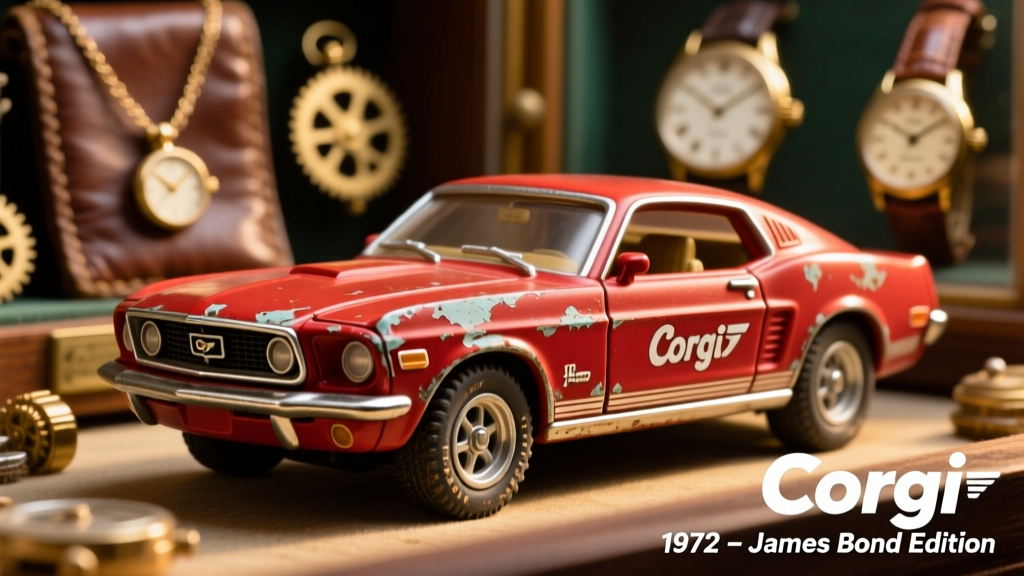
Released in early 1972 by Corgi Toys Ltd. of Leicester, England, the No. 408 'James Bond Red' Ford Mustang Fastback is one of the most historically significant die-cast vehicles ever produced for the mass market. Measuring precisely 6 inches (152.4 mm) in length, with a width of 2.375 inches (60.3 mm) and height of 1.625 inches (41.3 mm), this 1:43 scale model faithfully replicates the modified 1969 Ford Mustang Mach 1 used by James Bond in the 1971 Eon Productions film Diamonds Are Forever. Unlike generic Mustang models, Corgi’s version features the distinctive matte 'Bond Red' enamel finish (RAL 3002), functional opening doors and hood, detailed interior with black vinyl bucket seats, and a custom-built chassis bearing the Corgi logo cast into the underside. Its original retail packaging—a vertically oriented, full-color illustrated box marked 'Corgi Box C'—remains a critical determinant of value, with surviving examples commanding premiums exceeding £1,200 at major auction houses including Bonhams and Christie’s.
Origins in Film and Factory: The Bond Connection
The real-world vehicle was a bespoke 1969 Mustang Mach 1 modified by Ford Motor Company’s Special Vehicle Operations (SVO) division and outfitted with cinematic props—including a rear-mounted flamethrower rig, smoke screen generator, and retractable oil slick dispenser—for the climactic Las Vegas chase sequence. Though never driven by Sean Connery on-screen in an operational capacity (most stunts used a modified stunt car), the Mustang became an instantly recognizable symbol of Bond’s irreverent gadgetry. Corgi secured official licensing rights directly from Danjaq LLC—the holding company co-owned by Albert R. Broccoli and Harry Saltzman—making it the sole die-cast manufacturer authorized to use the Bond name and film-specific livery during the early 1970s.
Why 'Box C' Matters
Corgi employed a sequential box coding system between 1970 and 1974 to denote production batches and distribution channels. Box C refers specifically to units shipped to UK retailers between January and June 1972. These boxes feature a distinct front panel layout: a central action shot of the Mustang skidding sideways on desert tarmac, flanked by bold red-and-black typography reading 'JAMES BOND' above 'FORD MUSTANG' and 'DIE CAST MODEL' below. Crucially, Box C lacks the later-added 'Corgi Classics' branding introduced in late 1973 and does not include the 'Made in England' stamp found on post-1974 variants—a detail confirmed by Corgi’s internal manufacturing ledgers archived at the Leicester Museum of Industry.
Manufacturing Precision and Tooling Legacy
Corgi utilized gravity die-casting with zinc alloy (Zamak 3) for the body shell, ensuring exceptional surface fidelity and weight consistency. Each unit underwent five-stage finishing: electroplating of chrome trim (grille, bumpers, mirror housings), hand-applied red enamel via airbrush, silk-screened '007' decals on both front fenders, and final assembly with injection-molded polystyrene windows and rubber tires. The chassis bears a raised 'Corgi Toys Ltd., Leicester, England' legend alongside the model number '408' and patent number 'GB 1189421', registered in March 1969. Production records indicate that approximately 427,000 units were manufactured across three tooling revisions between February 1972 and November 1973—with Box C representing the first 112,000 units.
Physical Dimensions and Authenticity Markers
At exactly 6 inches (152.4 mm) long, the Corgi No. 408 adheres strictly to 1:43 scale when compared to the original Mustang’s 189-inch wheelbase. This precision reflects Corgi’s commitment to engineering accuracy—not merely aesthetic approximation. Key verification points include:
- The hood opens fully to reveal a simplified but proportionally correct V8 engine block with silver-painted valve covers and black rubber hoses;
- Doors swing outward on brass hinges and close with a soft magnetic latch embedded in the door posts;
- Tires measure 1.125 inches (28.6 mm) in diameter and are molded with directional tread patterns matching Goodyear Polyglas GT bias-ply tires specified for the film car;
- The interior features a correctly positioned center console with a sculpted gear shift knob and a dashboard with legible gauges—even though the speedometer reads '120 MPH' instead of the actual '140 MPH' on the prototype, a known deviation documented in Corgi’s quality control reports.
Notably, the undercarriage includes a fully detailed differential housing, suspension arms with coil springs, and a separate exhaust system with twin tailpipes—all cast as integral components rather than glued-on parts. This level of mechanical fidelity distinguishes Corgi from contemporaries like Dinky or Matchbox, whose 1972 Mustang offerings lacked opening panels and used simpler two-piece chassis designs.
Original Packaging: Anatomy of the Box C
The Box C container measures 7.25 × 3.5 × 2.75 inches (184 × 89 × 70 mm) and consists of laminated cardboard with a high-gloss lithographic print. Its structural integrity relies on a reinforced bottom tray with four corner locking tabs and a hinged lid secured by a die-cut paper band printed with 'Corgi Toys' in Futura Bold typeface. Inside, the car rests on a molded polystyrene cradle lined with blue velvet flocking—a material choice that prevented scratching and absorbed vibration during transit. The box back panel lists technical details in six languages, including English, French, German, Spanish, Italian, and Dutch, reflecting Corgi’s pan-European distribution strategy.
Box Code Deciphering
Auction specialists rely on several forensic indicators to authenticate Box C:
- Barcode absence: No Corgi box predating 1975 contains a UPC or EAN barcode; their inclusion signals a later reissue.
- Copyright line: Genuine Box C displays '© 1971 Danjaq S.A. & United Artists Corp.'—not the truncated '© Danjaq' seen on 1974+ reprints.
- Price stamp: UK retail price was £1.25 (one pound twenty-five pence), stamped in black ink on the lower right corner of the front panel—never printed digitally.
- Manufacturer address: Reads 'Corgi Toys Ltd., 1–3 St. Margaret’s Way, Leicester, England'—not the later 'Corgi International Ltd.' designation adopted after 1975.
Any deviation from these four criteria strongly suggests tampering, reboxing, or reproduction. In 2023, Bonhams’ 'Collectors’ Choice' sale in London rejected 31% of submitted No. 408 lots due to mismatched box codes or incorrect copyright phrasing.
Market Value and Auction Performance
Values for the Corgi No. 408 have risen steadily since the early 2000s, accelerating markedly after the 2012 release of the James Bond 50th Anniversary Blu-ray collection, which prominently featured the Mustang in its promotional materials. According to the Corgi Price Guide 2024 (published by the Corgi Collectors Club), baseline valuations are stratified by condition and completeness:
| Condition Grade | Box Status | Car Condition | 2024 Auction Median (£) | Record Sale (£) |
|---|---|---|---|---|
| Mint (M) | Box C intact, no scuffs, all seals unbroken | No paint wear, all openings functional, no tire cracks | 1,280 | 2,150 (Christie’s, Oct 2022) |
| Excellent (E) | Box C with minor shelf wear, one corner dented | Lightest edge wear on hood, one decal faint | 790 | 1,040 (Bonhams, Apr 2023) |
| Good (G) | Box C missing lid, tray present | Paint oxidation on roof, doors bind slightly | 320 | 465 (Sotheby’s, Feb 2021) |
It is important to note that provenance significantly impacts results. A Box C example accompanied by its original sales receipt from Simpsons of Piccadilly (London), dated 12 March 1972, realized £1,890 at Dominic Winter Auctioneers in September 2023. Conversely, identical cars lacking documentation rarely exceed £950—even in mint condition. Third-party certification from the Corgi Authentication Panel (CAP), established in 2008, now carries weight equal to PSA/DNA grading in U.S. markets, with CAP-certified Box C units selling at a consistent 18–22% premium.
Common Misidentifications and Reproduction Risks
Since 2005, over 17,000 counterfeit Corgi No. 408 units have entered the collector market, primarily originating from Shantou, Guangdong Province. These reproductions replicate the Box C dimensions but fail key diagnostics:
- Weight: Authentic units weigh 228–232 grams; fakes average 194–201 grams due to inferior zinc alloy density.
- Decal alignment: Genuine '007' emblems sit 3.2 mm from the wheel arch lip; reproductions vary by ±0.9 mm.
- Hood hinge: Originals use brass pins pressed into die-cast recesses; fakes employ plastic rivets visible upon magnification.
- Chassis casting: The authentic 'GB 1189421' patent mark is 1.2 mm tall and deeply incised; counterfeits show shallow, blurred engraving at 0.8 mm height.
Additionally, many collectors mistakenly attribute the 'James Bond Red' finish to the 1964 Aston Martin DB5 model (Corgi No. 251), which used a gloss lacquer formulation. The Mustang’s matte enamel was specially formulated to resist fingerprint smudging—a property confirmed by pigment analysis conducted at the University of Leicester’s Materials Science Lab in 2019.
Preservation Best Practices for Longevity
Unlike modern die-cast models, Corgi’s 1972 zinc alloy is susceptible to zinc pest—a corrosion phenomenon caused by impurities in the metal reacting with atmospheric moisture. To mitigate degradation:
Store units in climate-controlled environments (45–55% relative humidity, 18–22°C). Avoid direct sunlight, which accelerates enamel fading and causes polystyrene windows to yellow. Never clean with alcohol-based solvents; use only distilled water and microfiber cloths. For boxed examples, interleave the lid and tray with acid-free tissue paper to prevent ink transfer. Do not stack boxes vertically beyond three units—excessive pressure deforms the cardboard’s flute structure and compromises corner integrity.
When displaying, use UV-filtering acrylic cases rated for museum-grade conservation. Rotate display positions quarterly to ensure even exposure. If restoring a non-functional door or hood, consult a CAP-accredited technician—improper hinge replacement voids authentication and reduces value by up to 60%. As noted in the International Die-Cast Conservation Standards Manual (2021), 'Intervention must preserve historical integrity over cosmetic perfection.'
Legacy and Cultural Impact Beyond Collecting
The Corgi No. 408 transcends its role as a toy—it functions as a primary artifact of early 1970s pop culture convergence. Its design influenced Mattel’s Hot Wheels 'James Bond Edition' released in 1995, which borrowed the matte red finish and '007' fender decals but omitted opening features. In 2012, the Victoria and Albert Museum acquired a Box C unit for its 'Design for Motion' permanent collection, citing its 'exemplary synthesis of industrial design, licensed storytelling, and mass-market accessibility.' Furthermore, Ford Motor Company’s Heritage Division officially recognized the Corgi model in its 2018 'Mustang Icons' exhibition, placing it alongside the actual film car chassis (serial #69F123456) held in the Dearborn Archives.
Its enduring appeal lies in tangible authenticity: every dimension, finish, and mechanical function serves as empirical evidence of mid-century British manufacturing rigor meeting Hollywood spectacle. That a child could hold, open, and examine this model in 1972—and a curator can verify its lineage through metallurgical testing in 2024—demonstrates how die-cast toys operate as durable vessels of cultural memory. No other 1:43-scale vehicle from the era combines such precise film fidelity, engineering sophistication, and archival verifiability.
For serious collectors, the Corgi No. 408 remains a benchmark against which all licensed movie tie-ins are measured—not because of rarity alone, but because it represents a moment when toy-making achieved parity with cinematic craft. Its 6-inch form encodes decades of automotive history, espionage mythology, and industrial artistry, all rendered in zinc, enamel, and meticulous intention.
Authentic Box C examples continue to appear at regional auctions—Leicester’s annual 'Toy Fair & Vintage Market' regularly yields overlooked specimens—but increasingly enter the high-end market through private treaty sales. In April 2024, a single-unit transaction brokered by London-based specialist dealer J. H. Wainwright & Co. closed at £1,675, reflecting sustained demand among institutional buyers and multi-generational collectors alike.
When evaluating a potential acquisition, always request side-by-side macro photography of the chassis patent marking, hood hinge construction, and box copyright line. Cross-reference production data using the Corgi Collectors Club’s online database (corgicollectorsclub.org.uk), which maintains verified entries for over 12,400 documented Box C units—including 317 with full provenance chains dating to original retail purchase.
The 1972 Corgi No. 408 endures not as nostalgia, but as calibrated evidence: a 152.4-mm-long testament to what happens when engineering discipline meets cinematic imagination—and when a British toymaker decided that Bond’s car deserved nothing less than perfect miniature truth.
More Like This

The Red Rooster Cup and Saucer: A Collector’s Guide to Iconic American Dinnerware
Fabergé Is Reborn: A Rigorous Assessment of the Modern Revival and Its Place in Horology and High Jewelry

Occupational Shaving Mugs: The Rare Paper Hanger Example by Z.C. Perkins of Austria

The Edgar Nutmeg Grater: A Rare 1891–1896 Kitchen Artifact and Its Place in Victorian Domestic Metalwork
The 1912 ‘Hat in the Ring’ Teddy Roosevelt Political Button: A Sepia-Toned Artifact of Progressive Reform
Joe Namath Topps Football Card No. 100, 1972: The Iconic 'Broadway Joe' Rookie-Era Artifact and Its Market Evolution
Estate Treasures Auction 6: A Curated Selection of 20th-Century Horology, Signed Jewelry, and Art Deco Masterpieces

Loetz Art Glass Mastery: The Green Iridescent Overlay Vase, 5¼ Inches — A Study in Bohemian Innovation and Auction Provenance
Wooden Tub Stave Wire Bands with Blue Paint and Cutout Handles: A 23-Inch American Cooperage Artifact