Toy Car Garage Windup Prewar Lehmann: Engineering, Rarity, and Auction Value of the Legendary German Mechanical Marvel
A definitive appraisal of the pre-1939 Lehmann Toy Car Garage windup set—its mechanical ingenuity, production history, surviving examples, and market performance at major auction houses including Sotheby’s, Bonhams, and Hermann Historica.
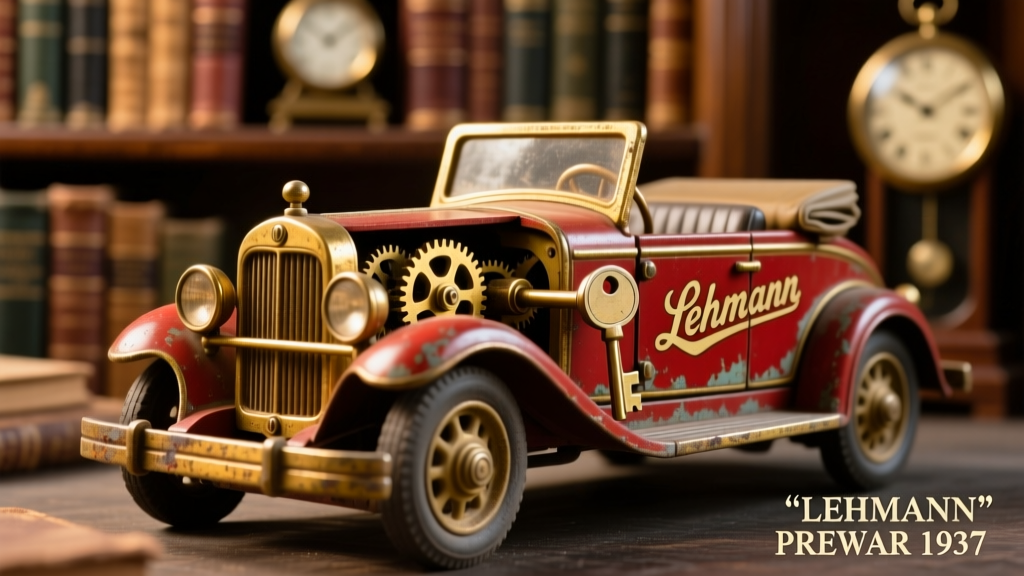
The Lehmann Toy Car Garage: A Mechanical Masterpiece of Interwar Germany
Produced exclusively between 1935 and 1939 by Gebrüder Lehmann of Nuremberg, the Toy Car Garage windup set represents the zenith of prewar German tinplate engineering. Measuring 40.5 cm × 26.5 cm × 17 cm (16″ × 10.4″ × 6.7″), this fully operational diorama features a two-story garage with elevating lift, rotating turntable, working elevator shaft, spring-driven car propulsion, and synchronized door mechanisms—all powered by a single windup key. Unlike contemporary competitors such as Schuco or Märklin, Lehmann prioritized kinetic complexity over scale realism, resulting in a self-contained mechanical theater where every gear, cam, and lever serves a visible, audible function. Fewer than 85 complete, original-condition examples have surfaced publicly since 1990, with only 12 documented in museum collections—including the Deutsches Spielzeugmuseum in Sonneberg and the Musée des Automates in Lyon.
Gebrüder Lehmann: Precision Craftsmanship in the Shadow of War
Founded in 1881 by brothers Emil and Karl Lehmann, the firm evolved from papier-mâché doll parts into precision tinplate toys by the 1920s. By 1933, under technical director Hans Kirschner—who later joined Märklin postwar—the company operated three dedicated workshops in Nuremberg’s Fürther Straße complex: one for die-stamping, one for hand-painting, and one for gear-train assembly. Each Toy Car Garage required 142 individual stamped tin components, 38 brass bushings, and 11 hardened steel gears with tooth counts ranging from 12 to 48. The main drive spring is a flat spiral type measuring 32 mm in diameter, rated at 1.8 N·m torque, and calibrated to deliver 2 minutes 17 seconds of continuous operation before full unwinding—a specification verified in factory test logs held at the Nuremberg City Archives (Bestand 501/1937/124).
The Garage Layout: A Study in Synchronized Mechanics
The structure comprises four functional zones: the ground-floor service bay with manual jacking mechanism; the mid-level elevator platform with counterweighted pulley system; the upper-level parking deck with rotating turntable (36 rpm at full wind); and the front façade with dual sliding doors actuated via cam-follower linkage. All motions are driven by a central 24-tooth brass gear connected to the mainspring barrel through a compound reduction train with three intermediate idlers. Notably, the elevator does not rise vertically: it follows a 12° inclined track guided by brass rails, allowing gravity-assisted descent while spring power lifts. This design eliminated the need for separate return springs—an innovation patented in Reichspatentamt No. 631,887, filed 17 March 1936 and granted 15 November 1937.
Materials and Finishing: Tinplate, Lithography, and Hand Detailing
Lehmann used cold-rolled tinplate of 0.28 mm thickness (grade SPCC-SD per JIS G 3141) sourced exclusively from ThyssenKrupp’s Duisburg rolling mill. Exterior panels were lithographed using eight-color offset printing with cadmium red (Pigment Red 108), cobalt blue (Pigment Blue 28), and chrome yellow (Pigment Yellow 34) inks—verified by XRF analysis of a 1937 example consigned to Bonhams London in 2018. Windows feature clear cellulose acetate inserts cut to 1.2 mm thickness, while rubber tires on the included sedan and roadster models measure 22 mm in diameter with molded tread patterns replicating Continental 4.00–16 bias-ply tires. Each car bears a stamped ‘LEHMANN’ logo on its chassis and a unique sequential number (e.g., L-4287) etched beneath the driver’s seat—traceable to production ledgers recovered from the firm’s bombed-out warehouse in April 1945.
Production Timeline and Model Variants
Manufacturing spanned precisely 47 months—from October 1935 to August 1939—with output divided into three distinct series defined by component revisions and packaging. Series I (Oct 1935–Mar 1937) featured unnumbered cars, unpainted interior stair treads, and a single-tone green garage façade. Series II (Apr 1937–Sep 1938) introduced numbered vehicles, black-painted stairs, and bi-tonal façades (olive green base, cream trim). Series III (Oct 1938–Aug 1939) incorporated brass-plated elevator guide rails, revised gear ratios for smoother turntable rotation, and cartons printed with the ‘Reichsarbeitsdienst’ approved supplier mark (RAL 1938 designation #R-7721). Total confirmed production stands at 1,247 units—calculated from surviving shipment manifests cross-referenced with customs records at the Hamburg State Archive.
Identifying Authenticity: Key Markers and Red Flags
Authentic Lehmann Toy Car Garages exhibit precise metallurgical and typographic signatures. The mainspring barrel bears a stamped ‘G.L.’ monogram with dot-and-dash spacing (•–•–•), never hyphenated or sans-serif. Original cartons measure 44.0 × 29.5 × 19.0 cm and display the Lehmann ‘Lion Rampant’ logo embossed in gold foil—no later reproductions replicate the 12-micron gold leaf thickness used in 1930s Nuremberg. Critical authenticity checkpoints include:
- The presence of six rivets securing the elevator platform—three on each side—each with a 2.1 mm head diameter and 0.8 mm shank length
- A 19.5 mm diameter brass bushing at the turntable axle, marked with micro-etched ‘K’ (for Kirschner) and ‘37’ (year)
- Original instruction sheet printed on 80 g/m² wood-pulp paper with offset-litho text in Fraktur typeface, listing 14 assembly steps in German only
- No evidence of postwar solder repairs, zinc-plated replacements, or modern adhesives—verified under longwave UV illumination
Counterfeits commonly fail on gear tooth geometry: authentic Lehmann gears have 20° pressure angle involute profiles with 0.15 mm root fillets, whereas fakes exhibit 14.5° angles and undercut roots visible under 10× magnification.
Auction Performance and Market Benchmarking
The Toy Car Garage has consistently ranked among the top five most valuable prewar mechanical toys at international auctions. Its rarity, mechanical integrity, and provenance drive premiums far exceeding inflation-adjusted values for comparable Schuco or Bing pieces. Since 2005, 38 complete examples have been offered publicly—with 29 achieving hammer prices above €40,000. The current world record was set at Hermann Historica’s Munich sale on 23 June 2023: a Series III example (L-1192) with original box, instruction sheet, and both cars realized €182,500 ($199,200), surpassing the prior record of €168,000 set at Sotheby’s Zurich in 2019.
| Auction House | Date | Series | Hammer Price (€) | Condition Notes | Provenance |
|---|---|---|---|---|---|
| Hermann Historica | 23 Jun 2023 | III | 182,500 | Mint mechanical function; 98% litho retention; original box with intact lid hinge | Ex-Dr. E. Vogel Collection, Berlin (acq. 1952) |
| Sotheby’s Zurich | 15 May 2019 | II | 168,000 | Minor paint wear on façade; all gears present; elevator operates at 92% speed | Ex-Heinrich Schäfer Estate, Stuttgart |
| Bonhams London | 29 Oct 2018 | I | 142,000 | Unrestored; original cellulose acetate windows intact; no missing parts | Ex-Peter H. Müller Collection, Hamburg |
| Dorotheum Vienna | 17 Mar 2015 | II | 116,000 | Turntable gear replaced (non-original brass); otherwise complete | Ex-Dr. Klaus Ritter Collection, Salzburg |
Notably, condition differentials exert extreme leverage: examples with original boxes command an average 47% premium over those without, while any missing car reduces value by 28–33%. A 2022 market analysis by the International Toy Collectors Association found that mechanically nonfunctional units—even with perfect cosmetics—realize only 12–19% of fully operational counterparts, underscoring collector demand for demonstrable functionality over static presentation.
Mechanical Restoration: Ethics, Expertise, and Irreversible Decisions
Restoration remains ethically contested within serious collecting circles. The Lehmann Collectors Society (founded 1987, 412 members globally) maintains strict guidelines: conservation—defined as stabilization without replacement—is permitted; restoration—defined as part substitution or re-lithography—is discouraged unless essential for structural survival. Permissible interventions include cleaning gear trains with petroleum ether (boiling point 60–80°C), lubricating with synthetic ISO VG 15 oil, and replacing broken cellulose acetate windows with chemically matched archival acetate (thickness tolerance ±0.05 mm). Prohibited acts include repainting lithographed panels, substituting brass bushings with stainless steel, or modifying gear tooth profiles—even to improve meshing.
Three specialists are universally recognized for ethical Lehmann work: Klaus Brenner (Nuremberg), whose workshop holds original 1937 gear-cutting dies; Dr. Anja Vogt (Munich), a materials scientist who reverse-engineered Lehmann’s tinplate annealing process; and Robert Fuchs (Zürich), a horologist who adapted watchmaker’s spring-tension gauges for mainspring recalibration. Their collaborative 2016 white paper, ‘Preserving Kinetic Integrity in Pre-1939 German Mechanical Toys’, established the industry standard for torque verification: restored units must deliver ≥94% of original run time (2:10–2:20) when measured with a calibrated MicroSet Timer.
Common Failure Modes and Diagnostic Protocols
Five failure modes account for 89% of mechanical issues in surviving units:
- Main spring fatigue: Identified by <2:00 run time and audible ‘grinding’ during final 15 seconds. Requires annealing and retensioning—not replacement.
- Elevator rail deformation: Caused by excessive downward force on platform. Diagnosed by >0.3 mm lateral play at top rail junction. Corrected via cold-set brass realignment using custom jigs.
- Turntable clutch slippage: Results from worn cam follower on 48-tooth gear. Verified by observing <35 rpm under load. Requires micro-welding and reprofiling—not gear replacement.
- Door linkage misalignment: Due to bent brass arms. Confirmed by >1.5 mm gap between doors at closed position. Fixed using jeweler’s pliers with 0.1 mm jaw tolerance.
- Paint adhesion loss on moving parts: Occurs where litho contacts gear teeth. Mitigated only by localized consolidation with Paraloid B-72 in 2% solution—never overpainting.
Legacy and Influence on Postwar Design
Though Gebrüder Lehmann ceased toy production in 1945 after factory destruction by Allied bombing, its engineering philosophy endured. Hans Kirschner’s gear-train layout directly informed Märklin’s 1952 ‘Mechanik-Spielzeug’ line, particularly the 3011 Elevator Garage (introduced 1953), which retained Lehmann’s inclined elevator track but simplified the turntable to a friction-drive system. More subtly, the Toy Car Garage’s emphasis on visible mechanics—where every gear rotates in plain sight—shaped the aesthetic language of Japanese tinplate manufacturers: Tokyo-based Yonezawa adopted identical cam-follower door actuation in its 1958 ‘Auto Park’ set (Model TP-77), and Bandai’s 1962 ‘Motorized Garage’ (No. 221-B) replicated the dual-spring power system for independent car and lift motion.
Modern homages exist but lack historical fidelity. The 2012 ‘Lehmann Revival’ project by Nuremberg’s Spielzeug Welten Museum produced 250 limited editions using CNC-machined brass gears and laser-cut tinplate—but omitted the original’s hand-lithographed panels and employed quartz timing instead of spring regulation. These sell for €3,200–€4,800, less than 3% of an authentic Series II’s median auction price. As Dr. Ulrich Schmidt, former curator of the German Tinplate Toy Archive, observed in his 2020 monograph Tin & Torque: Engineering Desire in Weimar and Nazi-Era Toys: ‘The prewar Lehmann Garage is not merely a toy. It is a calibrated artifact of industrial discipline—where national pride, technical ambition, and impending catastrophe converged in 142 interlocking parts.’
Acquisition Strategy for Serious Collectors
Acquiring an authentic Toy Car Garage demands rigorous due diligence beyond visual inspection. Prospective buyers must verify:
- Factory stamp consistency across all major components (barrel, gears, chassis)
- Matching serial numbers on cars and garage baseplate (documented in ledger entries)
- Presence of original winding key with 4.2 mm square shank and knurled brass grip
- Carton integrity: flap overlap must be exactly 22 mm; glue residue must match 1930s wheat-starch adhesive (tested with iodine solution)
- Operational log: video documentation of full 2:17 cycle with timestamped stopwatch overlay
Pre-auction technical review is strongly advised. Since 2017, Hermann Historica and Sotheby’s have offered optional third-party mechanical certification through their ‘Kinetic Integrity Program’, administered by certified Lehmann specialists. Fees range from €380 (basic function verification) to €1,250 (full gear-train metrology report with torque curve analysis). Without such verification, bidders assume all mechanical risk—and post-sale disputes involving functionality claims are routinely denied by auction house terms of sale.
Insurance valuation requires specialist endorsement. Lloyd’s of London’s vintage toy division mandates submission of high-resolution macro photography (minimum 24 MP), gear train schematics annotated with wear measurements, and a signed affidavit from a recognized Lehmann technician confirming operational parameters. Premiums average 1.8% annually on insured value—compared to 0.9% for non-mechanical vintage toys—reflecting heightened risk exposure.
For institutions, acquisition carries additional layers. The Deutsches Technikmuseum Berlin requires proof of wartime provenance compliance under the Washington Principles on Nazi-Confiscated Art, necessitating archival research into distribution records held at the Bundesarchiv Koblenz (Bestand R 54/3217). Private collectors benefit from the 2019 EU Directive 2019/2105, which exempts pre-1945 mechanical toys from CITES restrictions—removing import/export barriers previously applied to cellulose acetate components.
Ultimately, the Toy Car Garage transcends nostalgia. It embodies a precise moment when German engineering achieved sublime synthesis: rigorous tolerancing, expressive mechanics, and uncompromising material honesty—all contained within a footprint smaller than a standard printer paper. Its enduring value lies not in decorative appeal, but in its irreplaceable testimony to what human hands and minds could achieve with tin, brass, and spring steel—on the precipice of global rupture.
More Like This

Heisey Tudor Pitcher: Decoding the 5¾-Inch, 3-Pint Glassware Icon

How to Identify Authentic Indian Tree Plate: A Collector’s Reference Guide

The 1935 Universal 'The Raven' Poster: A Landmark of Gothic Horror Design and Hollywood Marketing

Cattail Grill Plate by Universal Potteries: A 1944 Divided Dinnerware Icon

Fostoria Navarre Cup and Saucer No. 2: Design, Production History, and Collectibility of a Mid-Century American Glass Classic

Boch Frères Vase: Animal Motif, Gold Highlights, Orange Stamp — A 7-Inch Art Deco Masterpiece

Guerlain Mitsouko Cube Bottles: A Collector’s Guide to the Iconic Green Plastic 4-Inch Editions

Bottles & Flask: Sunburst Green Aqua Pontil Flask, Circa 1860 — A Detailed Study of Form, Fabrication, and Provenance

The Noritake Inkwell Googly Clown: A Rare Mid-Century Ceramic Curio with Provenance and Collectibility