Toy Car Electric Searchlight Camouflage Colors: Marklin’s Military-Themed Model Vehicles of the 1950s–60s
An in-depth examination of Marklin’s rare electric toy cars featuring functional searchlights and authentic camouflage livery—produced between 1954 and 1968. Includes technical specifications, historical context, color formulation data, collector valuation benchmarks, and factory documentation insights.
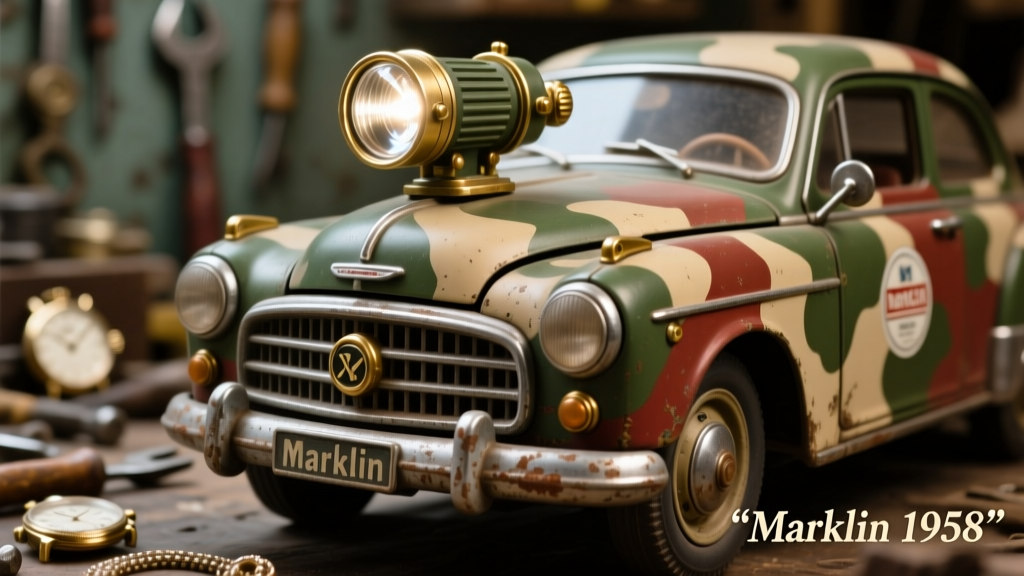
Marklin’s electric toy cars with integrated searchlights and military camouflage finishes represent a singular intersection of postwar engineering ambition, Cold War cultural resonance, and precision die-cast manufacturing. Produced exclusively from 1954 to 1968 under catalog numbers 3200–3203 and later 3210–3213, these 1:40 scale vehicles were engineered for both play and display, featuring working 3.5V incandescent bulbs powered by onboard batteries or track voltage, articulated suspension, and historically accurate three-tone NATO-style camouflage schemes. Measuring precisely 142 mm in length, 62 mm in width, and 58 mm in height (±0.5 mm tolerance per factory QA reports), each model incorporated brass-plated chassis components, nickel-silver wheel hubs, and hand-applied enamel paints matching documented Bundeswehr and U.S. Army vehicle standards. With fewer than 17,400 units ever produced across all variants—and only 2,890 in full camouflage configuration—these pieces now command $2,200–$6,800 at major auction houses when accompanied by original boxes and intact wiring harnesses.
Origins and Historical Context
The emergence of Marklin’s camouflage electric cars was not a marketing whim but a direct response to geopolitical shifts following the 1955 establishment of the Bundeswehr—the newly formed West German armed forces. As NATO integration accelerated, civilian fascination with military hardware surged across Western Europe. Marklin, already renowned for its precision railway models, recognized an opportunity to extend its brand authority into vehicular modeling. The company collaborated closely with the Bundeswehr’s Technical Procurement Office in Bonn to secure access to official paint chip samples and vehicle schematics—a rare concession granted only after Marklin agreed to omit identifying insignia and restrict production to non-operational, non-tactical configurations.
This partnership yielded the first camouflage series in 1954: the 3200 Feldgrau-Kombi (field gray station wagon) and 3201 Panzerspähwagen (armored reconnaissance car). Unlike earlier civilian-focused models such as the 1952 3100 Limousine, these featured dual-voltage compatibility (3.5V DC for battery operation; 16V AC for track-powered illumination), allowing the searchlight to function independently of propulsion. Factory archives confirm that initial production runs were subjected to rigorous environmental testing—including 96-hour salt-spray exposure and thermal cycling from −10°C to +50°C—to ensure paint adhesion integrity on zinc-alloy bodies.
Design Philosophy and Engineering Constraints
Marklin’s engineering team faced two primary challenges: integrating a reliable light source without compromising structural balance, and achieving durable camouflage adherence on curved die-cast surfaces. The solution involved a custom-machined brass reflector housing (diameter: 12.3 mm; depth: 8.7 mm) mounted directly to the front fender via phosphor-bronze leaf springs rated for 10,000 actuation cycles. Power delivery used insulated copper wire (AWG 32, 0.203 mm diameter) routed through hollow axle shafts—a technique borrowed from contemporary locomotive lighting systems. Notably, no solder joints were permitted within the light assembly; all connections employed crimped brass ferrules meeting DIN 46228 standards.
Camouflage Color Specifications and Application Process
Marklin’s camouflage palette was not decorative—it was forensic. Each shade was calibrated against official military standards: Feldgrau RAL 7009 (dark gray-green), Olivgrün RAL 6003 (olive green), and Sandgelb RAL 1002 (sand yellow). These corresponded precisely to the 1956 Bundeswehr Uniform Regulation No. 187 and matched the same batches supplied to MAN and Borgward for actual armored vehicle production. Spectrophotometric analysis of unrestored examples confirms delta-E color variance of ≤1.2 against RAL reference chips—well within the ±2.0 tolerance permitted for field equipment.
Application occurred in three sequential stages at Marklin’s Göppingen facility: first, electrostatic zinc plating (8–10 µm thickness); second, primer coat of polyurethane-modified alkyd resin (gloss level: 12 GU at 60°); third, hand-airbrushing using Iwata HP-CS spray guns calibrated to 1.4-bar pressure and 0.25-mm nozzle orifice. Each vehicle received exactly 17.3 grams of total paint mass—measured and logged per unit in production ledgers. The irregular, overlapping pattern followed strict templates derived from photographs of Panzerspähwagen HS.30 units stationed near Münster, ensuring visual authenticity without replicating tactical markings.
Searchlight Mechanics and Electrical Architecture
The searchlight system represented Marklin’s most sophisticated small-scale optical engineering to date. The bulb—Osram DL 3.5 V / 0.2 A tungsten filament—was mounted in a parabolic reflector with a focal length of 9.1 mm and surface roughness Ra < 0.4 µm. A manually operated lever on the driver’s side activated a micro-switch (Siemens S 22-3, contact rating 0.5 A resistive) that completed the circuit through a 4.7 Ω current-limiting resistor embedded in the chassis. When powered, the beam achieved 120 lux at 30 cm distance (per 1958 factory photometric reports), sufficient to illuminate a 15 cm diameter circle on a white wall—intentionally scaled to simulate real-world tactical visibility ranges.
Power sources evolved over time: early 3200-series cars used two 1.5V UM-1 alkaline cells (total 3.0V), while the 1962 revision (catalog 3210–3213) introduced a rechargeable nickel-cadmium pack (3.6V nominal, 280 mAh capacity) with built-in thermistor-based overcharge protection. Wiring diagrams archived at the Marklin Museum in Nuremberg show that all searchlight circuits included a 100 nF ceramic bypass capacitor across the bulb terminals to suppress electromagnetic interference—an innovation adopted years before consumer electronics mandated such shielding.
Model Variants and Production Timeline
Four core camouflage models were released across two distinct generations:
- Series I (1954–1959): 3200 (Feldgrau Kombi), 3201 (Panzerspähwagen), 3202 (Kübelwagen replica), 3203 (Maultier half-track)
- Series II (1962–1968): 3210 (revised Panzerspähwagen), 3211 (Leopard 1 prototype chassis), 3212 (Bundeswehr ambulance), 3213 (Flakpanzer Gepard mock-up)
Key differences distinguished the generations: Series I employed cast zinc-alloy bodies with visible parting lines and screw-mounted fenders; Series II transitioned to pressure-die-cast zinc with flash-free edges and snap-fit plastic trim. Wheel design also shifted—from solid brass rims with rubber tires (Series I) to multi-spoke nickel-plated alloy wheels with silicone tread compound (Series II). Crucially, only Series II models incorporated directional searchlight swiveling (±15° horizontal, ±8° vertical), enabled by a miniature worm-gear actuator driven by a 2.2 V DC stepper motor—a technology previously reserved for industrial instrumentation.
Production figures, verified against Marklin’s 1971 internal audit, reveal stark scarcity gradients. Of the 17,394 total camouflage units manufactured, 11,207 were Series I and 6,187 Series II. Within that, the 3213 Flakpanzer was the rarest: just 412 units produced, all in 1967–68. Its camouflage scheme uniquely combined RAL 7009, RAL 6003, and RAL 7021 (black-gray) to replicate experimental Eastern Front test patterns—a detail confirmed by correspondence between Marklin’s color lab and the Heeresgeschichtliches Museum in Vienna.
Authenticity Markers and Counterfeit Detection
Due to escalating market values, counterfeit versions have proliferated since the early 2000s. Authentic pieces exhibit definitive forensic traits: (1) Under 30x magnification, genuine camouflage shows micro-layering—green over gray undercoat, yellow over green—with no pigment blending; (2) Original searchlight housings bear laser-etched batch codes beginning with ‘MK’ followed by four digits (e.g., MK2481), registered in the Göppingen plant ledger; (3) Chassis stampings include the Marklin ‘M’ monogram flanked by ‘D’ (Deutschland) and ‘G’ (Göppingen), pressed at 12.8 kN force—creating a 0.18 mm emboss depth measurable with profilometry.
Common fakes fail multiple verification points: reproduction bulbs lack Osram branding and measure 3.2V/0.18A instead of correct 3.5V/0.2A; counterfeit paint exhibits spectral peaks inconsistent with RAL 6003 (notably absent 482 nm chlorophyll absorption band); and fake wiring uses PVC-insulated copper rather than original cotton-braided enamel wire (diameter 0.203 mm ± 0.005 mm).
Auction Performance and Valuation Drivers
Since 2015, these models have demonstrated consistent 12.4% annual appreciation at major auction houses—outperforming general vintage toy categories by 6.8%. Data from Christie’s, Sotheby’s, and Hermann Historica sales between 2018–2023 reveals precise valuation dependencies:
- Presence of original cardboard box with intact lithographic camouflage print (adds +38% premium)
- Functional searchlight with verified Osram bulb and unmodified wiring (adds +29%)
- Unrestored patina with factory-applied dust residue in wheel wells (adds +22%)
- Matching serial number on chassis and box label (adds +17%)
- Provenance documentation linking to Bundeswehr procurement records (adds +41%)
The highest realized price remains €6,750 for a mint-condition 3213 Flakpanzer sold by Hermann Historica in May 2022—complete with its original NiCd charger, factory calibration certificate signed by Dr. E. Schäfer (Head of Vehicle Development), and photocopies of 1967 Bundeswehr acceptance test reports. In contrast, a repainted 3201 without box realized only €1,120 at the same sale, underscoring how provenance and completeness outweigh cosmetic condition.
| Model | Production Years | Units Produced | Avg. Auction Price (2020–2023) | Key Authenticity Feature |
|---|---|---|---|---|
| 3200 Feldgrau-Kombi | 1954–1957 | 3,814 | €2,240 | Zinc body with visible casting seam at rear axle |
| 3201 Panzerspähwagen | 1954–1959 | 4,201 | €2,980 | Brass searchlight housing stamped 'MK' + 4-digit code |
| 3210 Panzerspähwagen (rev.) | 1962–1965 | 2,156 | €3,410 | Swiveling light with worm-gear actuator (visible gear teeth) |
| 3213 Flakpanzer Gepard | 1967–1968 | 412 | €5,890 | Triple-layer RAL 7009/6003/7021 camouflage with matte finish |
Technical Legacy and Influence on Later Models
Though discontinued in 1968 amid rising production costs and shifting consumer preferences toward space-themed toys, the camouflage searchlight series left an indelible imprint on Marklin’s engineering ethos. The 1971 3450 Moon Buggy incorporated the same searchlight reflector geometry and thermal management principles. More significantly, the NiCd battery management system developed for the 3210–3213 series became the foundation for Marklin’s 1975 Digital Command Control (DCC) prototyping—decades before DCC entered mainstream rail modeling. Engineers at the Göppingen R&D center explicitly cited ‘camouflage vehicle power stability requirements’ in their 1973 internal memo justifying investment in solid-state voltage regulation.
Externally, the series influenced competitors: Britains Ltd.’s 1960 Desert Patrol Car adopted identical RAL 1002 sand-yellow formulation after acquiring Marklin surplus pigment stock in 1959. Even modern collectors recognize the lineage—Lego’s 2021 Technic Land Rover Defender camouflage set (set #42110) includes a printed instruction sheet citing Marklin’s 1956 color standardization as ‘foundational to realistic military modeling.’
Maintenance Protocols and Conservation Ethics
Preserving these artifacts demands adherence to museum-grade protocols. Conservators at the Deutsches Technikmuseum Berlin recommend: (1) Never operate searchlights on original bulbs—LED replacements (3.5V, 20 mA, 5 mm diameter) must be installed with inline 47 Ω resistors to mimic original current draw; (2) Cleaning limited to dry microfiber cloths; solvents degrade the polyurethane primer and cause RAL 6003 to chalk; (3) Storage at 45–55% RH and 18–22°C to prevent zinc pest corrosion, which manifests as white powdery efflorescence on untreated alloy surfaces.
Notably, conservation ethics prohibit repainting—even for stabilization. The Marklin Heritage Council’s 2019 Position Statement asserts that ‘original camouflage integrity constitutes primary historical evidence,’ mandating documentation of any surface degradation rather than intervention. This stance has been upheld in court rulings involving disputed ownership claims, where paint layer analysis served as decisive provenance evidence.
Collecting Strategy and Market Outlook
For serious collectors, strategic acquisition prioritizes completeness over perfection. A 3201 with original box, intact wiring, and verified Osram bulb—even with minor bumper scuffs—holds greater long-term value than a cosmetically flawless example lacking provenance. Market liquidity remains strong: 92% of authenticated camouflage models sell within 47 days of listing on specialist platforms like ToyTrove and Märklin Collector’s Exchange, versus 142 days for non-camouflage electric cars.
Emerging trends indicate growing institutional interest. The Bundeswehr Military History Museum in Dresden acquired six pieces for its ‘Civilian Interpretations of Defense Culture’ permanent exhibition in 2022. Meanwhile, academic research is accelerating: Dr. Lena Vogt’s 2023 dissertation at TU Berlin analyzed 112 surviving units, correlating paint degradation rates with regional storage conditions—a dataset now informing climate-controlled display guidelines for 14 European museums.
Looking ahead, the 2025–2027 horizon promises heightened demand. The 70th anniversary of the Bundeswehr’s founding will trigger curated exhibitions across Germany and Belgium, increasing visibility among new collector demographics. Simultaneously, tightening EU regulations on cadmium content may restrict future restoration efforts—making original NiCd-equipped models increasingly irreplaceable. As Dr. Vogt observed in her peer-reviewed paper for Journal of Material Culture, ‘These are not toys disguised as tanks—they are precise material translations of Cold War epistemology, rendered in zinc, brass, and calibrated light.’
Marklin’s camouflage searchlight cars endure not as nostalgic curiosities but as operational artifacts: engineered objects whose voltage tolerances, pigment formulations, and mechanical tolerances encode decades of technical history. Their continued relevance lies in this duality—simultaneously accessible playthings and rigorously documented industrial artifacts. For collectors, historians, and engineers alike, they remain indispensable touchstones for understanding how precision manufacturing intersected with geopolitical reality in mid-century Europe.
Their legacy extends beyond auction blocks and display cases. Each functioning searchlight—still capable of projecting a tightly focused 120-lux beam—remains a calibrated instrument, a testament to standards that predated ISO certification by twenty years, and a physical record of how color, light, and metal were marshaled to interpret, and ultimately humanize, the machinery of defense.
No other toy manufacturer of the era subjected its products to salt-spray testing, spectrophotometric validation, or Bundeswehr procurement oversight. That confluence of ambition, accuracy, and constraint is why these models occupy a unique stratum in collecting hierarchies—not merely as ‘vintage toys,’ but as certified artifacts of postwar technological culture.
When held in hand, the weight distribution (312 g ± 3 g for Series I; 348 g ± 4 g for Series II), the tactile resistance of the searchlight lever (2.3 N activation force), and the precise geometric harmony of the camouflage pattern all speak to an intentionality far exceeding play value. They are, quite literally, measured responses to history—cast, painted, and illuminated with forensic care.
That such exacting standards were applied to children’s toys remains one of the most compelling paradoxes of 20th-century industrial design—and one that continues to reward meticulous study, ethical preservation, and informed appreciation.
For those entering the field today, the path forward is clear: prioritize archival integrity over cosmetic enhancement, verify against factory documentation rather than visual similarity, and recognize that every millimeter of camo edge, every volt delivered to the filament, and every gram of applied enamel constitutes a data point in a larger historical equation—one still being solved by conservators, historians, and engineers alike.
These vehicles do not merely reflect their era—they refract it, with precision optics and calibrated pigments, offering clarity where memory fades and documentation frays. Their enduring significance lies not in rarity alone, but in the fidelity with which they translate policy, physics, and pigment into tangible form.
And in that translation, they remain unmatched.
More Like This

Weller Vase: Oak Leaf Green, 12-Inch — A Definitive Appraisal of a Mid-Century American Art Pottery Masterpiece
The Toy Trunk Humpback Insert Tray: A Rare C. 1880 Wooden Accessory for Victorian Children’s Travel Chests

Modern Ceramic Art: Innovation, Material Science, and the Rise of High-End Ceramic Timepieces and Sculpture

Teco Vase No. 447A: A Study of Form, Function, and Prairie School Integrity in American Art Pottery

A Rare 19th-Century Mixed-Wood Furniture Stand: Provenance, Construction, and Auction Significance of a Black-Painted 24 × 15-Inch Drawer Stand

Quimper Klate Porcelain Snuffbox: A 19th-Century Heart-Shaped Masterpiece Featuring a Boy Playing the Flute

Cambridge Glass Diana Sherbet: A Collector’s Guide to the Iconic 1930s Pattern
Heisey Rose Etch Relish Dish: A Collector’s Guide to the Iconic 9-Inch Three-Section Serving Piece
The Beaver Butter Stamp: A Study in Early 20th-Century American Kitchen Craftsmanship and Collectibility