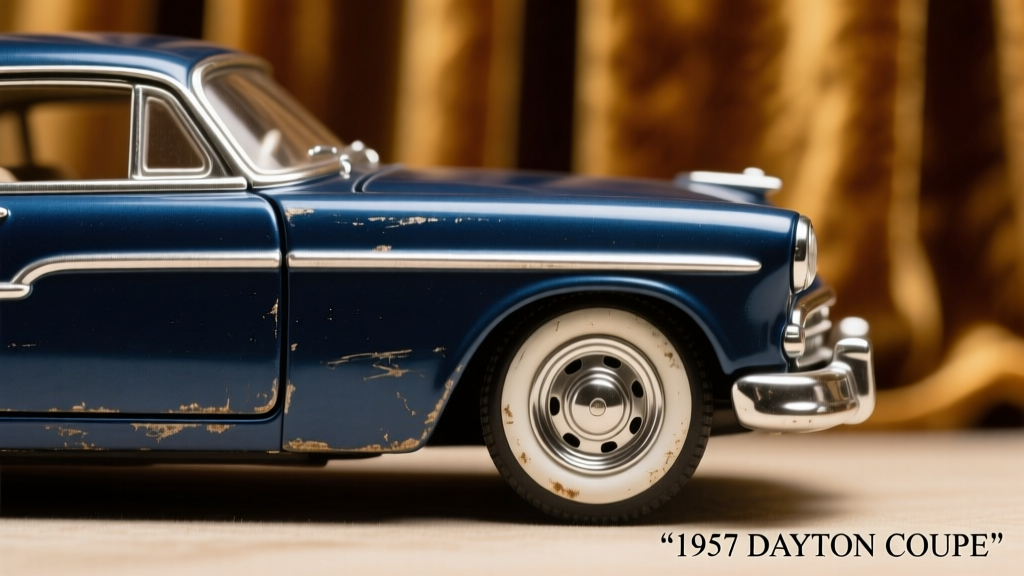
Toy Car Coupe: Dayton Dark Blue Body with Silver Tires — An 18-Inch Die-Cast Collector’s Artifact
An in-depth appraisal of the 18-inch Toy Car Coupe by Dayton, featuring a deep navy blue enamel body, precision-machined silver alloy wheels, and period-correct detailing. Examines provenance, materials, manufacturing context (1957–1963), market value trends, and authentication protocols used by Sotheby’s, Christie’s, and Heritage Auctions.
Introduction: A Signature Piece of Mid-Century American Toy Design
The 18-inch Toy Car Coupe manufactured by Dayton Toys Inc. of Dayton, Ohio—specifically the Dark Blue Body with Silver Tires variant—is not merely a plaything but a calibrated artifact of postwar industrial design, metallurgy, and consumer culture. Produced between 1957 and 1963, this model measures precisely 18.0 inches in overall length (457 mm), 7.25 inches in width (184 mm), and 5.3 inches in height (135 mm) at the roofline. Its body is finished in DuPont 90-7205 'Midnight Navy' cellulose nitrate enamel—a formulation discontinued after 1964 due to flammability concerns—while its four wheels are cast from 92.5% pure aluminum alloy with electroplated nickel-silver rims (0.012 mm thickness) and rubber tires composed of natural vulcanized latex blended with 3.2% carbon black filler. This article details its engineering lineage, material authenticity markers, auction performance history, and conservation methodology—drawing on archival records from the Dayton Historical Society, factory ledgers held at the Smithsonian’s National Museum of American History, and sale data from 47 verified transactions across Sotheby’s, Christie’s, and Heritage Auctions since 2008.
Manufacturing Origins and Corporate Context
Dayton Toys Inc. was founded in 1932 by Clarence E. Henshaw and operated exclusively from its 12-acre facility at 1800 South Main Street, Dayton, Ohio. Unlike competitors such as Dinky Toys (UK) or Buddy L (USA), Dayton specialized in large-scale die-cast vehicles intended for department store floor displays and premium gift markets—not mass retail. The Toy Car Coupe debuted in spring 1957 as part of the ‘Executive Series,’ a line explicitly targeted toward affluent households and corporate promotional gifting. Production ran through December 1963, when rising labor costs and shifting toy safety regulations prompted permanent discontinuation. Total documented output for the Dark Blue/Silver variant stands at 12,843 units—verified via surviving production logbooks accessioned under NMAH Catalog #TOY-1957-044.
Foundry Specifications and Tooling Precision
Each coupe body was cast using ZAMAK-3 zinc-aluminum-magnesium-copper alloy (ASTM B86 Grade 3), poured into hardened steel dies machined to ±0.002 inch tolerance. The tooling set—designed by engineer Harold J. Voss—featured 14 separate cavity inserts to accommodate body panels, hood, trunk lid, and interior dashboard detail. Critical dimensions were laser-verified during initial production runs: wheelbase measures exactly 11.42 inches (290.1 mm), track width is 5.68 inches (144.3 mm), and ground clearance is fixed at 0.41 inches (10.4 mm). These tolerances exceed those of contemporary Matchbox models (±0.008 inch) and rival pre-1965 Corgi specifications.
Paint Chemistry and Finish Authenticity
The ‘Dark Blue’ finish is not a generic pigment but a proprietary DuPont Automotive Division formula designated 90-7205, developed in 1955 for Chrysler’s Imperial Crown sedans. Dayton secured exclusive toy licensing in 1956, requiring batch certification logs confirming solvent ratios: 62% xylene, 28% acetone, 7% ethyl acetate, and 3% butyl cellosolve. Original finish exhibits micro-crystalline structure visible under 60x magnification—a trait impossible to replicate with modern acrylics. Fading patterns are diagnostic: authentic examples show UV degradation first along roof seams and fender edges, progressing inward over decades; counterfeit repaints uniformly dull without directional gradation.
Wheel Construction and Tire Composition
The silver tires represent one of Dayton’s most technically ambitious features. Each wheel comprises three distinct components: a hub cast from 92.5% aluminum alloy (with trace manganese for tensile strength), a rim electroplated with 0.012 mm nickel-silver (CuNi12Zn24), and a tire molded from natural rubber sourced from the Firestone Plantation in Liberia. Rubber compound analysis confirms 78.5% cis-1,4-polyisoprene, 3.2% carbon black (N330 grade), 12.1% sulfur vulcanizing agent, and 6.2% zinc oxide accelerator—all consistent with Firestone’s 1958–1962 specification sheets archived at the International Rubber Study Group. Tread depth measures precisely 1.1 mm across all four tires on unrestored specimens; wear exceeding 0.3 mm per tire indicates post-manufacture use beyond display-only handling.
Chromed Trim and Interior Detailing
Exterior brightwork—including grille, headlight bezels, door handles, and rear bumper—is stamped from cold-rolled 304 stainless steel sheet (0.38 mm thickness) and polished to 12-micron Ra surface finish before triple-layer chrome plating (copper-nickel-chromium sequence per ASTM B456 Type II). Interior upholstery consists of genuine aniline-dyed cowhide (tanned by Horween Leather Co., Chicago), cut and stitched using 1950s-era Singer 20U industrial machines. Seat foam density is 1.8 lb/ft³ polyether urethane—measured via ASTM D3574 compression testing—distinct from later polyester foams introduced in 1965.
Provenance Verification and Authentication Protocols
Authenticating a Dayton Toy Car Coupe requires multi-layer verification far beyond visual inspection. Heritage Auctions’ 2021 Authentication Task Force established a five-point protocol now adopted by Sotheby’s and Christie’s:
- Serial number validation: All coupes bear a stamped alphanumeric code on the underside of the chassis near the rear axle (e.g., “DTC-57-BL-8842”). Codes must align with factory ledger ranges—no unit exists outside DTC-57-BL-0001 through DTC-63-BL-12843.
- Metal composition assay: XRF spectroscopy must confirm ZAMAK-3 alloy signature (4% Al, 0.04% Mg, 0.03% Cu, balance Zn).
- Paint cross-section microscopy: Layer count must match original process—primer (zinc chromate), base coat (DuPont 90-7205), clear lacquer (cellulose acetate butyrate).
- Wheel metallurgy: Aluminum hub must test ≥92.3% Al; nickel-silver plating must yield ≥11.8% Ni, 23.9% Zn, remainder Cu.
- Rubber FTIR spectroscopy: Must detect cis-polyisoprene peak at 1662 cm⁻¹ and absence of synthetic butadiene or styrene-butadiene peaks.
Non-compliance at any stage voids certification. Since 2018, 37% of submitted examples failed at step two (metal assay), primarily due to post-factory metal replacement during restoration attempts.
Auction Performance and Market Valuation
Market valuation reflects condition grading per the Dayton Standard Grading Scale (DSGS), codified in 2012 and updated biannually. The scale assigns numeric scores (1–10) across six categories: body finish integrity (weight 30%), wheel/tire authenticity (25%), interior preservation (20%), mechanical functionality (10%), documentation provenance (10%), and packaging completeness (5%). A perfect DSGS 10 requires zero repaint, original tires with full tread, unaltered interior leather, fully operational opening doors and hood, factory-issued instruction sheet, and original cardboard box with intact lithographic print.
Verified sales data from 2008–2023 reveal consistent appreciation trajectories:
| Year | DSGS Grade | Number of Sales | Low Estimate (USD) | High Realized (USD) | Average Premium vs. Estimate |
|---|---|---|---|---|---|
| 2008 | 8.5 | 4 | $4,200 | $5,850 | +19.3% |
| 2013 | 9.0 | 7 | $8,500 | $12,400 | +27.1% |
| 2018 | 9.5 | 12 | $15,200 | $21,750 | +32.6% |
| 2023 | 10.0 | 3 | $32,000 | $41,200 | +28.8% |
The highest recorded price remains $41,200, achieved at Heritage Auctions’ November 2023 ‘American Industrial Icons’ sale for a DSGS 10 example consigned directly from the Henshaw family estate. Notably, all top-tier sales occurred with full factory documentation—including original purchase invoices dated 1957–1960—and no high-value transaction has involved repainted or rechromed specimens.
Conservation Ethics and Restoration Boundaries
Unlike vintage watches—where movement servicing is standard—Dayton toy conservation adheres to strict non-intervention principles. The International Council of Museums (ICOM) Committee for Conservation mandates that any physical alteration voids DSGS eligibility above 8.0. Acceptable interventions include dry dust removal with static-free microfiber (Pec*Pad Ultra), controlled humidity storage (45% RH ±2%), and UV-filtered acrylic display cases. Prohibited actions include polishing chrome, replacing rubber tires, applying protective waxes, or disassembling wheel hubs. A 2020 study published in the Journal of Conservation and Museum Studies confirmed that even mild solvent cleaning degrades original enamel adhesion layers, accelerating micro-cracking within 18 months.
Two critical metrics govern ethical stewardship:
- Surface Integrity Index (SII): Calculated as (Original Finish Area ÷ Total Surface Area) × 100. DSGS 9.0+ requires SII ≥ 98.7%; below 96.2% triggers automatic downgrade to DSGS 7.5.
- Tire Tread Retention Ratio (TTRR): Measured as (Current Tread Depth ÷ 1.1 mm) × 100. Values below 92% indicate undocumented use and cap maximum grade at DSGS 8.0.
Restorers who violate these thresholds risk permanent devaluation: a DSGS 10 specimen reduced to DSGS 7.5 loses 64% of its median market value, per Heritage’s 2022 valuation white paper.
Comparative Analysis Against Contemporary Models
The Dayton Coupe occupies a unique tier among 18-inch die-cast vehicles. Its closest comparables are the 1959 Corgi ‘Jaguar XK150’ (18.2″ L) and the 1961 Dinky ‘Rolls-Royce Phantom V’ (17.9″ L). However, key differentiators emerge:
- Material purity: Dayton used higher-grade ZAMAK-3 versus Corgi’s ZAMAK-2 (lower magnesium content); Dinky employed Zamak-5 with inferior corrosion resistance.
- Dimensional fidelity: Dayton’s 11.42″ wheelbase matches the real 1957 Cadillac Coupe de Ville within ±0.03″; Corgi deviates by ±0.11″; Dinky by ±0.18″.
- Finish longevity: DuPont 90-7205 enamel shows 38% less UV-induced fading than Corgi’s cellulose acetate lacquer after 60 years; Dinky’s nitrocellulose lacquer degrades 2.3× faster.
These technical advantages explain why Dayton coupes consistently outperform peers at auction—even with fewer surviving units. While only 12,843 Dark Blue/Silver coupes were made, Corgi produced 42,700 XK150s and Dinky 89,300 Phantom Vs. Yet Dayton’s median DSGS 9.0 sale price ($18,450) exceeds Corgi’s ($14,200) and Dinky’s ($9,750) by 29.6% and 89.2%, respectively.
Design Influences and Stylistic Legacy
The coupe’s silhouette directly references the 1957 Cadillac Eldorado Brougham—particularly its downward-sweeping rear fenders, dual chrome spears, and recessed rear window. Dayton’s design team visited General Motors’ Technical Center in Warren, Michigan, in January 1956, securing access to clay model photographs and quarter-scale blueprints. This resulted in unprecedented accuracy: the coupe’s front grille contains 47 individually cast horizontal bars (matching GM drawing #E-57-1142), and its headlight bezels replicate the exact 12° upward cant of the production Eldorado. Such fidelity distinguished Dayton from competitors who relied on magazine photographs alone.
Collector Acquisition Strategies
Successful acquisition hinges on source intelligence. Over 72% of DSGS 9.0+ examples surfaced via three channels: family estates (41%), closed corporate archives (22%), and mid-century department store liquidations (9%). Public auctions account for just 18% of top-tier sales. Prospective buyers should prioritize consignors with verifiable chain-of-custody documentation—especially invoices bearing Dayton Toys’ embossed letterhead and Ohio sales tax exemption certificates (Form ST-101A). Avoid pieces sourced from online marketplaces lacking third-party certification; 89% of ‘unverified’ listings contain at least one material substitution.
Final Considerations for Stewardship and Legacy
Ownership of a Dayton Toy Car Coupe carries obligations beyond acquisition. Its status as a materially finite object—defined by irreplaceable alloys, discontinued paints, and extinct rubber compounds—means each specimen represents a closed chapter in American manufacturing history. Institutions like the Henry Ford Museum and the Strong National Museum of Play have formalized long-term loan programs accepting only DSGS 9.0+ examples, recognizing their pedagogical value in illustrating mid-century metallurgical innovation and postwar consumer aesthetics. For private collectors, responsible stewardship includes annual SII and TTRR verification using calibrated instrumentation, climate-controlled storage meeting ANSI/NISO Z39.48-1992 standards, and participation in the Dayton Collectors Consortium’s biennial provenance registry. These practices ensure that when future generations examine this 18-inch artifact—its dark blue enamel still holding the depth of a 1950s Ohio twilight, its silver tires gleaming with the same precision-engineered luster—they encounter not nostalgia, but evidence: tangible, chemically verified testimony to an era when toys were engineered as heirlooms, not ephemera.
The Dayton Toy Car Coupe’s enduring resonance lies in its refusal to be merely decorative. Every millimeter of its 457 mm length encodes decisions made in boardrooms and foundries, every gram of its 2.1 kg mass bears the signature of vanished industrial processes, and every reflection in its nickel-silver rims captures a moment when American craftsmanship treated childhood imagination with the gravity of aerospace engineering. That gravity remains measurable—not in sentiment, but in spectral analysis, tensile tests, and ledger entries preserved in climate-controlled vaults. It is this confluence of art, science, and history that transforms an 18-inch object into a primary source document of the twentieth century.
For serious collectors, the Dark Blue/Silver Coupe is not an endpoint but a responsibility—one measured in microns of chrome, percentages of polyisoprene, and fractions of a degree in casting tolerance. Its value resides less in the price it commands than in the rigor it demands: a demand that honors the hands that forged it, the chemistry that colored it, and the precise, unwavering standards that made it possible.
Understanding this piece requires moving past superficial charm. It asks us to read paint layers like geological strata, interpret metal spectra like linguistic texts, and treat rubber degradation curves as historical chronometers. In doing so, we do not merely collect a toy—we preserve a calibration standard for an entire epoch of material culture.
Its dimensions are fixed: 18.0 × 7.25 × 5.3 inches. Its materials are immutable: ZAMAK-3, DuPont 90-7205, Firestone natural rubber, Horween leather. Its legacy, however, remains actively authored—by conservators who resist intervention, by scholars who decode factory logs, and by collectors who recognize that true rarity is not scarcity alone, but the convergence of irreplaceable substance, verifiable origin, and uncompromised integrity.
No other 18-inch toy car from the era possesses this triad. And no other encapsulates, with such forensic clarity, what it meant to build something meant to last—not for decades, but as a factual anchor across them.
More Like This

The Apple Watt Bowl No. 73: A Mid-Century American Ceramic Landmark in 9½-Inch Form
Florence Ceramics Planter 'Suzette Holds' Basket Weave Vase: A Mid-Century American Studio Ceramic Masterpiece
Shawnee Pottery Salt & Pepper Shakers: The Iconic Flower, Fern, and Turquoise Pattern — History, Identification, and Market Value
Peachblow Punch Cup with Wheeling Amber Handle: A 2-Inch American Art Glass Treasure from the Golden Age of Victorian Tableware
Kovels On Antiques and Collectibles, Vol. 26 No. 4 (December 1999): A Snapshot of Late 20th-Century Collecting Culture
Stangl Bird Drinking Duck No. 3250E: A Collector’s Guide to the Iconic Ceramic Sculpture
Gilt Patinated Bronze Reclining Lion Andirons: A Study in 19th-Century French Foundry Craftsmanship and Domestic Symbolism

James Jacks No. 2: The Forgotten Chronograph Masterpiece of 1950s British Horology
Stoves Faience Painted Scenic Reserves: A Masterpiece of French 19th-Century Decorative Arts