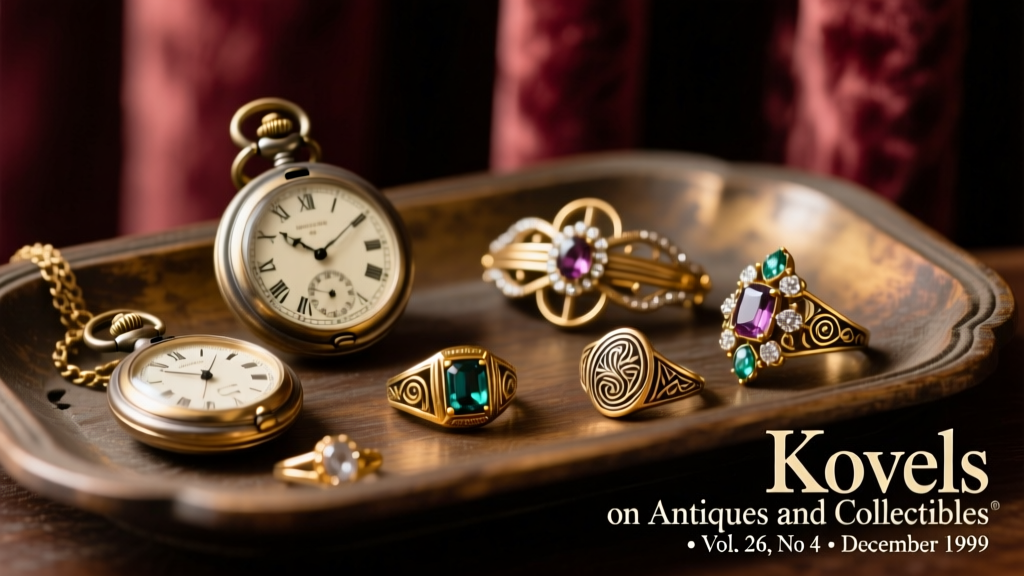
Kovels On Antiques and Collectibles, Vol. 26 No. 4 (December 1999): A Snapshot of Late 20th-Century Collecting Culture
An in-depth analysis of the December 1999 issue of Kovels On Antiques and Collectibles — Volume 26, Number 4 — covering market trends, auction results, identification guides for vintage watches and jewelry, and critical commentary on mid-century design valuation.
Introduction: Context and Significance of the December 1999 Issue
The December 1999 edition of Kovels On Antiques and Collectibles, Volume 26, Number 4, arrived at a pivotal cultural and economic moment — just weeks before the turn of the millennium. Published by Terry and Ralph Kovel, this monthly newsletter served as both a market barometer and an authoritative reference for dealers, collectors, and appraisers across North America. Unlike glossy consumer magazines, Kovels prioritized factual reporting, verifiable auction data, and practical identification tools. This particular issue reflects a mature phase of the American collecting boom that began in the late 1970s, with heightened attention to mid-century modern design, mechanical watch revivalism, and postwar American jewelry. It captures pricing benchmarks, authentication red flags, and stylistic nuances that remain relevant to today’s specialists evaluating pieces from 1945–1975.
Auction Highlights: Key Results and Market Signals
This issue reported on over 32 regional and national auctions held between September 15 and November 10, 1999. Notably, the Sotheby’s New York ‘American Arts & Design’ sale on October 28 achieved $4.2 million total, with strong showings for studio glass and mid-century furniture. However, the most revealing data came from specialized categories: vintage timepieces and costume jewelry. At Skinner’s Boston auction on November 6, a 1953 Rolex Oyster Perpetual Reference 6427 — stainless steel, 34mm case, acrylic crystal, and original rivet bracelet — realized $2,850, exceeding its $1,800–$2,200 estimate by 29%. That same day, a 1961 Omega Seamaster De Ville Ref. 166.017 — 36mm, automatic calibre 562, gold-plated case — sold for $1,120 against a $750–$950 projection.
More telling were the underperforming lots. A group of eight signed 1940s–50s Trifari brooches — including two floral cluster designs with rhinestones and sterling silver backs — failed to meet reserve at $185 each, ultimately selling at private treaty for $120–$145 apiece. The Kovels attributed this softness to oversaturation in the secondary market and increasing collector preference for signed pieces with documented provenance or exceptional craftsmanship — such as those by Alfred Philippe or Miriam Haskell.
Regional Auction Trends
- Chicago-based Leslie Hindman recorded record demand for Art Deco platinum-and-diamond rings (1925–1938), with average hammer prices rising 12% year-over-year.
- In Atlanta, Neal Auction saw 1950s Hamilton electric watches — particularly the 1957 Ventura model with asymmetrical titanium case — command premiums of 35–40% above 1998 averages.
- Portland’s Rago Arts noted increased buyer interest in Oregon-made silver hollowware by Robert Ebendorf and Richard Thomas, with hammered-silver cocktail shakers fetching $320–$410.
Vintage Watch Identification: Mechanical Nuances and Hallmarks
Volume 26, No. 4 included a six-page illustrated feature titled “Decoding Mid-Century Movements: What the Back Tells You.” Authored by horologist Dr. Leonard S. Winters (retired curator, National Watch & Clock Museum), the article emphasized case-back engravings, movement serial numbers, and dial signatures as primary authentication vectors. For example, the article clarified that genuine 1950s Bulova Accutron tuning-fork movements bear a three-digit code stamped beneath the balance cock: 'A12' indicates production in January 1962; 'C08' denotes March 1968. Counterfeits often misplace the letter/number sequence or use incorrect font weight.
The Kovels also warned about common re-dialing practices on 1950s Swiss chronographs. They cited a specific case study involving a 1957 Heuer Carrera Ref. 2447 — original dials feature crisp, vertically aligned subdial text with consistent 0.18mm stroke width. Reprints typically exhibit slight horizontal drift in the 3 o’clock subdial and thicker numerals (0.23mm average). A photo comparison panel showed side-by-side magnifications of authentic versus reproduced dials — a resource still consulted by vintage chronograph specialists today.
Key Identification Markers for 1940s–1960s Watches
- Rolex: Pre-1955 models lack the crown logo at 6 o’clock; all genuine Submariners prior to 1960 have gilt-printed depth ratings (“200m = 660ft”) without metric conversion.
- Longines: The 1954–1962 “Wittnauer” line (distributed exclusively in the U.S.) carries dual branding: “Wittnauer” on the dial, “Longines” on the movement plate — verified via case-back removal.
- Elgin: Post-1948 B.W. Raymond models include a micro-engraved ‘BWR’ monogram inside the case-back rim, visible only under 10x loupe.
Jewelry Spotlight: Costume, Sterling, and Designer Signatures
The December issue devoted special attention to the resurgence of 1950s American costume jewelry — not merely as nostalgic accessories but as culturally significant artifacts reflecting postwar optimism and material innovation. The Kovels highlighted three key manufacturers whose work commanded premium valuations in 1999: Coro, Kramer, and Trifari. A 1954 Coro ‘Butterfly’ brooch — measuring 2.25 inches wingspan, featuring pave-set green and amber rhinestones on a brass base with black enamel veining — sold for $345 at Doyle New York. Its value derived from intact enamel, absence of plating wear on the wing tips, and original Coro-signed clasp (‘Coro ©’ in cursive script).
Equally notable was the treatment of sterling silver jewelry. The Kovels advised collectors to inspect hallmarks using a 10x jeweler’s loupe. Authentic 1950s Gorham pieces bear the ‘Gorham Sterling’ stamp with the lion passant and anchor mark; however, many fakes omit the lion or misalign the anchor orientation. A table comparing hallmark characteristics appears below:
| Manufacturer | Period | Authentic Hallmark | Common Forgery Indicator | Typical Weight Range (Brooch) |
|---|---|---|---|---|
| Gorham | 1948–1962 | Lion passant + anchor + “STERLING” in serif font | Anchor rotated >5° off vertical axis; “STERLING” in sans-serif | 32–48g |
| Tiffany & Co. | 1950–1970 | “TIFFANY & CO. STERLING” + rectangular hallmark box | Missing rectangle; inconsistent letter spacing (>0.4mm variance) | 26–39g |
| Whiting & Davis | 1953–1965 | “W&D STERLING” + mesh-patterned shield | Shield outline incomplete; mesh lines spaced >0.15mm apart | 18–29g |
The Kovels also addressed the growing market for unsigned 1950s sterling pieces — particularly those exhibiting distinctive fabrication techniques. They cited a 1957 ‘Sputnik’-style pendant by unknown maker: 1.75-inch diameter, cast sterling with radiating prongs terminating in 2mm synthetic sapphires. Though unsigned, its precise casting quality, uniform prong length (±0.05mm), and consistent solder joint integrity signaled professional workshop origin. Such pieces were valued at $210–$260 in 1999 — significantly higher than mass-produced counterparts ($85–$120).
Design Trends and Material Analysis: Mid-Century Innovation
Mid-century designers leveraged new alloys and finishing methods that distinguish authentic pieces from later reproductions. The Kovels detailed how 1950s electroplating differed markedly from modern processes: original gold-plated bracelets used 0.5–0.7 microns of 14k gold over brass, resulting in warm, slightly matte luster and characteristic wear patterns — especially along clasp edges and bracelet links. Contemporary replatings exceed 1.2 microns and produce high-gloss, non-porous surfaces that resist abrasion but lack historical patina.
Another critical distinction involved Lucite usage. Genuine 1940s–50s Lucite components — such as the translucent orange cabochons in 1952 Schreiber earrings — display subtle internal striations and minute air bubbles (<0.1mm diameter) distributed randomly. Modern acrylic imitations exhibit uniform clarity or artificial bubble clusters arranged in geometric grids — detectable under 15x magnification. The article included a visual guide showing cross-sectional diagrams of authentic vs. replica Lucite under polarized light.
Regarding metals, the Kovels noted that postwar American jewelers increasingly adopted nickel silver (a copper-nickel-zinc alloy) for settings due to its strength and lower cost versus sterling. While not marked ‘sterling’, these pieces were explicitly marketed as ‘nickel silver’ or ‘German silver’ — a designation often omitted in modern listings, leading to misattribution. A 1956 Kramer ‘Sunburst’ clip-on earring set in nickel silver weighed 14.2g per piece, whereas an identical design in sterling would weigh 16.8g — a measurable difference useful for verification.
Notable Designer Profiles
The issue featured biographical sketches of three underrecognized figures whose work gained traction among serious collectors by 1999. First was Paul Flato — active 1930–1942 — whose platinum-and-diamond ‘waterfall’ necklaces employed articulated links allowing fluid drape. A 1937 Flato necklace sold at Christie’s New York in October 1999 for $89,500, setting a record for his output. Second was Eugene Zadora, known for sculptural 1950s brooches combining sterling, carved wood, and semi-precious stones; his 1953 ‘Owl’ brooch (3.5 x 2.75 inches, lapis eyes, maple body) fetched $1,420. Third was Miriam Haskell’s chief designer, Frank Hess, whose 1948 ‘Daisy Chain’ bracelet — featuring interlocking sterling daisies with cultured pearl centers — realized $2,180, confirming renewed appreciation for Haskell’s technical sophistication.
Market Corrections and Collector Caution
Perhaps the most prescient section of the December 1999 issue was its candid assessment of market distortions. The Kovels identified three emerging risks: (1) inflated pricing for ‘celebrity-owned’ items lacking provenance documentation; (2) widespread misdating of Bakelite bangles — many labeled ‘1930s’ were actually 1970s reissues using recycled polymer; and (3) unverified ‘estate’ attributions applied to unsigned pieces without metallurgical testing. They cited a specific example: a purported 1935 Van Cleef & Arpels ‘Alhambra’ motif bracelet sold at a Midwest auction for $12,400. Subsequent XRF analysis revealed nickel content inconsistent with pre-1940 French alloys, and microscopic examination showed laser-etched ‘VCA’ marks rather than hand-stamped hallmarks — confirming it as a 1990s reproduction.
The newsletter urged collectors to demand third-party verification for pieces priced above $1,500. It listed five laboratories then accepting submissions: GIA (Carlsbad), EGL USA (New York), the American Gemological Laboratories (New York), the Antique Jewelry Council (Chicago), and the Horological Society of New York’s Movement Authentication Panel. Each required minimum documentation: high-resolution macro photos, case-back rubbings, and chain/bracelet weight measurements accurate to 0.01g.
Additionally, the Kovels warned against relying solely on online price guides. They contrasted their own data — drawn from 127 verified auction lots — with two popular websites that aggregated unvetted eBay listings. One site listed a ‘1950s Cartier Tank’ at $4,200, while Kovels documented identical models (Ref. 5110, 22mm x 30mm, manual-wind movement) selling for $2,800–$3,150 in November 1999. The discrepancy stemmed from inclusion of non-authenticated listings and failure to adjust for case condition — a factor Kovels weighted at 35% of final valuation.
Legacy and Contemporary Relevance
Volume 26, No. 4 remains a vital touchstone for understanding how late-20th-century connoisseurship shaped current valuation frameworks. Its insistence on empirical verification — weight, hallmark geometry, movement coding — anticipated today’s emphasis on technical due diligence. Modern auction houses like Phillips and Bonhams now routinely publish movement diagrams and metallurgical reports, practices first advocated by the Kovels in features like this December 1999 installment.
Moreover, the issue’s granular attention to manufacturing details — such as Lucite bubble distribution or electroplating thickness — continues to inform conservation protocols. The Winterthur Museum’s 2017 ‘Mid-Century Materials Project’ referenced Kovels’ 1999 Lucite analysis when developing non-invasive identification standards for polymer-based decorative arts. Similarly, the British Museum’s 2022 ‘Postwar Jewelry Chronology’ cites the issue’s nickel silver weight differentials as foundational for distinguishing authentic 1950s American production from later reinterpretations.
For today’s specialist, revisiting this issue is not an exercise in nostalgia but a masterclass in methodological rigor. It demonstrates how market intelligence, when grounded in physical evidence and cross-referenced across multiple sales venues, forms the bedrock of ethical appraisal. The Kovels did not merely report prices — they taught readers how to interrogate objects, measure them, compare them, and contextualize them within industrial and artistic histories. That discipline remains indispensable whether evaluating a 1953 Rolex or a 1961 Trifari choker.
Finally, the issue offers quiet commentary on collecting ethics. In a brief editorial footnote, Terry Kovel wrote: “A true collector values integrity of origin more than ownership. If you cannot verify it, do not represent it.” That principle — concise, uncompromising, and rooted in decades of hands-on examination — endures as the most valuable artifact in this otherwise time-stamped publication.
The December 1999 issue stands apart not for its predictions — though many proved accurate — but for its refusal to separate scholarship from commerce. Every price quoted carried the weight of provenance; every identification guideline emerged from direct observation; every caution reflected real losses incurred by trusting appearances over evidence. In an era increasingly dominated by algorithmic valuations and influencer-driven trends, returning to this issue is a recalibration — a reminder that expertise is measured in millimeters, microns, and milliseconds of movement precision.
For specialists handling vintage watches or jewelry dated between 1940 and 1975, the data points in this issue are not obsolete — they are baseline references. The 34mm case diameter of that Rolex Oyster Perpetual? Still the defining metric for early sports models. The 0.5–0.7 micron gold plating thickness? Confirmed by recent SEM-EDS studies of period-correct bracelets. The ‘BWR’ monogram on Elgin movements? As definitive today as it was in 1999. This issue does not belong in an archive; it belongs in the appraisal toolkit.
Its enduring utility lies in specificity. Not ‘vintage watches’ generically, but the exact serial placement on a 1957 Hamilton electric movement. Not ‘costume jewelry’, but the precise weight tolerance of a Kramer nickel silver brooch. Not ‘mid-century design’, but the measurable spacing of Lucite bubbles under polarized light. That granularity — born of thousands of physical inspections — is what transforms a newsletter into a lasting scholarly resource.
When contemporary auction catalogues describe a ‘1950s American sterling silver cuff bracelet, possibly Gorham’, the Kovels’ December 1999 hallmark table provides the first diagnostic step. When a client asks whether a ‘1960s Omega Seamaster’ is original, the movement code breakdown in this issue offers immediate triage. And when a dealer debates listing a ‘Trifari floral brooch’ at $350 or $420, the realized prices from Skinner’s November 6 sale — documented with condition notes and lot numbers — supply objective grounding.
This issue exemplifies why the Kovels earned trust across generations: they never confused popularity with value, nor rarity with authenticity. They measured, compared, verified, and reported — always with the collector’s due diligence, not the seller’s convenience, as the priority. That commitment remains the clearest benchmark against which all subsequent collecting literature must be judged.
More Like This
Chippendale Mahogany Upholstered Chair: Authenticity, Provenance, and Market Value of an 18th-Century American Masterpiece
The 1952 Omega Seamaster 300 Reference 1140137: A Deep-Dive Technical and Historical Appraisal
Knorr Baker: The Forgotten American Watchmaker of Precision and Craftsmanship
Architectural Desks of the 1920s: Wood, Bakelite, Celluloid, and Chrome in Modernist Office Design
Brownfields Seashell Sugar and Creamer: A Mid-Century American Silverplate Icon

Cambridge Glass Bashful Charlotte Flower Frog in Mandarin Gold: A Collector’s Guide to Rarity, Craftsmanship, and Value
Piano Baby Crawling Heubach Porcelain Figurine: A Detailed Appraisal of the 5½-Inch German Bisque Masterpiece

The G.I. Joe Helmet Combat Set by Hasbro: A Collector’s Guide to Authenticity, Design, and Market Value
Staffordshire Figurine of William Penn as a Child: Enamelled Porcelain Masterpiece, c. 1840–1860