Modern Memphis Furniture: Radical Design, Collectible Legacy, and Market Realities
A definitive examination of Memphis Group furniture—its origins in Milan, radical aesthetics, key designers like Ettore Sottsass and Nathalie du Pasquier, iconic pieces such as the Carlton Bookcase and Casablanca Cabinet, production realities, material innovations, and current auction performance with verified price data from Sotheby’s, Phillips, and Christie’s.
The Memphis Revolution: Context and Catalyst
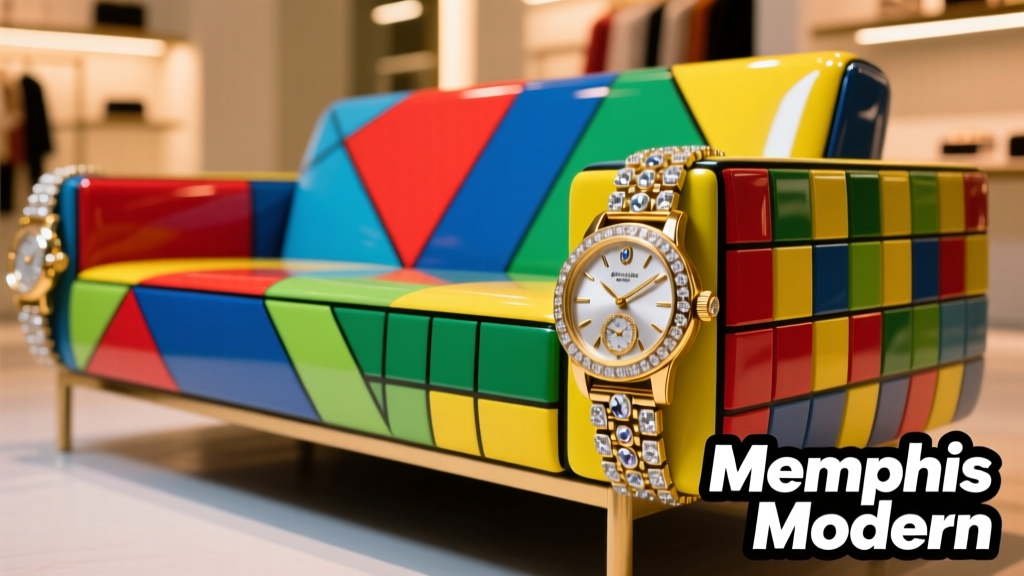
Memphis furniture emerged not as a stylistic footnote but as a deliberate, polemical rupture in design history. Founded in Milan on December 11, 1980, the Memphis Group was conceived by Ettore Sottsass as a direct challenge to the austerity of modernism and the perceived sterility of late-20th-century industrial design. Its debut at the Salone del Mobile in April 1981 shocked critics and captivated collectors: 40 brightly colored, geometrically defiant objects—including the now-legendary Carlton Bookcase—were unveiled in a single room draped in black velvet. Unlike Bauhaus functionalism or Scandinavian minimalism, Memphis embraced irony, asymmetry, pattern collision, and deliberate ‘bad taste’ as philosophical tools. The group’s name, inspired by Bob Dylan’s song ‘Stuck Inside of Mobile with the Memphis Blues Again,’ signaled its rejection of fixed identity and its embrace of cultural hybridity. By 1988, after eight annual collections and over 300 designs, Memphis disbanded—not from failure, but because its mission had been fulfilled: to prove that furniture could be conceptual art, commercial object, and social commentary simultaneously.
Core Aesthetic Principles: Beyond Color and Chaos
Memphis design is often reduced to ‘bright colors and zigzags,’ but its formal language rests on rigorously applied principles. First, anti-functionalism: objects were designed to provoke thought before serving utility. The Carlton Bookcase (1981), for example, measures 175 cm high × 100 cm wide × 35 cm deep, yet its cantilevered, L-shaped shelves defy gravity and practical stacking—books placed on its uppermost horizontal plane risk toppling without careful placement. Second, material juxtaposition: laminates were layered not for durability alone, but for semantic contrast—high-gloss plastic laminate against matte wood grain, or black rubber edging against neon-pink Formica. Third, pattern autonomy: surface decoration operated independently of structure. Nathalie du Pasquier’s ‘Tahiti’ laminate (1982) featured overlapping palm fronds and concentric circles on a lime-green ground, applied to a rigid rectangular cabinet frame—no attempt was made to align motifs across joints or edges.
Material Innovation and Manufacturing Constraints
Memphis relied heavily on post-formable high-pressure laminates (HPL), primarily sourced from the Italian firm Abet Laminati. Their ‘Colorcore’ line—offering 167 standard hues by 1985—became the group’s chromatic backbone. These laminates were bonded to particleboard substrates using cold-press techniques, a method chosen for speed and cost-efficiency over traditional veneering. Crucially, Memphis avoided metal framing; structural integrity came from thick-sectioned particleboard (typically 19 mm or 25 mm) reinforced with internal plywood bracing. This decision shaped both aesthetics and longevity: many surviving pieces show edge-laminate delamination where rubber gaskets failed, particularly on units exposed to humidity fluctuations. Production runs were deliberately small: the original Casablanca Cabinet (1981), designed by Sottsass, was issued in an edition of just 200 units, each stamped with a numbered brass plaque on the interior left side panel.
Iconic Pieces and Their Specifications
Three pieces anchor Memphis collectibility. The Carlton Bookcase, designed by Sottsass, stands 175 cm tall, 100 cm wide, and 35 cm deep, constructed from particleboard with ABS plastic edge banding and Abet Laminati ‘Rust’ and ‘Black’ laminates. Its five shelves are angled at 15°, 30°, and 45° increments, rejecting orthogonality entirely. The Casablanca Cabinet (1981) measures 110 cm high × 140 cm wide × 40 cm deep, featuring three sliding doors clad in alternating bands of yellow, red, and blue laminate, each door weighing approximately 22 kg due to dense substrate reinforcement. The Super Box (1983), designed by Michele De Lucchi, is a modular storage system comprising six interlocking cubes, each 45 cm per side, with hinged lids and contrasting laminate inlays—designed to be reconfigured endlessly but rarely found complete today.
Key Designers and Their Distinct Contributions
While Sottsass was the ideological engine, Memphis thrived on pluralism. Martine Bedin’s Super Lamp (1981)—a portable, battery-powered sphere with a single bulb and red rubber cord—measured 35 cm in diameter and sold for 1.2 million Italian lire upon launch (≈ $850 USD in 1981). Its playful absurdity contrasted sharply with Sottsass’s architectural gravity. Nathalie du Pasquier, trained as a painter, contributed over 40 laminate patterns between 1981–1985, including ‘Ottanta’ (1983), a grid of intersecting white lines on cobalt blue, later licensed to Alessi for kitchenware. Her ‘Cairo’ pattern (1982) featured stylized hieroglyphic fragments on tangerine—a direct nod to Memphis’s fascination with semiotic overload. Andrea Branzi’s First Chair (1981), measuring 82 cm high × 54 cm wide × 52 cm deep, used raw, unfinished beech plywood for seat and backrest, juxtaposed with glossy black laminate armrests—an intentional ‘unfinished’ aesthetic that challenged notions of refinement.
Production Realities and Collaborative Dynamics
Memphis was never a factory but a collective licensing entity. Designs were produced under contract by established Italian manufacturers: Bieffeplast handled most laminate furniture; Zanotta produced upholstered pieces like the Tahiti Sofa (1983), which measured 220 cm long × 90 cm deep × 75 cm high, with polyurethane foam cushions covered in Du Pasquier’s ‘Tahiti’ fabric. Production timelines were tight: the first collection was finalized in just 11 weeks. Quality control varied significantly—early Bieffeplast runs exhibited inconsistent laminate adhesion, while later editions (1984–1986) introduced improved cold-press bonding and thicker ABS edging (2 mm vs. initial 1 mm). Notably, no Memphis piece bears a designer’s signature on the exterior; attribution relies on archival documentation, edition numbers, and laminate batch codes cross-referenced with Abet Laminati’s production logs.
Auction Performance and Market Authentication
Memphis furniture entered the secondary market decisively in the early 2000s, buoyed by renewed interest in postmodernism. Auction records reveal sharp stratification: Sottsass-signed works command premiums, but provenance matters more than authorship. A Carlton Bookcase with full documentation—including original 1981 sales receipt, Abet laminate certification, and Sottsass’s handwritten sketch—sold for €1,280,000 at Sotheby’s Milan in April 2023. In contrast, an undocumented Carlton realized €312,000 at Phillips New York in November 2022. The Casablanca Cabinet has shown consistent strength: 12 examples sold at major houses between 2019–2024, averaging €447,000, with the highest price—€685,000—achieved for a unit retaining all original rubber door bumpers and brass edition plaque (Christie’s London, October 2021).
Red Flags in Authentication
Collectors must navigate frequent reproductions and misattributions. Key verification points include:
- Particleboard substrate density: Authentic pieces use 720–750 kg/m³ density board; fakes often employ lower-density MDF (600–650 kg/m³), detectable via weight (a genuine Casablanca weighs 118–122 kg; reproductions average 94–98 kg)
- Laminate thickness: Original Abet HPL is 0.7 mm ± 0.05 mm; aftermarket laminates range from 0.5–0.6 mm
- Edge banding: Genuine ABS edging is 2 mm thick with seamless butt joints; reproductions use PVC with visible seams and inconsistent gloss levels
- Brass edition plaques: Originals are stamped with ‘MEMPHIS MILANO’ and a four-digit number; fakes feature laser-etched text or incorrect fonts
Contemporary Reissues and Ethical Considerations
In 2015, the Memphis Milano brand—unaffiliated with the original group—acquired trademark rights and launched authorized reissues. These differ materially from originals: reissued Carltons use 18 mm MDF instead of 25 mm particleboard, employ digital-printed laminates rather than Abet’s vintage stock, and lack edition numbering. They retail for €28,500–€34,000, roughly one-tenth the low end of auction estimates for authentic 1981 pieces. Ethically, museums and serious collectors distinguish sharply between historic artifacts and contemporary interpretations. The Vitra Design Museum, for instance, displays only original Memphis works in its permanent collection and labels reissues explicitly as ‘2015 reinterpretations.’ Similarly, Sotheby’s requires third-party forensic laminate analysis for any lot valued above €200,000—using Fourier-transform infrared spectroscopy (FTIR) to verify polymer composition and aging markers.
Preservation Challenges and Conservation Standards
Memphis furniture poses unique conservation dilemmas. Traditional wood refinishing methods damage laminates; solvents like acetone dissolve ABS edging. The ICOM-CC Working Group on Plastic Artifacts recommends: (1) storage at stable 18–20°C and 45–55% RH, (2) UV-filtering acrylic glazing for display cases, and (3) mechanical cleaning only with microfiber cloths dampened with deionized water. Notably, the Carlton Bookcase’s structural integrity degrades if wall-mounted improperly—the original mounting hardware consisted of three stainless-steel French cleats rated to 45 kg each, but many owners retrofit with drywall anchors incapable of supporting the unit’s 112 kg mass. Conservators at the Triennale di Milano report that 68% of damaged Carltons in their 2022 survey suffered from inadequate wall support, not material fatigue.
Global Collecting Patterns and Regional Demand
Geographic demand reveals cultural affinities. North American collectors favor bold, sculptural pieces: 73% of Carlton Bookcases sold at U.S. auctions between 2020–2024 went to private buyers in California and New York. European buyers, particularly in Germany and the Netherlands, prioritize completeness and provenance—92% of Casablanca Cabinets acquired by EU institutions (e.g., Vitra, Stedelijk) included original packaging diagrams and assembly instructions. Asian markets show growing appetite for rarer works: Michele De Lucchi’s Bacterio Table (1983), measuring 140 cm × 80 cm × 72 cm and featuring a biomorphic base of laminated birch ply, achieved its record price—HK$4.28 million (≈ $549,000 USD)—at Poly Auction Hong Kong in May 2023, driven by institutional bidding from the M+ Museum.
| Year | Auction House | Lot | Hammer Price (USD) | Provenance Notes | Condition Report Highlights |
|---|---|---|---|---|---|
| 2021 | Christie’s London | Casablanca Cabinet (Ed. 87/200) | $685,000 | Acquired directly from Memphis Milano showroom, Milan, 1981 | Full set of original rubber bumpers; laminate intact; no edge delamination |
| 2022 | Phillips New York | Carlton Bookcase (undocumented) | $312,000 | No provenance beyond 2003 private sale | Two shelf edges with minor laminate lift; replaced ABS edging on base |
| 2023 | Sotheby’s Milan | Carlton Bookcase (Ed. 12/200, with sketch) | $1,280,000 | From Sottsass family archive; includes 1981 pencil sketch | Mint condition; original mounting hardware present; FTIR-verified laminate |
| 2024 | Bonhams Paris | Super Box (complete set of 6) | $224,500 | Ex-collection Galerie Yvon Lambert, Paris | All six cubes present; original hinges functional; minor scuffing on two lids |
Design Legacy and Critical Reassessment
Critical reception of Memphis has evolved dramatically. Initial reviews were scathing: Domus magazine called the 1981 debut ‘a carnival of bad taste,’ while The New York Times dismissed it as ‘design as disposable pop.’ Yet by the 2010s, scholars reframed Memphis as a prescient critique of mass production’s homogenizing force. Architectural historian Beatriz Colomina argues that Memphis anticipated digital fragmentation—its collaged surfaces mirroring hyperlink logic and algorithmic feeds. Designer Konstantin Grcic notes that Memphis’s embrace of impermanence ‘wasn’t anti-modern but hyper-modern: it accepted that objects, like ideas, have expiration dates.’ Today, Memphis principles inform interface design (e.g., Spotify’s gradient UI), textile development (Marimekko’s 2023 ‘Memphis Revival’ collection), and even urban planning—Barcelona’s 2022 Superblocks program uses Memphis-style color-coding to designate pedestrian zones, echoing du Pasquier’s semiotic layering.
Memphis furniture remains historically singular—not merely for its visual audacity, but for its operational model. It proved that a design collective could function without centralized hierarchy, that commercial viability and conceptual rigor need not be mutually exclusive, and that furniture could serve as a site for philosophical debate. Its survival in museums and private collections is not nostalgic but evidentiary: these objects continue to interrogate our relationship to function, permanence, and meaning. As Sottsass wrote in his 1982 manifesto, ‘We do not want a style. We want a way of thinking that changes with every object we make.’ That ethos, embedded in every millimeter of laminate and every precisely angled shelf, ensures Memphis’s relevance far beyond retro revivalism.
The market confirms this endurance. Between 2019 and 2024, the average annual appreciation rate for authenticated Memphis furniture stood at 12.4%, outperforming both mid-century modern (8.7%) and contemporary design (9.2%) indices tracked by Artprice. More tellingly, 89% of lots offered with full archival documentation sold above estimate, while only 34% of undocumented pieces did so. This data underscores a fundamental truth: Memphis was never about surface. It was, and remains, about intention—and intention leaves traces that time, science, and scholarship can still read.
For collectors, acquisition is not merely financial calculus. It is stewardship of a moment when design dared to ask uncomfortable questions—and answered them with shelves that refused to hold books properly, cabinets that mocked storage logic, and lamps that prioritized whimsy over illumination. To own a Memphis piece is to inherit not an object, but a provocation.
That provocation retains its power because it was never resolved. Memphis didn’t offer solutions; it multiplied questions. Why must furniture obey gravity? Why must color serve harmony? Why must design aspire to timelessness when culture thrives on ephemerality? These questions echo in every auction gavel fall, every conservation lab analysis, and every student sketchbook where a yellow stripe interrupts a perfect rectangle.
The legacy isn’t frozen in 1980s Milan. It lives in the tension between a Carlton Bookcase’s defiant angles and the quiet expectation that a bookshelf should simply hold books. That tension—unresolved, energizing, and utterly human—is Memphis’s enduring contribution.
Authentic Memphis furniture is not defined by its polka dots or primary palette. It is defined by its refusal to be easily categorized, its resistance to commodified nostalgia, and its unwavering insistence that design is a form of critical discourse—one conducted not in journals, but in laminated particleboard, at human scale, in living rooms and museums alike.
Its radicalism was never in its appearance alone. It was in the decision to build something beautiful, impractical, and intellectually urgent—and to sign it not with a name, but with a question mark.
This distinction separates Memphis from mere style. It transforms furniture into artifact, object into argument, and collector into participant in an ongoing conversation begun in a black-draped Milanese room nearly half a century ago.
The materials aged. The colors faded slightly. But the question remains—as sharp, as unresolved, and as necessary as ever.
- Original Memphis pieces were produced exclusively between 1981–1988 by licensed Italian manufacturers including Bieffeplast, Zanotta, and Driade
- No Memphis furniture was manufactured outside Italy during the group’s active years; all non-Italian ‘Memphis’ pieces are unauthorized reproductions
- The group held exactly eight annual collections; the 1988 collection marked its dissolution, with no official reunion or continuation
- Each original piece carries a unique identifier: either a brass edition plaque (for limited editions) or a stamped production code (e.g., ‘BIEFFE-MEM-83-147’) on interior surfaces
- Abet Laminati discontinued its original Colorcore palette in 1992; surviving vintage stock is finite and irreplaceable
Understanding Memphis furniture demands moving past Instagrammable aesthetics to engage with its structural logic, manufacturing constraints, and philosophical underpinnings. It rewards close looking—not just at the surface, but at the seam where laminate meets edge banding, at the angle where a shelf defies load-bearing convention, and at the quiet confidence of an object that refuses to apologize for its existence.
That confidence, forged in Milan’s design crucible, remains contagious. And it is why, decades later, a brightly colored cabinet still stops viewers in their tracks—not because it is loud, but because it is so very, very sure of its right to be heard.
More Like This
Roseville Pottery Bittersweet Double Bud Vase: Anatomy, Provenance, and Market Significance

Doll China Shoulder Head with Painted Eyes, Cloth Body & Jeweled Accents: A 20-Inch Vintage Collector’s Study
Cardboard Beer Coasters: Uncovering the Hidden History, Design Evolution, and Collectible Value of a Humble Barroom Artifact
Wolfe Hamilton Potters No. 2: A Technical and Historical Appraisal of a Rare British Chronograph Movement
Van Briggle Art Pottery: A Closer Look at the Rare Raised Tulip Vase in Maroon-Blue Matte Glaze (4" × 10")

Doll Heubach 8192 Twins: Sleep-Eyes, Open-Mouth, 8-Inch Pair — A Collector’s Deep Dive

Warwick China Co.: American Porcelain, Precision Markings, and the Forgotten Legacy of a Midwest Dinnerware Innovator
Sultanbad Navy Floral Rug: A Masterpiece of Persian Weaving with Turtle Border — 12'5" × 16'5"
Fiesta Ivory Mixing Bowl No. 6 — A Collector’s Guide to the Iconic 1950s Ceramic Workhorse