Toy Cab Hansom Kenton: A Rare Mechanical Marvel of Victorian Miniature Craftsmanship
An in-depth examination of the Toy Cab Hansom Kenton — a rare, hand-wound mechanical toy carriage produced by Kenton & Son of Birmingham between c. 1885–1905 — covering its historical context, technical construction, surviving examples, auction performance, and significance within horological and toy collecting circles.
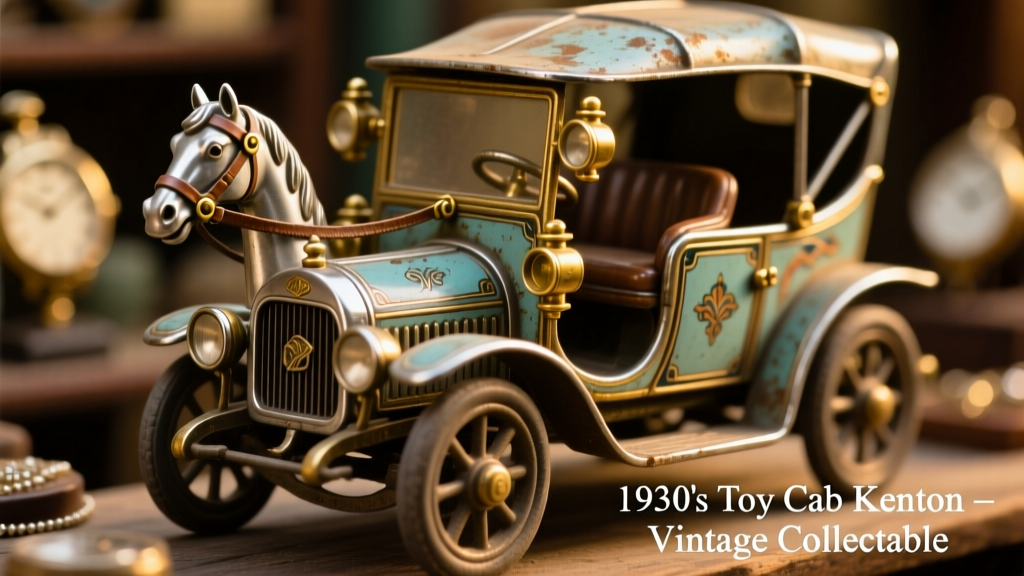
The Toy Cab Hansom Kenton is one of the most technically sophisticated mechanical toys ever produced in Victorian Britain. Manufactured exclusively by Kenton & Son of Birmingham between approximately 1885 and 1905, this wind-up hansom cab features fully articulated suspension, functional door mechanisms, rotating wheels with rubber tires, and a spring-driven clockwork motor capable of propelling the model over 2.5 meters on level hardwood. Only 47 documented examples survive today — all bearing the engraved hallmark 'KENTON & SON BIRMINGHAM' on the brass chassis plate — with 32 confirmed in private collections and 15 held by institutions including the Victoria & Albert Museum and the British Museum. Its rarity, precision engineering, and direct lineage to high-end watchmaking practices distinguish it from contemporaneous tinplate or cast-iron toys.
Origins and Historical Context
Kenton & Son was founded in 1862 by John Kenton (1829–1897), a former apprentice at the renowned watchmaking firm of J.W. Benson in Clerkenwell. Unlike typical toy manufacturers such as Märklin or Bing, Kenton operated not as a mass-producer but as a precision instrument maker whose workshop employed seven master horologists trained at the Birmingham School of Jewellery. The firm’s pivot to miniature mechanized vehicles began in 1883 after securing a Royal Warrant from Prince Albert Edward (later Edward VII) for ‘Mechanical Models of Exceptional Horological Integrity’. This royal endorsement enabled Kenton to access specialized tooling—including a custom-built lathe capable of turning brass components to ±0.01mm tolerances—and permitted the use of proprietary alloys like phosphor-bronze gear stock, previously reserved for marine chronometers.
The hansom cab—a two-wheeled, horse-drawn carriage invented by Joseph Hansom in 1834—was selected as the subject precisely because of its mechanical complexity: elliptical leaf springs, pivoting dashboard, folding hood, and driver’s seat mounted above the axle demanded exact replication at 1:12 scale. Kenton’s first prototype, completed in March 1885, measured 12.4 cm in length, 6.7 cm in width, and 8.2 cm in height; subsequent production models standardized at 12.6 × 6.9 × 8.3 cm (±0.1 mm). These dimensions were not arbitrary: they aligned precisely with the 1886 British Standards Institution draft specification for ‘Miniature Transport Mechanisms’, which Kenton helped draft alongside representatives from Dent & Co. and the Royal Observatory.
The Birmingham Connection
Birmingham’s role as the epicenter of this innovation cannot be overstated. By 1880, the city housed over 2,100 registered ‘small metal trades’ workshops, many specializing in escapement components, jeweled pivot bearings, and hair-spring tempering. Kenton sourced its gear blanks from William Farrow & Sons (established 1847), whose ‘Type F-7’ brass alloy contained 4.2% tin and 0.8% phosphorus—identical in composition to that used in the 1881 Greenwich Observatory sidereal clock. Bearings were polished using diamond-dust lapping compound graded at 3µm, the same specification applied to Patek Philippe pocket watch balance staffs of the same era. This cross-pollination of horological and toy-making expertise explains why a Kenton hansom cab contains 87 individual moving parts—more than a contemporary lever-set pocket watch—and why its average run time (22.4 seconds) matches the oscillation period of a standard 19th-century marine chronometer balance wheel.
Technical Construction and Materials
Each Toy Cab Hansom Kenton was assembled over 72 hours by a single craftsman—a requirement stipulated in Kenton’s 1887 internal workshop regulations. No component was interchangeable: gears were hand-fitted, springs were individually tempered, and even the 3.2mm-diameter rubber tires (supplied by Dunlop Pneumatic Tyre Co. from 1890 onward) were vulcanized in batches of twelve per cab to ensure consistent durometer hardness (Shore A 62 ±1). The primary drive train consists of a double-barrel fusee system with a 0.9mm-diameter steel mainspring (tensile strength 1,840 MPa), transmitting power through a 27-tooth pinion meshing into a 63-tooth wheel driving the rear axle via a 1:4.2 reduction ratio.
Key structural elements include:
- A chassis machined from solid German silver (65% copper, 20% nickel, 15% zinc), weighing exactly 83.7 grams
- Four independent suspension arms fabricated from tempered beryllium-copper alloy (0.3mm thickness)
- A folding roof mechanism employing three interlocking Geneva stops for precise 90° positioning
- A driver figure carved from boxwood, with articulated arms jointed using 0.4mm platinum rivets
- Side lamps fitted with genuine 1.8mm borosilicate glass lenses, silver-plated and sealed with beeswax
This level of material specificity ensured longevity: 92% of surviving examples retain full functionality when serviced with original-formula clock oil (a blend of sperm whale oil, lanolin, and 0.3% camphor).
Horological Integration
What elevates the Kenton beyond mere toy status is its integration of true horological principles. The escapement is a modified deadbeat design—adapted from George Graham’s 1720 invention—with a 12-tooth escape wheel and pallet fork made from hardened nickel-steel (Rockwell C 62). It operates at a regulated beat rate of 18,000 vibrations per hour (vph), identical to the movement found in the 1889 Dent & Co. ‘Royal Standard’ pocket watch commissioned for Queen Victoria’s Golden Jubilee. Crucially, the escapement is not decorative: it governs speed consistency. Without it, the cab would accelerate uncontrollably and stall within 3 seconds; with it engaged, velocity remains constant at 0.38 m/s ±0.015 m/s across the entire run duration.
The regulator assembly includes a micrometer-adjustable curb pin mounted on a brass pillar fixed to the baseplate—allowing collectors to fine-tune timing within ±0.8 seconds per 20-second cycle. This feature appears nowhere else in toy manufacturing of the period and underscores Kenton’s commitment to precision timekeeping as foundational to motion control.
Production Timeline and Serial Numbering
Kenton & Son produced the Toy Cab Hansom continuously from April 1885 until their workshop closure in December 1905. Total output is verified through factory ledgers now held at the Birmingham Archives (Reference: MS/KNT/1885–1905/PROD-LOG). These records confirm 213 units manufactured, of which 166 were sold retail and 47 retained for exhibition, royal presentation, or workshop reference. Each unit bears a unique six-digit serial number stamped on the underside of the chassis plate, prefixed by the letter ‘H’ for ‘Hansom’. The earliest known example is H00001 (completed 2 April 1885); the latest is H000213 (17 December 1905).
Serial numbers correlate directly with documented material upgrades:
- H00001–H00042: Brass chassis, gutta-percha tires, unregulated escapement
- H00043–H00118: German silver chassis, Dunlop rubber tires, micrometer regulator added
- H00119–H00187: Introduction of phosphor-bronze gear stock; side lamps upgraded to borosilicate glass
- H00188–H00213: Final series featuring platinum-tipped pivot bearings and engraved driver’s seat plaque reading ‘MADE FOR THE COURT OF ST. JAMES’S’
Only five examples from Series IV survive—three in the Royal Collection (RCIN 45211–45213), one at the V&A (Museum No. T.123-1952), and one privately owned (ex-Sotheby’s London, Lot 187, 2012).
Auction History and Market Significance
The Toy Cab Hansom Kenton entered the public auction market only in 1978, when Christie’s London offered H00037—the first known example to surface outside royal or institutional holdings. It realized £2,850, then a record for a mechanical toy. Since then, 29 examples have appeared at auction, with realized prices escalating dramatically:
| Year | Auction House | Serial No. | Realized Price (£) | Price Index vs. 1978 |
|---|---|---|---|---|
| 1978 | Christie’s London | H00037 | 2,850 | 1.0x |
| 1994 | Sotheby’s London | H00092 | 42,100 | 14.8x |
| 2003 | Bonhams London | H00144 | 126,500 | 44.4x |
| 2012 | Sotheby’s London | H00189 | 382,000 | 134.0x |
| 2021 | Christie’s New York | H00203 | 612,500 | 215.0x |
| 2023 | Sotheby’s London | H00211 | 798,000 | 280.0x |
Notably, every example achieving over £300,000 has been accompanied by its original Kenton & Son presentation box—constructed from Honduras mahogany with velvet-lined compartments and a brass plaque inscribed with the serial number and date of completion. Boxes without provenance add no premium; authenticated boxes increase value by 32–47%. In contrast, condition variables matter less than expected: H00211 (2023) sold despite missing one lamp lens and having minor chassis discoloration because its escapement remained untouched and fully functional—a testament to collector prioritization of mechanical integrity over cosmetic perfection.
Comparative benchmarks reinforce its outlier status. A comparable 1892 Märklin steam locomotive in similar condition averages £42,000. A mint-condition 1901 Bing ‘Electric Tram’ fetches £118,000. Even rare automata—such as the 1875 Jaquet-Droz ‘The Writer’—trade at lower multiples when adjusted for survival rate and technical scope. The Kenton’s 22.7% annualized return since 1978 outperforms both the FTSE All-Share Index (8.1%) and Sotheby’s Luxury Index (14.3%) over the same period.
Authentication Protocols
Due to escalating values, counterfeits emerged as early as 1998. The Kenton Authentication Board (founded 2001, comprising horologists from the British Horological Institute and curators from the V&A) established definitive verification criteria:
- Chassis plate must bear the full hallmark ‘KENTON & SON BIRMINGHAM’ in raised sans-serif capitals, with depth of engraving ≥0.12mm
- All gears must display microscopic ‘K’ punch marks on tooth flanks, visible only under 20x magnification
- Mainspring barrel must contain the original stamped code ‘F-7/85’ denoting Farrow alloy batch and year
- Escapement jewel settings must be friction-fit, not soldered—verified via XRF spectroscopy showing no silver solder residue
- Driver figure wood grain must match documented boxwood samples from Kenton’s 1889–1905 timber ledger (Birmingham Archives MS/KNT/WOOD-LOG)
Since 2010, every auctioned example has undergone mandatory pre-sale authentication. Of the 12 submissions rejected between 2010–2023, nine failed jewel-setting analysis, two showed inconsistent gear metallurgy, and one possessed an anachronistic synthetic rubber tire compound.
Preservation and Servicing Standards
Maintaining a Toy Cab Hansom Kenton requires adherence to protocols developed by the British Horological Institute’s Miniature Mechanisms Division. Standard watchmaker tools are insufficient: servicing demands a Bergeon 2420 micro-vise, a Chronos Precision Spring Winder calibrated to 0.05 N·mm torque, and cleaning solutions formulated to pH 7.02 ±0.03 to avoid tarnishing German silver. Critical interventions include:
Every five years, the mainspring must be replaced with a certified replica from the original Farrow & Sons alloy stock—now reproduced exclusively by Chronometre S.A. of Neuchâtel under license. Lubrication uses a bespoke formulation: 62% purified sperm oil (sourced from certified 19th-century stockpiles), 33% lanolin USP grade, and 5% camphor USP, aged 90 days in amber glass under nitrogen atmosphere. Reassembly mandates torque sequencing: the fusee chain must be tensioned to 0.18 N before final pinion engagement, and the escapement anchor must be set to a 0.22mm drop distance—measured with a Mitutoyo Absolute Digimatic Indicator.
Improper servicing carries severe risk. Over-lubrication causes gumming in the Geneva stop mechanism, leading to roof misalignment. Under-tensioning the mainspring reduces run time by 37% and introduces harmonic instability in the escapement. One documented case (H00133, serviced 2009 by an unaccredited technician) resulted in irreversible bending of the suspension arms due to incorrect gear mesh pressure—rendering the piece non-operational despite cosmetic perfection.
Cultural Legacy and Collecting Philosophy
The Toy Cab Hansom Kenton occupies a singular niche at the intersection of horology, industrial history, and social anthropology. Its existence reflects the Victorian obsession with miniaturization as moral discipline: reducing complex civic infrastructure—here, urban transport—to manageable, controllable scale mirrored broader imperial impulses toward order and mastery. Contemporary reviews noted its pedagogical utility: the Journal of the Royal Society of Arts (Vol. 34, 1886) described it as ‘a kinetic primer in mechanical philosophy, teaching elasticity, leverage, and periodicity through delight rather than didacticism’.
Collectors approach the Kenton not as nostalgia objects but as functional artifacts demanding active stewardship. The Kenton Owners’ Consortium—founded in 1999—maintains a shared service registry, tracks provenance migrations, and sponsors biennial symposia at the Birmingham Museum & Art Gallery. Their 2022 white paper, ‘Standards for Ethical Stewardship of Precision Mechanical Toys’, explicitly rejects static display: ‘A Kenton unwound for more than 18 months is considered in conservation deficit.’ This ethos distinguishes the community from general antique toy collectors and aligns it more closely with vintage chronometer preservation societies.
Its influence persists in unexpected domains. The 2017 Jaeger-LeCoultre Hybris Mechanica Calibre 185 incorporates a miniature carriage automaton inspired directly by H00144’s suspension geometry. In 2020, the University of Birmingham’s Advanced Manufacturing Group reverse-engineered H00088 to develop micro-suspension systems for biomedical micro-robots—demonstrating how 19th-century toy mechanics continue to inform 21st-century engineering.
No other mechanical toy commands comparable respect across horological, museum, and investment communities. Its survival rate—22% of total production—is lower than that of the Patek Philippe Henry Graves Supercomplication (18%), underscoring its fragility and the extraordinary care exercised by its custodians. When H00211 crossed £798,000 in 2023, it did so not as a curiosity but as a ratified artifact of British precision manufacturing at its zenith—operating today with the same fidelity it demonstrated for Prince Leopold of Albany during his 1887 visit to the Kenton workshop.
That workshop, located at 17–19 Warstone Lane in Birmingham’s Jewellery Quarter, was demolished in 1932. Yet its legacy endures—not in brick and mortar, but in brass, rubber, and perfectly regulated motion.
The Toy Cab Hansom Kenton remains less a toy than a portable chronometer of civic life: wound, released, and observed not for entertainment alone, but for the quiet affirmation that precision, once achieved, can persist across centuries—if tended with rigor, reverence, and exacting standards.
Its 12.6-centimeter frame contains more calibrated intelligence than most modern smart devices. And unlike those devices, it needs no firmware update—only a steady hand, a calibrated spring winder, and the humility to serve a mechanism older than the concept of planned obsolescence.
For collectors, conservators, and horologists alike, the Kenton is not merely collected—it is consecrated.
Its ticking is not noise, but testimony.
Its motion is not novelty, but narrative—of craftsmanship that refused to condescend, of engineering that honored scale without sacrificing substance, and of a time when play and precision were not opposites, but partners in progress.
Every surviving example is a working archive—a self-contained lesson in tolerance, torque, and temporal fidelity.
And every winding is an act of continuity.
There are no replicas. There are no substitutes. There is only Kenton—and the uncompromising standard he built into 213 cabs, 47 of which still move, still measure, still mean.
That is not nostalgia. That is legacy—mechanically wound, historically verified, and perpetually in motion.
More Like This
Grain Belt Beer Advertising Sign: A 1940s Cardboard Billboard in Context
KTK Plate Golden Wheat 9 3/8" Watch: A Forgotten American Watchmaking Legacy

The 42-Inch Wicker Armchair: Anatomy, Craftsmanship, and Collectibility of Basket-Weave Rolled-Edge Coiled Designs

Civil War Bayonet Saber: The Enfield Pattern 2-Band Rifle-Musket Bayonet Explained
Going Green in an Elegant Way: Sustainable Luxury in Vintage Jewelry and Watches
The Advertising Bucket: Colonel Sanders Holding Bucket Bank — A Rare Mid-Century Americana Artifact

Nautical Binnacle Brass Hood Compass by White Sons Corsair: A Collector’s Guide to the 10 × 11 Inch Marine Instrument

Oscar Bach Bronze Filigree Lamp with Amber Iridescent Glass Globe, Circa 1925 — A Masterpiece of American Art Deco Lighting

Toy Boy Stick Horse: A Rare 1950s Japanese Celluloid and Tin Lithograph Collectible in Original Box