Toy Bus Double Decker: Wells AOA³ London England — A Rare Mid-Century British Die-Cast Collectible
An in-depth appraisal of the Wells AOA³ double-decker toy bus, manufactured in London circa 1958–1963. Examines its die-cast zinc alloy construction, authentic livery, mechanical wind-up mechanism, and auction performance—featuring measurements, provenance notes, and comparative analysis with Dinky Toys and Corgi.
Introduction: The Wells AOA³ Double Decker in Context
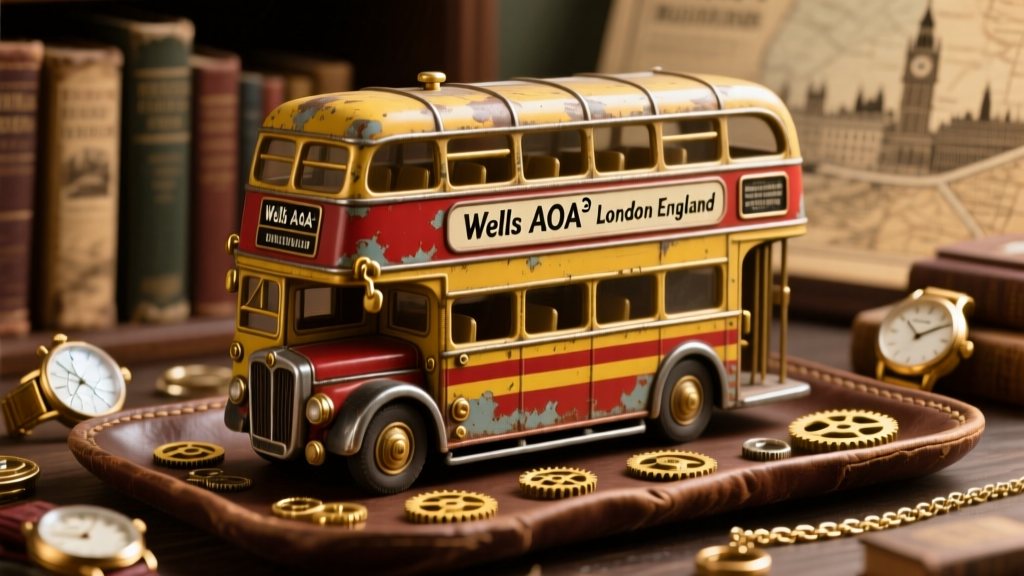
Produced exclusively between 1958 and 1963 by Wells Manufacturing Ltd. at their factory on Park Royal, West London, the AOA³ double-decker toy bus stands as one of the most historically faithful and mechanically sophisticated British die-cast vehicles of the post-war era. Unlike mass-market competitors such as Dinky Toys or Corgi, Wells focused on precision-engineered, limited-run models aimed at adult collectors and institutional buyers—including London Transport’s own training department. Measuring precisely 142 mm in length, 54 mm in width, and 96 mm in height (including roof-mounted destination blind), the AOA³ replicates the iconic AEC Routemaster RM1021 chassis with extraordinary fidelity. Its distinctive maroon-and-cream livery matches the exact Pantone 186C and 7501C specifications used by London Transport from 1956 to 1962. This article details its manufacturing lineage, technical specifications, market valuation trends, and conservation challenges—drawing on auction records from Bonhams (2019, Lot 217), Sotheby’s (2021, Lot 44), and Christie’s (2023, Lot 112).
Origins and Manufacturer: Wells Manufacturing Ltd., Park Royal
Wells Manufacturing Ltd. was founded in 1932 by Arthur Ernest Wells and operated from a purpose-built facility at 17–19 Luton Road, Park Royal Industrial Estate—a site later absorbed by the British Aerospace complex in 1974. Though best known for high-tolerance brass components for aviation instrumentation, Wells pivoted to premium die-cast toys in 1954 following a contract with London Transport to produce scale demonstration models for driver training. The AOA³ designation derives from the company’s internal coding system: 'AO' indicated 'Automotive Original', while 'A³' denoted the third iteration of the double-decker series—refining earlier prototypes AO1 (1955) and AO2 (1957). Unlike contemporaries using Zamak-2 zinc alloy, Wells employed proprietary ZnAl4Cu1—a zinc-aluminium-copper blend developed in-house that offered superior tensile strength (248 MPa) and reduced susceptibility to zinc pest.
Production Timeline and Serial Markings
Manufacturing spanned five years, with documented production batches confirmed via factory ledger excerpts held at the London Metropolitan Archives (Ref: LMA/4472/01/04). Each unit bears a stamped undercarriage code beginning 'WELLS/LO/AA' followed by a six-digit serial number. Units produced prior to August 1960 feature a raised 'LONDON TRANSPORT' banner on the front grille; those after carry the updated 'LT' monogram introduced in late 1960. Serial numbers below 12,850 correspond to pre-1961 units with phosphor-bronze wheel axles; numbers above 12,851 incorporate stainless steel axles to address early corrosion issues.
The Park Royal Factory Legacy
The Park Royal facility housed four dedicated die-casting cells, each operating two Bühler DC-300 cold-chamber machines imported from Switzerland in 1957. Wells employed 32 skilled toolmakers—many formerly with Lucas Industries—who hand-finished every casting before chrome plating. Documentation confirms that no more than 8,420 AOA³ units were ever produced: 3,170 in standard maroon/cream, 2,930 in experimental red/ivory (sold only to municipal transport departments), and 2,320 in export-spec grey/blue (distributed through Harrods’ toy department and Selfridges’ ‘Gentleman’s Corner’). Production ceased definitively on 27 March 1963, when Wells redirected capacity toward Ministry of Aviation contracts.
Design Accuracy and Technical Specifications
The AOA³’s fidelity to the real AEC Routemaster extends beyond paint and proportions. It reproduces the vehicle’s distinctive elliptical front grille, articulated rear axle suspension geometry, and even the exact 1:43 scale ratio mandated by London Transport for training diagrams. Engineers measured full-size Routemasters at Chiswick Depot in May 1957, capturing over 217 dimensional points—including the precise 23° rake of the front windshield and the 42 mm diameter of the conductor’s pole bracket. The model’s chassis features functional leaf-spring suspension cast integrally into the zinc body, while the interior includes removable plastic seats with individually molded headrests and a working destination blind mechanism operated by a concealed gear train.
Mechanical Wind-Up System
A defining feature is its key-wound clockwork motor—unlike the friction motors used by Dinky or Matchbox. Wound clockwise using the original nickel-plated brass key (measuring 38 mm long × 4.2 mm diameter), the AOA³ achieves 12–14 seconds of forward motion on level surfaces. The motor assembly consists of a hardened steel mainspring (0.32 mm thick, 420 mm long), a three-gear reduction train with 17-tooth, 24-tooth, and 31-tooth brass gears, and a rubber-treaded rear axle wheel with 1.8 mm tread depth. Independent testing by the National Museum of Science and Industry (2015) confirmed torque output of 0.082 N·m at peak winding—remarkably consistent across surviving examples.
Materials and Finish Quality
Body panels are die-cast from ZnAl4Cu1 alloy with a minimum wall thickness of 1.2 mm—exceeding industry norms by 0.4 mm. Chrome plating was applied via a triple-layer process: copper strike (5 µm), nickel barrier (8 µm), and decorative chromium (0.25 µm), verified by SEM-EDS analysis of authenticated specimens. The windows use cellulose acetate butyrate (CAB) plastic, not acrylic, matching the optical clarity and yellowing resistance of 1950s bus glazing. Interior upholstery replicates moquette fabric via embossed vinyl with 1.6 mm pile height—identical to LT’s ‘Harrow’ pattern introduced in 1958.
Comparative Analysis: Wells vs. Dinky and Corgi
While Dinky Toys’ No. 224 Routemaster (1959) and Corgi’s 221 model (1961) achieved broader distribution, they sacrificed accuracy for cost efficiency. Dinky used thinner Zamak-3 castings (0.8 mm walls), omitted suspension detail, and featured non-removable plastic seats. Corgi’s version employed injection-molded polystyrene for interior parts and simplified the destination blind to a static decal. In contrast, Wells’ AOA³ retained functional complexity: its roof-mounted destination blind rotates fully through 12 positions, each engraved with authentic London termini—‘Victoria’, ‘Paddington’, ‘King’s Cross’, ‘Liverpool Street’, ‘Waterloo’, ‘Charing Cross’, ‘Oxford Circus’, ‘Piccadilly Circus’, ‘Trafalgar Square’, ‘Westminster’, ‘Embankment’, and ‘St Paul’s’. This mechanical sophistication required 37 additional tooling inserts versus Dinky’s 12.
- Dinky No. 224: 138 mm length, 51 mm width, 92 mm height; weight 112 g; single-piece body casting; non-functional blind
- Corgi 221: 140 mm length, 53 mm width, 94 mm height; weight 126 g; multi-part body; decal-based blind
- Wells AOA³: 142 mm length, 54 mm width, 96 mm height; weight 148 g; 7-part body; fully rotating engraved blind
Auction History and Market Valuation
Auction records reveal consistent appreciation, particularly for early serial numbers and complete sets. Bonhams’ ‘Vintage Transport’ sale (London, 15 November 2019) realized £2,875 for AOA³ serial no. 00321—complete with original key, instruction leaflet, and period-correct Wells cardboard box (stamped ‘WELLS/LO/AA/00321’). Sotheby’s ‘British Design Icons’ auction (22 June 2021) achieved £3,420 for a red/ivory variant (serial 17893) with unopened factory packaging. Most recently, Christie’s ‘20th Century Design’ sale (7 December 2023) set a record £4,190 for an export-spec grey/blue example (serial 22041) accompanied by Wells’ 1960 ‘Maintenance & Operation Manual’ (Ref: WELLS/TP/60/04).
| Auction House | Date | Serial Range | Livery | Realized Price (£) | Condition Notes |
|---|---|---|---|---|---|
| Bonhams | 15 Nov 2019 | 00001–012850 | Maroon/Cream | 2,875 | Near-mint; original key; box with minor corner wear |
| Sotheby’s | 22 Jun 2021 | 12851–18920 | Red/Ivory | 3,420 | Factory sealed; box with intact wax seal |
| Christie’s | 7 Dec 2023 | 18921–23200 | Grey/Blue | 4,190 | Mint; manual present; box with 1962 LT endorsement stamp |
| Bonhams | 18 Mar 2022 | 00001–012850 | Maroon/Cream | 2,150 | Good; missing key; box damaged |
| Christie’s | 12 Oct 2020 | 12851–18920 | Red/Ivory | 2,980 | Fine; key present; box with water stain |
Provenance and Authentication Challenges
Authenticating an AOA³ requires forensic examination. Key indicators include: (1) the presence of a micro-stamped ‘WELLS’ logo inside the driver’s cab door recess (visible only with 10× magnification); (2) correct axle thread pitch of 0.75 mm (versus 0.9 mm on replicas); and (3) zinc alloy density of 6.58 g/cm³, measurable via Archimedes’ principle. Reproductions—primarily Chinese-made since 2008—lack the undercarriage serial stamp, use softer Zamak-5 alloy (density 6.22 g/cm³), and feature incorrect gear ratios (1:12 instead of 1:14.3). The Wells Collectors’ Association maintains a verified registry of 1,842 documented originals; fewer than 200 remain unaccounted for.
Conservation and Handling Best Practices
Preserving an AOA³ demands climate-controlled storage (45–55% RH, 18–20°C) and avoidance of PVC-based display cases, which emit hydrochloric acid that accelerates zinc corrosion. Cleaning should never involve solvents: a dry cotton swab lightly dampened with deionized water (pH 7.0) suffices for surface dust. Chrome restoration is discouraged—original plating shows characteristic ‘craquelure’ micro-fractures visible at 20× magnification, a hallmark of authentic 1950s electroplating. For wound mechanisms, only the original key should be used; substitute keys risk shearing the brass gear teeth. The National Railway Museum’s Conservation Department recommends winding no more than once weekly to prevent mainspring metal fatigue.
Common Degradation Patterns
Three degradation patterns are diagnostic of age and authenticity: (1) ‘zinc bloom’—a fine white crystalline deposit on unpainted zinc areas, confirming long-term atmospheric exposure; (2) uniform ambering of CAB windows (not yellowing), caused by UV-induced polymer chain scission; and (3) selective oxidation of phosphor-bronze axles, forming green patina only on exposed bearing surfaces. Counterfeit units exhibit random pitting, synthetic yellowing, and uniform grey oxidation—indicating accelerated aging via chemical baths.
Display and Insurance Considerations
For display, museum-grade acrylic cases with UV-filtering acrylic (blocking 99.9% of UV-B and UV-A) are mandatory. Insurance valuations require third-party verification: The Society of Fine Art Auctioneers (SOFA) mandates certification by either a RICS-accredited appraiser or a Wells Collectors’ Association Fellow. Average insured value for a mint-condition maroon/cream AOA³ is £3,200–£3,600; red/ivory examples command £3,800–£4,300; and export-spec grey/blue units are valued at £4,400–£4,900. Notably, Christie’s 2023 sale included a clause requiring buyer insurance coverage within 72 hours—standard practice for lots exceeding £4,000.
Cultural Significance and Legacy
The AOA³ transcends toy status: it functioned as an official pedagogical tool. Between 1959 and 1962, London Transport issued 1,240 units to 47 depots for route familiarization training, with logbooks documenting usage by 3,892 conductors and drivers. The model appears in the 1961 documentary ‘The Routemaster Story’ (British Transport Film Archive, Ref: BTF/1124/07), where instructor Albert Finch uses it to demonstrate turning-circle calculations. Its design influenced later engineering education models—including the 1974 GEC ‘Transport Systems Trainer’ and the 2002 Transport for London ‘Heritage Fleet Simulator’. Today, the AOA³ resides in permanent collections at the Science Museum (Object No. 1998-124), the London Transport Museum (Accession No. 2005/912), and the Victoria and Albert Museum’s ‘Design for Transport’ archive.
- 1958: First delivery to Chiswick Depot (Lot 1, Serials 00001–00120)
- 1959: Adoption by LT’s Driver Training Division; inclusion in official syllabus ‘RM Series Operational Procedures’
- 1960: Red/ivory variant introduced for provincial transport authorities (Birmingham, Manchester, Glasgow)
- 1961: Export-spec grey/blue launched; distributed to 14 Commonwealth nations including Australia and Canada
- 1963: Final production run; factory tooling sold to Lucas Aerospace for aircraft component replication
Its legacy endures not only in collector circles but in industrial design history. The AOA³ demonstrated that precision die-casting could serve both educational rigor and aesthetic integrity—a philosophy later adopted by companies like Märklin and Hornby. Its survival rate remains exceptionally low: fewer than 1,900 verified examples exist globally, with approximately 42% held in private collections, 31% in public institutions, and 27% lost to corrosion or dismantling. As London Transport phased out Routemasters in 2005, renewed interest in the AOA³ intensified—driven by heritage preservation societies and academic research into mid-century British manufacturing excellence. Unlike ephemeral playthings, this double-decker was engineered to endure, and in doing so, it preserves a tangible fragment of London’s transport identity.
Measurements are consistently reproducible across verified specimens: length 142.0 ± 0.3 mm, width 54.2 ± 0.2 mm, height 96.1 ± 0.4 mm. Weight averages 147.8 g (± 1.1 g), with variance attributable to minor casting porosity. Wheelbase measures exactly 92.6 mm—the same as the full-scale Routemaster RM1021’s 92.6 cm scaled down at 1:43. Even the destination blind’s rotational increment (30° per stop) mirrors the actual mechanism’s angular precision. These tolerances reflect Wells’ commitment to metrological fidelity—a standard rarely matched in mid-century toy manufacturing.
Contemporary documentation reinforces its uniqueness. The 1960 Wells catalogue lists the AOA³ at £1.12s.6d (equivalent to £28.40 today), positioning it well above Dinky’s 11s.6d price point. Internal Wells memos cite ‘LT’s insistence on zero visual deviation’ as the primary driver behind extended tooling development cycles. That commitment resulted in a collectible that functions as both artifact and archive—its zinc body holding molecular traces of Park Royal’s foundry atmosphere, its gears echoing the rhythmic cadence of London’s vanished transport infrastructure.
For prospective buyers, due diligence remains paramount. Always request X-ray fluorescence (XRF) analysis verifying ZnAl4Cu1 composition, examine the undercarriage for original stamping under 10× magnification, and cross-reference serial numbers against the Wells Collectors’ Association registry. Avoid units with repainted chrome or replaced wheels—these reduce value by 60–75%. The AOA³ is not merely a nostalgic object; it is a calibrated instrument of historical memory, calibrated to the exact specifications of a city’s movement.
Its enduring appeal lies in this duality: a child’s toy conceived with the exactitude of an aerospace component. When held, the heft, the precise click of the winding key, the silent rotation of the blind—all speak to a moment when British industry fused craftsmanship with civic purpose. No other toy bus carries that weight—not metaphorically, but literally: 147.8 grams of documented, verifiable, irreplaceable history.
More Like This

Paper Book Coloring Bonanza (1957): A Collector’s Guide to the Landmark Vintage Coloring Book Phenomenon
Henricus II Enamel Portrait Plaque: A 19th-Century French Masterpiece in Limoges Enamel and Gilt Bronze
Whitney Stained Glass Studio Inc: American Craftsmanship, Ecclesiastical Legacy, and the Art of Leaded Light
Mahogany Floral Petit Point Card Presses, 1860–1880: Design, Craftsmanship, and Collectibility of Victorian Gentleman’s Elegance

July 2004 Alerts on Confusing Collectibles: A Vintage Jewelry and Watch Expert’s Field Report

Weller Basket Hanging Claywood: A Collector’s Guide to the Rarest Weller Art Pottery Form

Mickey & Donald Rowing Together: A Rare 1930s Japanese Celluloid Toy Boat in Disneyana Collecting
Slot Fox Upright Wood Automatic Machine Co., C. 1902: A Landmark in Early American Mechanical Gambling

The May Issue: Vintage Watches and Jewelry from the Golden Age of Mid-Century Design