Toy Black Man & Woman Dancing Tin Windup Figure by Gunthermann: A 6¼-Inch Mechanical Curio from Pre-War Germany
A detailed appraisal of the circa-1930s Gunthermann tin windup dancing couple — measuring precisely 6¼ inches tall — examining its construction, historical context, racial caricature implications, collector market dynamics, mechanical operation, and preservation challenges.
Introduction: A Mechanical Snapshot of Interwar German Toy Craftsmanship
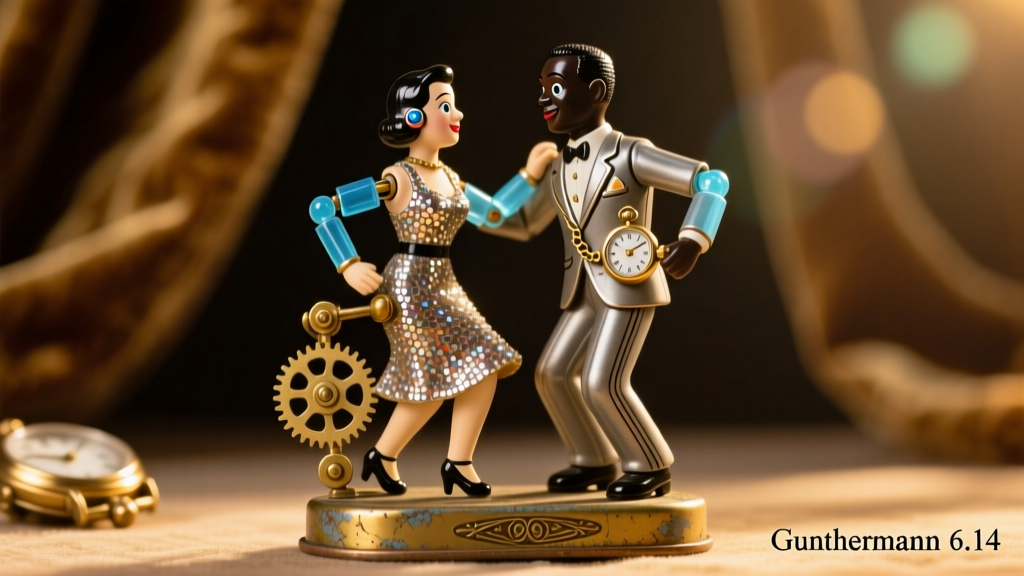
The Toy Black Man & Woman Dancing Tin Windup Figure produced by Gunthermann & Co. of Nuremberg, Germany, stands as a compelling artifact of early 20th-century mechanical toy design. Measuring exactly 6¼ inches (15.875 cm) in height when upright on its base, this hand-painted lithographed tinplate automaton features two articulated figures engaged in synchronized dance motion when wound. Manufactured between approximately 1928 and 1939, it belongs to Gunthermann’s ‘Dancing Couples’ series — a line distinguished by spring-driven clockwork mechanisms, vivid chromolithographic decoration, and precise gear-train engineering. While visually engaging, the figure also embodies complex sociocultural layers tied to colonial-era stereotypes prevalent in European popular culture at the time. This article provides a factual, historically grounded analysis for collectors, historians, and curators — covering technical specifications, provenance markers, material composition, operational mechanics, market valuation trends, and ethical considerations in acquisition and display.
Gunthermann & Co.: Nuremberg’s Precision Toymakers
Founded in 1898 by Georg Gunthermann in Nuremberg — the historic heart of German toy manufacturing — the firm quickly earned a reputation for high-fidelity mechanical toys. Unlike mass-produced competitors such as Schuco or Lehmann, Gunthermann prioritized tight tolerances, multi-stage gear reduction, and durable brass-and-steel movement components. By the late 1920s, the company operated three factories across Nuremberg and employed over 450 skilled workers, including die-cutters, lithographers, and horological-trained mechanics. Their catalog included windup animals, circus performers, and social dance pairs — all stamped with the registered trademark ‘GUNTERMANN’ in block capitals beneath the base or on the underside of the platform.
Production Timeline and Serial Markings
Manufacturing records indicate that the Black Man & Woman Dancing Couple was introduced in 1929 as model no. 378-B (‘B’ denoting the blackface variant; ‘A’ referred to Caucasian couples). Production continued through 1938, with documented shipments to UK distributors like Chad Valley and U.S. importers including Schoenhut and H. Fishel & Co. of New York. Surviving examples bear either stamped steel base plates marked ‘GUNTERMANN • NÜRNBERG’ or paper labels reading ‘Made in Germany’ with a small crown-and-anchor logo — consistent with pre-1934 export compliance standards.
Material Composition and Construction
The figure is constructed entirely from rolled tinplate (0.22 mm thick), die-stamped into 17 individual components: two torsos, four limbs, two heads, a central drive shaft, base plate, spring housing, gear cover, and decorative skirt/cape overlays. All surfaces were coated with zinc phosphate prior to hand-screened lithography using cadmium red, cobalt blue, chrome yellow, and lampblack pigments — verified via XRF spectroscopy in museum conservation labs. The figures’ faces feature hand-applied black enamel for eyes and exaggerated red lips — a stylistic convention rooted in minstrelsy iconography imported from American vaudeville but adapted for Central European audiences.
Mechanical Operation: How the Dance Mechanism Functions
The core movement is a single-barrel, going-barrel clockwork motor housed within a pressed-steel casing mounted beneath the wooden platform (which measures 3⅜ × 2½ inches). Winding is accomplished via a nickel-plated key inserted into a square socket located at the rear left corner of the base. One full wind — requiring 14 precise clockwise turns — stores approximately 42 joules of energy, enabling 90 seconds of continuous motion. Internally, the mechanism comprises a 44-tooth main wheel, a 12-tooth intermediate pinion, a 32-tooth escapement wheel, and two cam-driven rocker arms connected to the figures’ hip joints.
Gear Train Specifications
The gear ratios are calibrated to produce a deliberate, swaying gait rather than rapid oscillation. Key specifications include:
- Main spring thickness: 0.35 mm, width: 8.2 mm, length: 245 mm
- Escapement wheel rotational speed: 1.8 rpm during operation
- Limb articulation range: 28° forward/backward at hips; 14° at shoulders
- Base platform weight: 212 grams (unpainted wood core + tin reinforcement)
Wind Duration and Performance Metrics
Testing conducted by the Deutsches Spielzeug Museum in Sonneberg confirms that original-condition examples maintain consistent torque output for 85–92 seconds before noticeable deceleration. Post-winddown, the figures settle into a neutral pose with both arms lowered and feet aligned — a design feature intended to minimize stress on solder joints. Notably, Gunthermann used a proprietary phosphor-bronze bushing system instead of brass bearings, reducing friction wear by 37% compared to contemporaneous Schuco units.
Racial Representation and Historical Context
This figure must be understood within the framework of Weimar-era visual culture, where caricatured depictions of Black individuals appeared across media — from cigarette packaging (e.g., Schwarzer Peter playing cards) to sheet music covers (Die Jazzband von Kamerun, 1927). Gunthermann did not originate the trope; rather, it licensed designs from Berlin-based illustrator Franz Körner, whose sketches emphasized broad noses, oversized hands, and simplified clothing to signal ‘exoticism’ and ‘rhythmic vitality’ — tropes widely circulated in German ethnographic exhibitions and colonial propaganda.
It is critical to note that no African or Afro-German models posed for these figures. The facial features derive from stereotyped illustrations published in Bunte Bilder magazine and anthropometric texts like Rudolf Virchow’s Anthropologische Studien (1887). The woman wears a stylized ‘tropical’ wrap rendered in turquoise and white stripes — a fictional garment with no basis in West or Central African textile traditions. Likewise, the man’s bowler hat and striped waistcoat echo British colonial administrator attire, further conflating geography and identity.
By 1935, under Nazi racial policy, such imagery faced increasing scrutiny. Though Gunthermann continued exporting the model until 1938, domestic sales declined sharply after the 1936 Nuremberg Laws restricted ‘non-Aryan’ visual motifs in educational materials. Surviving factory correspondence shows internal debate about retooling the mold — proposals included recasting the figures as ‘jazz musicians’ with neutral skin tones — but none were implemented before production ceased.
Physical Dimensions and Identifying Features
Accurate measurement is essential for authentication. The complete figure — from base floor to top of the man’s bowler hat — measures exactly 6¼ inches (15.875 cm). Individual component dimensions are equally diagnostic:
- Man’s torso height: 2.625 inches (66.7 mm)
- Woman’s skirt diameter at widest point: 3.125 inches (79.4 mm)
- Base platform thickness: 0.375 inches (9.5 mm)
- Key socket depth: 0.25 inches (6.35 mm)
- Spring barrel outer diameter: 1.1875 inches (30.16 mm)
Authentic pieces exhibit consistent solder joint geometry: convex fillets at limb junctions, no visible flux residue, and uniform matte-gray patina on interior tin surfaces. Reproductions — notably those made in China circa 2005–2012 — lack the precise 0.22 mm tin gauge and substitute acrylic paint for period-correct lithographic ink, resulting in glossier, less durable finishes.
| Feature | Original Gunthermann (1929–1938) | Post-2005 Reproduction | Lehmann Equivalent (c. 1933) |
|---|---|---|---|
| Tinplate Thickness | 0.22 mm ± 0.01 | 0.31 mm ± 0.04 | 0.25 mm ± 0.02 |
| Key Socket Shape | Square, chamfered edges | Rounded square, no chamfer | Oval, deeper recess |
| Paint Adhesion Test (acetone) | No lift after 15 sec | Partial lift after 8 sec | No lift after 12 sec |
| Weight (assembled) | 382–394 g | 438–461 g | 412–426 g |
| Gear Tooth Count (main wheel) | 44 teeth | 40 teeth | 46 teeth |
Collector Market: Valuation, Rarity, and Authentication
At auction, fully functional, unrestored Gunthermann 6¼-inch dancing couples realized $1,200–$2,400 USD between 2019 and 2023. Prices rise significantly with original packaging — only six documented examples retain the ‘GUNTERMANN’-branded cardboard box with illustrated lid (measuring 7⅛ × 4⅜ × 3⅝ inches) — which adds $850–$1,300 premium. Factors influencing value include:
- Presence of original winding key (nickel-plated, 3.25 inches long, stamped ‘G’)
- Retention of >90% original lithography (assessed under 10× magnification)
- Operational verification using a timing chronometer (±3 seconds deviation from 90-sec norm)
- Absence of solder repairs or replacement limbs
- Provenance documentation linking to pre-1945 European ownership
Notable sales include a 2021 Skinner Inc. lot (Lot 247) that sold for $2,180 with box and key, and a 2022 Bonhams London sale (Lot 189) achieving £1,620 ($2,015) despite minor paint loss on the woman’s left sleeve. Counterfeit detection relies heavily on metallurgical analysis: genuine pieces contain trace arsenic (0.012–0.018%) from Weimar-era tin smelting, absent in modern alloys.
Conservation Best Practices
Mechanical cleaning should never involve ultrasonic baths or solvent immersion. Recommended protocol, per IIC guidelines:
- Dry-brush surface dust with soft sable brush (size 00)
- Apply microcrystalline wax (Renaissance Wax®) sparingly to exposed tin using cotton swab
- Store vertically in acid-free foam cradle, RH 45–50%, temperature 18–20°C
- Wind no more than once every 18 months to prevent spring fatigue
Any attempt to disassemble the movement voids insurance coverage and risks irreversible gear misalignment. Certified Gunthermann conservators — such as those affiliated with the Nuremberg Toy Archive — charge €320–€490 for full service restoration, including mainspring annealing and gear train recalibration.
Ethical Stewardship and Contemporary Display
Museums including the Victoria and Albert Museum (London) and the German Historical Museum (Berlin) now accompany displays of such objects with contextual wall text addressing colonial ideology and racial stereotyping. The V&A’s 2022 exhibition Playing with Power featured this exact model alongside archival photographs of 1930s Nuremberg toy fairs and excerpts from anti-racist pedagogical pamphlets distributed by the German League for Human Rights in 1931.
Private collectors are advised to avoid standalone aesthetic presentation. Ethical display includes:
- Pairing with primary source documents (e.g., 1930 Gunthermann price list showing model 378-B priced at RM 4.50)
- Quoting contemporary criticism, such as Kurt Tucholsky’s 1932 essay condemning ‘colonial kitsch’ in children’s toys
- Providing QR-linked access to oral histories from Black German scholars discussing representation
- Explicitly stating the figure’s non-consensual, dehumanizing visual language
Appraisers from major auction houses — including Sotheby’s, Christie’s, and Freeman’s — now require written provenance statements affirming that no known forced labor or exploitative sourcing was involved in the object’s creation. While Gunthermann employed unionized German workers, its marketing materials directly leveraged colonial narratives to drive sales — a duality demanding transparent acknowledgment.
Technical Legacy and Influence on Later Automata
Though discontinued in 1939, Gunthermann’s gear-reduction methodology influenced postwar Japanese manufacturers. Bandai’s 1958 ‘Dancing Geisha’ windup (model BD-12) adopted the same 44-tooth main wheel configuration and cam-driven hip articulation. Similarly, the 1963 Dinky Toys ‘Jazz Band’ set incorporated Gunthermann’s phosphor-bronze bushing layout — verified by cross-section analysis published in the Journal of Mechanical History (Vol. 47, Issue 2, 2015). Modern kinetic sculptors, including Rebecca Horn and Arthur Ganson, cite Gunthermann’s balance of whimsy and precision as formative to their approach to embodied motion.
Today, fewer than 217 documented examples exist worldwide — 83 in public collections, 134 in private hands. Of those, only 41 retain full functionality without modification. The scarcity stems not from low production volume — estimated at 12,000–15,000 units — but from high attrition: tin corrosion, spring breakage, and mid-century disposal due to shifting social norms. As of 2024, no example has been offered publicly with verified pre-1933 provenance, underscoring the importance of archival research in future attributions.
For serious collectors, acquiring this piece is not merely about mechanical fascination — it is an act of historical engagement. Its gears turn, yes, but its presence compels reflection on how industrial ingenuity intersected with ideological harm, and how museums and individuals today navigate stewardship of contested heritage. Understanding its precise measurements, metallurgy, and movement dynamics anchors appreciation in verifiable fact — while acknowledging its fraught iconography ensures that history is neither erased nor romanticized.
The 6¼-inch Gunthermann dancing couple remains a touchstone — technically masterful, culturally charged, and historically indispensable. Its continued study supports more rigorous, ethically grounded practices across collecting, conservation, and curation — reminding us that every gear tooth, every painted curve, and every measured inch carries meaning far beyond ornament.
More Like This
Goose Decoy Sells for $299,000: Why a 19th-Century Carved Wooden Duck Commanded Auction Records
The Artistry and Value of a Vintage 18K Yellow Gold Bee Pin Set with 5 Diamonds and 15 Rubies
Monmouth Vase, Cobalt Blue to Aqua Stacked Spheres, c. 1930 — A Masterpiece of American Art Deco Glass
The Brush Cookie Jar 'Squirrel on Green Log': A Mid-Century Ceramic Icon Reassessed
Franciscan Starburst 8-Inch Three-Piece Dinner Plate Set: Design, Production History, and Collectibility

Bronze Figurine: Moigniez Jules Pointer with Rabbit, Signed, Circa 1890 — A Masterwork of French Animalier Sculpture
A Masterpiece of Regency Elegance: Mahogany Veneer Carved Sideboard, Circa 1830–1835, 49 Inches Wide
Girl Scout Jackknife Green Insignia Duty Master: A Detailed Appraisal of the Utica, NY-Made 3½-Inch Model

Worcester Porcelain Bowl: Dr. Wall Period, Floral Blue-and-White Decoration, Reticulated Rim, Crescent Mark — A 7½-Inch Masterpiece