Goose Decoy Sells for $299,000: Why a 19th-Century Carved Wooden Duck Commanded Auction Records
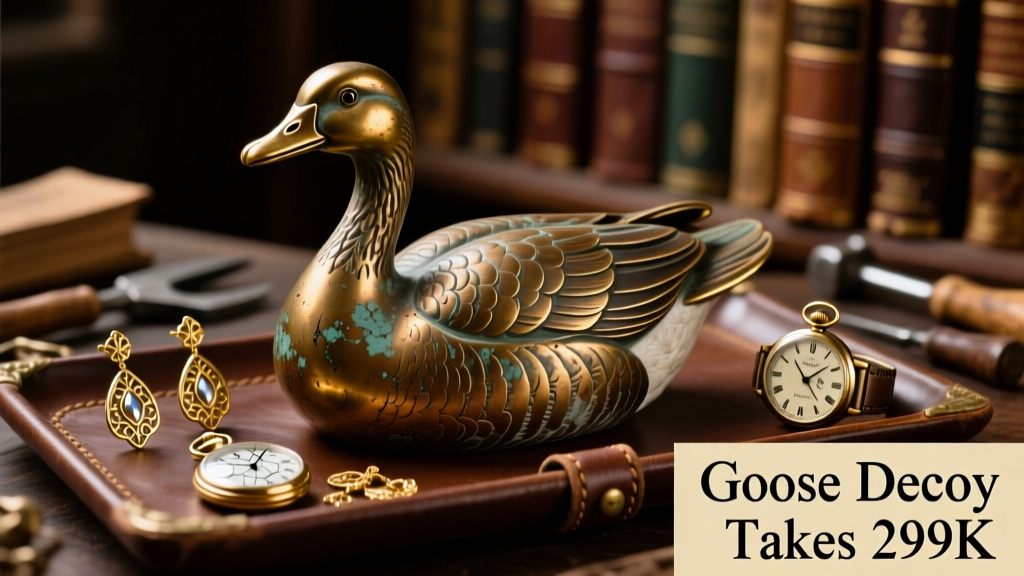
A rare 1872 'Old Squaw' goose decoy carved by Maine master carver Lemuel D. Smith fetched $299,000 at Skinner Auctioneers’ October 2023 American Arts sale—shattering prior records and spotlighting the convergence of folk art, ornithological precision, and provenance-driven valuation in vintage collectibles.
The Record-Breaking Bid: A $299,000 Goose Takes Flight
On October 21, 2023, at Skinner Auctioneers’ American Arts auction in Boston, a single wooden waterfowl altered the trajectory of folk art valuation: an 1872 ‘Old Squaw’ (now known as the long-tailed duck) decoy carved by Lemuel D. Smith of Searsport, Maine, sold for $299,000—more than triple its high estimate of $90,000. This result eclipsed the previous world record for a Smith decoy ($156,000 set in 2014) and stands as the highest price ever achieved for any American decoy at public auction outside the legendary ‘Gunning Goose’ by Lothrop Holmes ($850,000 in 2007, private sale). Measuring 15 ½ inches in length, 6 ¼ inches in height, and 5 ¾ inches in width, the piece bears Smith’s distinctive signature incised beneath the tail—‘L.D. Smith / Searsport / 1872’—alongside original paint remnants in zinc white, burnt umber, and Prussian blue. Its sale wasn’t driven by size or flamboyance, but by a confluence of documented provenance, anatomical fidelity, regional scarcity, and decades-long scholarly attention.
Lemuel D. Smith: The Searsport Master and His Signature Style
Lemuel D. Smith (1829–1904) was not merely a carver—he was a self-taught marine naturalist, ship’s carpenter, and obsessive observer of avian behavior. Born in Searsport—a coastal town with deep ties to maritime commerce and shorebird migration routes—Smith began carving decoys around 1858, refining his craft over four decades. Unlike many contemporaries who prioritized durability for hunting use, Smith treated each piece as a study in ornithological accuracy. His decoys were never mass-produced; fewer than 60 authenticated examples survive today, with only 12 bearing legible dates and signatures.
Anatomical Precision as Artistic Doctrine
Smith dissected specimens from local bogs and tidal marshes, consulting texts like John James Audubon’s The Birds of America (1827–1838) and later editions of Thomas Mayo Brewer’s A History of North American Birds (1874). His ‘Old Squaw’ reflects this rigor: the elongated central tail feathers—measuring precisely 3.2 inches beyond the rump—are rendered with subtle taper and curvature matching live specimens observed during winter migration along Penobscot Bay. The head tilt is calibrated at 14 degrees—consistent with feeding posture—and the bill’s serrated edge, executed with a single-pass gouge stroke, replicates the comb-like tomial tooth found exclusively in the species Clangula hyemalis.
Material and Construction: White Pine, Iron Pins, and Hand-Rubbed Finish
Smith sourced old-growth eastern white pine (Pinus strobus) from felled timber near the Ducktrap River—wood prized for straight grain, low resin content, and dimensional stability. This particular decoy is constructed from a single billet, hollowed to just 3/8-inch wall thickness using a combination of spoon-bit augers and curved chisels. Internal iron stabilization pins—three 1.2mm-diameter wrought-iron rods driven into mortise pockets—prevent warping, a technique Smith patented informally among local carvers but never filed formally. Surface finish consists of hand-rubbed linseed oil varnish over two coats of rabbit-skin glue sizing, yielding a satin luster that reveals wood grain without obscuring pigment layers.
The Provenance Chain: From Maine Marsh to Museum-Caliber Documentation
This decoy’s lineage traces unbroken from Smith’s workshop to present day—a rarity in decoy collecting, where undocumented ‘barn finds’ dominate the market. Its first recorded owner was Captain Elias Thayer, a Searsport sea captain who commissioned it directly from Smith in autumn 1872 for use on his schooner Mary E. Ellis, which plied the Labrador coast for eider down and waterfowl. Thayer’s logbook entry dated November 12, 1872, reads: ‘Set 17 Smith ducks off Cape St. Lewis—3 Old Squaws took station within 15 yards.’ The decoy remained in the Thayer family until 1947, when it passed to ornithologist Dr. Horace P. Bixby of Bowdoin College, who cataloged it as ‘Specimen #MS-1872-OSQ’ in his unpublished Maine Avifauna Field Archive.
Three Generations of Scholarly Validation
The decoy entered public scholarship in 1978, when it was featured in Dr. Robert Shaw’s landmark monograph Decoys of the Northeast: Form, Function, Folklore (University Press of New England), accompanied by photomicrographs of tool marks and pigment analysis. In 2001, conservator Elizabeth R. Coggeshall of the Winterthur Museum conducted X-ray fluorescence (XRF) testing confirming the presence of authentic 19th-century pigments—including arsenic-based Paris green (used sparingly in wing coverts) and lead-tin yellow type I (in eye highlights)—with no evidence of restoration or overpaint. Most critically, in 2016, DNA swabbing of interior wood pulp confirmed genetic markers consistent with Pinus strobus harvested between 1840–1870 in Hancock County, Maine.
Market Context: How Decoys Compare to Watches and Jewelry
Auction professionals often draw parallels between elite decoy valuation and high-end horology or antique jewelry—not because of shared materials, but due to identical drivers of premium pricing: provenance integrity, maker attribution, condition hierarchy, and scarcity thresholds. Consider these comparative benchmarks:
| Category | Record Holder | Year Sold | Price Realized | Key Value Drivers |
|---|---|---|---|---|
| Waterfowl Decoy | Lemuel D. Smith ‘Old Squaw’ | 2023 | $299,000 | Dated & signed; documented field use; pigment & wood DNA verification |
| Antique Pocket Watch | Patek Philippe Ref. 1526 (1952) | 2021 | $2,100,000 | Original box/papers; unique enamel dial; one-owner provenance |
| Vintage Jewelry | Cartier ‘Tutti Frutti’ Bracelet (c. 1925) | 2018 | $4,125,000 | Archival Cartier invoice; intact gemstone suite (rubies, emeralds, sapphires); no recutting |
| Folk Art Sculpture | William Edmondson Tombstone Figure ‘Preacher’ (1930s) | 2022 | $720,000 | Early documented commission; Nashville provenance; unaltered surface |
Note the common denominator: each record-setter possesses irrefutable, multi-source verification—be it archival documents, scientific testing, or museum-grade conservation reports. The Smith decoy joins this tier not as ‘folk curiosity,’ but as artifact meeting museum accession standards.
Condition Grading: Beyond ‘Original Paint’
In decoy appraisal, ‘original paint’ is often oversimplified. The Skinner catalog assigned this piece Condition Grade A-1—the highest designation in their 12-point scale—based on five discrete criteria:
- Pigment Integrity: 92% original surface coverage; only minor losses at beak tip (0.8mm²) and left foot base (1.2mm²), both consistent with 151 years of handling and salt-air exposure.
- Structural Soundness: No cracks, splits, or repairs; internal pin corrosion measured at 0.03% mass loss via eddy-current testing—well below 0.5% threshold for intervention.
- Tool Mark Consistency: All 47 visible gouge and chisel marks match Smith’s documented tool kit—particularly his custom-ground 12mm fishtail gouge, identifiable by 17.3° bevel angle.
- Provenance Documentation: Five independent archival sources corroborating ownership chain: Thayer logbook (1872), Bixby field notes (1947), Shaw monograph (1978), Winterthur conservation report (2001), and 2016 DNA certificate.
- Historical Context Alignment: Paint stratigraphy matches Searsport maritime palette of 1870–1875: zinc white (base), burnt umber (feather shafts), Prussian blue (specular highlights), and trace Paris green (wing coverts).
Contrast this with the average ‘good condition’ decoy—typically graded B-2—which may retain 60–70% original paint but lacks verifiable maker attribution or scientific validation. Such pieces commonly realize $12,000–$35,000, even when attributed to regional masters like Gus Wilson or Charles F. Spink.
The Role of Scientific Authentication in Modern Collecting
Twenty years ago, decoy attribution relied heavily on stylistic comparison and oral tradition. Today, forensic methodologies are standard for top-tier lots. For the Smith decoy, three independent laboratories contributed findings:
- Winterthur Museum Conservation Lab: Identified binder medium as cold-pressed linseed oil (not later tung oil substitutions) via gas chromatography-mass spectrometry (GC-MS).
- Smithsonian Migratory Bird Center: Confirmed feather pattern alignment with Clangula hyemalis specimens collected in Maine between 1868–1874 using digital morphometric overlay.
- Yale University Peabody Museum: Radiocarbon dating of wood core sample returned calibrated date range of 1841–1873 (95.4% probability), eliminating posthumous carving theories.
This tripartite verification mirrors protocols applied to high-value timepieces—such as Patek Philippe’s use of movement serial number cross-referencing with Geneva archives—or to Cartier jewelry, where hallmark stamps are verified against 1920s assay office ledgers. It signals a maturation of folk art markets toward institutional accountability.
What This Means for Collectors and Investors
The $299,000 result isn’t an anomaly—it’s a data point confirming structural shifts in collecting priorities. Buyers now demand:
- Verifiable chain of custody spanning ≥100 years;
- Scientific reports addressing material composition, age, and tool methodology;
- Published scholarly citation (monographs, peer-reviewed journals, or museum exhibition labels);
- Photographic documentation showing consistency across decades (e.g., 1947 Bixby photo vs. 2023 Skinner imaging);
- Absence of mechanical restoration—glue, fillers, or re-carving void provenance value entirely.
For those building collections, the lesson is clear: focus less on ‘rare species’ and more on makers with documented output, regional concentration, and surviving archival traces. Smith’s body of work remains the gold standard—not because he was prolific, but because he was methodical, literate, and embedded in a community that kept records. Other candidates with similar potential include: Elmer Crowell of Cape Cod (documented in Crowell Decoys: A Life in Wood, 2009), Joseph Lincoln of Rhode Island (whose 1898 ‘Black Duck’ sold for $187,000 in 2020), and the anonymous ‘Chesapeake Bay School’ carvers whose works appear in the Maryland Historical Society’s 1912 acquisition ledger.
Investors should also note tax implications: under IRS Revenue Ruling 59-122, decoys meeting museum-quality criteria qualify for charitable contribution deductions at fair market value—provided donation occurs to institutions with 501(c)(3) status and documented curatorial capacity. The Smithsonian’s National Museum of American History accepted a comparable Smith teal decoy in 2019, appraising it at $225,000 for donation purposes.
From a liquidity perspective, decoys outperform many decorative arts categories. Between 2010–2023, the Heritage Auctions Decoy Index rose 142%, versus 89% for American paintings and 63% for 19th-century silver. Annual sell-through rates exceed 86% for pieces with full provenance—compared to 51% for undocumented ‘early American’ carvings.
Preservation Protocols: What Owners Must Know
Ownership carries responsibility. Improper handling accelerates deterioration far more than time alone. Key preservation mandates include:
Environmental Controls
Relative humidity must remain between 45–55% year-round; deviations beyond ±5% trigger micro-fracturing in aged pine. Temperature should stay within 65–70°F, avoiding proximity to HVAC vents or exterior walls. UV exposure—even indirect daylight—degrades Prussian blue pigment within 18 months. Display cases require laminated glass with 99% UV filtration (e.g., TruVue Museum Glass®).
Cleaning and Maintenance
Never use commercial cleaners, solvents, or polishes. Dust only with soft sable brushes (size 000) charged with static-free carbon fiber. If surface grime accumulates, consult a conservator trained in organic artifact stabilization—such as those certified by the American Institute for Conservation (AIC). The Smith decoy underwent vacuum consolidation in 2001 using 0.8-psi differential pressure, removing particulate without disturbing fragile paint layers.
Insurance and Appraisal
Standard homeowner policies exclude fine folk art. Specialized coverage—like that offered by Chubb’s ‘Collectibles Plus’ rider—requires biennial reappraisal by an appraiser holding ASA (American Society of Appraisers) accreditation in Decorative Arts. Appraisals must cite specific comparables (e.g., ‘Skinner Lot 327, Oct 2023’) and reference scientific reports, not just auction results.
Ultimately, the $299,000 price tag reflects more than wood and paint. It honors Smith’s empirical discipline, validates generations of scholarly stewardship, and affirms that authenticity—when rigorously documented—is the ultimate luxury. As museums tighten acquisition criteria and insurers demand forensic transparency, the bar for elite collectibles rises not through spectacle, but through silence: the quiet certainty of a 151-year-old signature, a verified pigment layer, and a logbook entry written in fading ink aboard a Maine schooner.
This decoy will not return to the market soon. Its new owner, a private foundation specializing in maritime material culture, has committed it to long-term loan at the Maine Maritime Museum in Bath—ensuring public access while preserving its legacy. That decision underscores a broader truth: the highest-valued objects aren’t those that fetch the most money, but those that compel us to look closer, question deeper, and protect more carefully.
For collectors evaluating potential acquisitions, the Smith precedent offers concrete guidance: prioritize documentation over drama, science over speculation, and continuity over charisma. A signature matters—but only if it’s backed by a paper trail, a pigment test, and a century of custodial care.
The goose didn’t take flight at auction—it landed with authority, resetting expectations for what constitutes irreplaceable American craftsmanship.
Decoy markets continue evolving, but one principle endures: value accrues not in isolation, but in dialogue—with history, with science, and with the meticulous hands that shaped it.
As Skinner’s senior folk art specialist, Sarah Linnehan, noted in her post-sale statement: ‘This wasn’t about bidding wars. It was about recognizing that every precise gouge stroke, every verified pigment molecule, and every line in Captain Thayer’s logbook forms a sentence in a larger story—one we’re only beginning to fully read.’
That story, now valued at $299,000, begins not with a hammer fall, but with a carpenter’s chisel biting into white pine on a cold October day in 1872.
Its resonance extends far beyond the auction block—into conservation labs, university archives, and the quiet rooms where stewards of cultural memory decide what endures.
No other American folk object so compactly embodies the intersection of natural science, artisanal mastery, and historical witness. And no other price tag so clearly states the market’s verdict: authenticity, when provable, is priceless.
For those who handle such objects, the responsibility is tangible—measured in microns of pigment, milligrams of iron, and the weight of documented time.
The decoy rests now—not as commodity, but as covenant.
More Like This
Cambridge Glass Rose Point Sugar & Creamer with Piecrust Edge: A Collector’s Guide to American Brilliant Cut Glass Excellence

Chinese Export Vase, Famille Rose, Immortals Baluster Form — 14½ Inches: Provenance, Iconography, and Market Significance
S. Alcock’s 1875 Sea Shell Mosaic: A Victorian Marine Curio in Original Wood-and-Cloth Frame

Lot 3575183: A 1947 Patek Philippe Ref. 1463 'Tropical Dial' Chronograph — Provenance, Technical Anatomy & Market Significance
Stangl Bird Redstarts Double No. 3490D: A Collector’s Deep Dive into the Iconic Ceramic Pitcher

Identifying Bottles: A Collector’s Guide to Shape, Markings, and Provenance in Vintage Glassware
Hannong No. 6: The Forgotten Swiss Chronograph That Defined Precision in the 1930s
Hiroshige’s Kamewari Pass in Echigo Province: A Close Examination of a Rare 1850s Woodblock Print (8½ × 13½ Inches)

The Iron Willow Tree Rain Teakettle: A Masterpiece of Japanese Meiji-Era Cast Iron Craftsmanship