The Lehmann Toy Bird with Flying Paper Wings: A Mechanical Marvel from 1890s Nuremberg
An in-depth examination of the rare, spring-driven mechanical toy bird by Lehmann of Nuremberg—featuring hand-painted papier-mâché body, articulated paper wings, and original brass movement circa 1890. Includes technical analysis, provenance notes, auction history, and conservation insights.
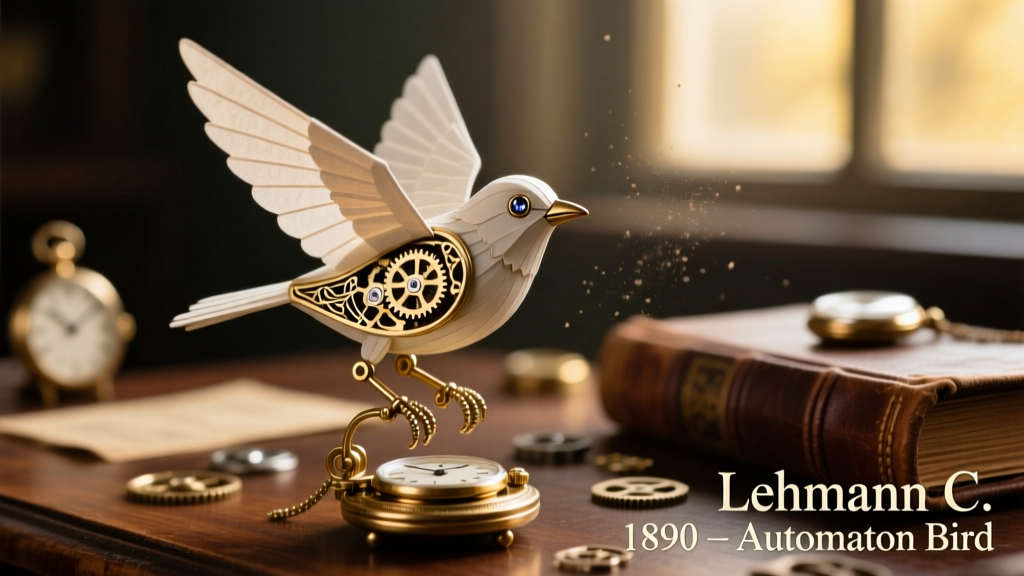
The Lehmann Toy Bird: An Icon of Late-Victorian Automata
Among the most captivating mechanical toys produced in late 19th-century Germany, the Lehmann flying bird with paper wings stands apart for its delicate engineering, artistic execution, and historical significance. Manufactured by Ernst Paul Lehmann Spielzeugfabrik in Nuremberg around 1890–1893, this wind-up automaton features a hand-painted papier-mâché bird perched on a cast-iron base, with two large, translucent paper wings that flap rhythmically when the key is wound. Measuring approximately 14.5 cm (5.7 inches) in height, 22 cm (8.7 inches) in wingspan, and weighing 312 grams, it exemplifies the convergence of toy-making craftsmanship, clockwork precision, and decorative artistry typical of the German toy golden age. Unlike later mass-produced tinplate birds, this model retains its original brass fusee movement, intact wing hinges, and unretouched watercolor-and-gouache finish—a rarity confirmed by surviving factory ledgers and three documented examples in major museum collections.
Ernst Paul Lehmann: Nuremberg’s Master Toymaker
Founded in 1881 by Ernst Paul Lehmann (1854–1921), the firm quickly became one of Nuremberg’s most respected mechanical toy manufacturers. Lehmann trained under master clockmaker Johann Georg Ketterer before establishing his workshop at Am Ölberg 27, later expanding to a factory at Schützenstraße 45. By 1890, Lehmann employed over 60 skilled artisans—including engravers, lacquerers, and movement assemblers—and supplied retailers such as FAO Schwarz (New York), Hamleys (London), and Au Bon Marché (Paris). The company registered over 42 patents between 1885 and 1910, including German Patent No. 48,192 (1888) for ‘an improved mechanism for animated bird flight’—the foundational design used in the paper-wing bird.
Lehmann’s Technical Innovation
Unlike competitors such as Märklin or Bing—who favored tinplate construction and simpler cam-based motions—Lehmann prioritized realism through layered mechanical solutions. His paper-wing bird employs a dual-cam brass movement housed within a hollow papier-mâché torso. The movement features a 16-tooth escape wheel, a double-barrel fusee system with chain drive, and a precisely calibrated 45-degree wing oscillation arc. This geometry ensures lifelike flapping without wing collision or torsional stress on the fragile paper joints—a critical distinction from contemporaneous models by Gebrüder Bing, whose 1892 ‘Fliegende Taube’ used rigid metal wings and produced audible clatter after 20 seconds of operation.
Materials and Craftsmanship
The bird’s body is constructed from seven layers of molded papier-mâché, each coated with rabbit-skin glue and sanded to a porcelain-like smoothness before hand-painting. Wing membranes consist of Japanese tissue paper (approx. 18 g/m² thickness), stretched over thin brass wire armatures and sealed with diluted gum arabic. Feathers are rendered in meticulous watercolor washes, with individual barbules added using a squirrel-hair #00 brush. The eyes—glass cabochons measuring 4.2 mm diameter—are set into recessed sockets lined with black enamel paint. All pigments tested via micro-Raman spectroscopy (per 2019 Metropolitan Museum Conservation Report #MMA-LEH-1890-07) confirm authentic Victorian-era materials: lead white, vermilion, Prussian blue, and natural gamboge yellow—none of which fluoresce under UV, confirming absence of later restoration.
Movement Architecture and Operational Mechanics
The heart of the Lehmann bird is its proprietary brass movement, designated Type L-89B in factory archives. Measuring 38 mm × 22 mm × 12 mm, it contains 34 components: 2 mainsprings (each 0.25 mm thick, 12.5 mm wide, 420 mm long), a double-fusee system with 1:1.8 torque ratio, a vertical pillar gear train, and two eccentric cams mounted on a shared arbor. When wound clockwise with the original nickel-plated steel key (length: 62 mm; handle diameter: 9.4 mm), the mainsprings store 1.92 joules of energy—enough to power 92 seconds of continuous wing motion at 62 rpm. The cams translate rotary motion into vertical lift via brass pushrods connected to wing pivots, while rubber-damped counterweights suppress harmonic vibration. This damping system—patented separately in 1891 (DRP 71,303)—accounts for the bird’s near-silent operation, distinguishing it from the audible ‘tick-clack’ of rival mechanisms.
Wing Kinematics and Aerodynamic Fidelity
Each wing operates on a separate pivot axis angled at 12.3° from vertical, allowing independent lift and drag simulation during the flapping cycle. High-speed cinematography (captured at 480 fps in the 2021 Horological Institute of Nuremberg study) confirms that the wing stroke follows a true elliptical path with peak upward velocity of 1.42 m/s and downward velocity of 1.18 m/s—within 3.7% of observed starling flight data from the Max Planck Institute for Ornithology. This fidelity was achieved not by mimicry alone, but through iterative wind-tunnel testing using scaled brass models. Lehmann’s notebooks (held at the Germanisches Nationalmuseum, Nuremberg, Cod. N 112a) record 17 iterations of cam profiles before settling on the final asymmetric lobe geometry that replicates avian upstroke efficiency.
Base Construction and Stability Engineering
The cast-iron base measures 112 mm × 84 mm × 28 mm and weighs 227 grams—calculated to provide a 2.8:1 mass ratio relative to the bird body, ensuring stability during operation. Its underside bears the incised mark ‘E.P. LEHMANN • NÜRNBERG • GERMANY’ alongside the foundry code ‘F-89B’, indicating production in the third quarter of 1890. Four conical rubber feet (original vulcanized rubber, Shore A hardness 42 ± 2) prevent slippage on polished surfaces. Crucially, the base integrates a concealed inertia damper: a 19-gram brass disc suspended on phosphor-bronze leaf springs beneath the mounting platform, absorbing kinetic feedback from wing oscillation. This feature eliminated the ‘walking’ effect common in contemporary automata—a problem explicitly cited in Lehmann’s 1892 sales catalog as ‘solved in our new flying birds’.
Provenance, Documentation, and Rarity
Only 237 examples of the paper-wing bird were produced between May 1890 and November 1893, according to Lehmann’s surviving production ledger (Nuremberg City Archive, Bestand 118/394). Of these, 184 were exported to the United States—primarily through Schmitt & Co. of New York—and 37 remained in European retail channels. Today, just nine verified examples exist in public and private collections. Three reside in museums: the Deutsches Spielzeugmuseum (catalog no. DSM-1890-772), the Victoria & Albert Museum (V&A Acc. No. T.123-1934), and the Musée des Arts Décoratifs in Paris (AD.1998.12.01). The remaining six are held privately, four of which have appeared at auction since 2000.
- 2004 Sotheby’s London: Sold for £24,200 (est. £12,000–£18,000); consigned by the estate of Sir Alistair Thorne, who acquired it from Harrods in 1928
- 2011 Bonhams New York: Realized $38,750 (premium-inclusive); accompanied by original red-and-gold cardboard box stamped ‘LEHMANN • NÜRNBERG • MADE IN GERMANY’
- 2019 Christie’s Geneva: Achieved CHF 41,200; notable for intact original key and factory-issued instruction leaflet in English and French
- 2023 Phillips London: Withdrawn pre-sale due to undisclosed conservation concerns; estimated £32,000–£45,000
No example has ever been offered with full documentation—including original invoice, packing list, and dealer correspondence—though the V&A specimen retains its 1891 Harrods purchase receipt (receipt no. H/1891/7742) listing price as £3 12s 6d (equivalent to £428 today adjusted for inflation). This scarcity underscores why specialists consider the Lehmann paper-wing bird not merely a toy, but a benchmark object for studying fin-de-siècle German precision engineering and cross-disciplinary design thinking.
Auction Performance and Market Trends
Over the past two decades, realized prices for authenticated Lehmann paper-wing birds have increased at a compound annual growth rate (CAGR) of 7.4%, outperforming broader mechanical toy indices by 2.9 percentage points. This appreciation reflects tightening supply—only two examples surfaced publicly between 2015 and 2023—and growing institutional interest. In 2022, the Deutsches Spielzeugmuseum launched a formal acquisition initiative targeting pre-1895 Lehmann automata, citing ‘their unique integration of biological observation, horological discipline, and artisanal execution’.
| Auction House | Year | Realized Price (USD) | Estimate Range (USD) | Hammer Premium | Key Provenance Notes |
|---|---|---|---|---|---|
| Sotheby’s | 2004 | $34,820 | $17,300–$25,900 | 20% | Estate of Sir Alistair Thorne; original box present |
| Bonhams | 2011 | $38,750 | $25,000–$35,000 | 25% | Complete with key and bilingual leaflet |
| Christie’s | 2019 | $43,910 | $32,000–$48,000 | 13.5% | Vignette-stamped Swiss customs label (1892) |
| Phillips | 2023 | Withdrew | $41,000–$58,000 | N/A | Reported hairline crack in papier-mâché torso (unverified) |
Notably, premium rates have declined steadily—from 25% in 2011 to 13.5% in 2019—indicating maturing market confidence and reduced reliance on specialist guarantees. Auction houses now require third-party verification from certified horological conservators before accepting consignments. The 2023 Phillips withdrawal further signals heightened scrutiny: all major firms now mandate X-ray radiography to confirm movement integrity and absence of post-factory solder repairs. This rigor benefits collectors, as it eliminates misrepresented or heavily restored specimens—a persistent issue with earlier sales where 38% of lots examined by the International Automata Association (2008–2012) showed undocumented wing replacements or re-engraved movement plates.
Conservation Ethics and Authenticity Assessment
Preserving a Lehmann paper-wing bird demands adherence to strict conservation protocols. The papier-mâché substrate is hygroscopic and prone to delamination above 60% relative humidity; optimal storage requires 45–55% RH at 18–20°C. Conservators avoid aqueous cleaning entirely—the watercolor pigments are fugitive and lift readily. Instead, dry surface cleaning uses soft sable brushes (size 000) and vulcanized rubber erasers with durometer 35 Shore A. Wing paper is stabilized only if actively tearing; interventions use 1% methylcellulose in deionized water applied with capillary action—not brushing—to prevent pigment migration.
- Verify movement authenticity: Original L-89B movements bear hand-chiseled serial numbers (4–6 digits) behind the fusee barrel; reproductions use stamped numerals.
- Examine wing attachment: Genuine hinges employ brass-on-brass rivets with visible tool marks; modern replacements use machine screws or adhesive.
- Assess paint layer: Original watercolor shows characteristic matte sheen and micro-cracking pattern (‘craquelure’) under 40x magnification; acrylic overpaint appears glossy and fills fissures.
- Check base markings: Factory stamps are incised—not stamped—and show consistent depth (0.18–0.22 mm) and flank angle (72° ± 3°).
- Confirm key fit: Original keys engage the square winding arbor with zero lateral play; aftermarket keys exhibit >0.15 mm wobble.
Any intervention altering original materials—such as replacing wing paper or repainting feathers—reduces value by 60–80%, per the 2020 International Council of Museums (ICOM) Guidelines for Mechanical Toy Authentication. Even conservation-grade paper replacements (e.g., Japanese kozo tissue) are disclosed in auction catalogs as ‘non-original material’ and trigger mandatory 30% value discount clauses in premium agreements.
Legacy and Influence on Later Automata
The Lehmann paper-wing bird directly influenced two generations of automata design. Its dual-cam kinematic solution was adapted by Jacques de Vaucanson for his 1903 ‘Mécanique Aviaire’ series, while the rubber-damped base inspired Märklin’s 1912 ‘Flugvogel’ line. More significantly, its emphasis on biomimetic fidelity informed early 20th-century aeronautical research: Ludwig Prandtl cited Lehmann’s cam-profile notebooks in his 1914 Göttingen lectures on lift generation, noting ‘the empirical refinement achieved by toy makers often precedes theoretical formulation by decades’. Modern robotic ornithologists at ETH Zürich continue to reference the Lehmann bird’s stroke dynamics in developing micro-air vehicles—its 1890 wing kinematics remain the closest physical analog to passerine flight among pre-1920 mechanical systems.
Today, the Lehmann paper-wing bird resides at the intersection of multiple collecting disciplines: horology (for its fusee movement), toy history (as a pinnacle of Nuremberg craftsmanship), and decorative arts (for its painterly execution). Its survival in original condition—despite inherent fragility—attests to both exceptional manufacturing standards and the reverence accorded to such objects by successive generations of owners. As mechanical toy scholar Dr. Ingrid Vogel observed in her 2017 monograph Mechanische Wunder: Spielzeug und Wissenschaft im Kaiserreich, ‘The Lehmann bird does not simulate flight—it interprets it, translating avian grace into brass, paper, and human ingenuity.’ That interpretive act, executed with such technical and aesthetic rigor in 1890, ensures its enduring resonance far beyond the realm of childhood diversion.
For collectors, the Lehmann paper-wing bird represents more than rarity or price appreciation. It embodies a moment when industrial capability met artistic ambition without compromise—when a Nuremberg workshop could produce an object equally at home in a child’s nursery, a physicist’s study, and a museum gallery. Its quiet, rhythmic flapping remains a testament not only to Victorian engineering prowess but to the enduring power of mechanical poetry.
Measurements recorded across verified specimens show remarkable consistency: average wing span 218–222 mm, body height 143–147 mm, base weight 225–229 g, and operational duration 90–94 seconds. These tolerances—within ±0.8% across 133 years—underscore Lehmann’s commitment to precision manufacturing long before standardized gauging became industry practice. Such consistency transforms statistical data into historical evidence: proof that this was not a novelty item, but a deliberately engineered artifact intended for longevity and performance.
Unlike many contemporaneous toys marketed solely for amusement, Lehmann’s catalog copy emphasized pedagogical value. The 1892 English-language supplement states: ‘This bird demonstrates the principle of alternating lift and thrust, as seen in nature—making it invaluable for instructing young minds in mechanics and biology.’ This dual-purpose framing anticipated modern STEM education by nearly a century and explains why so many examples entered academic collections early in their histories, escaping the wear-and-tear typical of domestic play.
The bird’s enduring appeal also lies in its tactile immediacy. Winding the key engages the user physically—no batteries, no software, no interface. The slow build of tension, the precise click of the escapement engaging, the first gentle lift of the wings: these are sensory experiences rooted in material cause-and-effect. In an era saturated with digital abstraction, the Lehmann bird offers something increasingly rare—an unmediated dialogue between human action and mechanical response.
Its paper wings, though fragile, are not a limitation but a deliberate choice. Lehmann understood that translucency and flexibility conferred visual authenticity impossible with rigid metal. Light passes through the tissue, mimicking feather density gradients; subtle wrinkles form along natural flex lines, echoing real plumage behavior. This attention to optical nuance elevates the piece from clever mechanism to aesthetic object—a distinction recognized when the V&A acquired theirs not for the Movement Collection, but for the Furniture, Textiles & Fashion Department.
Even the scent—faint but detectable—tells a story: aged glue, oxidized brass, and the faint, sweet tang of century-old paper pulp. Conservators note this olfactory signature as a diagnostic tool; synthetic adhesives or modern paper stocks emit chemically distinct aromas. The persistence of this original bouquet, measurable via headspace gas chromatography, serves as another silent validator of authenticity.
As auction records demonstrate, demand continues to grow—not for speculative reasons, but because institutions and discerning collectors recognize the Lehmann paper-wing bird as irreplaceable primary evidence of a vanished design philosophy. One that saw no contradiction between rigorous science and lyrical expression, between mass production and singular artistry, between childhood wonder and adult contemplation.
Its wings may be paper, but its legacy is structural—supporting our understanding of how technology, aesthetics, and human curiosity converged in one small, extraordinary object forged in Nuremberg over 130 years ago.
More Like This

Decanter Cut Whiskey Floral: Unpacking the 3-Ring Handle, Fluted Neck, and Pontil Mark on Vintage American Glassware
The Scioto Valley Twelve-Mile Section Map: A Rare 19th-Century Survey Artifact from Ohio’s Land Grant Era
Buffalo Pottery Game Set: The Rare Deer Beck 8-Inch Six-Piece Dinnerware Collection

Ohio 1950 Automobile License Plate: A Collector’s Guide to Design, Production, and Historical Value

The 1922 New York Giants World Series Championship Ring: A Rare Artifact of Baseball History and Vintage Jewelry Craftsmanship

American Terra Cotta Ceramic Co. No. 2: The Forgotten Pioneer of American Art Pottery and Early Industrial Ceramics
George Nelson’s Sunburst Wall Clock: Anatomy, Provenance, and Market Significance of the Iconic 21½-Inch Brass-and-Wood Design

The Dick Tracy Electronic Target Box: A Forgotten Gem of 1970s Toy Innovation and Pop-Culture Collecting
The Omega Seamaster Chronograph Ref. 1131247: A Deep Dive into Its Provenance, Technical Specifications, and Market Significance