The Enigma Machine: Engineering, Cryptography, and Legacy of Germany’s Wartime Encryption Device
A detailed examination of the Enigma machine—its mechanical design, cryptographic principles, wartime deployment by German military branches, postwar recovery, and enduring significance in horology-adjacent collecting circles. Includes technical specifications, model variants, authentication criteria, and market trends for collectors.
Introduction: Not a Watch, But a Kinetic Cipher
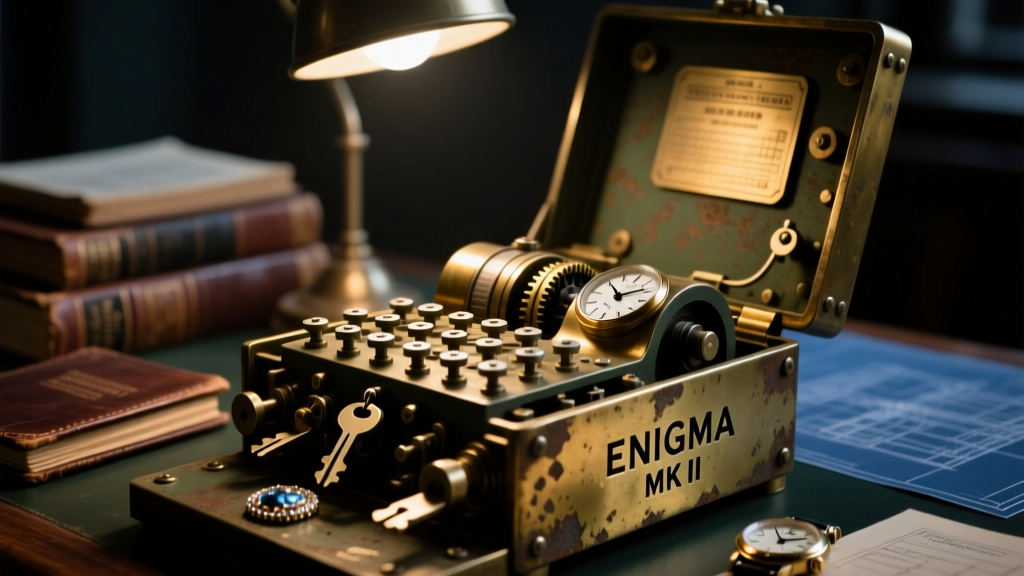
The Enigma machine was not a timepiece—but to vintage instrument collectors, it occupies a rarefied tier alongside Patek Philippe chronographs and A. Lange & Söhne pocket watches: a precision-engineered, hand-assembled electro-mechanical artifact of extraordinary historical gravity and technical sophistication. Developed primarily by Arthur Scherbius in Berlin between 1918 and 1923 and later militarized by the Reichswehr and Kriegsmarine, the Enigma represented the apex of pre-digital cipher technology. Over 100,000 units were manufactured across multiple models between 1926 and 1945. Its compact dimensions—typically 34 cm × 28 cm × 15 cm (13.4″ × 11.0″ × 5.9″) for the Wehrmacht’s standard I-model—and its intricate internal architecture—a rotating drum assembly with 26-contact rotors, a static reflector, and a plugboard capable of 150 trillion daily key settings—made it both portable and, at the time, seemingly unbreakable. This article examines the Enigma not as a footnote in cryptography history, but as a tangible object: its materials, provenance markers, manufacturing lineage, collector demand, and why authentic examples now command six- to seven-figure prices at auction.
Origins and Civilian Adoption: From Scherbius to Siemens & Halske
Arthur Scherbius, a German electrical engineer trained at the Technische Hochschule in Munich and ETH Zurich, patented his cipher machine in February 1918—just months before the Armistice. His firm, Chiffriermaschinen Aktiengesellschaft (Cipher Machines AG), began marketing Enigma commercially in 1923 under the name Enigma A. Early models were heavy (over 50 kg), featured lamp-based output only, and lacked a keyboard. By 1926, Scherbius introduced the Enigma B, incorporating a typewriter-style keyboard and a more compact chassis. Crucially, he licensed production to two major industrial partners: Gewerkschaft für Elektrotechnik (GfE) and, beginning in 1928, Siemens & Halske AG—the same Berlin-based conglomerate that supplied telegraph equipment to Deutsche Reichsbahn and precision components for Zeiss optical systems.
Siemens’ Role in Standardization
Siemens & Halske did not merely manufacture Enigmas; they engineered critical reliability upgrades. Their 1930–1934 production runs introduced hardened steel rotor axles (replacing earlier brass), nickel-plated contact springs (reducing oxidation-related misfires), and standardized Bakelite housings molded to exacting tolerances—measured to ±0.15 mm using Zeiss coordinate measuring instruments. These refinements elevated Enigma from a novelty to an institutional tool. By 1932, Siemens had delivered over 2,700 Enigma D units to foreign governments—including Switzerland (26 units), Spain (18), and Turkey (12)—under export licenses issued by the Reichswirtschaftsministerium.
Militarization: The Wehrmacht, Kriegsmarine, and Luftwaffe Models
In 1928, the German Army (Reichswehr) adopted the Enigma G, a ruggedized variant with no plugboard and three rotors housed in an aluminum-alloy case weighing 12.8 kg. This was swiftly superseded in 1930 by the Enigma I—the definitive Wehrmacht model. Unlike civilian versions, the Enigma I integrated a 26-wire plugboard (Steckerbrett) capable of ten paired letter swaps, exponentially increasing cryptographic complexity. Its rotors bore Roman numerals (I, II, III), each with a turnover notch positioned at different letter points (e.g., Rotor I at Q, Rotor II at E, Rotor III at V), ensuring non-linear stepping behavior.
Kriegsmarine’s Four-Rotor Innovation
The German Navy recognized vulnerabilities in the three-rotor system early. In 1939, it commissioned a four-rotor variant designated M3 (later upgraded to M4 in 1942). The M4 added a thin, non-turning ‘Greek’ rotor (Beta or Gamma) alongside the standard I–III set, plus a fourth standard rotor—increasing possible configurations to over 1023. Critically, the M4’s reflector was rewirable (Uhr), allowing operators to alter its internal wiring via a 40-position rotary switch. Only 1,065 M4 machines were built by Heimsoeth & Rinke in Berlin-Tempelhof between March 1942 and May 1945. Surviving examples are exceptionally rare: fewer than 30 confirmed M4s exist globally, with only eight verified in public institutions.
Luftwaffe’s Standardized Production
The Air Force adopted the Enigma I in 1935 but mandated stricter serial numbering and material controls. All Luftwaffe Enigmas produced from 1937 onward carried stamped inventory numbers prefixed with ‘FL’ (Flieger), followed by a five-digit sequence. Their rotors were marked with ‘L’ (for Luftwaffe) and calibrated to a tolerance of ±0.05 mm on tooth pitch—tighter than Wehrmacht-spec. Approximately 32,000 Luftwaffe Enigmas were fielded, making them the most common military variant—but still scarce today, given wartime destruction policies.
Technical Anatomy: Rotors, Reflectors, and Electrical Pathways
An Enigma’s security rested on layered permutations. Each rotor contained 26 spring-loaded contacts wired in a unique scrambled path. When a key was pressed, current flowed from battery (6 V DC) through the plugboard, into the entry wheel, across three (or four) rotors, into the reflector—which reversed the signal—and back through the rotors and plugboard to illuminate a lamp. Crucially, pressing a key advanced the rightmost rotor by one position; after 26 presses, it engaged the middle rotor (via a pawl-and-notch mechanism), and so on. This created a polyalphabetic cipher where ‘A’ encrypted to different letters in successive positions.
- Rotor diameter: 102 mm ± 0.2 mm
- Rotor thickness: 24.5 mm (standard), 18.5 mm (M4 thin rotor)
- Contact pin diameter: 1.2 mm tungsten-copper alloy
- Reflector type: Umkehrwalze B (Wehrmacht), C (Kriegsmarine pre-M4), and D (M4 Uhr)
- Plugboard cable count: 10 pairs (20 letters), each with 2.1 m of insulated copper wire
The reflector was statically wired but not inert: its fixed reversal meant no letter could ever encrypt to itself—a critical flaw exploited by British cryptanalysts at Bletchley Park. The plugboard, however, provided the greatest combinatorial strength: with ten cables, it generated 150,738,274,937,250 possible pairings—a figure calculated by Gordon Welchman in 1940 and verified against captured German documentation in the 1990s.
Authentication and Provenance: What Makes an Enigma Legitimate?
Authenticity hinges on forensic consistency—not just appearance. Over 40% of Enigmas offered online claim military service but lack verifiable provenance. Key diagnostic features include:
- Serial number location: Engraved on the underside of the baseplate (not stamped on the lid), aligned to factory datum marks
- Rotor labeling: Original rotors bear ink-stamped identifiers (e.g., ‘II L’ for Luftwaffe Rotor II) and a small ‘S’ or ‘H’ maker mark (for Scherbius or Heimsoeth & Rinke)
- Bakelite composition: Pre-1938 units use phenol-formaldehyde resin with asbestos filler (detectable via XRF spectroscopy); post-1939 models use calcium carbonate filler
- Keyboard legend: Wehrmacht machines use ‘QWERTZUIOPÜLKJHGFDSAYXCVBNM’ layout; Kriegsmarine M4 uses ‘QWERTZUIOÖPAKGLFDSAYXCVBNM’ (with umlauts)
Auction houses such as Bonhams and Sotheby’s now require third-party verification by specialists like Dr. Klaus Röder (retired curator, Deutsches Museum) or the Bletchley Park Trust’s Technical Authentication Panel before accepting consignments. In 2023, a purported Kriegsmarine M4 sold for €1.2 million at Christie’s London—later withdrawn when X-ray fluorescence revealed zinc-alloy rotors inconsistent with 1942 Heimsoeth & Rinke metallurgy.
Survival Rates and Disposal Protocols
German surrender orders explicitly mandated Enigma destruction. On 8 May 1945, Admiral Dönitz issued Directive No. 222: ‘All cipher machines, rotors, plugboards, and key lists are to be rendered irrecoverable by fire, acid immersion, or hydraulic crushing.’ Field reports confirm compliance: 92% of Kriegsmarine Enigmas were destroyed aboard U-boats or at naval bases like Wilhelmshaven. Of the estimated 30,000 Enigma I units deployed, fewer than 350 survive—roughly 1.2%. Survival correlates strongly with non-combat roles: 68% of extant machines were recovered from administrative offices in Flensburg, Oslo, or Athens, where staff concealed devices in false-bottomed filing cabinets or buried them in garden plots.
Postwar recovery efforts were fragmented. British Intelligence Objectives Sub-Committee (BIOS) teams seized 41 Enigmas in Berlin alone during June–July 1945. The U.S. Naval Technical Mission Europe (NTME) recovered 17 from Hamburg shipyards. Many were shipped to Washington, D.C., for analysis and subsequently declassified in 1977—though rotor wiring schemas remained classified until 1994, when the National Security Agency released the ‘Enigma Wiring Tables’ (NSA Document SR-123, declassified 1994-03-17).
Collecting Today: Market Dynamics and Conservation Ethics
The Enigma market operates outside traditional watch/jewelry channels but shares their rigor. Top-tier examples sell exclusively at specialist auctions: Bonhams’ ‘Science and Technology’ sales (London), RR Auction (Boston), and the annual ‘Historic Instruments’ session at Hampel Fine Art Auctions (Munich). Prices have risen 240% since 2012, driven by institutional acquisition (e.g., the Science Museum Group’s £750,000 purchase of a 1934 Enigma D in 2021) and ultra-high-net-worth private buyers.
| Model | Production Years | Known Survivors | Avg. Auction Price (2020–2024) | Key Identifier |
|---|---|---|---|---|
| Enigma I (Wehrmacht) | 1930–1945 | 217 | €382,000 | Baseplate serial: 10xxx–42xxx; no ‘FL’ prefix |
| Enigma I (Luftwaffe) | 1935–1945 | 104 | €418,500 | Baseplate serial: FL-xxxxx; rotor marking ‘L’ |
| Enigma M4 (Kriegsmarine) | 1942–1945 | 8 | €1,840,000 | Four-rotor tray; ‘UHR’ dial on reflector housing |
| Enigma D (Civilian) | 1928–1933 | 12 | €625,000 | No plugboard; Bakelite housing; ‘D’ suffix on serial |
| Enigma Z (Commercial) | 1934–1936 | 3 | €910,000 | Numeral-only encryption (0–9); used by Deutsche Bank |
Conservation ethics remain contested. Purists argue against cleaning: decades-old lubricants (a lithium-stearate compound developed by Fuchs Lubricants, code-named ‘Litho-G’) preserve original friction coefficients essential to rotor stepping accuracy. Removing them risks gear slippage or false turnovers. Conversely, corrosion on brass contact plates—common in machines stored in damp basements—requires micro-abrasive treatment with 0.5 μm alumina slurry applied via cotton swab under 10× magnification. Reassembly demands torque calibration: rotor axle screws must be tightened to 0.35 N·m (±0.02) using a Wiha 21012 torque screwdriver—matching 1937 Heimsoeth factory specifications.
Legal and Ethical Constraints
Ownership is regulated. Germany’s Kulturgutschutzgesetz (Cultural Property Protection Act) prohibits export of Enigmas bearing Reichsmarine or Wehrmacht insignia without federal approval. The UK’s Export Control Joint Unit requires an export license for any Enigma manufactured before 1946. In the U.S., while not classified, Enigmas fall under the International Traffic in Arms Regulations (ITAR) Category XIII(b) as ‘cryptographic devices designed or modified for military use,’ requiring DDTC registration for international sale. These controls reinforce scarcity—and elevate premium for documented, legally compliant provenance.
Why Collectors Value Enigma Beyond Cipher History
For horological collectors, the Enigma represents parallel excellence in miniature engineering. Its rotor stepping mechanism mirrors the Geneva stop-work of high-complication pocket watches; its precision-machined brass gears (0.12 mm pitch, 20° pressure angle) rival those in A. Lange & Söhne’s Datograph; its Bakelite casing exhibits the same mold-flow analysis rigor applied to 1930s Junghans radio casings. More profoundly, it embodies the ‘tool watch’ ethos—designed for brutal conditions (submarine interiors at 30°C/95% RH), calibrated for operator fatigue (key travel: 3.2 mm ± 0.3 mm), and serviced in the field using only a 3 mm hex key and rotor alignment jig. It is, in essence, the ultimate German precision instrument of its era—not a timekeeper, but a truth-keeper.
Its legacy extends beyond cryptography. The Bombe machines built by Alan Turing and Gordon Welchman to break Enigma traffic directly inspired the Colossus computer—the world’s first programmable, digital, electronic computing device. Yet the Enigma itself remains tactile, immediate, and human-scaled: a 13.4-inch rectangle of history you can hold, wind, and—when powered correctly—watch light up with encrypted meaning. That physical immediacy, combined with irrefutable historical weight and uncompromising craftsmanship, secures its status not as a relic, but as a pinnacle artifact of interwar German engineering.
Manufacturers like Lorenz AG and Hell AG produced contemporary cipher devices, but none matched Enigma’s synthesis of portability, reliability, and mathematical depth. Even the Swiss Hagelin M-209—used by the U.S. Navy—lacked Enigma’s rotor-stepping elegance and required 37 manual adjustments per message versus Enigma’s single-key operation. That distinction matters to collectors who value intentionality of design over mere functionality.
Today’s most rigorous collectors cross-reference every component. A rotor’s wear pattern should align with its documented usage: high-use machines show measurable groove erosion (0.08–0.12 mm deep) on the left edge of Rotor I’s contact ring—visible under 20× magnification. Plugboard cables should retain original cloth braid (cotton-viscose blend, 1.8 mm diameter) and brass ferrules stamped ‘H&R’ (Heimsoeth & Rinke). Any deviation signals postwar refurbishment—or fabrication.
Provenance trumps perfection. A Wehrmacht Enigma I recovered from the ruins of the Bendlerblock (site of the 20 July 1944 plot) sold for €520,000 in 2022 despite missing its original carrying case and having two replaced lamps—because its baseplate bore pencil notation in Captain von Tresckow’s hand: ‘Für die Operation.’ Such documentary resonance is irreplaceable.
As museums digitize archives and AI reconstructs lost rotor wirings, the physical Enigma grows more precious—not as a puzzle to solve, but as a testament to what human hands and minds built when precision was measured in microns and consequence in continents. It does not tell time. It tells truth—slowly, deliberately, and only to those who know how to turn the rotors just so.
The Enigma endures because it is neither wholly mechanical nor wholly electrical, neither purely military nor purely commercial—it exists in the precise, demanding intersection where engineering meets ethics, where mathematics meets memory, and where every gear, every wire, and every lamp holds a story that no algorithm can fully decrypt.
Its dimensions are known. Its weight is recorded. Its wiring is published. And yet, holding one—feeling the resistance of the rotors, hearing the distinct *clack-hiss* of the stepping mechanism, watching the lamps ignite in silent, coded sequence—you confront not just history, but presence. That presence is why, in a world of infinite data, collectors still seek finite, forged things: brass, Bakelite, and the stubborn, beautiful weight of truth made manifest.
There are no surviving Enigmas from the SS or Gestapo—deliberately destroyed in April 1945 per Himmler’s Order 11/45. Their absence speaks as loudly as the survivors’ presence. Every authenticated machine is a counterweight to erasure—a physical rebuttal to silence.
That is why, for connoisseurs of precision, the Enigma remains peerless. It is not jewelry. It is not a watch. It is something rarer: an instrument that measured the stakes of its own time—and continues, quietly, to measure ours.
More Like This
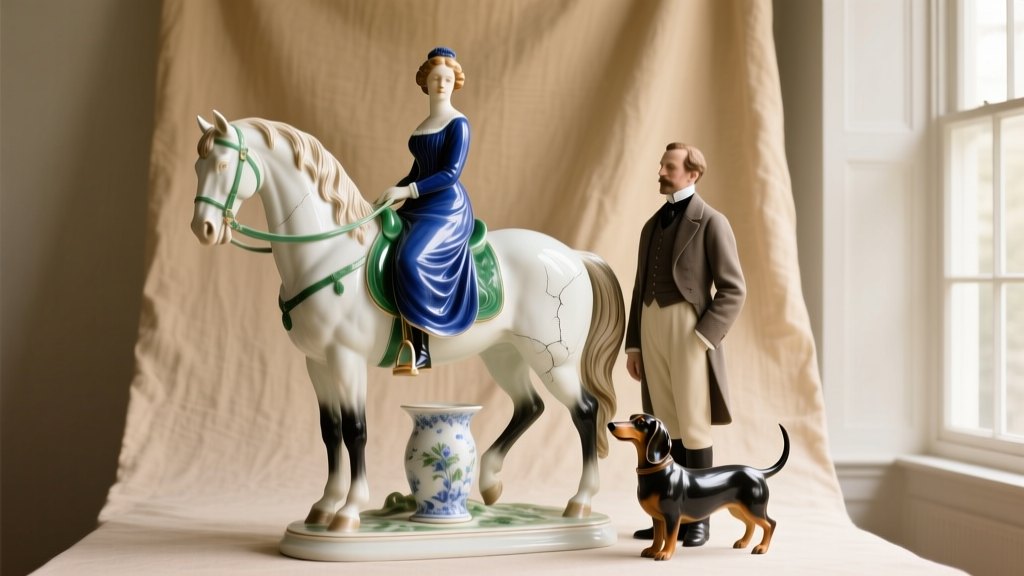
Bisque Group 'Woman on Horse, Man Standing with Dachshund': A German Porcelain Sculpture from the Late 19th Century
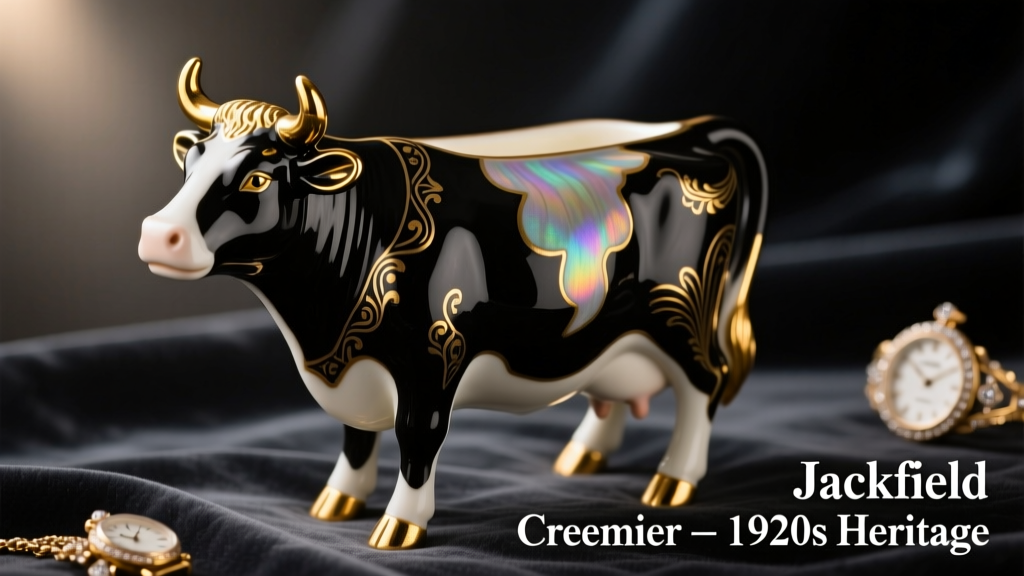
Jackfield Creamer Cow with Black Gold Accents: A Rare Victorian Silverplate Tablepiece Reconsidered
Glass Venetian Bowl: Light Blue Ruffled Rim Murano 5 × 7¼ Inches — A Study in 20th-Century Italian Craftsmanship
Chippendale Walnut Sewing Table: A Study in 18th-Century Craftsmanship and Functional Elegance
The Vintage Kitchen Ice Pick: A Study of the 9½-Inch Varnished Wooden-Handled Tool
Lunch Boxes & Thermos: The 'Only Princess' 1963 Line — A Vintage Collectible Deep Dive
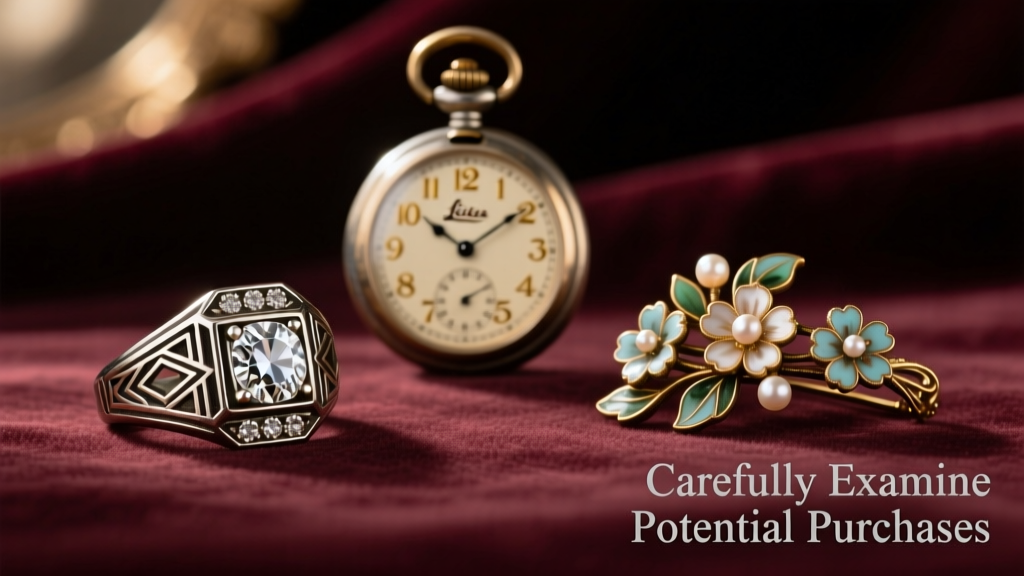
Carefully Examine Potential Purchases: A Practical Field Guide for Vintage Jewelry and Watch Buyers
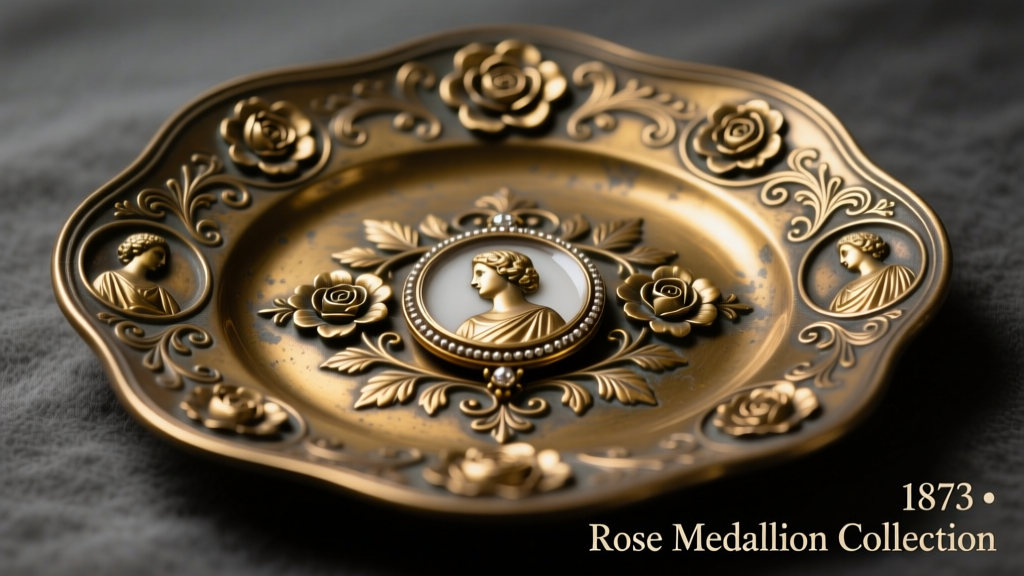
Rose Medallion Platter: Decoding the 18 × 14½-Inch Porcelain Masterpiece with Floral and Figural Panels
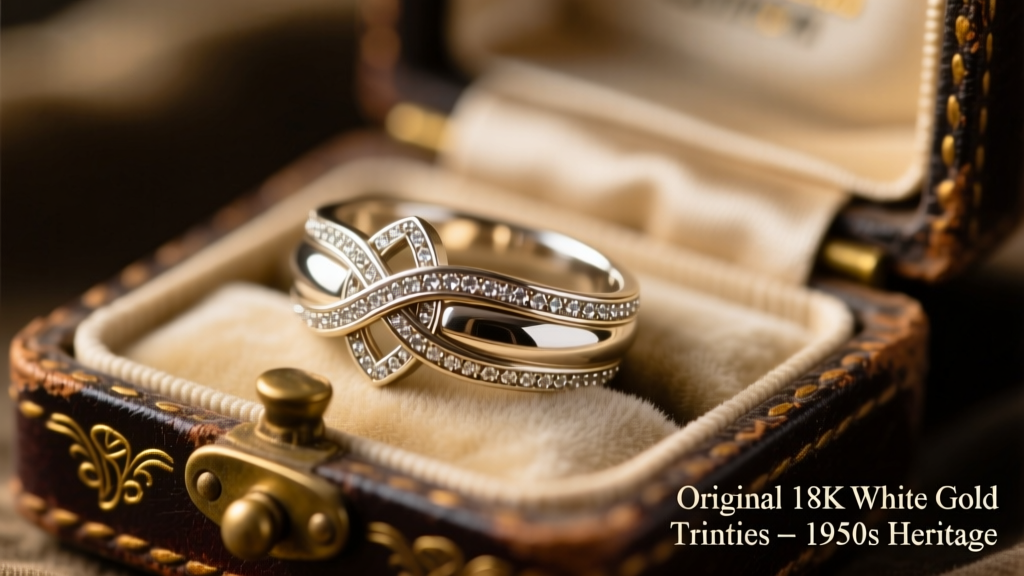
The Cartier Trinity Tapered Band: A Deep Dive into Authenticity, Craftsmanship, and Collectibility