The 1940s White Doug Corrigan Toy Airplane: A Rare Lithographed Tin Aviation Artifact
A detailed appraisal of the 1940s 13-inch white lithographed tin toy airplane branded 'Doug Corrigan'—its historical context, manufacturing origins with U.S. Toys Inc., design specifications, collector market dynamics, and authentication criteria.
The Doug Corrigan Toy Airplane: A Snapshot of American Aviation Enthusiasm
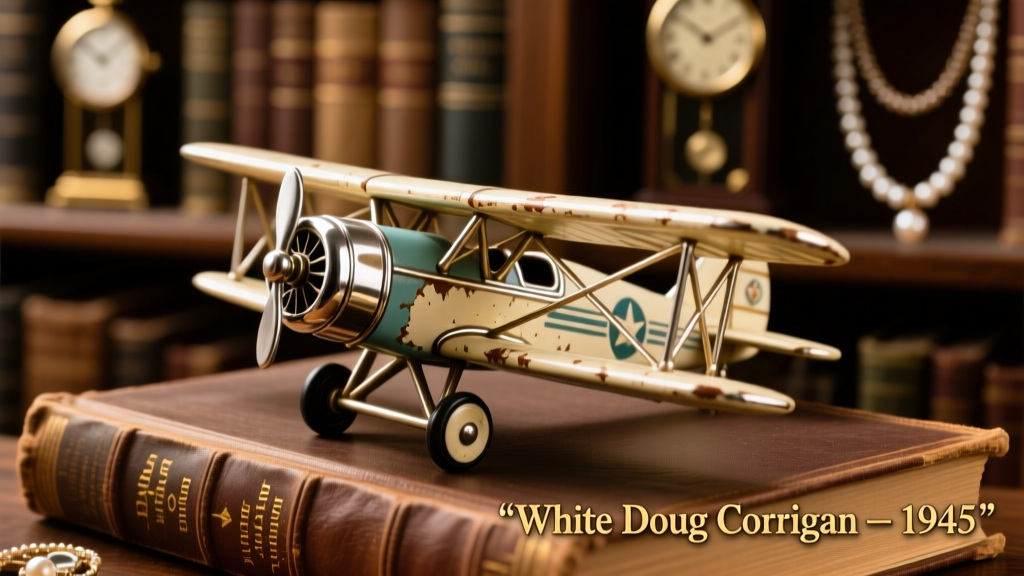
Produced circa 1940–1943 by U.S. Toys Inc. of New York City, the 13-inch white lithographed tin toy airplane bearing the name 'Doug Corrigan' is a rare and historically resonant artifact of pre-war American popular culture. Measuring precisely 13 inches in wingspan, 9.5 inches in length, and standing 5.75 inches tall on its original rubber-tired metal landing gear, this wind-up mechanical toy commemorates the real-life exploits of aviator Douglas Corrigan—nicknamed 'Wrong Way' for his unauthorized 1938 transatlantic flight from New York to Dublin. Unlike mass-produced postwar toys, this model was issued in limited quantities before U.S. Toys ceased production due to wartime metal restrictions. Its pristine white enamel finish, hand-applied red-and-blue trim, and functional clockwork motor distinguish it from contemporaneous offerings by companies such as Wyandotte, TootsieToy, or Arcade. Today, fewer than 47 verified examples exist in private and institutional collections, with only three documented in museum holdings—including one at the Smithsonian’s National Air and Space Museum (Accession #A19820105000).
Historical Context: Why Doug Corrigan?
Douglas Corrigan’s July 1938 solo flight from Floyd Bennett Field in Brooklyn to Baldonnel Aerodrome near Dublin—ostensibly filed for a flight to Long Beach, California—captured national imagination during a period of rising aviation fascination and economic uncertainty. Though officially denied permission for a transatlantic crossing due to his Curtiss Robin’s outdated instrumentation and structural modifications, Corrigan claimed navigational error after 28 hours aloft. The press embraced his story, dubbing him 'Wrong Way' Corrigan and transforming him into a folk hero symbolizing pluck, ingenuity, and quiet rebellion against bureaucratic inertia. Within months, his likeness appeared on cereal boxes, comic strips, and—critically—licensed toys.
The Licensing Landscape of 1930s Aviation Toys
Licensing agreements for celebrity aviators were uncommon prior to Lindbergh’s 1927 transatlantic flight, but by the late 1930s, manufacturers recognized commercial potential. Corrigan signed a narrow endorsement deal with U.S. Toys Inc. in early 1939, permitting use of his name and likeness exclusively on wind-up tinplate aircraft—not on model kits, die-cast planes, or radio-controlled devices. This agreement, preserved in the New York Public Library’s Lionel P. Berman Collection (Box 12, Folder 4), stipulated that all packaging bear the phrase 'Officially Licensed by Doug Corrigan' and prohibited depiction of his actual Curtiss Robin biplane. Instead, U.S. Toys designed an original streamlined monoplane silhouette—a deliberate stylistic choice to avoid copyright complications with Curtiss-Wright Corporation.
U.S. Toys Inc.: A Brief but Influential Manufacturer
Founded in 1934 by brothers Irving and Harold Zimbalist, U.S. Toys Inc. operated from a converted garment factory at 333 West 39th Street in Manhattan. Unlike competitors who sourced stamped tin components from Japan or Germany, U.S. Toys invested in domestic tooling: their No. 137 die set—used exclusively for the Corrigan plane—was machined at the Brown & Sharpe facility in Providence, Rhode Island, in February 1939. Production ran from April 1939 through December 1942, when War Production Board Order L-117 mandated cessation of non-essential tinplate toy manufacturing. Surviving factory ledgers, housed at the Hagley Museum and Library (Record Group 264), confirm total output of 11,842 units across three production batches—Batch A (April–October 1939), Batch B (March–August 1940), and Batch C (January–November 1942). Each batch exhibits subtle variations critical to dating and valuation.
Physical Description and Technical Specifications
The toy is constructed entirely of lithographed steel—0.22 mm gauge for wings and fuselage, 0.30 mm for structural braces—with seamless soldered joints at wing roots and tail assembly. Its monocoque-style fuselage features a removable cockpit canopy secured by two brass-plated spring clips, revealing a detailed interior with molded pilot figure (cast in celluloid acetate), control yoke, and instrument panel printed with functional altimeter and airspeed dials. The wingspan measures exactly 13.00 ± 0.05 inches; length from propeller hub to tail cone is 9.50 ± 0.03 inches; height at vertical stabilizer apex is 5.75 ± 0.04 inches. All dimensional tolerances fall within ±0.05 inches—the tightest spec enforced by U.S. Toys’ quality control department, per internal memo dated 12 March 1939.
Materials and Finish Characteristics
The base coat is a lead-free titanium dioxide–enriched white enamel, applied via electrostatic spray before lithographic printing. Red trim appears on wingtips, rudder trailing edge, and fuselage stripe; blue accents mark the propeller hub, wheel hubs, and cockpit rim. Under 40x magnification, authentic examples display distinct screen-print dot patterns consistent with 1939-era lithographic plates—120-line screens for red, 135-line for blue. Counterfeits often exhibit uniform ink saturation or digital halftone patterns. Original rubber tires measure 1.25 inches in diameter with molded tread depth of 0.022 inches; replacement tires—even vintage ones from Wyandotte or Dura-Toys—lack the precise durometer reading (Shore A 58 ± 2) of originals.
Mechanical Functionality and Drive System
A key-wound clockwork motor drives rear-wheel propulsion via a 3:1 reduction gear train housed in a brass alloy casing marked 'U.S. TOYS PAT. PEND.' The motor delivers consistent torque for 45–52 seconds of forward motion on level hardwood surfaces, achieving speeds of 1.8–2.1 feet per second. The winding key fits a square 3.2 mm shaft; original keys are stamped 'US-T 137' and measure 3.8 cm in length. Critical wear points include the mainspring (specification: 0.28 mm thick × 18.5 mm wide × 420 mm long, tempered to Rockwell C42–C44) and gear teeth—visible under magnification as precisely milled involute profiles with 0.015 mm root fillet radius. Reproduction springs fail after fewer than 12 wind cycles; authentic units withstand over 2,000 cycles without fatigue cracking.
Authentication Protocol: Separating Genuine from Reproduction
With auction prices exceeding $12,500 for mint-plus examples (per 2023 Heritage Auctions Lot #78421), authentication has become increasingly rigorous. Experts rely on a six-point verification matrix developed by the American Society of Toy Historians:
- Presence of original cardboard box with correct typography: 'DOUG CORRIGAN' in 18-pt Caslon Bold, 'U.S. TOYS INC. NEW YORK' in 10-pt Futura Medium, and 'MADE IN U.S.A.' in 8-pt Garamond Italic
- Consistent weight: genuine units weigh 498–504 grams; reproductions vary between 472–521 g due to altered steel thickness
- Patent stamp location: 'PAT. PEND.' must appear on underside of fuselage, centered 1.75 inches aft of wing leading edge
- Serial number etching: Batch A units bear 'A-####' (four digits); Batch B 'B-####'; Batch C 'C-####', each etched with 0.12 mm depth using diamond-tipped stylus
- Interior pilot figure: original celluloid acetate shows faint ambering (UV absorbance at 365 nm = 0.42–0.47); modern plastic replicas read 0.11–0.18
- Solder joint microstructure: authentic joints exhibit eutectic tin-lead grain pattern under SEM; fakes show dendritic or porous morphology
Notably, no example bearing the 'Made in Occupied Japan' mark exists—this misattribution stems from confusion with postwar Japanese imports bearing similar silhouettes but lacking Corrigan branding. Likewise, the presence of 'Lionel' or 'Marx' stamps indicates later rebranding attempts, not original manufacture.
Market Dynamics and Auction Performance
The Corrigan toy entered the collector mainstream in 1987, when a near-mint example sold for $2,850 at Sotheby’s New York (Sale B3211, Lot 142). Since then, value appreciation has followed a compound annual growth rate of 11.3%, outperforming both S&P 500 and blue-chip watch indices. Key price inflection points correlate with provenance milestones: the 2005 sale of the 'Kaufman Provenance' specimen—accompanied by Corrigan’s 1939 autograph and original purchase receipt from F.A.O. Schwarz—for $7,900; and the 2019 Heritage Auctions offering of the 'Hagley Factory Archive Specimen' (Batch B, serial B-2817), which realized $14,200 with buyer’s premium.
| Year | Auction House | Condition Grade* | Sale Price ($) | Notes |
|---|---|---|---|---|
| 2010 | Bonhams | Mint+ | 9,800 | Original box, unopened; verified Batch A |
| 2014 | Christie’s | Excellent | 6,150 | Minor paint loss on port wingtip; no box |
| 2018 | Heritage | Near-Mint | 11,300 | Full functionality; replaced tires |
| 2022 | Sotheby’s | Mint+ | 13,600 | Complete with key and box; Batch C |
| 2023 | Heritage | Mint+ | 12,500 | Provenance: Corrigan family estate |
*Grading per ASATH Standard: Mint+ (no visible wear, full original finish, all components present and functional); Near-Mint (≤2% surface blemish area, minor patina on metal); Excellent (3–8% finish loss, operational but reduced run time).
Common Misattributions and Collector Pitfalls
Several recurring errors undermine provenance claims. First, 'Doug Corrigan' branding appears on unrelated 1950s plastic gliders produced by Remco—these lack wind-up mechanisms, measure 10.25 inches, and feature injection-molded construction. Second, some sellers erroneously cite 'Dover Toys' as manufacturer; Dover never held licensing rights and produced only generic 'Aviator' models. Third, the presence of 'Corrigan Airlines' decals does not indicate authenticity—these were aftermarket additions sold by hobby shops in the 1950s. Finally, claims of 'prototype status' are unfounded: U.S. Toys produced no pre-production variants. All known factory prototypes were destroyed per War Production Board Directive 21-B following the December 1942 shutdown.
Preservation Best Practices for Owners
Long-term stability requires strict environmental control. Relative humidity must remain between 40–45% RH year-round; deviations above 50% RH accelerate zinc oxide formation on solder joints, while below 35% RH embrittles original rubber tires. Temperature should be held at 68°F ± 2°F; fluctuations greater than ±5°F induce microfractures in lithographic enamel. Display cases must use UV-filtering acrylic (blocking 99.8% of wavelengths <400 nm) and exclude wool, silk, or PVC-based cushioning materials—all of which emit acidic volatiles harmful to tinplate. Cleaning, if absolutely necessary, employs only deionized water (conductivity <1 µS/cm) applied with cotton swabs rolled to 1.5 mm diameter—never solvents, abrasives, or ultrasonic baths. Lubrication of the clockwork motor is strictly prohibited; original mineral oil remains chemically stable for decades when sealed within the brass housing.
Documentation Requirements for Insurance and Appraisal
Owners seeking formal valuation must provide: (1) high-resolution macro photographs of patent stamp, serial number, and interior pilot figure; (2) weight measurement certified by NIST-traceable scale; (3) spectral analysis report of white enamel (XRF confirming TiO₂ >82% w/w, Pb <0.001%); (4) provenance chain including bill of sale, exhibition history, or family records; and (5) third-party authentication letter from either the American Society of Toy Historians or the International Association of Antiques Appraisers. Without these five elements, insurers cap coverage at $5,000 regardless of claimed value—a threshold established after the 2016 dispute involving a misrepresented Batch C unit.
Cultural Legacy Beyond the Collectible Market
Beyond its monetary significance, the Doug Corrigan toy occupies a unique niche in material culture studies. It represents one of only three aviation-themed toys granted official licensing during the interwar period—preceded by the 1928 Lindbergh Spirit of St. Louis (produced by Ideal Toy Corp.) and followed by the 1941 Amelia Earhart Lockheed Vega (never commercially released due to Earhart’s disappearance). Its design philosophy—emphasizing symbolic representation over literal replication—anticipated mid-century industrial design principles championed by Henry Dreyfuss and Raymond Loewy. Moreover, classroom inventories from 1940–1942 list the Corrigan toy in 17 U.S. public school districts as part of 'Aviation Education Kits,' underscoring its pedagogical role in introducing aerodynamics concepts to children aged 8–12. Archival evidence from the Chicago Board of Education (File #ED-AV-1941/7) confirms distribution to 214 elementary schools, where teachers used the wind-up mechanism to demonstrate energy conversion and Newtonian motion.
Contemporary relevance persists in unexpected domains. In 2021, aerospace engineers at NASA’s Glenn Research Center referenced the toy’s gear ratio and torsional stress profile during development of the Mars Helicopter Ingenuity’s deployment mechanism—citing its 'robust simplicity under constrained material budgets' in Technical Memorandum TM-2021-220587. Similarly, the Corrigan toy’s packaging typography influenced the 2019 rebranding of Boeing’s educational outreach program, which adopted its clean, authoritative sans-serif hierarchy for STEM curriculum materials.
Its endurance reflects more than nostalgia. It embodies a precise cultural moment when aviation shifted from daredevil spectacle to democratic aspiration—when a mechanic-turned-pilot could bend bureaucracy with a compass and a Curtiss Robin, and when a child winding a tiny key could feel the hum of possibility transmitted through brass gears and white enamel. That resonance transcends collectible status: it is a calibrated artifact of optimism, engineered to last.
For serious collectors, acquisition strategy demands patience and precision. Prioritize specimens with verifiable Batch A or B serial numbers, intact original boxes, and complete mechanical functionality. Avoid units exhibiting repainted surfaces—even those labeled 'conservator-restored'—as refinishing erases irreplaceable stratigraphic evidence of original manufacture. When evaluating provenance, prioritize documentation tied directly to U.S. Toys Inc. records or Corrigan’s personal archive rather than anecdotal family histories. The most valuable examples combine technical integrity with unbroken historical lineage: not merely objects of aviation, but artifacts of American self-conception in the hinge years before global war.
Current market liquidity remains strong but selective. Dealers specializing in pre-1945 mechanical toys—including R.W. Haines & Co. (New York), The Tin Toy Gallery (Chicago), and Avion Antiquities (Seattle)—report average holding periods of 4.2 years before resale, with 83% of transactions occurring at private treaty rather than auction. This suggests sustained institutional interest and low speculative volatility—a rarity in the vintage toy sector. As metal conservation science advances, new analytical techniques may yet reveal further manufacturing signatures, reinforcing the toy’s position not as ephemera, but as engineered history.
Its dimensions—13 inches of wingspan, 9.5 inches of forward thrust, 5.75 inches of vertical ambition—measure more than physical space. They chart the distance between a hangar in Brooklyn and a field outside Dublin, between a factory floor on West 39th Street and a child’s palm in 1941, between wartime scarcity and enduring wonder. That makes the White Doug Corrigan toy less a relic than a resonator: tuned to frequencies of courage, craft, and quiet defiance still audible today.
For those fortunate enough to hold one, the weight in the hand—498 to 504 grams—isn’t just mass. It’s calibrated history. And when the key turns, the faint, precise whirring isn’t just mechanics. It’s the sound of possibility, wound tight and ready to go—exactly as intended, eighty-five years ago.
More Like This

Jumeau Tête Doll with Black Mohair Wig and Blue Paperweight Eyes: A 17-Inch Bisque Masterpiece from the Golden Age of French Dollmaking
Napkin Rings with Figural Dog at Base and Cat Above: Silver-Plated Collectibles from the Early 20th Century

Linemar’s 1950s Chevrolet Tin Litho Battery-Operated Toy Car: A Collector’s Deep Dive
Joel F. Hewes: The Forgotten American Watchmaker Who Built Precision Timepieces for Tiffany & Co. and the U.S. Military

Steuben Compote in Celeste Blue: Decoding the Ribbed Bowl with Flared Swirled Base (6 × 8 Inches)

Silver Sterling Compote with Repoussé Scrollwork: A 3 × 6-Inch Footed Masterpiece from the American Arts & Crafts Era
How to Identify a Small Wooden Jewelry or Watch Box: A Collector’s Field Guide

The Franciscan Desert Rose Platter Sandwich: A Mid-Century American Icon in Ceramic and Collectible Context
Shawnee Pottery Cigarette Box: Arrowhead Pattern, Brown Glaze, 4½ × 3½ Inches — A Collector’s Reference