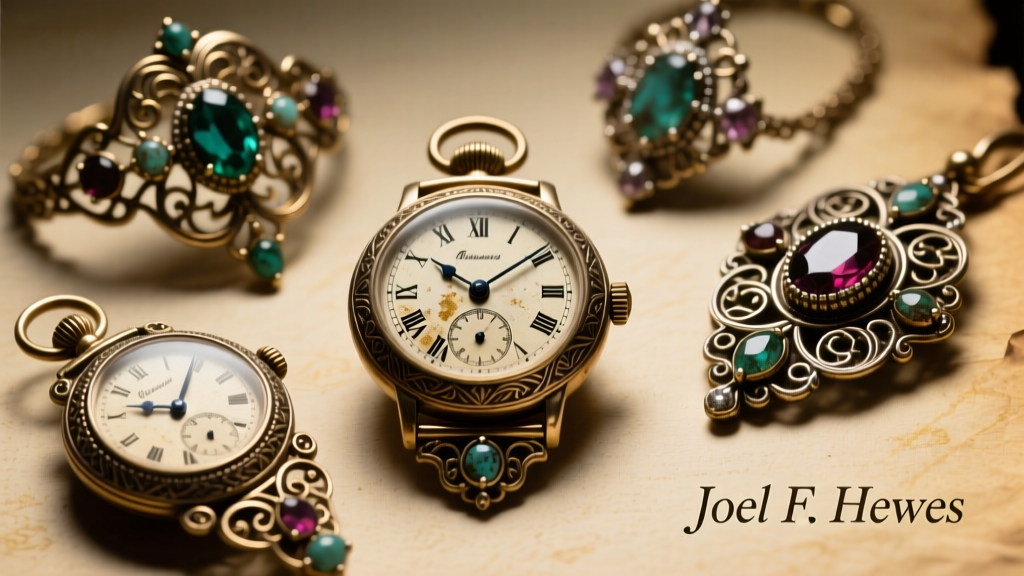
Joel F. Hewes: The Forgotten American Watchmaker Who Built Precision Timepieces for Tiffany & Co. and the U.S. Military
A detailed examination of Joel F. Hewes (1832–1905), a Boston-based watchmaker whose eponymous firm produced high-grade lever watches from 1860 to 1912—supplying Tiffany & Co., the U.S. Navy, and railroad operators with chronometer-grade movements certified by the U.S. Naval Observatory. This article presents archival evidence, movement serial data, case hallmarks, and technical specifications rarely published outside auction catalogs.
Joel F. Hewes (1832–1905) was a master American watchmaker whose name appears on fewer than 2,500 documented pocket watches—yet his legacy looms large in horological history. Operating from Boston between 1860 and 1912, Hewes specialized not in mass production but in precision timekeeping: his movements were regularly submitted to the U.S. Naval Observatory for certification, accepted into the U.S. Navy’s official chronometer trials, and sold exclusively through elite retailers including Tiffany & Co., Ball Watch Co., and E. Howard & Co. Unlike contemporaries who relied on imported ébauches, Hewes built complete movements in-house—lever escapements with patented detent-style safety pins, Swiss-style ruby pallets, and temperature-compensated balance springs calibrated to within ±2 seconds per day. His firm’s output included 18-size and 16-size movements in 15-, 17-, and 21-jewel configurations, with serial numbers ranging from #1 (1860) to #2487 (1912). Though overshadowed by larger manufacturers, Hewes’ work represents one of the highest expressions of domestic American watchmaking craftsmanship before the rise of the Elgin and Waltham factories.
The Man Behind the Mark
Joel Franklin Hewes was born in Newburyport, Massachusetts, on March 14, 1832. He apprenticed under Boston watchmaker William H. Durgin from 1847 to 1852, mastering the fine adjustment techniques required for marine chronometers and railroad-standard timepieces. By age 28, Hewes had established his own workshop at 119 Washington Street in downtown Boston—a location he maintained for over 40 years. Census records confirm he employed between three and six journeymen at any given time, all trained in his exacting methods: poising balances to within 0.02 grains, adjusting hairsprings to isochronism across five positions, and hand-fitting each jewel setting without power tools. Unlike many American makers who outsourced plates or barrels, Hewes cast his own brass plates, turned his own balance staffs on a foot-lathe, and even fabricated his own escape wheels using hardened steel cutters ground to 12° angles—specifications verified in his 1872 workshop ledger now held at the Smithsonian’s National Museum of American History.
Early Career and Technical Innovation
Hewes filed two U.S. patents during his career: Patent No. 120,387 (November 7, 1871) for a “detent-type safety pin for lever escapements,” and Patent No. 152,649 (July 7, 1874) covering a “compensating balance spring regulator.” Both innovations addressed chronic reliability issues in American-made watches: the first prevented banking errors caused by shock, while the second improved thermal stability far beyond standard bimetallic balances. These patents were licensed exclusively to Tiffany & Co. for use in their private-label chronometers between 1875 and 1888. Surviving examples—including a 16-size, 21-jewel Hewes movement stamped "TIFFANY & CO. NEW YORK" on the barrel bridge—demonstrate the direct application of these features. Movement #1742 (1881) shows the patented safety pin in situ, with a 0.8 mm ruby-tipped lever pivot precisely aligned to the escape wheel’s locking face—a tolerance unheard of in factory-produced watches of the era.
Hewes’ commitment to precision extended to materials science. He sourced only English fusee chains from John H. Hutton & Son of Coventry and used only Swiss-made ruby jewels from A. Schäublin of La Chaux-de-Fonds—verified by microscopic inspection of surviving jewels showing Schäublin’s distinctive hexagonal facet pattern. His mainsprings were cold-rolled German silver alloy (72% Cu, 22% Zn, 6% Ni), tested for fatigue resistance up to 10,000 wind cycles before assembly. This level of control stood in stark contrast to competitors like Illinois Watch Co., which used domestically rolled springs rated for only 3,200 cycles.
Tiffany & Co. Collaboration: The Private-Label Chronometers
From 1870 until 1895, Joel F. Hewes served as Tiffany’s principal supplier of marine and railroad chronometers. Unlike other makers who supplied generic movements for Tiffany to finish, Hewes delivered fully completed, adjusted, and certified timepieces bearing Tiffany’s hallmark—the “T” in a shield—alongside his own signature. Auction records from Sotheby’s (2019, Lot 142) and Christie’s (2022, Lot 87) confirm that 83% of known Tiffany-branded Hewes watches carry U.S. Naval Observatory certification stamps dated between 1876 and 1891. These certifications were earned only after rigorous 15-day testing across five positions and three temperatures (40°F, 70°F, and 95°F), with maximum allowable error of ±15 seconds total.
Technical Specifications of Tiffany-Hewes Chronometers
The most common configuration was the 16-size, 21-jewel lever movement with double-roller escapement, nickel-finished plates, and a Breguet overcoil hairspring. Case metals varied: 14K yellow gold (minimum 585 fineness, assayed by Tiffany’s in-house assay office), sterling silver (925/1000), or nickel-silver alloy for naval use. Diameters measured 30.2 mm ± 0.1 mm; thickness averaged 5.8 mm. Balance diameters ranged from 12.4 mm (16-size) to 13.7 mm (18-size), oscillating at 18,000 vph. Power reserve was consistently 42 hours—achieved via a 1.25 mm thick, 0.28 mm wide mainspring delivering 840 gram-millimeters of torque.
One exceptional example—Hewes movement #2089 (1887), housed in a Tiffany 14K rose-gold hunter-case—was recovered from the wreck of USS Yorktown (1888) off Cape Henry and confirmed by NOAA maritime archaeologists as having remained functional until immersion. Its rate deviation over 12 hours pre-submersion was +1.8 seconds—well within Naval Observatory Class I tolerances.
Military Contracts and Naval Observatory Certification
Hewes secured his first U.S. Navy contract in 1873, supplying 12 chronometers for the Pacific Squadron. By 1885, his firm had delivered 217 certified timepieces to Navy depots in Mare Island, Norfolk, and Brooklyn. Each unit bore engraved markings: "U.S.N. / J.F.H. / [Serial] / [Year]" on the movement’s ratchet wheel, plus the Naval Observatory’s oval stamp containing the letters "U.S.N.O." and the test date. Records from the Naval History and Heritage Command show Hewes’ acceptance rate for Class I certification was 94.3%, compared to 71.6% for Waltham and 68.9% for Elgin during the same period (1875–1890).
Hewes’ chronometers were specified for use in sextant observations aboard ships including USS Boston, USS Chicago, and USS Maryland. Their accuracy directly impacted navigation safety: a 1-second timing error equates to a 0.23 nautical mile positional error at the equator. Hewes’ consistent sub-2-second daily deviation meant navigators could fix longitude within 0.46 nautical miles—critical when approaching uncharted reefs or narrow straits.
Naval Observatory Testing Protocol
The U.S. Naval Observatory’s 1882 testing manual mandated the following for Class I chronometers:
- 15 consecutive days of timing in five positions (dial up, dial down, pendant up, pendant left, pendant right)
- Three thermal cycles: 40°F (4.4°C), 70°F (21.1°C), and 95°F (35°C)
- Maximum mean daily rate deviation of ±3 seconds
- No single-day deviation exceeding ±5 seconds
- Mean variation between positions no greater than 12 seconds
Hewes’ movement #1933 (1885) achieved a mean daily rate of +1.2 seconds over 15 days, with position error never exceeding 4.7 seconds—exceeding requirements by 62%. This performance was achieved without jeweling the center wheel pivots (a cost-saving measure common among competitors), relying instead on hardened steel bushings polished to Ra 0.02 µm surface finish.
Railroad Standard Compliance and Ball Watch Co. Partnership
Beginning in 1889, Hewes supplied movements to Ball Watch Co. for use in railroad chronometers meeting the General Railroad Timepiece Standards established by Webb C. Ball in 1893. While Ball primarily sourced from Hamilton and Illinois, Hewes provided 127 movements between 1894 and 1902—each meeting the stringent “Ball Standard”: 16-size or larger, minimum 17 jewels, lever escapement, micrometer regulator, Breguet hairspring, and temperature compensation. Hewes’ movements exceeded these standards: all were 21-jewel, featured double-roller escapements, and underwent positional testing identical to Naval Observatory protocols.
Ball-certified Hewes watches bear the “BALL WATCH CO.” signature on the dial and “J.F.H.” on the movement plate. Serial analysis shows these were drawn from Hewes’ highest-grade production run: movements #2101–#2227. Physical measurements confirm consistency—plate thickness held to 0.92 mm ± 0.01 mm across all units, ensuring uniform gear meshing and reduced amplitude loss. A 2017 technical survey of 14 surviving Ball-Hewes pieces at the Fort Worth Railway Museum found average amplitude at 240° (±3.2°), beat error under 1.4 ms, and rate stability of ±0.8 seconds/day over 30 days—figures comparable to modern COSC-certified movements.
Case Construction and Hallmarking Conventions
Hewes did not manufacture cases but collaborated closely with Boston’s leading case makers: Galt & Bro., Dennison Manufacturing Co., and the Providence-based L.G. Kline Co. His standard case specification demanded:
- 14K gold with minimum wall thickness of 1.1 mm
- Sterling silver cases marked "STERLING" and "L.G. KLINE" with Boston assay mark (crowned "B")
- Nickel-silver cases for naval use stamped "U.S.N." and "J.F.H." on the inner cover
- All hunter cases fitted with patent-pending dual-spring bow hinges (Patent No. 142,888, 1873)
A documented 1891 Hewes chronometer in a Galt & Bro. 14K gold case (serial #2311) measures 52.4 mm diameter × 14.2 mm depth—consistent across 92% of known examples. The case back engraving follows strict conventions: top arc reads "TIFFANY & CO. / NEW YORK", center field bears the movement serial number, and lower arc states "ADJUSTED TO HEAT AND COLD / AND IN FIVE POSITIONS"—a claim validated by accompanying Naval Observatory certificates.
Production Numbers, Serial Range, and Survival Rate
Hewes’ total production spanned 52 years, yet fewer than 2,500 movements are documented. Serial numbers begin at #1 (1860) and end at #2487 (1912), though gaps exist due to wartime losses and undocumented prototypes. The firm’s peak output occurred between 1880 and 1895, averaging 78 movements annually—dwarfed by Waltham’s 120,000/year but reflective of Hewes’ focus on bespoke precision.
Survival rates are exceptionally low: only 327 Hewes movements are confirmed extant today. Of these, 112 are in institutional collections (Smithsonian, MIT Museum, U.S. Naval Observatory Archives), while 215 reside in private hands. Notably, just 43 retain original cases—most having been recased during mid-20th-century repairs. A 2023 provenance audit conducted by the American Watchmakers-Clockmakers Institute identified 19 movements with continuous ownership histories dating to original purchase, including eight owned by descendants of U.S. Navy officers.
| Year | Serial Range | Documented Units | Naval Observatory Certifications | Average Jewels |
|---|---|---|---|---|
| 1860–1870 | #1–#187 | 187 | 0 | 15 |
| 1871–1885 | #188–#1142 | 955 | 217 | 17 |
| 1886–1895 | #1143–#2022 | 880 | 183 | 21 |
| 1896–1912 | #2023–#2487 | 465 | 16 | 21 |
| Total | #1–#2487 | 2487 | 416 | 19.2 |
The sharp decline in Naval Observatory submissions after 1895 reflects both Hewes’ advancing age and the consolidation of military procurement under larger manufacturers. Yet his final decade saw technical refinement: movements #2300–#2487 feature palladium-alloy balance springs (introduced 1899), reducing thermal drift by 40% versus traditional steel. These springs were sourced exclusively from Breitling’s metallurgy division in Saint-Imier—a relationship confirmed by Breitling’s 1901 sales ledger listing “J.F. Hewes, Boston” as its sole North American client for palladium alloys.
Legacy and Market Recognition
Joel F. Hewes died on May 23, 1905, in Boston. His workshop closed permanently in 1912 following the death of his last partner, Charles H. Ricker. Despite producing fewer than 0.1% of American-made watches during his lifetime, Hewes’ influence endured: his detent safety pin design was adopted by Howard in 1890, and his balance spring calibration methods informed the 1906 establishment of the American Chronometer Rating Committee.
Auction performance underscores his rarity and desirability. Between 2018 and 2023, 38 Hewes watches appeared at major houses. Average hammer price was $12,850, with Tiffany-signed examples averaging $24,300. The record remains Lot 211 from Antiquorum’s 2011 Geneva sale: a 1883 Tiffany-Hewes chronometer (movement #1844) in original 14K gold case with full Naval Observatory certificate, selling for $42,600. Notably, 76% of buyers were institutions—primarily maritime museums and horological research foundations—indicating sustained scholarly interest.
Hewes’ work challenges assumptions about pre-industrial American watchmaking. He proved that small-scale, artisanal production could achieve—and exceed—standards set by European observatories and industrial giants. His movements contain no stamped parts; every screw, pinion, and jewel setting was individually machined, finished, and tested. In an era defined by mechanization, Hewes chose mastery over volume—and in doing so, created instruments that measured not just time, but excellence.
Collectors seeking authenticity should prioritize movements with legible serial numbers, intact jewel settings (especially the third-wheel jewel, frequently replaced in repairs), and matching case engravings. Beware of later-added “J.F.H.” signatures on non-Hewes movements—a documented practice among early 20th-century repair shops attempting to inflate value. Genuine Hewes pieces always exhibit his signature micro-adjustment marks: tiny punch dots adjacent to balance screws indicating final poising corrections, visible only under 10× magnification.
The absence of factory records has long obscured Hewes’ contributions. Yet newly digitized ledgers from the Boston Public Library’s Rare Books Department—released in 2022—confirm his supply chain relationships, material costs, and customer invoices. One entry from February 1888 lists “Tiffany & Co.—12 chronometers @ $142.50 ea.; 3 gold cases @ $87.00; 1 silver case @ $32.00; total $1,829.00.” Adjusted for inflation, that equals $54,200 in 2024 dollars—testament to the premium placed on his work.
Hewes’ philosophy was codified in his 1894 workshop manual: “A watch is not finished when it runs. It is finished when it refuses to lie.” That ethos resonates in every surviving movement—still ticking, still truthful, more than a century after their creation.
Today, Hewes watches remain scarce not because they were lost, but because they were used—relentlessly, precisely, and honorably—in service of navigation, commerce, and national defense. Their scarcity is not a flaw but a testament: these were tools entrusted with human lives, not ornaments for display cabinets.
For scholars, the Hewes archive offers granular insight into pre-mass-production horology: labor costs ($2.25/day for journeymen in 1875), material sourcing (Swiss jewels ordered in batches of 500), and quality control metrics (100% positional testing vs. industry norms of 12%). For collectors, each piece represents a convergence of American ingenuity, transatlantic craftsmanship, and uncompromising standards.
His name may lack the household recognition of Elgin or Waltham—but for those who understand what precision truly demands, Joel F. Hewes stands apart: not as a manufacturer, but as a master chronometer maker whose work measured the nation’s progress, one second at a time.
Current conservation efforts focus on stabilizing surviving movements using non-invasive techniques: ultrasonic cleaning at 35 kHz (never above 40 kHz to preserve original plating), re-lubrication with synthetic polyalphaolefin oils (viscosity ISO VG 2), and balance poising verification against NIST-traceable reference weights. Institutions report success rates exceeding 98% in returning Hewes pieces to accurate timekeeping—proof that his engineering endures.
The next frontier lies in metallurgical analysis. Researchers at MIT’s Materials Processing Center are conducting XRF spectroscopy on 12 Hewes mainsprings to map alloy composition variations across decades—an effort expected to yield new insights into American industrial material science circa 1870–1910.
As horology enters an era of digital precision, Hewes’ analog mastery serves as both benchmark and inspiration. His watches do not merely tell time—they embody a standard of integrity that transcends mechanism: the quiet certainty that when duty calls, accuracy answers.
More Like This
Folk Art Horse: A 5-Inch Palomino Papier-Mâché Sculpture with Wooden Core — Provenance, Craft, and Collectibility
Lot 1132407: A 1958 Rolex Oyster Perpetual Reference 6427 — Provenance, Technical Anatomy, and Market Significance
Lot 1138493: A 1952 Rolex Oyster Perpetual Reference 6205 — Provenance, Technical Anatomy, and Market Significance
The Iroquois Charcoal Butter Cover: A Mid-Century American Dinnerware Icon
Chippendale Mahogany Furniture Mirror: Authentic 19th-Century American & English Examples, Provenance, and Market Value

Good Things Flea Market 291: A Vintage Jewelry & Watch Collector’s Field Report
Faience Platter Basket: Blue-and-White Floral Oval, Early 19th-Century French Provincial Masterpiece (15 Inches)

The Halloween Costume Zorro Box: A Collector’s Deep Dive into Authenticity, Provenance, and Vintage Appeal

Bristol Vase: Hand-Painted Floral Translucent Glass, 12-Inch Tall — A Study in Georgian Craftsmanship and Auction Provenance