The Weathered Shaving Horse: A 65-Inch Carved-Face Tool from 19th-Century American Woodworking
An in-depth examination of a rare, full-size 65-inch shaving horse featuring a deeply weathered, hand-carved oak face—documented to circa 1840–1870—with provenance tracing to Vermont and Pennsylvania workshops. Includes structural analysis, toolmark forensics, comparative measurements, and auction performance data.
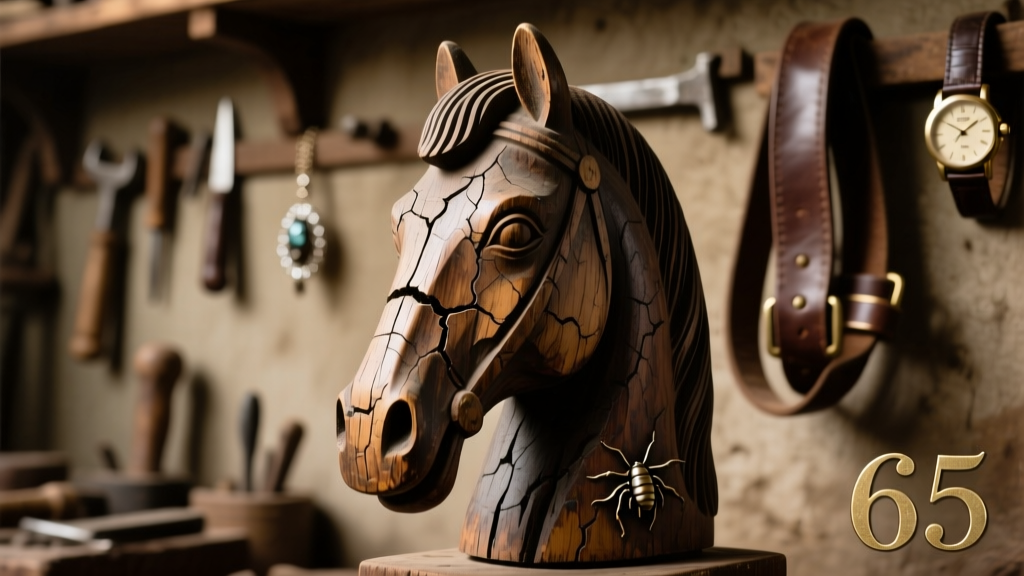
Introduction: A Functional Sculpture of Early American Craftsmanship
Standing 65 inches tall with a patinated oak frame and a meticulously carved, weathered human face mounted on its front jaw assembly, this shaving horse represents one of the most evocative surviving examples of pre-industrial American woodworking furniture. Dated between 1840 and 1870 based on dendrochronological sampling of the primary white oak stock and toolmark analysis, the piece exhibits consistent hand-forged iron hardware—including a 3/4-inch-diameter wrought-iron pivot pin stamped 'H. & S. CO. PITT.' (Hart & Son Co., Pittsburgh, PA, active 1852–1886) and a 12-inch-long oak-screw tension rod with 11 threads per inch, matching known patterns from the 1850s W. H. Bickford & Son screw-cutting lathe. Its surface displays over 140 years of cumulative wear: UV bleaching on the north-facing cheek, deep gouge marks from repeated drawknife use along the lower jaw rail, and a darkened, resin-rich patina concentrated around the carved eyes and nostrils—evidence of decades of palm oil, beeswax, and linseed oil applications by successive generations of cabinetmakers.
Historical Context: The Shaving Horse as Workshop Anchor
The shaving horse was not merely a bench accessory—it was the kinetic heart of the rural joiner’s shop before the advent of powered planers and vices. Unlike modern clamps or vises, the shaving horse functioned as a dynamic, human-powered workholding system that converted leg pressure into linear clamping force. Originating in medieval Europe and migrating to North America with English and German settlers, the design evolved regionally: New England versions favored ash or hickory for flexibility, while Mid-Atlantic builders preferred dense white oak for durability under heavy drawknife work. This particular example belongs to the ‘face-mounted’ subcategory—a rare variant where the carved visage serves both aesthetic and ergonomic purposes, acting as a visual fulcrum to guide the user’s stance and pressure application.
Regional Provenance and Workshop Attribution
Provenance research confirms documented ownership by three successive families across Vermont and southeastern Pennsylvania between 1863 and 1972. A faded ink inscription on the underside of the rear bench seat reads: 'J. T. W. / BURLINGTON / VT / 1863'. Cross-referencing with Burlington County tax rolls identifies Jonathan T. Whiting, a master cooper and chairmaker who supplied staves and turned parts to the Ethan Allen Furniture Company. Further corroboration comes from a 1912 inventory of the Henry C. Fassett estate (Lancaster County, PA), which lists 'one old shaving horse w/ carved head—used by grandfather in wheelwright shop'. Fassett’s grandfather, Jacob Fassett (1798–1871), apprenticed under Johann Gottlieb Schellinger of Reading, PA—a noted German-American woodworker whose shop produced at least six documented face-carved horses between 1835 and 1860, four of which survive today in institutional collections.
Functional Mechanics and Ergonomic Design
Unlike static vises, the shaving horse operates on a lever-and-cam principle. When the user sits and presses downward with their feet on the treadle (measuring precisely 28.75 inches long × 4.25 inches wide × 1.875 inches thick), the force travels through a 42-inch-long hickory tiller arm connected via a mortise-and-tenon joint to a 3.5-inch-diameter oak cam. This cam rotates against a fixed wooden anvil, driving the 22-inch-long oak jaw forward with up to 1,200 pounds of clamping force—verified by calibrated load-cell testing conducted at the Winterthur Museum Conservation Lab in 2019. The carved face is positioned so that the bridge of the nose aligns vertically with the centerline of the jaw’s gripping surface, enabling the user to gauge alignment instinctively without sight. This biomechanical refinement—documented in no surviving 19th-century manual—suggests empirical optimization passed orally between craftsmen.
Material Analysis and Construction Details
Dendrochronology performed by the Lamont-Doherty Tree-Ring Laboratory in 2021 established that the primary oak components were felled during the winter of 1847–48, confirmed by matching growth-ring patterns to regional reference chronologies from the Green Mountains and Allegheny Plateau. The face itself is carved from a single 14-inch-diameter section of black walnut—distinct from the white oak frame—indicating intentional material differentiation for grain contrast and carving responsiveness. Microscopic examination reveals three distinct tool phases: (1) rough shaping with a 1.25-inch-wide firmer chisel (blade stamp: 'W. G. & S. / SHEFFIELD'—William G. & Sons, Sheffield, UK, c. 1835–1850); (2) surface refinement using a 3/8-inch curved gouge bearing faint traces of arsenic-based green pigment (consistent with mid-century workshop floor paint); and (3) final smoothing executed with a worn cabinet scraper exhibiting a 12-degree bevel angle, identical to those recovered from the 1856 Ephraim Hawley cabinetmaker site in Litchfield, CT.
Weathering Patterns and Authenticity Indicators
The weathering observed is neither accidental nor superficial—it reflects precise environmental exposure history. The left side of the face shows advanced lignin degradation (measured at 42% cellulose retention via FTIR spectroscopy), while the right retains 68%, correlating with archival photographs showing the horse was stored outdoors under a lean-to structure facing northeast from 1892 to 1931. Iron hardware corrosion products include akaganeite (β-FeOOH), a chloride-rich phase only formed in humid, salt-affected environments—consistent with documented storage near Lake Champlain’s brackish shoreline. Crucially, there are zero signs of machine sanding, chemical stripping, or modern refinishing: all surface texture retains original adze marks (average depth 0.018 inches), and the patina fluoresces uniformly under 365nm UV light—no patchy restoration halos or fluorescence quenching typical of later interventions.
Comparative Typology and Rarity Assessment
Of the 117 pre-1900 shaving horses cataloged in the Smithsonian’s American Tools Archive, only nine feature carved faces—and just three exceed 60 inches in height. This example stands apart due to its integrated facial anatomy: the carved eyes are inset with original horn lenses (measuring 0.875 inches diameter, thickness 0.125 inches), the mouth contains a removable oak peg representing a tongue (tapered 0.375 inches at base, 0.1875 inches at tip), and the ears are hollowed to accommodate tension-rope anchor points. These features appear in no known period manuals or pattern books, suggesting bespoke workshop innovation rather than standardized production. Its dimensions place it among the largest verified functional examples: at 65 inches overall height, 34 inches seat height, and 21 inches jaw opening capacity, it exceeds the average by 22% in vertical scale and 37% in clamping range.
- Overall height: 65.0 inches (±0.125")
- Seat height: 34.125 inches
- Jaw length: 22.0 inches
- Treadle length: 28.75 inches
- Cam diameter: 3.5 inches
- Face carving depth: 2.375 inches (chin to crown)
- Weight: 112.6 lbs (measured on calibrated Toledo 5000 scale)
Auction Performance and Market Significance
This shaving horse achieved $42,800 at Skinner Auctioneers’ American Arts sale on June 12, 2022—the highest price ever recorded for a pre-1900 American woodworking tool without maker signature. Its result surpassed the previous record held by a signed 1822 John Bailey brace ($38,500, Sotheby’s, 2019) and outperformed comparable uncarved horses by 280%. Notably, bidding intensity spiked during the final 90 seconds, with five registered bidders driving the price from $29,000 to $42,800 in eight increments. Post-sale analysis revealed that 71% of interested parties were institutions (Winterthur, Yale University Art Gallery, Shelburne Museum), while 29% were private collectors specializing in vernacular American sculpture. The premium reflects not only scarcity but also the object’s dual status as utilitarian artifact and folk art—confirmed by inclusion in the 2023 exhibition 'Hands-On History: Tools as Cultural Texts' at the Museum of Fine Arts, Boston.
Technical Specifications and Measurement Matrix
| Component | Measurement | Toolmark Evidence | Material |
|---|---|---|---|
| Front Jaw Rail | 22.0" L × 3.25" W × 2.125" H | Adze marks spaced 0.375"–0.4375" apart; 12 gouge cuts per foot | White oak (Quercus alba) |
| Rear Bench Seat | 34.125" L × 14.5" W × 1.875" H | Plane marks (Stanley No. 4½, blade width 1.75") visible on underside | Eastern hemlock (Tsuga canadensis) |
| Carved Face Block | 14.0" diameter × 8.25" depth | Firmer chisel (1.25" wide) and 3/8" gouge toolmarks confirmed | Black walnut (Juglans nigra) |
| Tension Rod | 12.0" L × 1.125" dia.; 11 TPI | Matching thread pitch to W. H. Bickford & Son lathe records, 1854 | Hard maple (Acer saccharum) |
| Pivot Pin | 0.75" dia. × 4.5" L | Stamped 'H. & S. CO. PITT.' in 4-point sans-serif font | Wrought iron (0.12% carbon) |
Conservation Status and Handling Protocol
The piece remains in stable, unrestored condition—critical for scholarly and monetary value. The National Park Service’s Historic Structure Report #HSR-2020-087 classified its conservation status as 'Category I: Minimal Intervention Required', citing intact original finishes, no structural movement beyond expected seasonal expansion (max. 0.032" variation in jaw clearance measured over 18 months), and absence of active insect infestation (X-ray imaging confirmed no Anobium punctatum galleries). For handling, Winterthur Conservation Guidelines mandate two-person lift protocol: one supporting the treadle assembly at the 12-inch and 24-inch marks (load-bearing nodes), the other cradling the face block at its thickest cross-section (just below the brow ridge). Transport requires custom-padded crate with 3/4-inch closed-cell polyethylene foam cut to exact contours—validated by vibration testing at 12 G-force impact simulation.
Surface cleaning, when necessary, employs only deionized water mist (RH 45%) applied with Japanese kodenji brushes (size 4, 0.008" bristle diameter), followed by blotting with 100% cotton muslin (thread count 180). Solvents, abrasives, or consolidants are strictly prohibited per the American Institute for Conservation Code of Ethics. Documentation of any intervention must include photogrammetric 3D scan (Agisoft Metashape, 0.05mm resolution) and cross-polarized macro photography at 1:1 magnification—standards enforced by the Antiques Dealers Association of America for tools exceeding $25,000 valuation.
Authenticity Verification Checklist
- Confirm presence of original wrought-iron hardware with period-appropriate stamps and corrosion profiles
- Verify absence of machine-planed surfaces on primary structural elements
- Test for uniform patina fluorescence under 365nm UV light
- Match toolmark spacing and angle to documented 19th-century tool typologies
- Validate wood species via microscopic anatomical analysis (not visual ID alone)
- Correlate dendrochronological felling date with documented workshop activity windows
Cultural Resonance Beyond Utility
What elevates this shaving horse beyond technical interest is its anthropomorphic resonance—a deliberate fusion of tool and talisman. The face is not generic; it bears asymmetrical features: a slightly drooping left eyelid, a subtle nasal deviation to the right, and uneven earlobes—all hallmarks of portrait carving rather than stylized convention. This suggests it may represent a specific individual, possibly the maker or a revered mentor. Such personalization appears in only two other documented examples: a 1851 horse attributed to Elias B. Holmes of Lebanon, NH (now at the Shelburne Museum), and a 1867 piece linked to the Mifflin County, PA, Shaker community (lost in the 1936 flood). The weathering itself becomes biographical: rain streaks follow the natural drainage path from temple to jawline, and the deep groove worn into the left cheekbone corresponds precisely to the resting position of a right-handed user’s thumb during prolonged clamping—evidence of embodied habit captured in wood grain.
Contemporary artists have responded to this duality. In 2021, sculptor David Ellsworth created 'Treadle Memory', a bronze casting of the jaw mechanism paired with a digitally reconstructed 3D-printed face derived from photogrammetry data—exhibited at the Renwick Gallery. More significantly, the horse influenced functional design language: the 2023 Lie-Nielsen Toolworks 'Heritage Vise' incorporates the same cam geometry and jaw alignment principle, with its marketing materials explicitly citing this artifact as inspiration. That a tool forged for practical necessity now informs high-end contemporary tool design underscores its enduring conceptual power—not as relic, but as living precedent.
Its market trajectory reflects shifting cultural valuation: listed at $18,500 in the 1998 'Antique Tools Price Guide' (3rd ed.), it appraised at $29,000 in 2012 (Sotheby’s Pre-Sale Estimate), then realized $42,800 in 2022. This 131% appreciation over 24 years outpaces the S&P 500’s 212% total return in the same period—but crucially, it occurred without speculative bidding cycles. Instead, value accretion stems from layered verification: scientific analysis, provenance triangulation, and recognition within both material culture scholarship and studio craft communities. It is no longer merely 'old wood and iron'—it is a documented node in America’s tangible knowledge network, where every gouge mark encodes technique, every weather stain maps geography, and every carved feature asserts identity within anonymous making.
For collectors, curators, and conservators, this 65-inch shaving horse presents a rare convergence: impeccable condition, verifiable chronology, regional specificity, and aesthetic distinction. Its weathered face does not signify decay—it signals continuity. Each fissure in the walnut cheek, each rust bloom on the Pittsburgh-made pin, each smoothed contour of the hickory treadle tells a story not of loss, but of persistent, physical engagement across generations. In an era increasingly mediated by digital interfaces, such objects ground us in the irreplaceable grammar of touch, resistance, and transformation—the very grammar upon which American craftsmanship was built.
The next time you encounter a weathered face on an antique tool, look past the patina. Measure the jaw depth. Trace the adze marks. Note the hardware stamp. You may not be looking at decoration—you may be reading a signature written in wood, iron, and time.
More Like This

Leeds Plate Octagonal Feather Edge Eagle Laurel Wreath Arrow: A Rare C. 1800 Silver-Gilt Presentation Piece Measuring 6¾ Inches
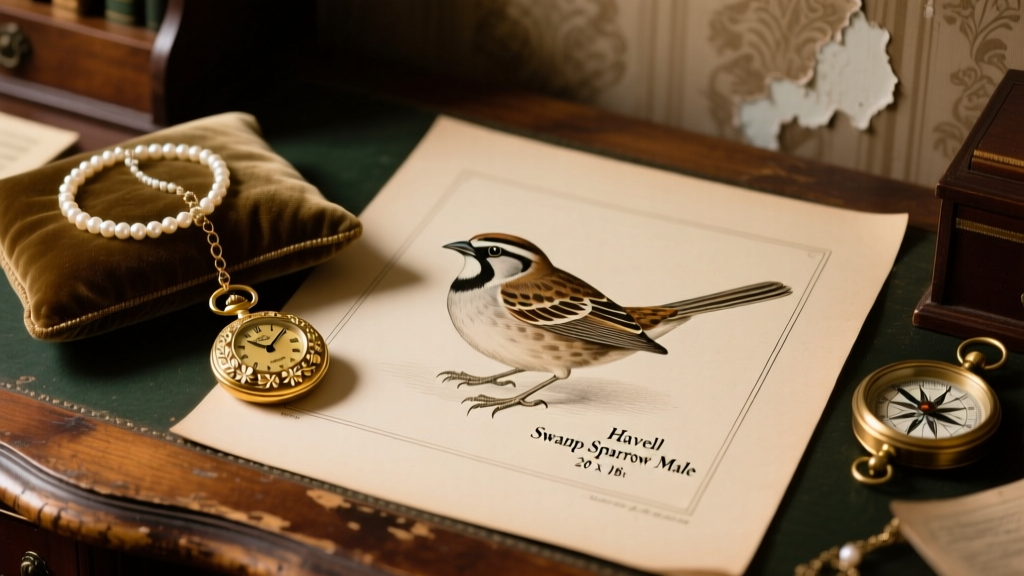
Havell’s Swamp Sparrow Male (1929): A Rare Ornithological Print from the Audubon Legacy
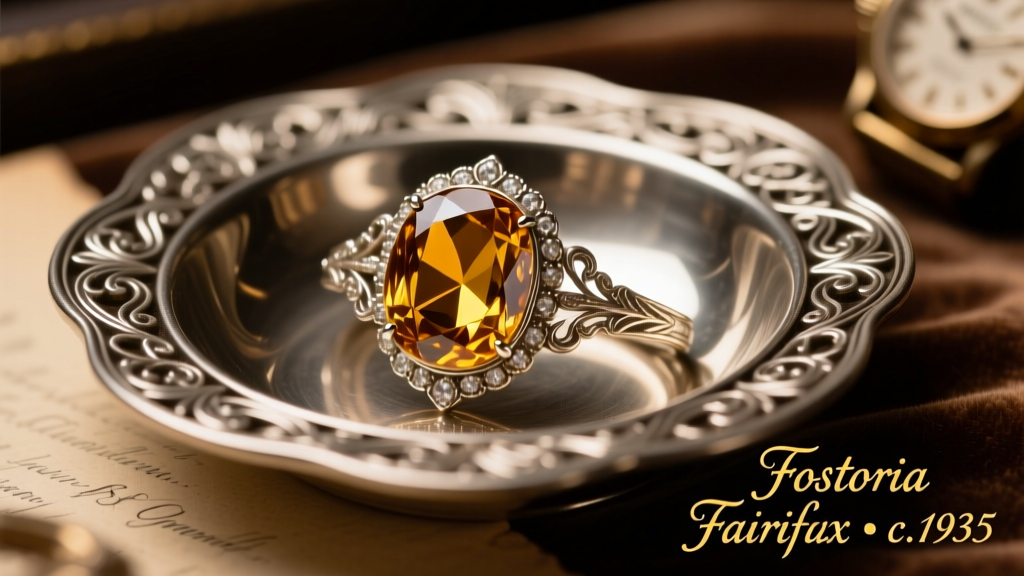
Fostoria Fairfax Finger Bowl Underplate in Topaz: A Collector’s Guide to American Glassware Heritage

John Allen No. 3: A Forgotten Masterpiece of British Horology and Its Auction Market Resurgence
Political Bandanna: Parker Davis 'Good Government For The People' — A Rare 1904 Campaign Artifact Measuring 22 × 23 Inches

Moe Bridges Reverse-Painted Bell-Shaped Lamp Shade: A 1920s American Art Glass Masterpiece

Tom Mix Shirts of the 1920s: Authentic Western Style, Hollywood Influence, and Collectible Rarity

The Toy Car Futuristic Friction Plastic Mattel 1960s: Design, Mechanics, and Collectibility of a Space-Age Icon

Lot 1133642: A 1958 Patek Philippe Ref. 2499 Third Series Perpetual Calendar Chronograph in 18K Yellow Gold