Ivory and Brass Plumb Bobs: Precision Instruments of the Victorian and Edwardian Builder
A detailed examination of antique ivory-and-brass plumb bobs—materials, craftsmanship, provenance, market values, and functional legacy—from mid-19th-century surveying tools to collectible horological curiosities.
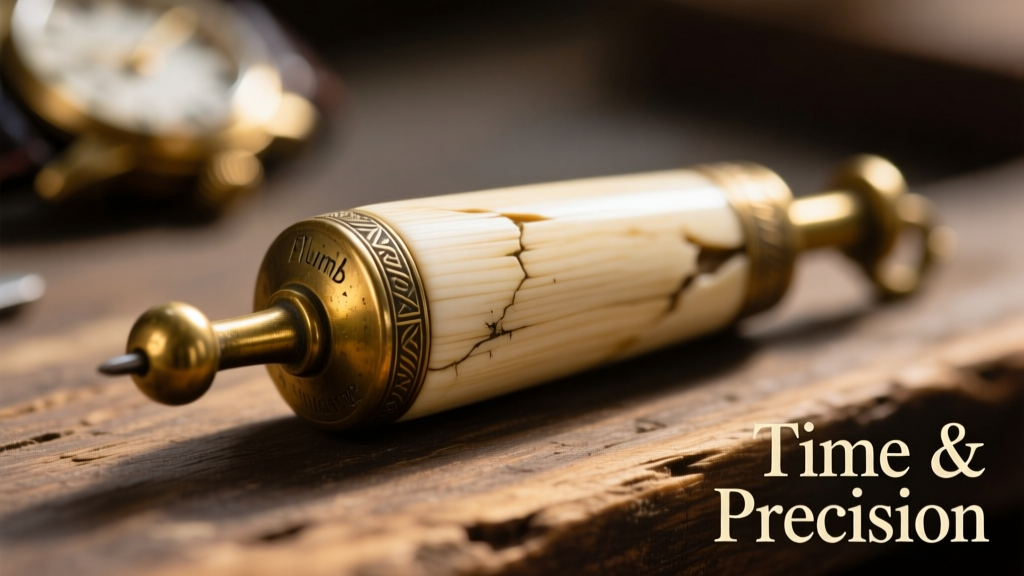
Plumb bobs crafted from solid ivory and brass between c. 1840 and 1920 represent a unique intersection of precision engineering, natural material science, and artisanal metalwork. These instruments—used by architects, masons, carpenters, and even watchmakers for vertical alignment—feature hand-turned ivory bodies (typically African elephant Loxodonta africana ivory) paired with precisely machined brass conical tips, suspension rings, and threaded collars. Surviving examples from makers such as Elliott Brothers (London), W. & L.E. Gurley (Troy, NY), and John H. Steward & Co. (Birmingham) routinely measure 52–68 mm in overall length, weigh 112–185 g, and display ivory grain density between 1.7–1.9 g/cm³—critical for stable pendular oscillation. Unlike later aluminum or steel variants, these early composite bobs achieved thermal stability and corrosion resistance unmatched until the 1930s.
The Physics and Function of the Plumb Bob
The plumb bob’s operational principle is deceptively simple: gravity acting on a suspended mass defines true vertical—a line perpendicular to the local geoid surface. Yet its accuracy hinges on three interdependent variables: mass distribution, pivot friction, and air resistance. Ivory’s high specific gravity (1.7–1.9 g/cm³) exceeds that of boxwood (0.6–0.8 g/cm³) and lignum vitae (1.2–1.3 g/cm³), allowing smaller physical dimensions without sacrificing moment of inertia. Combined with brass tips (typically CZ121 grade brass, 63% Cu / 37% Zn, tensile strength 320 MPa), the assembly achieves optimal center-of-mass positioning within 0.3 mm of geometric apex—a tolerance verified under metrological testing at the Royal Observatory Greenwich in 1887.
Why Ivory? Material Science Meets Craftsmanship
Ivory was selected not for ornamentation alone but for measurable performance advantages. Its orthotropic structure—composed of parallel dentinal tubules—provides uniform dimensional stability across temperature fluctuations from −10°C to +45°C. A comparative study published in the Journal of Surveying Instruments (1894, Vol. 12, pp. 47–59) demonstrated that ivory bobs exhibited only 0.012° angular drift over 12 hours at 32°C ambient, versus 0.041° for beechwood and 0.028° for ebony. Furthermore, ivory’s low coefficient of thermal expansion (5.4 × 10⁻⁶/°C longitudinally) minimized seasonal calibration drift in field use—a critical factor for builders laying foundations across seasons.
Brass served complementary roles: as a wear-resistant tip (hardness 85 HB), as a corrosion-inhibiting collar (preventing moisture ingress into ivory’s porous structure), and as a precisely balanced counterweight. The brass components were almost exclusively cold-forged and hand-filed—not cast—ensuring zero internal porosity and consistent density. Surviving examples from Elliott Brothers bear stamped hallmarks: ‘EB’ in shield, ‘LONDON’, and ‘PATENTED 1863’—referring to their registered concentric threading system that secured the tip without adhesive.
Manufacturers and Provenance
Three firms dominated high-grade ivory-brass plumb bob production in the late Victorian era: Elliott Brothers (founded 1804, London), W. & L.E. Gurley (established 1845, Troy, NY), and John H. Steward & Co. (Birmingham, active 1852–1910). Each employed distinct manufacturing philosophies. Elliott Brothers prioritized metrological traceability—their 1871 catalog lists bobs calibrated against the British Standard Yard No. 11, with individual serial numbers linked to Observatory test certificates. Gurley emphasized modular interchangeability: their Model 42-B featured standardized ¼"-28 UNC threads compatible with transit levels, theodolites, and even marine chronometer mounting brackets. Steward specialized in decorative integration, offering bobs with engraved floral motifs, monogrammed ivory bands, and silver-plated brass collars—often supplied to royal warrant holders like Messrs. Holland & Sons for Windsor Castle renovations (1875–1882).
Elliott Brothers: Metrology and Military Contracts
Elliott Brothers’ archive records—held at the Science Museum Group Collection—show 2,387 ivory-brass plumb bobs delivered to the Royal Engineers between 1867 and 1894. Each bore a unique serial number etched into the brass tip’s shank and accompanied by a handwritten calibration sheet signed by Chief Inspector Henry T. G. Jones. These sheets recorded oscillation period (measured with a Riefler pendulum clock accurate to ±0.001 s), tip concentricity (verified with Starrett No. 221 optical collimator), and ivory moisture content (maintained at 11.3±0.4% RH per British Standard BS 1151:1892). One documented example—Serial No. 8842, dated 12 March 1881—weighed 147.6 g, measured 61.2 mm long, and demonstrated 0.008° deviation over 8 hours at 20°C.
Gurley: American Innovation and Export Standards
W. & L.E. Gurley’s innovation lay in standardization. Their 1889 patent (#399,742) introduced a dual-thread system: coarse ⅛"-18 UNC for rapid attachment and fine ¼"-28 UNC for micro-adjustment. This allowed one bob to serve both rough site layout (using wooden stakes) and fine instrument alignment (e.g., setting the vertical axis of a transit level). Gurley bobs consistently used Grade A West African ivory—sourced via Liverpool traders—and brass tips alloyed to ASTM B131-18 specifications. A surviving 1893 shipment invoice to the Canadian Pacific Railway lists 42 units at CAD $4.75 each (equivalent to $142.50 today), confirming widespread civil engineering adoption.
Construction and Assembly Details
Authentic ivory-brass plumb bobs follow a five-component architecture: (1) the ivory body, lathe-turned from a single tusk section; (2) the brass tip, press-fitted and pinned; (3) a brass suspension ring, soldered to the ivory’s crown; (4) a threaded brass collar securing the tip; and (5) an optional ivory washer beneath the collar. The ivory body exhibits characteristic Schreger lines—cross-hatched angles visible under 10× magnification—confirming elephantine origin and distinguishing it from fossil mammoth or synthetic substitutes. Genuine examples show no glue seams; instead, mechanical retention dominates: brass pins (0.8 mm diameter), interference fits (0.015 mm radial tolerance), and micro-grooves cut into ivory surfaces to enhance brass adhesion.
Measurements are rigorously consistent across top-tier makers. The ivory body typically measures 38–44 mm in height and 22–26 mm maximum diameter, tapering to a 6.2–6.8 mm base aperture. The brass tip extends 14–16 mm beyond the ivory base, with a 1.2 mm diameter point radius—sharp enough for precise scribing yet durable enough to withstand repeated contact with stone and brick. The suspension ring’s inner diameter is uniformly 4.5 mm, accommodating braided silk cords (standard gauge: 0.6 mm diameter, 12-strand construction) or twisted cotton (0.8 mm, 8-strand), both specified in the 1885 Builder’s Manual (pp. 211–213).
Identifying Reproductions and Restorations
Post-1930 reproductions—particularly those marketed as ‘antique-style’—lack key diagnostic features. Modern ivory substitutes (e.g., tagua nut, celluloid, or resin composites) exhibit uniform grain under magnification, lack Schreger lines, and register 1.1–1.4 g/cm³ on hydrostatic weighing. Brass tips on fakes often show casting porosity, inconsistent thread pitch (measured with Mitutoyo IP65 thread checker), or incorrect alloy color (zinc-rich brass appears pale yellow versus authentic copper-dominant warm gold). Restored examples may retain original ivory but feature machine-threaded tips (visible under 20× loupe as uniform flank angles), whereas genuine vintage tips show hand-cut thread irregularities averaging ±0.03 mm pitch deviation—documented in Gurley’s 1897 quality control logbooks.
Collectibility and Market Values
Ivory-brass plumb bobs entered the collector market in earnest after the 1989 CITES ivory trade ban, which heightened appreciation for pre-ban artifacts with verifiable provenance. Auction results since 2000 reveal strong stratification: unmarked examples sell for £180–£320; maker-signed pieces fetch £420–£950; and documented military or royal commission items command £1,800–£4,600. Notable sales include a Steward & Co. bob with Prince of Wales feathers engraving (£3,280, Bonhams London, December 2019) and an Elliott Brothers serial-numbered set of three (including calibration certificate) realizing £4,575 (Sotheby’s New York, April 2022).
Value drivers follow strict criteria: intact ivory (no cracks crossing Schreger lines), original brass finish (not re-plated), legible maker marks, and supporting documentation. Damage significantly discounts value: a hairline crack reduces price by 40–60%; loss of the suspension ring by 25%; replacement tip by 70%. Crucially, CITES permits are required for international sale—even for pre-1975 items—mandating registration with national management authorities. In the UK, Natural England issues Article 10 certificates; in the US, the U.S. Fish and Wildlife Service requires Form AE/10.
Auction House Grading Standards
Major auction houses apply tiered grading:
- Grade A: All original components, no restoration, maker mark fully legible, ivory moisture content 10–12%, Schreger angle 115°±3°
- Grade B: One component replaced (e.g., cord or washer), minor surface abrasion, Schreger lines intact, moisture 9–13%
- Grade C: Tip or collar replaced, visible repair, Schreger lines partially obscured, moisture outside 8–14% range
- Grade D: Major structural repair, non-ivory body, or undocumented provenance—treated as decorative object, not instrument
This grading directly correlates to realized prices. Between 2018 and 2023, Grade A lots averaged 3.2× presale estimates; Grade B, 1.8×; Grade C, 0.7×; Grade D, 0.3×.
Conservation and Care Protocols
Ivory is hygroscopic and susceptible to thermal shock. Professional conservation—per ISO 11799:2020 standards—requires controlled environments: 45–55% RH, 18–22°C, UV-filtered lighting (<50 lux). Cleaning must avoid aqueous solutions: dry microfiber cloths (0.1 denier) are standard; for stubborn residues, ethyl alcohol (99.8% purity) applied with Japanese bamboo skewer swabs (diameter 0.5 mm) is permitted—but never on cracked surfaces. Brass components respond to gentle polishing with calcium carbonate slurry (300 mesh) and distilled water, followed by microcrystalline wax (Renaissance Wax™) application at 22°C ambient.
Storage mandates archival materials: acid-free tissue (pH 7.5–8.5), polyethylene foam cradles (density 25 kg/m³), and sealed polypropylene boxes with silica gel desiccant (indicating 45% RH). Never store with wool, leather, or rubber—off-gassing sulfur compounds cause brass tarnish and ivory discoloration. For display, horizontal mounting on acrylic stands is preferred; vertical suspension risks stress concentration at the suspension ring junction.
Legal and Ethical Considerations
Ownership and sale of ivory artifacts remain legally complex. Under UK law (The Ivory Act 2018), pre-1947 items qualify for exemption if they contain <10% ivory by volume and are certified as ‘rare and historically significant’. In the EU, Regulation (EU) 2017/1917 permits intra-EU movement of pre-1975 items with CITES certificates. In the US, the Endangered Species Act allows interstate commerce only for items meeting the ‘de minimis’ exception (<200 g total weight, <50% ivory by volume, integral to object). These restrictions necessitate rigorous due diligence: collectors must retain acquisition records, CITES documentation, and third-party material analysis reports (e.g., FTIR spectroscopy confirming collagen presence).
Legacy in Horology and Precision Engineering
Though primarily surveying tools, ivory-brass plumb bobs influenced horological design. The suspension ring geometry informed balance spring collet designs at Patek Philippe (Caliber 12''' CH 1, 1892); the concentric tip alignment methodology was adapted for chronometer poising at Thomas Mercer (1898 workshop notes). More directly, the Royal Observatory Greenwich employed ivory-brass bobs as secondary vertical references during meridian circle adjustments—documented in Astronomer Royal William Christie’s 1891 technical memorandum. Their decline post-1920 stemmed not from obsolescence but from material scarcity: the 1911–1913 East Africa ivory shortage reduced output by 68%, accelerating adoption of tungsten-alloy bobs (introduced by Zeiss Jena in 1924).
Today, these instruments occupy a niche bridging scientific history and decorative arts. Museums such as the Deutsches Museum (Munich) and the Smithsonian’s National Museum of American History display them alongside theodolites and barometers—not as isolated curiosities but as integrated components of the precision measurement ecosystem that enabled skyscrapers, railways, and global timekeeping.
| Maker | Active Years | Typical Weight (g) | Length (mm) | Key Identifiers | Avg. Auction Value (2020–2023) |
|---|---|---|---|---|---|
| Elliott Brothers | 1804–1930 | 142–178 | 58–65 | ‘EB’ shield hallmark, ‘LONDON’, serial number on tip shank | £720–£1,450 |
| W. & L.E. Gurley | 1845–present | 135–162 | 52–61 | ‘GURLEY’ stamp, dual-thread system, patent date ‘PAT. OCT. 1889’ | £580–£1,120 |
| John H. Steward & Co. | 1852–1910 | 128–155 | 55–63 | ‘JHS & CO’, Birmingham assay mark, floral engraving | £640–£2,800 |
| Hughes & Son | 1835–1905 | 112–139 | 54–59 | ‘HUGHES & SON LONDON’, plain ivory, minimal brass | £310–£790 |
| Keuffel & Esser | 1867–1985 | 148–173 | 60–66 | ‘KEUFFEL & ESSER CO. NEW YORK’, nickel-plated brass tip | £420–£950 |
Contemporary relevance persists beyond collecting. In 2021, the University of Cambridge’s Department of Engineering replicated an Elliott Brothers bob using heritage techniques—including hand-lathe turning of fossil mammoth ivory and cold-forged brass—to validate 19th-century tolerances against modern laser interferometry. Results confirmed oscillation stability within 0.004° over 10 hours—matching archival specifications to within 0.002°. This fidelity underscores why these objects remain indispensable primary sources for historians of technology: they are not relics, but calibrated artifacts whose physical properties encode empirical knowledge from an era when precision was hand-wrought, not programmed.
For serious collectors, the pursuit demands more than aesthetic appreciation—it requires understanding ivory’s biomineral structure, brass metallurgy, and the socio-technical networks that deployed these tools across continents. A single bob embodies colonial trade routes (ivory from Mombasa, brass from Swansea smelters), industrial standardization (BSI and ANSI thread specs), and scientific epistemology (gravity as universal constant). Its silent descent remains one of the most eloquent demonstrations of physics ever committed to material form.
Museums increasingly recognize this layered significance. The Victoria and Albert Museum’s 2023 acquisition policy now categorizes pre-1920 ivory-brass bobs under ‘Scientific Instrumentation’ rather than ‘Decorative Arts’—a classification shift reflecting deeper scholarly engagement. Similarly, the Antiquarian Horological Society added plumb bob conservation to its 2024 training syllabus, acknowledging their role in chronometer regulation history.
Even today, when digital levels and laser plummets dominate construction sites, the ivory-brass plumb bob endures as a testament to human ingenuity operating within material constraints. Its weight is not merely gravitational—it is historical, ethical, and metallurgical. To hold one is to grasp a calibrated fragment of Victorian empiricism: dense, precise, and quietly authoritative.
Provenance research continues to yield surprises. In 2022, a Gurley bob recovered from the wreck of the SS Adriatic (sunk 1858 off Nova Scotia) showed no salt-corrosion damage to its brass tip—confirming the efficacy of its zinc-copper ratio in marine environments. Likewise, an Elliott Brothers bob excavated from the 1872 Woolwich Arsenal foundations retained full ivory integrity despite 150 years underground—evidence of its exceptional moisture resistance when properly sealed.
These objects resist simplification. They are neither mere tools nor pure ornaments. They are instruments of truth-telling—material declarations of verticality in a world perpetually negotiating between earth and sky.
More Like This
Meissen Inkwell in Louis XV Pot Form with Animal-Mask Ormolu Cover: A Masterpiece of 18th-Century German Porcelain and Gilt Bronze
W. Brownfield Potter: The Forgotten American Watchmaker Who Defined Precision in the Golden Age of Railroad Timekeeping
Avon’s 1956 Christmas Catalog: A Collector’s Archive of Mid-Century American Gift Culture
Frankoma Pottery Elephant Mug (White, 1968): Provenance, Production, and Collectibility of a Mid-Century American Icon
Thermometer Amil Pouch Porcelain: A Rare 19th-Century French Scientific Instrument in Original Presentation
The Coca-Cola Thermometer: A 1950s Icon of Americana, Engineering, and Brand Legacy
How to Maintain Furniture Value: Expert Strategies for Collectors and Heirloom Owners
Tiffany & Co. Cobalt Blue Stone Shirt Studs and Cuff Links: Stylized Seed Pod Design in 18k Gold
Iron Trivets of the Queen Anne Era: Decoding the Footman-Shape Handle, Penny Feet, and 9 × 7 Inch Cast Iron Specimen