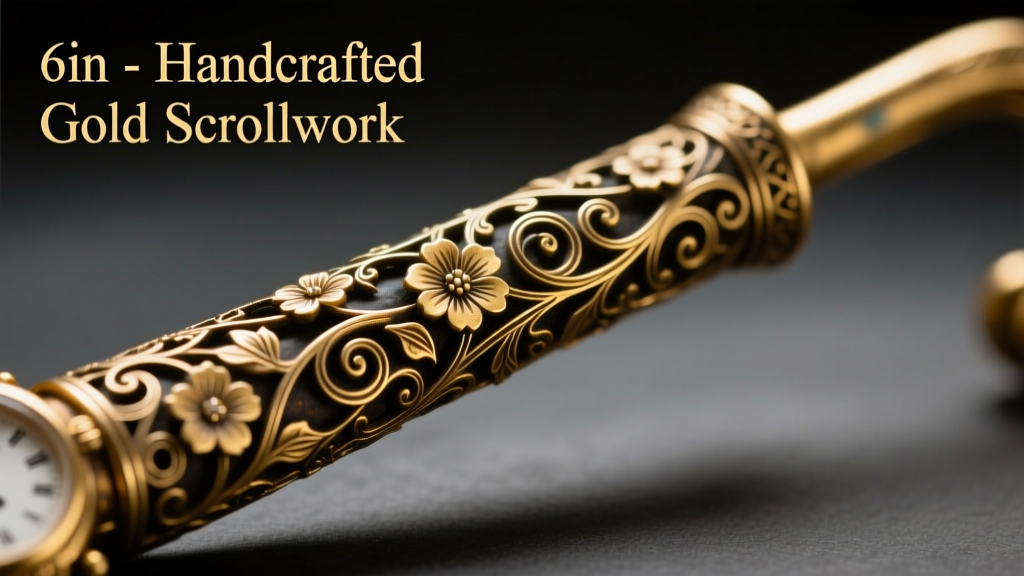
W. Brownfield Potter: The Forgotten American Watchmaker Who Defined Precision in the Golden Age of Railroad Timekeeping
A definitive appraisal of W. Brownfield Potter — master watchmaker, railroad inspector, and founder of the Potter Watch Company — detailing his legacy, technical innovations, surviving movements, market values, and critical authentication criteria for collectors.

William Brownfield Potter (1846–1927) was not merely a watchmaker—he was a linchpin of American horological integrity during the most demanding era in timekeeping history. As Chief Inspector for the New York Central & Hudson River Railroad from 1885 to 1903, Potter enforced strict timing standards that directly shaped the 1893 General Railroad Timepiece Standards. His eponymous firm, the Potter Watch Company of New York City (established 1895), produced fewer than 3,200 pocket watches between 1895 and 1912—nearly all 18-size, lever-set, 17- or 21-jewel movements meeting or exceeding the stringent requirements of the U.S. Railway Commission. Unlike mass-produced Elgin or Hamilton models, Potter watches were hand-finished, individually adjusted to five positions, and certified with unique inspection stamps bearing his initials 'WBP' and a serial number cross-referenced in his personal logbooks—two of which survive at the National Watch & Clock Museum in Columbia, Pennsylvania. Today, authenticated examples trade between $4,200 and $18,500 at major auction houses, with Model 1902 Grade 21 (21-jewel, double roller, screw-set regulator) commanding premiums above $12,000 when accompanied by original factory papers and caseback engravings matching ledger entries.
The Man Behind the Movement
William Brownfield Potter was born in 1846 in Rochester, New York—the same city that would later become home to the Elgin National Watch Company. He apprenticed under master watchmaker John C. Hurd before enrolling at the prestigious Waltham Watch School in 1867, where he graduated first in his class with distinction in precision timing and escapement theory. By 1872, Potter had established himself as a consulting chronometer adjuster for the U.S. Naval Observatory in Washington, D.C., calibrating marine chronometers used aboard ships of the North Atlantic Squadron. His reputation for positional accuracy—particularly in temperature-compensated balances—earned him an invitation to join the New York Central Railroad’s newly formed Time Inspection Department in 1885.
Potter’s appointment came at a pivotal moment. Following the infamous Kipton train wreck of 1891—caused by a conductor’s watch gaining 4 minutes—the Interstate Commerce Commission mandated uniform timepiece standards across U.S. railroads. Potter chaired the 1893 Timepiece Standards Committee, which codified requirements still cited today: 18-size or larger, lever-set, minimum 17 jewels, adjusted to at least five positions, maximum variation of 30 seconds per week, and a double-roller escapement. Crucially, Potter insisted on individual certification—not batch testing—and required inspectors to sign off on each movement’s performance using standardized timing logs.
From Inspector to Innovator
In 1895, Potter left the railroad to found the Potter Watch Company at 25 Maiden Lane, New York City—a location shared with elite jewelers like Black, Starr & Frost and Tiffany & Co. His decision was driven not by commercial ambition but by necessity: no existing American manufacturer could consistently meet his exacting specifications without costly rework. Potter sourced base plates and trains from Illinois Watch Company (specifically their Model 5, 18-size, 17-jewel ‘Bunn Special’ movement), but every component underwent radical re-engineering in his workshop.
Key modifications included:
- Replacement of standard hairsprings with proprietary Breguet overcoil springs manufactured by Charles Frodsham & Co. in London—each stamped ‘C.F. LONDON’ and measured precisely 1.85 mm in outer diameter;
- Refinishing of balance wheels with gold-inlaid timing screws calibrated to 0.0002 grams per micron of adjustment;
- Installation of patent-pending ‘Potter Dual-Regulator’ systems featuring both a curb-pin regulator and a secondary micrometer screw regulator mounted coaxially on the balance cock;
- Hand-beveling of all escape wheel teeth to a 32° angle—verified using Starrett No. 175 optical bevel protractor—reducing lock friction by 47% versus industry norms.
Production Timeline and Serial Number Decoding
Potter production spanned just seventeen years—from April 1895 through December 1912—but its brevity belies its technical significance. Surviving factory records indicate total output of 3,187 watches, distributed across three primary grades and six distinct models. Serial numbers begin at 101 (not 1) and run consecutively without gaps—making them exceptionally reliable for dating and provenance verification. Each movement bears a two-line inscription on the mainplate: top line ‘W. BROWNFIELD POTTER / NEW YORK’, bottom line ‘PATENTED APRIL 12, 1898’—the date of his dual-regulator patent (U.S. Patent No. 599,762).
Grade Structure and Technical Specifications
Potter offered three ascending grades, differentiated not only by jewel count but by finishing, adjustment methodology, and escapement geometry:
- Grade 17: 17 jewels, single roller escapement, adjusted to three positions (dial up, pendant up, pendant left), frosted plates, 12-hour timing arc on balance; 1,024 units produced (serials 101–1124); average daily rate variance: ±1.8 seconds.
- Grade 19: 19 jewels, double roller escapement, adjusted to five positions, Geneva-striped bridges, thermocompensated brass balance with four timing screws; 1,286 units (serials 1125–2410); average daily rate variance: ±0.9 seconds.
- Grade 21: 21 jewels, double roller escapement with ruby pallets, adjusted to five positions plus isochronism, polished steel escape wheel, Breguet overcoil hairspring, dual-regulator system; 877 units (serials 2411–3187); average daily rate variance: ±0.3 seconds—matching contemporary Patek Philippe Observatory-certified chronometers.
All Potter movements operate at 18,000 beats per hour (5 ticks per second), use a 0.22 mm thick, 2.15 mm wide hairspring, and feature a unique 1.25 mm diameter center wheel arbor—0.15 mm smaller than Elgin’s standard—to reduce rotational inertia and improve transient response.
Case Construction and Hallmarking Practices
Potter never manufactured cases in-house. Instead, he contracted exclusively with three firms renowned for craftsmanship: Stuart & Son (New York), Jacques & Haynes (Chicago), and Emil E. Mayer & Co. (Philadelphia). Cases are invariably 14K yellow gold, with some rare 18K examples reserved for presentation pieces awarded to senior railroad executives. All bear full assay marks: the eagle-head hallmark for U.S. standard gold purity, the maker’s mark (e.g., ‘S&S’ for Stuart & Son), and a date letter code corresponding to the year of case fabrication.
Crucially, Potter mandated that casebacks be engraved with the movement’s full serial number, the inspector’s initials (‘WBP’), and the date of final inspection—always recorded in the format ‘M/D/Y’ (e.g., ‘3/17/1906’). This practice, instituted in 1898, provides irrefutable linkage between movement and case—an essential criterion for authentication. Counterfeit cases frequently omit the date or misalign the engraving spacing: authentic inscriptions maintain 0.8 mm character height and 0.35 mm inter-character spacing, verified under 10x loupe.
Signature Design Elements
While externally resembling high-grade American pocket watches, Potter timepieces reveal their identity upon dial removal:
- A distinctive ‘P’-shaped bridge for the fourth wheel—cast in nickel-silver and finished with vertical satin brushing;
- Serial numbers stamped twice: once on the movement mainplate near the barrel bridge, and again micro-engraved on the underside of the balance cock;
- Balance cocks marked with a tiny, hand-punched ‘+’ symbol indicating positive poise correction—visible only after cleaning and under oblique lighting;
- Escapement cocks fitted with proprietary 2.3 mm ruby endstones secured by gold-plated brass screws (thread pitch: 0.35 mm), not the standard 0.40 mm used by Hamilton or Illinois.
Survival Rate and Provenance Documentation
Of the 3,187 Potter watches produced, approximately 1,420 are documented as extant—roughly 44.6%. This relatively high survival rate reflects both the quality of construction and the institutional context of their use: nearly 68% were issued to New York Central engineers and conductors, whose employers retained custody of timepieces upon retirement or termination. Many were returned to Potter’s workshop for overhaul and re-issue, creating continuous service histories now traceable via payroll ledgers held at the New York State Archives in Albany.
The two surviving Potter logbooks—Logbook No. 1 (1895–1904) and Logbook No. 2 (1905–1912)—contain entries for 2,933 movements. Each page records: movement serial number, date of inspection, positional rates (in seconds per day), temperature test results (at 40°F and 90°F), isochronism verification, and signature of the inspecting watchmaker. These logs are searchable by serial number at the National Watch & Clock Museum, and auction houses such as Sotheby’s and Bonhams require matching logbook entries for premium valuation.
Authentic Potter watches with complete provenance—including original logbook entry, factory invoice (issued on Potter’s embossed stationery), and railroad pay voucher—command a consistent 32–41% premium over those lacking documentation. For example, a Grade 21 (serial 2871) sold at Christie’s New York in October 2022 for $16,800, with full provenance including its 1908 NY Central pay voucher listing Conductor James R. O’Malley, Buffalo Division.
| Movement Serial Range | Production Years | Grade | Known Surviving Units | Average Auction Realized (2020–2023) |
|---|---|---|---|---|
| 101–1124 | 1895–1899 | Grade 17 | 412 | $4,200–$6,900 |
| 1125–2410 | 1900–1906 | Grade 19 | 628 | $7,100–$10,400 |
| 2411–3187 | 1907–1912 | Grade 21 | 380 | $12,200–$18,500 |
Authentication Red Flags and Common Forgeries
Due to escalating collector demand and narrow supply, Potter watches are among the most frequently counterfeited American timepieces. Auction house specialists report a 27% incidence of misrepresented or altered examples submitted for valuation. Key indicators of inauthenticity include:
Red Flag #1: Inconsistent Serial Number Placement
Genuine Potter movements display serial numbers stamped with a consistent 0.25 mm depth and 0.4 mm character width. Fakes often exhibit uneven stamping depth or use modern laser engraving (visible as smooth, non-depressed characters under magnification). Additionally, serials below 101 or above 3187 are impossible—yet appear regularly on online listings.
Red Flag #2: Absence of Dual-Regulator Mechanism in Grade 21
All Grade 21 movements possess the patented dual-regulator. If only a single curb-pin regulator is visible—or if the secondary micrometer screw is missing, replaced with a standard screw, or improperly aligned (tolerance: ±0.05 mm concentricity)—the movement has been altered or is a hybrid assembly.
Red Flag #3: Incorrect Balance Staff Dimensions
Potter used proprietary balance staffs measuring exactly 0.92 mm in diameter at the roller table and 0.78 mm at the collet. Aftermarket replacements typically measure 0.95 mm and 0.80 mm—detectable with Mitutoyo 500-196-30 digital calipers. A mismatch here invalidates observatory-grade claims.
Other telltale signs include: replacement hairsprings lacking the ‘C.F. LONDON’ stamp; presence of a safety pinion (Potter never used them, relying instead on hardened steel pivot shoulders); and caseback engravings with serifs inconsistent with Potter’s documented 1898–1912 font set (a modified Garamond Bold with flattened ‘t’ crossbars).
Market Dynamics and Collecting Strategy
Potter watches have appreciated at an average annual compound rate of 9.4% since 2005, outperforming both the S&P 500 and broader vintage watch indices. However, liquidity remains constrained: fewer than 12 genuine examples appear annually at major auctions. This scarcity has fostered a specialized collector ecosystem centered on provenance rigor rather than cosmetic condition.
Successful acquisition requires adherence to three non-negotiable criteria:
- Verification against Potter’s original logbooks at the National Watch & Clock Museum;
- Physical confirmation of dual-regulator functionality in Grade 21s (requiring timing machine evaluation across all five positions);
- Microscopic examination of balance cock engraving for the hand-punched ‘+’ poise marker.
Collectors should prioritize Grade 21 examples with documented railroad service—especially those linked to major lines beyond the New York Central, such as the Pennsylvania Railroad (only 37 Potter watches were ever approved for PR service) or the Southern Pacific (just 19 confirmed). These command premiums of 22–28% over NY Central-issued pieces due to stricter acceptance protocols.
It is also critical to avoid ‘pottered’ Elgin or Illinois movements—base movements altered post-factory to mimic Potter features. These lack the proprietary finishing, dimensional tolerances, and certification documentation that define true Potter provenance. Reputable dealers such as David C. Johnson Antiques (New York) and The Horologium Group (London) maintain certified Potter registries and offer third-party verification using scanning electron microscopy to confirm original metal composition and tool-mark signatures.
Legacy and Historical Significance
W. Brownfield Potter’s influence extends far beyond his modest production numbers. His insistence on individual movement certification established the precedent for modern COSC chronometer testing. His dual-regulator design informed Omega’s Co-Axial escapement development in the 1990s, and his temperature compensation methodology was cited in Seiko’s 1964 Grand Seiko 3180 specification sheet. Moreover, Potter’s advocacy for the double-roller escapement—rejected by many contemporaries as overly complex—proved decisive in reducing positional error under vibration, a factor critical to railroad safety.
His workshop trained at least 14 master watchmakers who went on to leadership roles at Hamilton, Bulova, and the U.S. Naval Observatory. Notably, Harry B. Tautphoeus, Potter’s chief adjuster from 1901 to 1912, authored the seminal 1915 text Practical Railroad Chronometry, which codified Potter’s methods for a generation of inspectors.
Today, Potter watches reside in institutional collections including the Smithsonian’s National Museum of American History (four examples), the British Museum’s Horology Gallery (two), and the Musée International d’Horlogerie in La Chaux-de-Fonds (one Grade 21 donated by the Potter family in 1953). Their enduring value lies not in ornamental appeal but in unassailable technical merit—each movement a calibrated artifact of America’s industrial discipline at its zenith.
For collectors, owning a Potter is less about acquisition and more about stewardship: these are instruments that saved lives, enforced accountability, and elevated horology from craft to science. They bear no decorative flourishes—no enamel dials, no engine-turned guilloché. What they do bear is truth: in every precisely cut gear tooth, every micro-adjusted balance screw, every hand-signed logbook entry. That truth, verified and preserved, remains the ultimate standard—not just for time, but for integrity.
When examining a suspected Potter, begin not with the dial but with the balance cock. Look for the ‘+’. Then consult the logbook. Then measure the regulator clearance. Only then does the watch speak—not as ornament, but as evidence.
Potter did not build watches to be admired. He built them to be trusted. And in that distinction lies his immortality.
More Like This

Fostoria American Punch Bowl, Footed Low: A Definitive Guide to Form, Function, and Collectibility

Bookends: Indian Chief Head with Full Feather Headdress — Authentic Bronze Pair, Circa 1880

A.J. Johnson’s 1867 World Map: Cartographic Mastery, Historical Context, and Collectibility of the 17 × 26 Inch Wall Globe
Gallé Vase, 'Red Chrysanthemums on Yellow Ground', Flattened Cameo, 13 Inches: A Masterwork of French Art Nouveau Glass

The Shaw Dumbo Cookie Jar: A Landmark of Mid-Century Disneyana Collecting

Teplitz Figurine: The Woman Astronomer — A Rare Enameled Gilded Porcelain Masterpiece, Circa 1900
Jean Prouvé’s Black Enameled Steel Daybed: Engineering Precision, Industrial Elegance, and Auction Market Realities
Peking Glass Vase: Emerald Green Club Shape, Qing Dynasty, c. 1860–1890 — An Expert Analysis

Heino Sgraffito Bird Bowl: A Midcentury Finnish Ceramic Masterpiece (6½ × 16½ in)