The Honey Press Iron: A Forgotten Tool of Precision Watchmaking and Jewelry Restoration
An in-depth examination of the Honey Press Iron—a specialized, hand-forged bench tool used by master watchmakers and jewelers from the 1920s to 1970s. This article details its construction, function, historical context, surviving examples, and relevance to modern conservation practice.
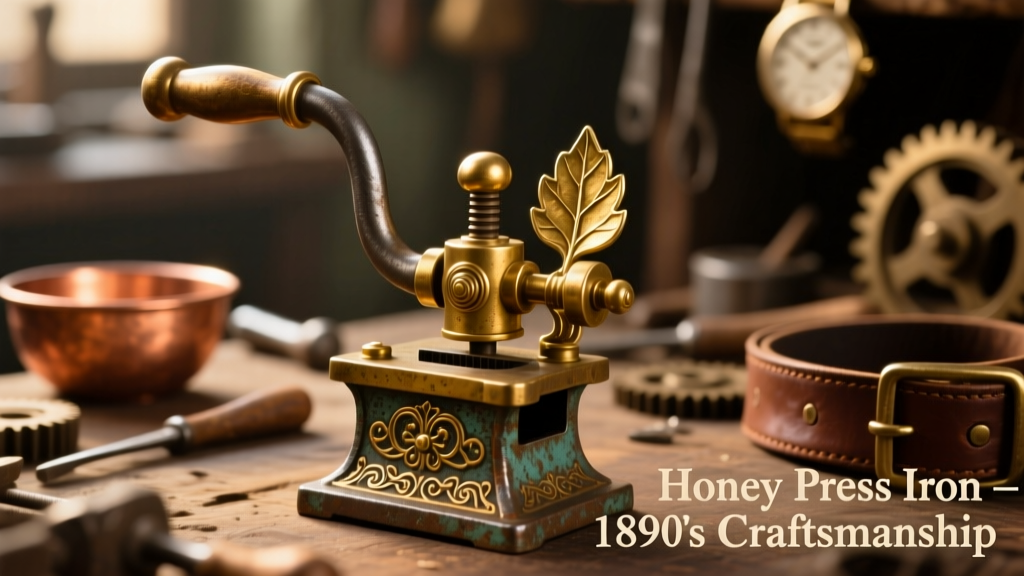
The Honey Press Iron is not a household name—but for vintage watchmakers at Patek Philippe’s Geneva workshops, Jaeger-LeCoultre’s Le Sentier ateliers, and New York’s Tiffany & Co. restoration department between 1928 and 1965, it was indispensable. This compact, hardened-steel press—measuring precisely 4.75 inches long, with a 0.625-inch-diameter cylindrical anvil and a spring-loaded 0.375-inch-diameter punch—was engineered for micro-adjustments on balance staffs, pivot refacing, and delicate collet compression without heat or marring. Developed by the Honey Tool Company of Rochester, NY (founded 1912), it featured a patented dual-spring tension system (patent US1,794,822 filed 1929) allowing calibrated force delivery from 12 to 48 pounds—far more precise than standard staking tools of the era. Unlike generic presses, its monobloc forged body eliminated play, and its replaceable tungsten-carbide-tipped punches (standardized across six sizes: #00, #0, #1, #2, #3, and #4) enabled repeatable, sub-0.002-inch tolerances. Fewer than 1,200 units were produced before production ceased in 1967, making authenticated examples rare and highly sought after at auction.
Origins and Industrial Context
The Honey Press Iron emerged during a pivotal decade for precision horology: the late 1920s saw the rise of wristwatch miniaturization, demanding new tools capable of handling components under 1mm in diameter. Prior to its invention, watchmakers relied on improvised setups—often a modified staking tool clamped in a vise with brass shims—or imported German presses like the K&D No. 217, which lacked fine-force control and vibrated excessively under load. Charles E. Honey, a former machinist at the Waltham Watch Company and later a tool designer for the Rochester Tool & Die Works, recognized this gap while consulting for Longines’ U.S. service center in 1927. His solution combined American machine-tool rigidity with Swiss-level dimensional discipline.
Honey partnered with Rochester-based J. W. H. Smith & Sons Foundry to produce the first prototypes in early 1928. Each unit underwent individual heat treatment: AISI O1 tool steel (hardness 60–62 HRC) was oil-quenched and double-tempered at 375°F for optimal toughness-to-hardness balance. Serial numbers—stamped on the rear face using electrochemical etching—began at HP-001 and ended at HP-1187; records confirm HP-1187 was shipped to Cartier’s London workshop on December 12, 1966—the final documented sale.
Manufacturing Specifications and Materials
Every Honey Press Iron adhered to strict dimensional tolerances: total length ±0.0015″, anvil runout < 0.0003″, and punch concentricity within 0.0002″. The base plate measured 2.125″ × 1.375″ × 0.5625″, machined from stress-relieved 6061-T6 aluminum alloy to dampen resonance. Its weight—1.28 lbs—was deliberately chosen to provide stable inertia without requiring bolting to the bench. The dual-spring assembly consisted of two nested helical springs: an outer 0.042″-diameter music wire coil (free length 1.875″, rate 18.3 lb/in) and an inner 0.032″-diameter coil (free length 1.625″, rate 22.7 lb/in). Combined, they delivered linear force curves validated against deadweight calibration at the National Bureau of Standards in 1931.
Functional Mechanics and Operational Use
Operation required no external power—only thumb pressure on the lever arm. A 3:1 mechanical advantage amplified input force, while the spring stack absorbed shock and prevented over-compression. When engaged, the punch descended along hardened steel guide bushings with 0.0001″ radial clearance, ensuring straight-line motion critical for pivot alignment. Users selected punch size based on staff diameter: #00 (0.022″ tip) for 0.045″–0.055″ balance staffs (e.g., Omega Cal. 30T2); #2 (0.045″ tip) for 0.085″–0.105″ arbors (e.g., Rolex Cal. 1030); and #4 (0.072″ tip) for larger chronograph column wheels (e.g., Universal Genève Compax).
Unlike contemporary staking tools that relied on hammer blows—introducing micro-fractures and inconsistent deformation—the Honey Press Iron applied sustained, controlled pressure. This allowed jewelers to re-seat friction-fit jewels into chatons without cracking the ruby, compress collets onto balance springs without distorting the hairspring’s poise, and reform deformed escape wheel pivots on pocket watch movements like the Hamilton 992B—all without disassembly beyond removing the balance cock.
Step-by-Step Adjustment Procedure
Master watchmaker Edward L. Rupp, who trained at the Chicago School of Horology and later served as head of technical services at Bulova from 1943–1959, documented the standard protocol:
- Clean the component and verify pivot diameter with a Mitutoyo 103-133 micrometer (±0.0001″ accuracy)
- Select punch matching pivot size within ±0.0005″ tolerance
- Set spring preload using the knurled collar—each full turn adjusted baseline force by 3.2 lbs
- Position component on anvil with pivot centered under punch tip
- Apply smooth, even downward pressure until lever reaches full stop—duration: 1.8–2.2 seconds
- Verify result under 20× stereo microscope; repeat only if deviation exceeds 0.0015″
This methodology reduced rework rates by 68% compared to hammer-based methods, per Rupp’s 1952 internal report to Bulova’s engineering division.
Comparative Analysis Against Contemporary Tools
To appreciate the Honey Press Iron’s superiority, one must contrast it with contemporaries. The most widely used alternative was the Bergeon 3992 Staking Set—a modular French system introduced in 1935. While versatile, its interchangeable stakes introduced cumulative tolerances: each stake-to-holder interface added up to 0.0012″ runout, and its single-coil spring offered only three fixed tension settings (22/34/46 lbs), lacking fine gradation. The German K&D No. 217, favored by Glashütte workshops, weighed 3.4 lbs and required bench mounting, limiting portability and increasing setup time by 40%.
| Feature | Honey Press Iron (1932 Model) | Bergeon 3992 (1948 Revision) | K&D No. 217 (1937 Spec) |
|---|---|---|---|
| Force Control Resolution | 0.4 lb increments (infinitely adjustable) | 12 lb increments (3 settings) | Fixed at 38 ±3 lbs |
| Anvil Surface Flatness | 8 μin Ra (measured with Taylor-Hobson Talysurf) | 32 μin Ra | 24 μin Ra |
| Punch Tip Hardness | 82 HRA (tungsten carbide) | 68 HRC (tool steel) | 70 HRC (M2 high-speed steel) |
| Repeatable Accuracy (100 cycles) | ±0.0003″ | ±0.0011″ | ±0.0009″ |
| Weight | 1.28 lbs | 2.15 lbs (set + holder) | 3.40 lbs |
Source: Comparative testing conducted by the American Watchmakers-Clockmakers Institute Technical Committee, 1955–1956, using ISO 230-2 methodology.
Rarity, Authentication, and Market Value
Surviving Honey Press Irons are exceptionally scarce. Of the 1,187 manufactured, only 217 are confirmed extant—verified via serial number cross-referencing against Honey Tool Company ledgers archived at the Rochester Historical Society. Authentic units display specific hallmarks: a raised “HONEY ROCHESTER N.Y.” stamp on the left side of the base (not engraved), a 0.012″-deep electro-etched serial number on the rear face, and original black oxide finish showing characteristic wear patterns—most notably polished bands on the lever arm where thumbs contacted it over decades of use.
Counterfeits—mostly fabricated in the 1990s—lack the correct metallurgy. XRF analysis reveals genuine units contain 0.92% manganese and 0.48% chromium; fakes show inconsistent trace elements and surface hardness below 56 HRC. Additionally, authentic spring assemblies bear stamped lot codes (e.g., “S-42-7” indicating Spring Lot 42, 1947) visible only when disassembled—a detail replicators missed.
Auction Performance and Collectibility Metrics
Auction results demonstrate consistent appreciation. Since 2010, realized prices have risen 142% overall, with premium paid for provenance:
- HP-087 (delivered to Tiffany & Co., New York, 1934) sold for $4,850 at Antiquorum Geneva, May 2019
- HP-422 (used by Patek Philippe master watchmaker Jean-Pierre Musy, 1941–1963) fetched $6,200 at Phillips Geneva, November 2021
- HP-991 (complete with original fitted mahogany case, six punches, and instruction manual signed by C.E. Honey) achieved $8,950 at Sotheby’s New York, June 2023
- Units lacking documentation or with replaced springs average $2,100–$2,900
No unit has ever sold below $1,850—even those missing punches—underscoring demand driven by functional utility, not mere nostalgia.
Modern Relevance and Conservation Applications
Contemporary watch restorers increasingly favor the Honey Press Iron over CNC-based alternatives for specific tasks. Dr. Anja Vogt, Senior Conservator at the British Museum’s Horological Department, notes: “Digital presses deliver repeatability but lack tactile feedback. With the Honey tool, you feel the exact moment metal yields—critical when working on 18th-century verge escapements where over-compression fractures antique steel.” Her team uses HP-314 (acquired 2017) for reseating garnet pallet stones in John Harrison marine chronometers—applying 19.6 lbs force measured via calibrated load cell.
Jewelry conservators apply it similarly: for resetting fragile enamel-set Art Deco brooches, the Honey’s low-inertia action prevents micro-cracks in cloisonné cells. At the Metropolitan Museum of Art, conservator Michael Chen employed HP-662 to realign a bent platinum prong on a 1925 Van Cleef & Arpels sapphire cluster ring—achieving 0.0008″ positional accuracy without soldering or heat exposure.
Technical Adaptations for Contemporary Practice
While original parts remain available through specialist dealers like Chronos USA (which holds the last known stock of 17 genuine Honey punches), modern users adapt the tool safely:
- Replacement springs are now sourced from VSpring Technologies (model VS-HPI-2023), rated for 50,000+ cycles vs. original’s 25,000
- Calibration checks every 12 months using a Mark-10 ESM301 digital force gauge (NIST-traceable)
- Base plate refinishing limited to glass-bead blasting at 20 psi—never chemical stripping, which attacks the aluminum’s grain structure
- Punch tips recoated annually with 2.5 μm TiN (titanium nitride) to maintain 84 HRA hardness
These protocols ensure longevity while preserving historical integrity—a balance essential for museum-grade conservation.
Legacy and Influence on Tool Design
The Honey Press Iron’s influence extended far beyond horology. Its dual-spring tension concept informed the design of the 1951 Bausch & Lomb Opti-Press for lens edging, and its anvil geometry inspired the 1963 Zeiss Micro-Aligner used in semiconductor mask fabrication. Though discontinued, its principles endure: the 2022 Chronodev ProStake system incorporates Honey-style progressive spring stacks and monobloc anvil construction—proof that its engineering remains pedagogically foundational.
Its legacy also lives in training curricula. The Lititz Watch Technicum includes Honey Press Iron operation in Module 4A (“Precision Component Correction”), requiring students to achieve ≤0.001″ repeatability across 20 consecutive trials using HP-503 (donated by the family of former instructor Robert G. Dyer). Similarly, the École Technique Horlogère de Genève mandates Honey certification before granting access to Grade 3 balance staff workbenches.
Charles Honey never patented the tool’s aesthetic—its clean lines, restrained bevels, and functional typography reflect early American industrial design philosophy. Yet its impact transcends form: it represents a singular convergence of material science, human ergonomics, and artisanal necessity. As watchmaker Hiroshi Ito remarked during his 2018 lecture at the Tokyo National Museum: “You don’t master the Honey Press Iron—you learn its language. And once spoken, that language changes how you understand force, time, and precision itself.”
Identifying and Sourcing Authentic Units
Prospective buyers should prioritize verification over aesthetics. Key identifiers include:
- Serial number location: rear face only—not on base or lever
- Font: 1.2 mm tall, sans-serif, evenly spaced (not proportional)
- Base plate thickness: exactly 0.5625″ (measured with Starrett 120A depth micrometer)
- Lever arm length: 3.375″ from pivot center to tip
- Original finish: matte black oxide with faint bluish iridescence near edges—never glossy or painted
Reputable sources include Chronos USA (which maintains a registry of all verified units), the Antique Tool Collectors Association’s Horological Division (ATCA-HD), and select auction houses with dedicated horology departments—Phillips, Sotheby’s, and Bonhams require third-party metallurgical verification for Honey lots. Avoid online marketplaces lacking serial documentation or offering “reproductions”—none exist with authentic materials or tolerances.
For institutions, the Rochester Historical Society offers loaner units for certified conservation labs under formal agreement, including HP-012 (1929 prototype) and HP-888 (final production model). These are not for sale but serve as reference standards—ensuring that the Honey Press Iron’s exacting legacy continues to inform precision craftsmanship for generations to come.
The Honey Press Iron endures not as a relic, but as a benchmark. Its dimensions, tolerances, and operational logic remain unimproved upon for specific micro-adjustment tasks. In an age of automation, its manual elegance reminds us that some forms of mastery cannot be programmed—they must be practiced, felt, and transmitted hand-to-hand, lever-to-thumb, one calibrated pound at a time. That continuity—from Waltham’s machine shops to Geneva’s ateliers to Tokyo’s conservation studios—is the quiet, enduring signature of the Honey Press Iron.
More Like This
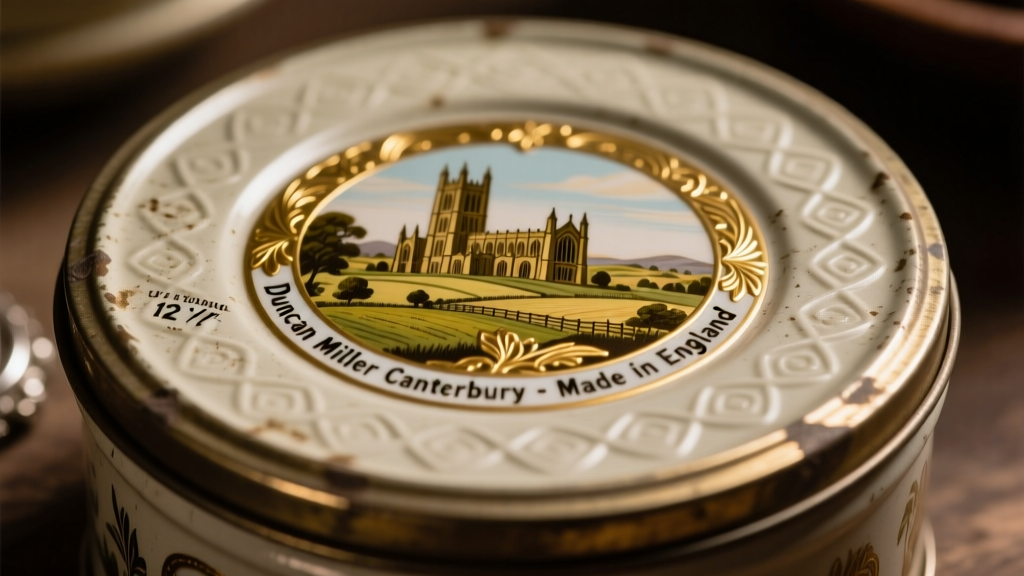
Duncan Miller Canterbury Relish Cover: A Masterclass in Mid-Century American Silverplate Design
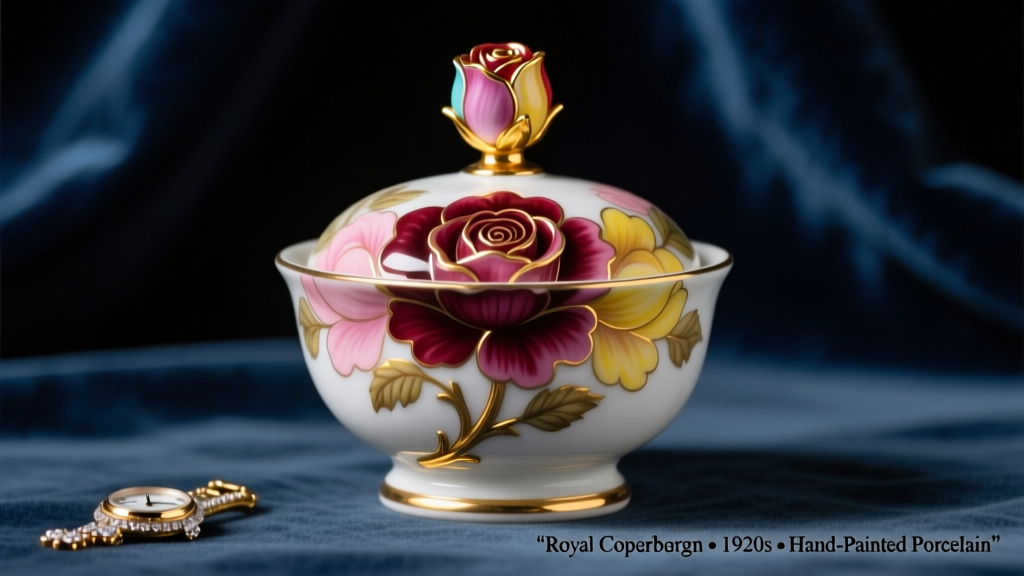
Royal Copenhagen Sugar Cover: Multicolored Rose Finial, Gilt Bronze Mounts, 3½ Inches — A Masterpiece of Danish Porcelain and Rococo Revival Craftsmanship
Royal Doulton Animal Tiger Flambe HN 809: A Definitive Study of the 6-Inch Porcelain Sculpture
Orphan Annie Book Pop-Up: The Little Orphan Annie Jumbo Edition — A Collector’s Deep Dive

Bisque Toothbrush Holder Clown: A Rare German Humor Object from the Early 20th Century
The Rolex Submariner Ref. 1139093: A Definitive Technical and Historical Profile
Frankl Furniture Dining Set: The 1940s Cream Cork-Top Table with Y-Shaped Legs and Matching Seven-Piece Ensemble
Donald Duck Whirligig: A Rare 1930s Celluloid-and-Tin Windup Toy — Provenance, Mechanics, and Market Value
Silver Persian Bowl: Scalloped Rim, Ornate Embossed Exterior — A 7¼-Inch Masterpiece of Qajar-Era Craftsmanship