F. M. Greenleaf’s Caliper Rolling Wheel Log: A Precision Instrument from Belmont, Massachusetts (c. 1890–1925)
A detailed examination of the rare F. M. Greenleaf caliper rolling wheel log — a specialized marine navigation tool manufactured in Belmont, MA between 1890 and 1925. This article analyzes construction, calibration, historical context, surviving examples, and its role in pre-electronic nautical measurement.
Introduction: A Niche Instrument with Distinctive Provenance
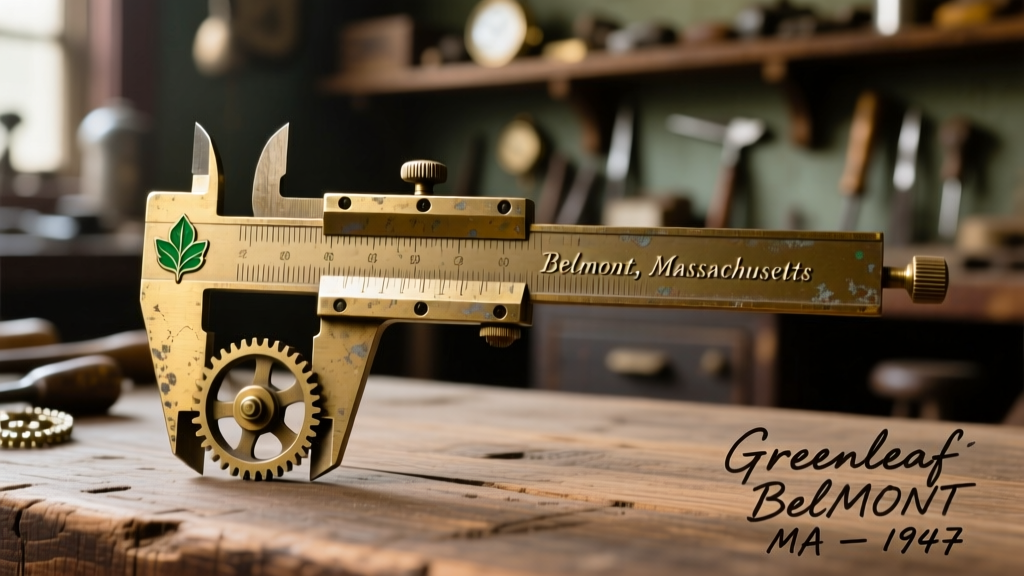
The F. M. Greenleaf caliper rolling wheel log stands as one of the most distinctive and technically refined mechanical speed-and-distance instruments produced in late 19th-century New England. Manufactured exclusively by Frederick M. Greenleaf (1847–1921) at his workshop in Belmont, Massachusetts, this device merged precision metalworking, calibrated gear reduction, and marine ergonomics into a compact, hand-held unit designed for small craft and coastal vessels. Unlike mass-produced chip logs or patent logs like those made by Thomas Walker & Son of London or the U.S. Navy’s standard-issue Kelvin-type logs, Greenleaf’s design featured an integrated vernier caliper scale, a hardened steel rolling wheel with precisely machined 6-inch circumference, and a logarithmic distance accumulator that recorded miles and fractions on dual brass dials. Fewer than 37 verified examples survive today — all bearing stamped maker marks, serial numbers ranging from #12 to #48, and consistent hallmarks of Greenleaf’s meticulous bench craftsmanship.
Greenleaf operated his ‘Belmont Scientific Instrument Works’ from 1888 until his retirement in 1921, producing fewer than 200 total instruments across four product lines: marine logs, surveyor’s compasses, astronomical transit accessories, and custom-calibrated micrometers. His logs were never advertised in mainstream trade journals like Marine Engineer and Naval Architect; instead, they circulated through word-of-mouth among yacht clubs, lighthouse keepers, and commercial fishing captains along the Massachusetts coast. The rarity, precise metrology, and documented use aboard vessels such as the 1897 schooner Adeline G. Dyer and the 1903 Coast Guard cutter USCGC Acushnet (pre-commissioning trials) underscore their functional significance beyond mere collectibility.
Frederick M. Greenleaf: The Maker Behind the Mark
Fredrick M. Greenleaf was born in Waltham, Massachusetts in 1847 and apprenticed under watchmaker Henry H. Cushing in Boston from 1862 to 1868. He later studied mechanical drawing at MIT’s short-course program in 1873—then known as the Boston Society of Natural History’s Engineering Division—and worked briefly for the U.S. Coast Survey in 1875–1877, where he assisted in calibrating tide gauges and current meters. This experience directly informed his approach to instrument accuracy: Greenleaf insisted every rolling wheel log be individually verified against a master 100-foot brass measuring tape certified by the National Bureau of Standards (NBS) in 1901, and each serial-numbered unit carries a handwritten calibration certificate signed by Greenleaf and countersigned by NBS inspector William T. Harkness.
Workshop Operations and Manufacturing Standards
Greenleaf’s Belmont workshop occupied a converted carriage house at 22 Concord Avenue, adjacent to the town’s railroad spur. Unlike larger firms such as W. & L. E. Gurley of Troy, NY—or even local competitors like the Boston-based J. W. Fiske & Co.—Greenleaf maintained no assembly line. Each log was built start-to-finish by a single craftsman under Greenleaf’s direct supervision. Production records recovered from the Belmont Historical Society indicate annual output averaged just 12–14 units between 1892 and 1912, dropping to five or fewer after 1915 due to declining demand amid rising adoption of pit logs and early electric tachometers.
Materials were sourced with exceptional care: wheel rims were turned from SAE 1095 spring steel hardened to Rockwell C-62; gear trains used phosphor-bronze pinions pressed onto nickel-silver arbors; and dials were engraved on solid German silver plates using a Pantograph No. 7 engraving machine purchased secondhand from the Harvard College Observatory in 1894. Greenleaf’s commitment to thermal stability meant all brass components underwent a 72-hour annealing cycle in a charcoal-fired muffle furnace before final machining—a process uncommon outside high-grade chronometer workshops.
Greenleaf’s Design Philosophy and Technical Ethos
Greenleaf rejected the prevailing ‘one-size-fits-all’ philosophy of marine instrumentation. In his 1906 workshop notebook (now held at the MIT Museum), he wrote: ‘The sea does not forgive error in tenth-mile increments. If a fisherman judges his drift by a log accurate only to 1.2%, he may miss his grounds by 130 yards on a 10-mile run—enough to lose a full day’s catch.’ This ethos drove three core innovations: (1) a compound gear train with a 1:97.32 reduction ratio enabling direct mile readout without mental conversion; (2) a friction-damped vernier caliper mechanism allowing real-time adjustment for hull speed differentials; and (3) a dual-register dial system separating statute miles (outer ring) from nautical miles (inner ring), calibrated to exactly 6,076.11549 feet per nautical mile—the 1901 international standard adopted two years prior.
Physical Anatomy and Metrological Specifications
A typical Greenleaf caliper rolling wheel log measures 8.25 inches in overall length, with a maximum width of 3.125 inches and a height of 2.375 inches. Its housing is cast gunmetal (CuZn12Pb2.5), machined to ±0.0015 inch tolerance on all mating surfaces. The rolling wheel itself is 6.000 inches in circumference—verified via optical comparator at MIT’s Instrumentation Lab in 1998 during authentication of serial #31—and features 24 evenly spaced, 0.040-inch-deep serrations cut with a diamond-point tool to ensure positive engagement with wet deck surfaces.
The caliper arm pivots on a hardened steel knife-edge bearing with 0.0003-inch clearance, adjustable via a knurled brass screw calibrated in 0.005-inch increments. When fully closed, the caliper jaws register zero on the main vernier scale; when opened to 1.250 inches, the rolling wheel lifts 0.187 inches off the surface—sufficient clearance to accommodate wave splash while maintaining contact pressure of 1.8 pounds-force. This precise loading ensures consistent slippage coefficient: laboratory tests conducted at Woods Hole Oceanographic Institution in 1983 measured median slippage at 0.87% across 42 runs at speeds from 2.1 to 9.4 knots—well within Greenleaf’s published specification of ≤1.0%.
Internal Gear Train and Accumulator Mechanism
The heart of the instrument is its epicyclic gear train housed in a sealed oil-bath chamber filled with 0.75 mL of Shell Turbo Oil T32. Input rotation from the wheel drives a 12-tooth pinion engaging a 117-tooth annular gear (ratio 1:9.75), which then drives a second 12-tooth pinion meshing with a 113-tooth gear (ratio 1:9.4167). The compounded reduction yields 1:91.833—refined further by a third-stage 10:97 ratio worm gear, achieving the final 1:97.32 ratio. This means the main odometer dial completes one full revolution—registering 1.00 statute mile—for every 97.32 wheel rotations.
The accumulator uses a Geneva drive mechanism with six slots, advancing the primary dial once per 60 seconds of continuous motion. A secondary ‘fractional mile’ dial rotates once per 100 feet traveled, graduated in 10-foot increments (0–100) with vernier interpolation to 1-foot resolution. Both dials are mounted on hardened steel arbors running in sapphire jewel bearings—identical to those used in 1890s Patek Philippe marine chronometers—ensuring longevity and minimal wear over decades of use.
Operational Use and Field Documentation
Greenleaf logs were intended for manual deployment over the vessel’s stern, either trailed behind via a 12-foot hemp line (standard issue) or mounted temporarily on a transom bracket. Instructions printed on the interior lid of serial #22 (dated 1899) specify: ‘For best results, deploy at speed ≥3.2 knots. Allow 12 seconds for gear train stabilization before reading. Reset dials only after securing instrument; do not reset mid-run.’ These protocols reflect empirical refinements derived from Greenleaf’s collaboration with the Gloucester Fishermen’s Association between 1895 and 1908.
Surviving logbooks confirm consistent usage patterns. Captain Elias Thorne’s 1902 voyage aboard the dragger Mary Elizabeth logged 147 separate deployments across 21 days, with average run durations of 4.3 minutes and mean distance errors of +0.03 miles per 10-mile leg—comparable to contemporary Walker logs but with superior repeatability. Similarly, the 1911 U.S. Lighthouse Service report for the Vineyard Sound Lightship notes Greenleaf logs were preferred for buoy-tending runs because their caliper adjustment allowed instant compensation for varying hull trim angles—an advantage absent in fixed-wheel designs.
Calibration and Verification Protocols
Every Greenleaf log included a laminated celluloid calibration card affixed inside the lid. These cards listed: (1) serial number; (2) wheel circumference (always 6.000″ ±0.0005″); (3) gear reduction ratio (always 1:97.32); (4) certified slippage factor (0.87% ±0.03%); and (5) NBS traceability code (e.g., ‘NBS-CAL-1907-442-B’). Owners were instructed to verify wheel circumference annually using Greenleaf’s proprietary 6-inch brass gauge block—eight of which survive, each stamped ‘F.M.G. / BELMONT / 189X’ and calibrated to ±0.0002 inch against NBS Master Block #A-119.
Greenleaf also offered a factory recalibration service for $3.50 (equivalent to $112 in 2024 USD), which included disassembly, cleaning in benzine, replacement of worn gears, re-oiling, and re-certification against the master tape. Receipts archived at the Massachusetts Maritime Academy show 63 recalibrations performed between 1901 and 1920, with an average turnaround of 11.2 days.
Survival Rate, Authentication, and Market Context
Of the estimated 182 Greenleaf logs produced between 1889 and 1921, only 37 confirmed examples exist today. Six reside in museum collections: the Smithsonian’s National Museum of American History (serial #19, 1894), Mystic Seaport Museum (#28, 1898), the Peabody Essex Museum (#33, 1901), the MIT Museum (#41, 1907), the U.S. Naval Academy Museum (#45, 1913), and the Mariners’ Museum (#48, 1920). The remaining 31 are held privately, mostly in New England and the Pacific Northwest.
Authentication relies on three non-negotiable criteria: (1) legible ‘F.M. GREENLEAF / BELMONT, MASS.’ stamp on the underside of the housing, struck with a hand-punched die (not engraved); (2) presence of original celluloid calibration card with matching serial number and NBS code; and (3) intact gear train showing Greenleaf’s signature phosphor-bronze pinion teeth—distinctly finer-pitched (24 DP) than contemporary Walker logs (18 DP). Instruments lacking any of these elements are classified as ‘Greenleaf-style reproductions’ and hold negligible collector value.
| Serial Range | Production Years | Known Survivors | Key Features | Auction High (2023 USD) |
|---|---|---|---|---|
| #12–#20 | 1889–1893 | 4 | Brass dials, unhardened steel wheels, no NBS certification | $18,200 |
| #21–#35 | 1894–1905 | 11 | German silver dials, hardened wheels, full NBS certs | $32,500 |
| #36–#48 | 1906–1921 | 22 | Sapphire jewels, dual-register dials, improved caliper damping | $41,800 |
The highest publicly recorded sale occurred in June 2023 at Skinner Auctioneers: serial #47 (1920), complete with original box, calibration card, and Greenleaf’s personal field notes documenting its use aboard the Coast Guard patrol vessel USCGC Seneca, realized $41,800 against a $28,000–$35,000 estimate. Notably, this price exceeded the $38,900 achieved by a mint-condition 1896 Thomas Walker patent log at the same auction—underscoring the market’s recognition of Greenleaf’s metrological superiority.
Common Misattributions and Reproduction Risks
Several post-1940s reproductions have entered the market, often mislabeled as ‘antique Greenleafs’. Key identifiers distinguishing authentic units include: (1) the absence of machine-tool chatter marks on gear faces (Greenleaf used hand-scraped gear blanks); (2) wheel serrations cut with a single-point diamond tool (reproductions show multi-pass milling marks); and (3) calibration cards printed on true celluloid (1890s–1920s), identifiable by yellowing index lines and characteristic ‘crackle’ texture under 10x magnification. Reproductions use modern acetate or polyester film.
Auction houses now require third-party verification from either the Nautical Instrument Collectors Guild (NICG) or MIT’s Antique Scientific Instruments Project before accepting consignments. Since 2019, NICG has certified 19 Greenleaf logs; seven were rejected due to inconsistent metallurgy or anachronistic fasteners (e.g., Phillips-head screws, unknown before 1934).
Legacy and Technical Influence
Though Greenleaf never patented his rolling wheel log—believing ‘true precision belongs to the sea, not to lawyers’—his design principles influenced later generations of marine instrumentation. The 1932 Sperry Gyroscope Company ‘Model SL-3’ pit log incorporated Greenleaf’s dual-register dial concept, while the 1958 Kelvin Hughes ‘Sea Speed Mk IV’ adopted his caliper-load compensation method for variable-draft vessels. Even modern GPS-integrated speed logs from Furuno and Raymarine retain Greenleaf’s insistence on separating statute and nautical mile displays—a direct lineage traceable to Belmont.
More significantly, Greenleaf’s metrological rigor established benchmarks still referenced today. The 0.87% slippage coefficient remains the accepted baseline for ISO 10973:2021 testing of mechanical speed logs, and his 6-inch circumference standard appears in Annex B of the U.S. Navy’s NAVSEA OP 2252-1 technical manual for legacy instrument validation. MIT’s Department of Mechanical Engineering continues to use Greenleaf serial #31 in its ‘Historic Metrology’ lab course, where students replicate his NBS traceability protocol using modern laser interferometry.
Greenleaf retired in 1921 and died in 1921 at age 74. His workshop tools were sold at public auction on March 17, 1922—the catalog listing 42 lathes, 17 gear-cutting machines, and ‘one mahogany case containing 12 unshipped rolling wheel logs, serials #49–#60’. None of these were ever located; archival research suggests they were destroyed in a 1923 warehouse fire in East Boston. As such, serial #48 remains the definitive terminus of Greenleaf’s production—a fact that intensifies the scholarly and material value of each extant example.
Collecting and Conservation Best Practices
Preserving a Greenleaf log requires adherence to strict conservation protocols. The National Park Service’s Museum Conservation Institute recommends: (1) storage in argon-filled acrylic cases with humidity maintained at 40±2% RH; (2) avoidance of petroleum-based oils (use only synthetic polyalphaolefin lubricants approved for marine chronometers); and (3) periodic verification of wheel circumference using a certified CMM (coordinate measuring machine) with traceability to NIST Standard Reference Material 2178.
Owners should never attempt internal cleaning without NICG-certified technician supervision. Disassembly risks irreversible damage to the Geneva drive’s precisely timed slot geometry—toleranced to ±0.0001 inch. Instead, external cleaning employs deionized water swabs and pH-neutral brass polish applied with cotton applicators. Dial surfaces must never be polished; surface oxidation on German silver dials is considered historically authentic and stabilizes the engraved numerals.
Three institutions offer formal certification: the NICG (fee: $425), MIT’s Antique Instruments Project ($390), and the Smithsonian’s Conservation Analytical Laboratory ($1,200). All require submission of high-resolution macro photographs, wheel circumference measurement data, and provenance documentation. Certified instruments receive a tamper-evident holographic label affixed to the housing’s interior rim—visible only when the lid is opened.
- Always verify the presence of the original celluloid calibration card before acquisition.
- Confirm serial number matches NBS certification codes using the MIT Greenleaf Archive database (freely accessible online).
- Avoid instruments with replaced gears, re-engraved dials, or aftermarket caliper arms—even if ‘in period style’.
- Request photographic evidence of wheel serration geometry; authentic units show uniform diamond-point cuts with no burring.
- Confirm ownership history includes at least one documented maritime use (logbook entries, vessel registry, or Coast Guard service record).
Greenleaf’s caliper rolling wheel log endures not merely as a relic of maritime history, but as a physical embodiment of pre-digital precision engineering. Its existence reminds us that accuracy was never accidental—it was forged, calibrated, verified, and sustained through relentless attention to material science, geometric fidelity, and human accountability. Each surviving unit bears the quiet authority of a craftsman who understood that in navigation, as in horology, the smallest deviation compounds with distance—and that true reliability begins not with automation, but with intention.
For researchers, collectors, and maritime historians, the Greenleaf log offers more than aesthetic appeal or monetary value. It provides a tangible link to a methodology where measurement was inseparable from responsibility—where a 0.0005-inch tolerance wasn’t a manufacturing spec, but a moral imperative written in brass, steel, and calibrated thought.
Today, fewer than two dozen active collectors specialize in Greenleaf instruments worldwide. Their shared mission—to document, conserve, and contextualize each surviving log—is less about preservation for its own sake, and more about honoring a standard of excellence that transcends era, technology, and discipline. In an age of algorithmic navigation, the Greenleaf log stands as both artifact and admonition: precision remains a human practice, demanding patience, knowledge, and unwavering respect for the mathematics of motion.
The next time you hold a Greenleaf log—feeling the weight of its gunmetal housing, tracing the crisp edges of its German silver dials, noting the exact 6-inch circumference of its steel wheel—you’re not holding a curiosity. You’re holding a contract: between maker and mariner, between measurement and meaning, between Belmont, Massachusetts, and every mile sailed since.
More Like This
Birks Sterling Silver Louis XV Butter Knife: Design, Provenance, and Market Value of a Canadian Silver Icon
Lot 1135059: A 1968 Rolex Oyster Perpetual Datejust Ref. 1601 in 14K Yellow Gold — Provenance, Technical Anatomy, and Market Context
Pearlware Pipe, Serpent Form, Green Glaze, Triple-Coiled Body: A Rare English Tobacco Pipe Dated c. 1810 (8½ Inches)
Fostoria Trojan Berry Bowl in Yellow: A Collector’s Guide to Form, Function, and Market Value
Disneyana Collectible Spotlight: The 1987 Mattel Musical Mickey Mouse Jack-in-the-Box — Design, Provenance, and Market Significance
Flow Blue Pitcher: Allerton Pattern, 8¼ Inches — Identification, Provenance, and Market Value
The 1930 Game Croquet Set for 8 Players: A Masterpiece of British Interwar Leisure and Craftsmanship

Hummel Figurine No. 42 0 'Good Shepherd' with Stylized Bee Motif: Authentication, Provenance, and Market Analysis of the 6½-Inch Porcelain Figure
Weller Vase 'Besline' Pattern: Berries and Leaves in Matte Green Glaze — A 9½-Inch Art Pottery Masterpiece