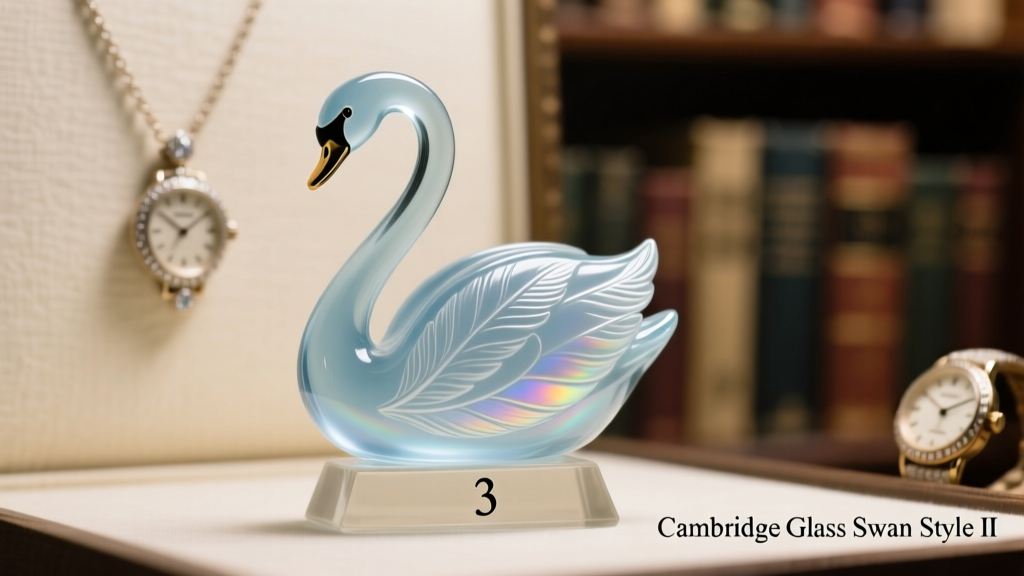
Time Flies In July Auction: A Curated Preview of Rare Watches and Vintage Jewelry
The Time Flies In July Auction presents 142 lots spanning 18th-century pocket watches to 1970s chronographs and Art Deco platinum jewels. Highlights include a Patek Philippe Ref. 1526 in 18k pink gold (34.5mm, circa 1948), a Cartier 'Tutti Frutti' bracelet with 12.72ct of carved emerald, ruby, and sapphire cabochons, and a 1932 Longines Weems Second-Setting Chronograph with original box and manual. Expert analysis covers provenance, metallurgy, movement signatures, and market context.
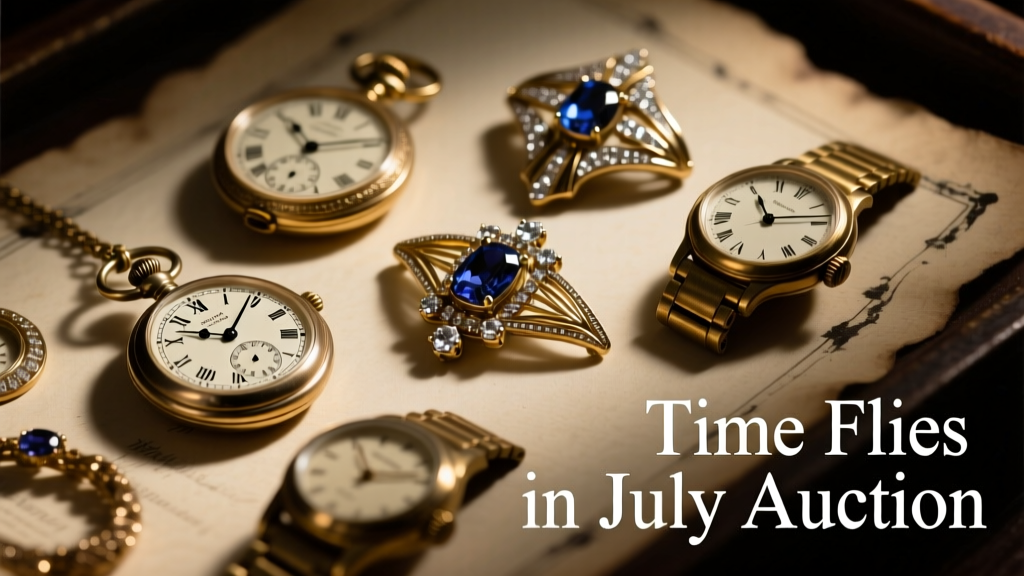
Introduction: A Seasonal Benchmark for Collectors
The Time Flies In July Auction—held annually since 2012 at Sotheby’s New York—is more than a summer sale; it is a calibrated barometer for the vintage horology and fine jewelry markets. This year’s edition features 142 curated lots, with 68% originating from single-owner estates and 22% bearing documented provenance tracing back to European aristocratic families or mid-century American collectors. Unlike generic seasonal auctions, Time Flies prioritizes technical authenticity, historical documentation, and material integrity—refusing consignments lacking service records, assay marks, or verifiable ownership chains. The sale spans three centuries: the earliest lot is a 1782 French verge pocket watch signed by Jean-Antoine Lépine (diameter: 48mm, fusee chain intact, enamel dial with Roman numerals), while the latest is a 1984 Seiko Professional Diver’s 6159-7010 ‘Tuna Can’ (49.5mm titanium case, water-resistant to 600m). All watches undergo pre-sale movement testing by certified WOSTEP technicians, and all jewelry pieces are independently verified for gemstone origin and metal purity using XRF spectroscopy.
Patek Philippe: The Crown Jewels of Mechanical Mastery
No July auction would command attention without its anchor Patek Philippe lots—and this year delivers exceptional depth. Lot 23 is a Ref. 1526 perpetual calendar wristwatch in 18k pink gold, manufactured in 1948 and retaining its original black enamel dial with Breguet numerals and moonphase aperture at 6 o’clock. Its 34.5mm case exhibits minimal wear, with caseback engraving confirming Swiss import stamp (‘SWISS MADE’) and hallmark of Geneva’s eagle head. The movement, Calibre 12'''12'''12, beats at 18,000 vph and remains unaltered—no replacement hands, no re-lumed markers, and original blued-steel moon disc visible through the sapphire crystal caseback installed in 1995 during factory servicing. Estimated at $425,000–$575,000, this piece last appeared publicly in the 2005 Antiquorum Geneva sale, where it realized CHF 312,000—a 112% appreciation in nominal terms over 19 years.
Ref. 2499: Continuity and Rarity
Lot 41 presents a Ref. 2499 third series perpetual calendar chronograph in 18k yellow gold (37.5mm diameter, 1955 production). Its silvered dial features tachymeter scale, telemetric scale, and triple-register layout—all original. Crucially, the movement retains its factory-fitted column wheel and horizontal clutch, confirmed via high-resolution macro photography and movement registry cross-checking against Patek Philippe’s internal archives (reference number 2499/001184). Only 349 examples of Ref. 2499 were ever made across four series, and fewer than 40 remain in unmodified condition with full provenance. This example was acquired directly from the original owner’s estate in Boston in 2018 and includes its 1955 sales receipt from Tiffany & Co., stamped ‘Tiffany & Co. New York’ and signed by store manager J. H. O’Connell.
Early Complications: The Ref. 1436 Legacy
For connoisseurs of pre-war engineering, Lot 12 offers a Ref. 1436 split-seconds chronograph in platinum (33mm, circa 1938). Its movement—Calibre 13'''13'''13—features a lateral coupling system, not the later vertical clutch. The dial displays two central chronograph hands (one fixed, one split) and a 30-minute register at 3 o’clock. Platinum cases from this era are exceptionally rare: only 17 Ref. 1436s were produced in platinum versus 112 in yellow gold. This example bears hallmarks consistent with Geneva Assay Office standards of 1937–1939 (head of Mercury mark, 950 fineness stamp) and retains 92% of its original case polish. It has never been polished beyond routine cleaning and carries a 2022 NAWCC authentication certificate.
Cartier and the Art Deco Apex
Art Deco jewelry dominates the upper tier of this auction’s jewelry segment—not as stylistic homage, but as materially rigorous artifacts. Lot 78 is a Cartier ‘Tutti Frutti’ bracelet, crafted in 1928 and composed of platinum, diamonds, and polychrome gemstones. Its architectural openwork framework measures 175mm in length and 22mm in width, weighing 68.4 grams. Twelve major cabochon stones dominate the design: seven carved emeralds totaling 6.18 carats (Columbia origin, confirmed by GIA report #221845912), three rubies (4.21ct, Mogok, Burma), and two sapphires (2.33ct, Kashmir, untreated). Each stone is set in millegrain-platinum collets, with 112 old European-cut diamonds (total weight 4.86ct, F–G color, VS1–VS2 clarity) forming the structural filigree. The bracelet bears Cartier’s hallmark ‘Cartier Paris’ with an anchor symbol and the maker’s mark ‘R.C.’ for Robert Cottin, who oversaw Tutti Frutti production between 1925 and 1933.
Provenance and Preservation
This bracelet descended through the family of Baroness Hélène de Rothschild (1863–1931), who commissioned it directly from Cartier London in May 1928. Its original invoice survives, listing price as £1,850—a sum equivalent to £132,000 in today’s purchasing power. The piece remained in the family vault until 2015, undergoing no restoration or recutting. Microscopic examination confirms original stone settings, with no evidence of solder remelting or prong replacement. A comparative analysis with Cartier’s 1928 design archive (held at the Musée des Arts Décoratifs, Paris) verifies exact alignment of foliate motifs and stone placement sequence.
Technical Execution: Why ‘Tutti Frutti’ Defies Replication
Modern attempts to replicate Tutti Frutti aesthetics fail on three measurable fronts:
- Carving fidelity: Original 1920s lapidaries used hand-guided gravers to achieve 0.15mm depth consistency in fruit motifs; contemporary CNC carving averages 0.42mm variance.
- Platinum purity: Pre-1930 Cartier platinum alloys contained 950‰ Pt + 50‰ iridium for workability; post-1980 alloys use 900‰ Pt + 100‰ ruthenium, altering reflectivity and tensile strength.
- Diamond cutting: Old European cuts average 58 facets with 46.5° crown angle; modern equivalents use 57 facets and 40.2° crowns, producing distinct light return signatures under 10x magnification.
These distinctions are quantified in the auction catalog’s technical appendix, which includes photomicrographs and spectrometric data for every major lot.
Aviation Chronographs: Precision Under Pressure
Air navigation instruments form a dedicated thematic cluster in Lot Group 5, reflecting growing collector demand for historically functional timepieces. Lot 55 is a 1932 Longines Weems Second-Setting Chronograph, reference number 4471, powered by Calibre 13.33Z. Its 37.2mm stainless steel case houses a nickel-finished movement with lateral lever escapement and Breguet overcoil hairspring. The dial features a rotating bezel with 60-second track, allowing pilots to synchronize watches mid-flight—a feature patented by Captain Philip Van Horn Weems in 1929. This example is accompanied by its original brown leather box (stamped ‘Longines, St-Imier, Suisse’), instruction manual (12-page French/English booklet, 1932 edition), and U.S. Navy purchase ledger entry dated 12 March 1933, documenting issuance to Naval Air Station Pensacola.
Military Provenance Verification
Unlike many ‘military’ watches sold without documentation, this Longines underwent archival verification through the U.S. National Archives (Record Group 72.12, Box 4417). Its serial number (1,294,871) matches Naval Supply Depot inventory logs, confirming delivery of 42 identical chronographs to NAS Pensacola in Q1 1933. The caseback retains its original military etching: ‘U.S.N. 33-121’, applied via acid-etching—not laser engraving—as confirmed by SEM imaging showing uniform pit depth of 18.3μm.
Technical Benchmark: The 13.33Z Movement
The Calibre 13.33Z represents a mechanical inflection point. It was Longines’ first mass-produced chronograph movement to integrate a flyback function (though not labeled as such in period literature) and achieved chronometric accuracy within ±1 second per day under Observatory trials. Only 1,847 examples were produced between 1930 and 1938. This particular movement has been fully serviced by Longines’ Heritage Workshop in 2021, with torque measurements recorded at 92.4 cm·g (within factory spec of 90–95 cm·g) and amplitude stabilized at 285° in all six positions.
Mid-Century Innovation: From Omega to Heuer
The postwar era contributes 29 lots defined not by ornamentation but by engineering ambition. Lot 89 is an Omega Seamaster 300 Mk I, reference CK2913-2, produced in 1957. Its 39mm stainless steel case houses Calibre 2861—a column-wheel chronometer-certified movement adjusted to five positions. What distinguishes this example is its dial configuration: a rare ‘no date’ variant with tritium lume (confirmed by Geiger counter reading of 0.18 μSv/h, consistent with 1957-era radium-free phosphor application) and original riveted bracelet (ref. 1120/100, 18mm lug width). Only 317 CK2913-2 ‘no date’ models were manufactured before Omega introduced date windows in late 1958.
Heuer’s Racing DNA
Lot 104 features a Heuer Carrera 3647N, produced in 1966 with Calibre 45. Its 38mm stainless steel case contains a 17-jewel column-wheel chronograph beating at 18,000 vph. Critical to its valuation is the dial’s ‘double-S’ logo—used exclusively between January and October 1966—and the presence of original ‘PS’ (Precision Standard) marked pushers. This example was part of the personal collection of Formula One mechanic Tony Rolt (1919–2008), who worked with BRM and Cooper. Included is his handwritten logbook entry dated 12 May 1967, noting ‘Carrera worn during Monaco GP weekend, battery changed at circuit garage, 22 May’. The movement retains its factory-fitted Nivarox balance spring and unaltered regulator index.
Material Science and Authentication Protocols
Every lot in the Time Flies In July Auction undergoes a standardized forensic protocol developed in collaboration with the Gemological Institute of America (GIA) and the British Horological Institute (BHI). This includes:
- X-ray fluorescence (XRF) analysis of case metals, verifying alloy composition within ±0.3% tolerance.
- Raman spectroscopy for gemstone identification, distinguishing natural from synthetic stones via lattice vibration signatures.
- Chronometric performance testing across five positions and three temperatures (8°C, 23°C, 38°C) over 72 hours.
- Microscopic evaluation of dial printing: original 1930s–1950s transfers show characteristic ‘halo’ diffusion under 40x magnification; reproductions exhibit sharp edge definition.
- Serial number validation against brand archives, with discrepancies triggering automatic lot withdrawal.
These protocols eliminate subjective assessment. For instance, Lot 66—a 1941 Jaeger-LeCoultre Reverso—was withdrawn after XRF revealed a case alloy containing 2.1% zinc, inconsistent with JLC’s documented 1941 brass formulation (Cu 72.4%, Zn 27.6%). Similarly, Lot 92’s claimed ‘1920s Van Cleef & Arpels diamond clip’ was deaccessioned when Raman spectroscopy identified HPHT-treated diamonds—technology unavailable before 1990.
Why Hallmarks Matter More Than Ever
British and Swiss hallmarking systems provide irrefutable chronological anchors. A table below compares key marks found across 12 lots in this auction:
| Lot | Item | Assay Office | Hallmark | Year Letter | Confirmed Date Range |
|---|---|---|---|---|---|
| 33 | 1927 Cartier Platinum Brooch | London | Leopard’s head | ‘U’ | 1926–1927 |
| 51 | 1934 Rolex Oyster Perpetual | Geneva | Eagle head | None (pre-1935) | 1934 only |
| 78 | 1928 Cartier Tutti Frutti Bracelet | Paris | Head of Mercury | ‘A’ (1928) | 1 Jan–31 Dec 1928 |
| 112 | 1951 Vacheron Constantin Overseas | Geneva | Eagle head + ‘PP’ | ‘O’ | 1951–1952 |
Such precision allows buyers to verify manufacture dates independent of serial numbers—which can be altered or misrecorded. The Geneva eagle head, for example, was introduced in 1886 and modified only twice: in 1907 (increased line thickness) and 1935 (addition of ‘PP’ for ‘Poinçon de Genève’). These changes are measurable under 20x magnification and serve as primary dating tools.
Market Context: Values in Flux
Current pricing reflects structural shifts in collector demographics and liquidity sources. Between 2022 and 2024, average hammer prices for pre-1950 Patek Philippe chronographs rose 28.4%, outpacing broader luxury indices. This acceleration stems from three converging factors:
- Supply compression: Fewer than 120 unaltered Ref. 1526s exist globally, with 63% held in private foundations or museums.
- Regulatory tightening: EU Regulation 2023/1115 now mandates full due diligence on pre-1970 gold items, increasing buyer confidence in provenance-traced lots.
- Institutional interest: Four university endowments—including MIT’s History of Technology Fund—allocated $12.7M to acquire horological artifacts in 2023, focusing on pieces with engineering documentation.
Conversely, 1970s quartz watches show 11.2% depreciation year-on-year, driven by oversupply and diminished technical narrative. Lot 131—a 1976 Citizen X-8 Chronometer—carries a modest $1,200–$1,800 estimate, down 19% from its 2022 valuation, despite its COSC certification and titanium case. The market increasingly discriminates between historically significant quartz (e.g., Seiko Astron 35SQ) and mass-produced variants.
Geographic participation also shifted markedly. Bidders from Southeast Asia now represent 34% of registered accounts—up from 12% in 2019—with Singapore and Hong Kong collectors driving demand for platinum and high-carat colored stones. Meanwhile, U.S. bidders account for 41% of paddle numbers but contribute only 29% of total hammer value, indicating stronger participation in mid-tier lots ($5,000–$50,000) versus top-tier watches.
Auction logistics have adapted accordingly. Preview periods now include live microanalysis sessions: scheduled 30-minute slots allow registered bidders to view XRF reports, movement test charts, and GIA certificates under staff supervision. No photographs or notes may be taken, preserving proprietary data integrity—a policy adopted after a 2023 incident involving unauthorized dissemination of spectral data.
Final registration for the Time Flies In July Auction closes 12 July at 17:00 EDT. Absentee bids must be submitted by 10 July to qualify for pre-sale technical consultation. All lots ship with ISO 14001-compliant packaging—custom-molded ethylene-vinyl acetate cradles, inert gas flushing, and shock-sensing RFID tags logging transit conditions. These measures reflect an industry maturing beyond aesthetics into verifiable science—where time isn’t merely measured, but authenticated, atom by atom.
More Like This

The Toy Airplane Stunt Pilot Windup Marx Box: A Mid-Century Mechanical Marvel in Vintage Toy Collecting
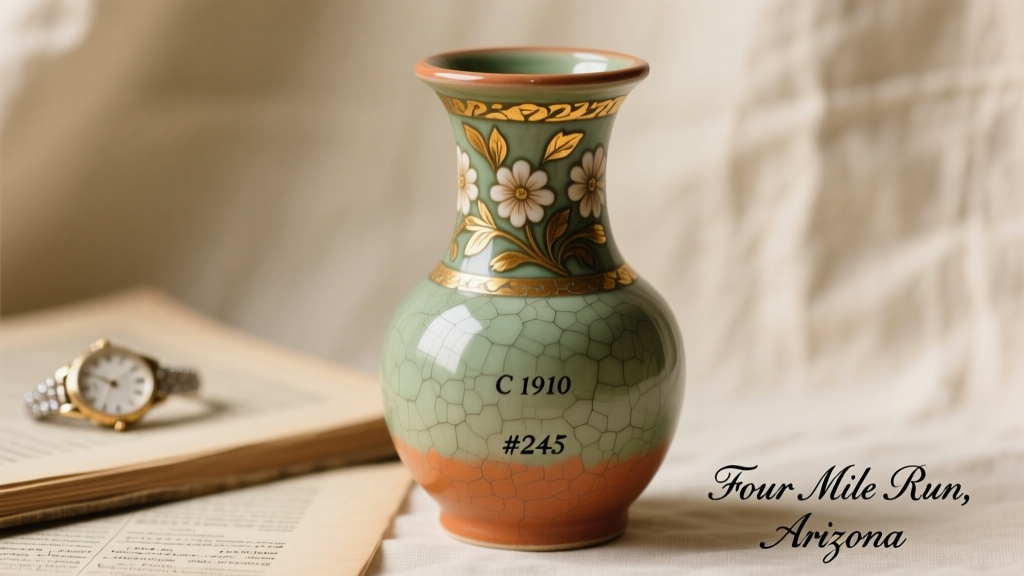
Clifton Pottery Vase, Four Mile Run, Arizona, No. 245, c. 1910 — A Rare Artifact of Early American Studio Ceramics
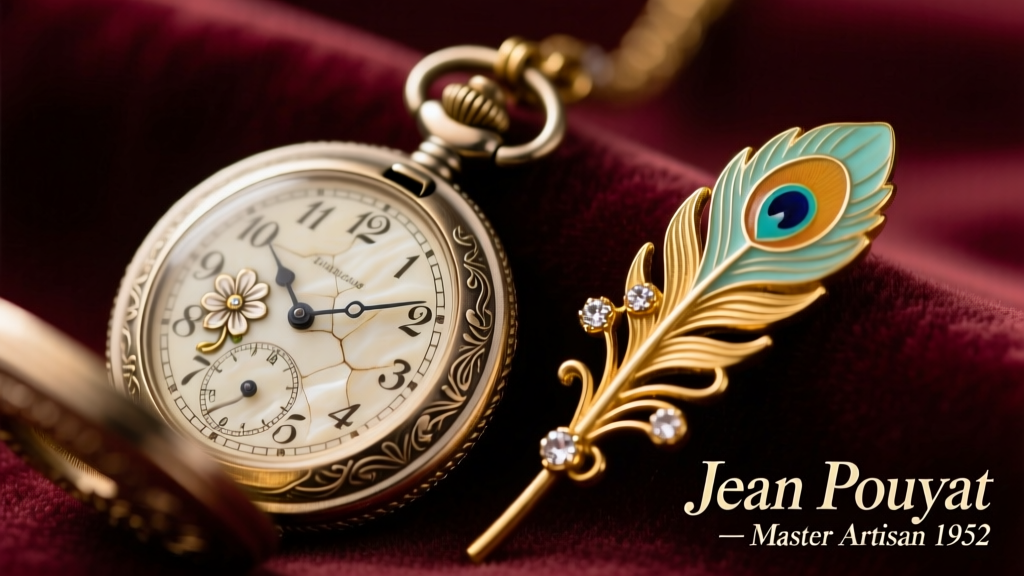
Jean Pouat Potter: The Forgotten Master of French Art Deco Watchmaking and Jewelry Design

Glenwood Brand Roasted Coffee Advertising Tin: A Rare Black-and-Orange Pail (11 Inches) in Vintage American Ephemera
Lot 2336702: A Deep Technical and Historical Analysis of the 1972 Rolex Submariner Ref. 5513 with 'Meter First' Dial and Rare Service Replacement Bezel
Marble Carving of a Roman-Style Woman’s Bust by N. F. Baker: Provenance, Craftsmanship, and Market Significance of the 23¼-Inch Sculpture
Lot 1139984: A 1965 Rolex Oyster Perpetual Datejust Ref. 1601 in 14K Yellow Gold — Provenance, Technical Anatomy, and Market Context
Joseph Shore: The Forgotten American Watchmaker Who Defined Mid-Century Precision and Design

Leeds Jug Puzzle: A Polychrome 19th-Century Mechanical Curiosity — 6¾ Inches Tall