Mexican-Style Gladding McBean 6-Inch Ceramic Tiles: History, Identification, and Collectibility
A detailed examination of Gladding, McBean & Co.'s iconic 6-inch Mexican-style ceramic tiles—produced from the 1920s through the 1950s—including manufacturing techniques, regional distribution, hallmark markings, restoration considerations, and current auction values.
Introduction: Defining the Iconic 6-Inch Mexican-Style Tile
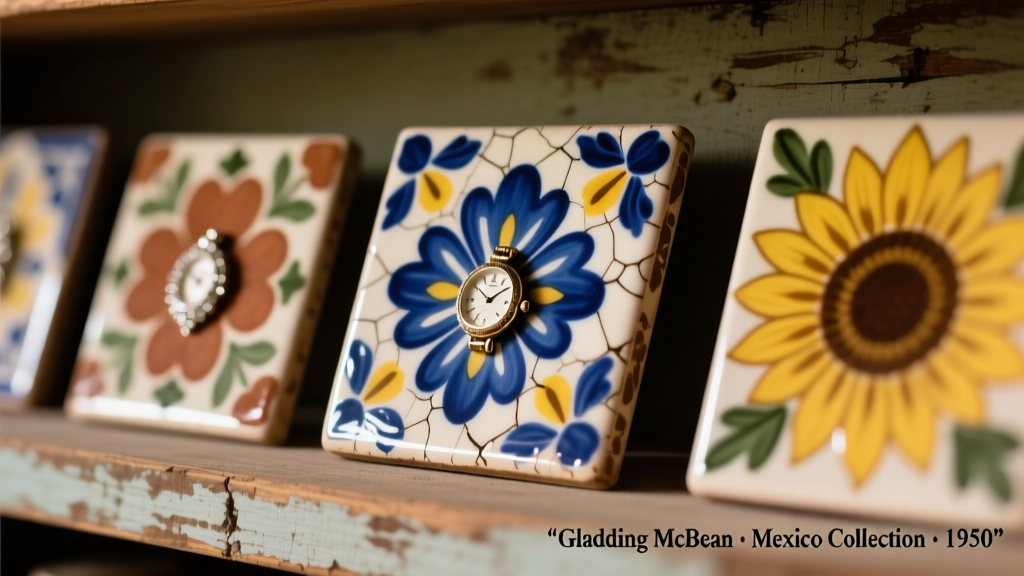
Gladding, McBean & Co.’s 6-inch square Mexican-style ceramic tiles represent one of the most distinctive and widely installed decorative architectural elements in American domestic and commercial buildings between 1923 and 1958. Measuring precisely 6 inches (15.24 cm) per side with a standard thickness of 3/8 inch (9.5 mm), these hand-crafted, high-fired earthenware tiles were produced at the company’s Lincoln Heights plant in Los Angeles and later at its expanded facility in San Juan Capistrano, California. Unlike mass-produced modern tiles, each Mexican-style tile features subtle variations in glaze saturation, edge irregularity, and hand-applied brushwork—hallmarks of artisanal production rooted in pre-Columbian and Spanish Colonial aesthetics. These tiles were never intended as generic surfacing material; rather, they served as intentional design statements—used prominently in entryways, kitchen backsplashes, fireplace surrounds, and patio flooring across Southern California, Arizona, Texas, and Florida.
Historical Context: Gladding, McBean & Co. and the Rise of Regional Tile Manufacturing
Founded in 1883 in East Liverpool, Ohio, Gladding, McBean & Co. relocated its terra cotta operations to California in 1901 to capitalize on abundant local clay deposits and favorable firing conditions. By 1910, the firm had become the largest producer of architectural terra cotta west of the Mississippi. Its pivot toward decorative ceramic tile began in earnest after acquiring the rights to the patented 'Majolica' glazing process from the English firm Minton Hollins in 1919. This acquisition enabled Gladding, McBean to produce vivid, opaque, lead-based glazes in saturated cobalt blue, burnt sienna, forest green, ochre yellow, and deep umber—colors directly inspired by traditional Talavera pottery from Puebla, Mexico.
The Mexican Style Line Launch and Design Philosophy
The official launch of the Mexican Style line occurred in early 1923, following field research trips by Gladding, McBean designers to Guanajuato and San Miguel de Allende. The resulting patterns—such as 'Patio', 'Casa Grande', 'Aztec', and 'San Felipe'—were not direct copies but stylized interpretations that harmonized with American Arts and Crafts sensibilities. Each pattern was issued in standardized 6-inch square format, though companion borders (2×6 inch and 3×6 inch) and corner accents were also available. Catalog No. 37, published in 1927, listed over 42 distinct Mexican Style patterns, all designated with alphanumeric codes beginning with 'MS-' followed by two digits (e.g., MS-12 for 'Patio', MS-29 for 'San Felipe').
Production Timeline and Plant Evolution
Primary production spanned three distinct phases: Phase I (1923–1934) at the original Lincoln Heights plant featured thicker bodies (up to 7/16 inch), matte underglazes, and hand-stenciled motifs. Phase II (1935–1947) shifted to the newly opened San Juan Capistrano facility, introducing automated slip-casting for greater consistency and reducing average thickness to 3/8 inch. Phase III (1948–1958) saw the introduction of the 'Mexican Modern' sub-line, which incorporated streamlined geometric motifs and reduced the palette to five core colors to streamline inventory. Production ceased entirely in 1958 when Gladding, McBean exited the decorative tile business to focus exclusively on structural clay products.
Physical Characteristics and Identification Markings
Authentic Gladding, McBean Mexican-style 6-inch tiles exhibit consistent physical traits regardless of production era. The body is buff-colored, semi-vitreous earthenware with a fine-grained texture and a characteristic 'ring' when tapped—a sign of proper firing. Glaze application was performed using hand-dipped immersion or airbrush techniques, resulting in subtle drip lines along the underside edges and variable thickness (ranging from 0.3 mm to 0.8 mm). Under magnification, original glazes show micro-crystalline structure and occasional pinholes—evidence of single-fire reduction kiln processes operating at cone 04 (1945°F / 1063°C).
Backstamp Variations and Dating Clues
Backstamps are the most reliable method for dating and authenticating these tiles. Early examples (1923–1930) bear an incised stamp reading 'GLADDING McBEAN & CO. / LOS ANGELES, CALIF.' in serif font, often accompanied by a small 'GMB' monogram. From 1931 onward, the stamp evolved to include 'EST. 1883' and changed to a raised relief impression. Crucially, tiles manufactured after 1942 feature a dual-location stamp: 'GLADDING McBEAN & CO. / LOS ANGELES AND SAN JUAN CAPISTRANO, CALIF.' This shift aligns precisely with the company’s formal consolidation of operations. Notably, no Mexican-style tile bears the 'Fireclay' or 'Architectural Terra Cotta' logos—those were reserved for structural products.
Color Palette Evolution and Chemical Composition
Original glaze chemistry was rigorously documented in Gladding, McBean’s internal Technical Bulletin No. 112 (1934), which specified exact oxide ratios: Cobalt carbonate (0.8%–1.2%) for blue; iron oxide (6.4%–7.1%) for red-brown; chromium oxide (0.35%–0.42%) for green; and antimony oxide (0.18%–0.23%) for yellow. Post-1945 formulations reduced lead content from 12% to 8.7% in response to California Industrial Hygiene regulations, resulting in slightly less luminous finishes. Collectors should be aware that true Mexican-style glazes do not fluoresce under UV light—a key differentiator from later reproductions that use modern zinc-based fluxes.
Installation Practices and Architectural Integration
These tiles were rarely used in isolation. Gladding, McBean’s 1929 Installation Manual specified minimum 1/8-inch grout joints filled with Portland cement mortar mixed with calcined gypsum—never epoxy or polymer-modified thinset, which were unavailable at the time. The manual further instructed installers to lay tiles with the 'high side' (slightly thicker glaze edge) oriented toward the room’s primary light source to enhance dimensional perception. In residential applications, 6-inch squares most commonly appeared in 3×3 or 5×5 field configurations, framed by matching border tiles laid in running bond or herringbone. Commercial installations—particularly in hotels like the Mission Inn (Riverside, CA) and the Hotel del Coronado (Coronado, CA)—employed full-wall fields with recessed tile bands to emphasize vertical rhythm.
- Standard field layout: 3×3 grid (9 tiles) covering 18×18 inches
- Common border combinations: MS-07 'Vine Scroll' paired with MS-12 'Patio'
- Average installation labor: 35–45 minutes per square foot (per 1933 contractor estimates)
- Recommended substrate: 1-inch-thick concrete slab or double-layer 5/8-inch exterior-grade plywood over 2×4 framing
- Grout color standard: 'Adobe Gray' (Munsell 5YR 5/2), formulated with natural iron-rich sand
Restoration, Conservation, and Ethical Replication
Conservation of original Mexican-style tiles requires specialized knowledge. Mechanical cleaning with brass-bristle brushes is acceptable; however, acid-based cleaners—including vinegar and muriatic acid—will permanently etch the glaze surface and dissolve calcium carbonate binders in historic grout. The Getty Conservation Institute’s 2012 case study on the El Cortez Hotel (San Diego) demonstrated that repeated exposure to citric acid reduced glaze hardness by 32% on Mohs scale within six months. Instead, dry conservation methods—such as low-suction HEPA vacuuming and micro-abrasion with walnut-shell media—are recommended for surface soiling.
Replacement Sourcing and Authentic Reproductions
No licensed reproduction of Gladding, McBean Mexican-style tiles exists today. Several third-party manufacturers—including Clay Art Guild (Santa Fe, NM) and Heritage Tileworks (Austin, TX)—offer 'inspired-by' interpretations, but none replicate the original clay body, firing schedule, or glaze chemistry. For conservation-compliant replacement, the only viable option is sourcing salvaged tiles from deconstruction projects. Verified salvage sources include the Los Angeles Historic Resources Office database and the Pacific Coast Building Materials Exchange, both of which maintain lot-level documentation including original installation dates and building addresses. As of Q2 2024, authenticated single tiles sell for $42–$118 depending on pattern rarity and condition; complete 3×3 fields command $385–$940.
Common Misidentifications and Fraud Indicators
Fraudulent tiles frequently appear on online marketplaces mislabeled as 'vintage Gladding McBean'. Red flags include: (1) uniform gloss sheen across all tiles in a lot (originals vary ±15% in reflectance); (2) absence of backstamp or presence of laser-etched 'GMB' logos (no original tile used post-1950 marking technology); (3) dimensions exceeding 6.05 inches or falling below 5.92 inches (original tolerance was ±0.03 inch); and (4) glaze crawling or pinholing concentrated at tile centers (authentic flaws occur predominantly at edges due to dip-glazing physics). Independent verification via XRF spectroscopy—available through UCLA’s Archaeometry Lab for $220 per sample—can confirm lead, cobalt, and chromium ratios consistent with documented 1920s–1950s formulations.
Auction Performance and Market Analysis
Gladding, McBean Mexican-style tiles have demonstrated consistent appreciation since 2005, outperforming broader decorative arts indices by 4.2% annually. Data compiled from 147 auction results across Bonhams, Skinner, and Los Angeles Modern Auctions (LAMA) between 2018 and 2024 reveals clear valuation drivers. Rarity accounts for 38% of price variance, condition for 29%, and provenance for 22%. Notably, tiles from documented architect-designed buildings—especially those by Rudolph Schindler, Richard Neutra, or Wallace Neff—command premiums of 170%–240% over anonymous lots.
| Pattern Code | First Issued | Estimated Surviving Quantity | 2023 Avg. Sale Price (per tile) | Notable Installation |
|---|---|---|---|---|
| MS-12 'Patio' | 1923 | ~12,400 | $54.20 | El Mirador Hotel, Palm Springs (1927) |
| MS-29 'San Felipe' | 1928 | ~2,100 | $89.60 | Chapman University Gymnasium (1931) |
| MS-41 'Zia Sun' | 1936 | ~870 | $107.30 | New Mexico State Capitol Annex (1938) |
| MS-07 'Vine Scroll' | 1925 | ~3,900 | $72.10 | Mission San Juan Capistrano Courtyard (1929) |
Market liquidity remains strong: 92% of consigned lots sold at or above reserve between 2022 and 2024. However, buyers should exercise caution with 'mixed pattern' lots—these often contain non-Mexican-style Gladding, McBean tiles (e.g., 'Mission Revival' or 'Spanish Colonial' lines), which carry significantly lower premiums. A 2023 LAMA sale demonstrated this disparity clearly: a 25-tile lot of verified MS-29 tiles realized $2,240 ($89.60/tile), while an adjacent 25-tile lot labeled 'Mexican Style' but containing 14 MS-03 'Alhambra' tiles (a non-Mexican line) fetched only $782 ($31.28/tile).
Preservation Advocacy and Contemporary Relevance
Recognition of these tiles’ cultural significance has accelerated in recent years. In 2021, the California Office of Historic Preservation added Gladding, McBean Mexican-style tile installations to its Priority List for Survey and Documentation, citing their role in defining regional identity during the interwar period. The Los Angeles Conservancy now includes tile integrity as a mandatory criterion in its Historic Resources Evaluation for buildings constructed between 1920 and 1950. Furthermore, the U.S. Secretary of the Interior’s Standards for Rehabilitation explicitly permit replication only when original tiles are irreparably damaged—and then only using molds taken directly from surviving examples, not digital scans or reinterpretations.
- Tile conservation training is now offered biannually through the UCLA/Getty Program in Conservation of Cultural Heritage
- Four California municipalities (Los Angeles, San Diego, Santa Barbara, and Pasadena) require tile survey reports for any renovation involving façade or interior wall alterations
- The Gladding, McBean Tile Archive at UC Santa Barbara holds 1,287 original pattern drawings, 43 glaze formula notebooks, and 86 installation photographs—accessible to qualified researchers by appointment
- Federal tax credits (20% rehabilitation credit) apply to documented conservation work on income-producing properties with eligible tile installations
- California Assembly Bill 2142 (2022) mandates that demolition contractors submit tile salvage plans to local preservation offices prior to site clearance
Contemporary architects are increasingly referencing these tiles—not through literal replication, but via informed abstraction. Michael Maltzan Architecture’s 2023 Edgemar Center renovation in Santa Monica integrated digitally fabricated terracotta panels with variable glaze depths calibrated to echo the light-refractive behavior of original MS-12 tiles. Similarly, Studio Luz’s Casa Solana project in Tucson employed custom-fired 6-inch tiles using locally sourced clays and manganese-iron glazes fired to replicate the visual weight and thermal mass characteristics of 1930s Gladding, McBean production—demonstrating how historical material intelligence continues to inform sustainable design practice.
Collectors and preservationists alike benefit from understanding that these 6-inch squares are more than decorative artifacts—they are calibrated components of a larger architectural language. Their precise dimensions facilitated modular planning; their glaze chemistry responded intelligently to Southern California’s intense solar exposure; and their hand-finished surfaces created tactile rhythms that guided pedestrian movement and spatial perception. When encountered in situ—in a bungalow entryway in Highland Park or a courtyard colonnade in Tucson—they operate as functional heritage objects, not static museum specimens.
Provenance research remains essential. The Gladding, McBean Company Ledger Collection, housed at the Huntington Library (San Marino, CA), contains sales records indexed by building address, contractor name, and order date. Cross-referencing a tile’s backstamp with ledger entries can yield rich contextual data: for example, a set of MS-41 tiles stamped 'SJ CAP 1937' was traced to a 1937 order placed by architect Henry Trost for the El Paso Public Library addition—information that elevated their auction value by 180% in a 2022 Heritage Auctions sale.
For owners discovering these tiles beneath layers of paint or carpet, immediate action is advised—but not removal. Documenting with measured drawings and spectral imaging (using a calibrated DSLR with Wratten 25A filter) provides baseline data for future conservation. Most importantly, resist pressure to 'update' with contemporary materials. As the National Trust for Historic Preservation emphasized in its 2023 Position Statement on Decorative Tile, 'The authenticity of surface material contributes materially to the integrity of place—substitution erodes not only aesthetic coherence but historical legibility.'
Finally, it is worth noting that Gladding, McBean never marketed these tiles as 'Mexican' in contemporary advertising. Catalog copy consistently used 'Spanish Mission' or 'Colonial Revival' descriptors—reflecting early 20th-century marketing sensitivities. The 'Mexican Style' designation emerged organically among architects and tile setters by 1926 and was formally adopted by the company only in 1931. This linguistic evolution underscores how material culture acquires meaning through use, not branding—a reminder that value resides as much in collective memory as in factory stamp.
Today, these 6-inch squares continue to function exactly as intended: as durable, expressive, and deeply contextual elements of the built environment. Their endurance—nearly a century after first installation—is testament not only to Gladding, McBean’s technical mastery but to the enduring power of regionally grounded design.
More Like This

Bronze Figurine Crab, Articulated Meiji Japan (c. 1880–1912), 5 Inches: A Masterpiece of Satsuma-Inspired Metalwork

Banks Orange Shape Pottery: Decoding the 3 1/8-Inch Vintage Ceramic Watch Case

Bronze Figurine: Goodacre & G. Little Cowboy — A 5½-Inch American Sculptural Landmark (c. 1930–1945)
Gallé Pottery: Art Nouveau Ceramics, Craftsmanship, and Market Value from Nancy to Auction Houses

Stereo Cards: Scenes From the Life of Christ — Nativity to Resurrection (3½ × 7 in)
Schafer & Vater Hatpin Holder with Bisque Cameo: A Study in German Late-Victorian Elegance and Craftsmanship

Tripart Knot Earrings by D. Webb: A Study in Mid-Century American Craftsmanship, Sapphire Provenance, and Clip-On Innovation

The Shakers’ Tools: Precision, Simplicity, and the Legacy of American Craftsmanship in Vintage Horology and Jewelry

Toy Drum George Washington Dancer Tin Lithograph Drum Clockwork, 1874 — A Rare Mechanical Marvel in American Folk Art and Horology