Tiffany Iridescent Vase with Art Nouveau Bronze Base: A Masterpiece of American Art Glass and Foundry Craftsmanship
An in-depth examination of Tiffany Studios' iridescent glass vases mounted on custom Art Nouveau bronze bases—covering design origins, production techniques, metallurgical composition, provenance patterns, auction performance, and authentication protocols.
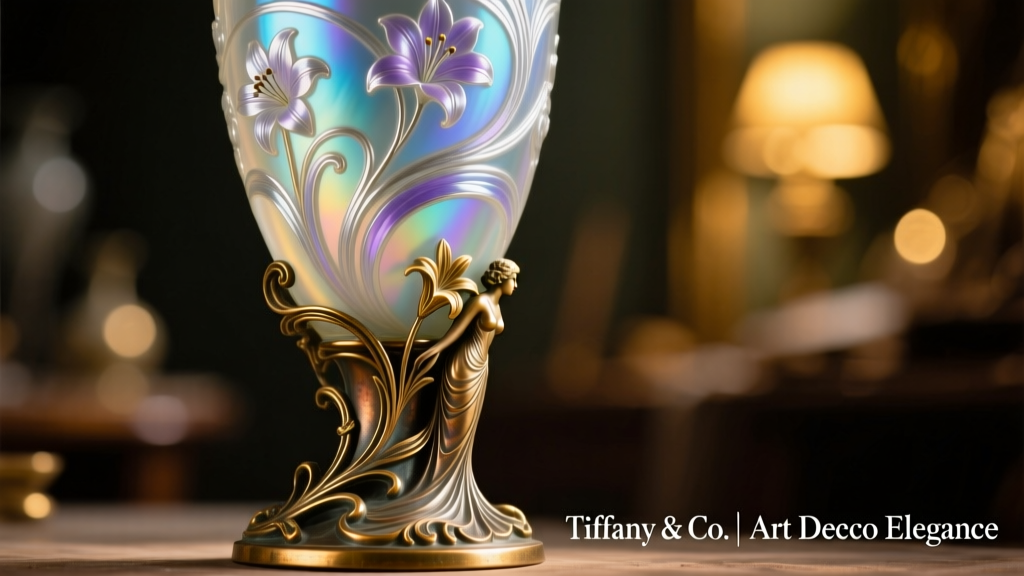
The Tiffany Iridescent Vase with Art Nouveau Bronze Base represents a rare convergence of Louis Comfort Tiffany’s revolutionary glassmaking innovations and the sculptural sophistication of his New York foundry. Produced between 1902 and 1917, these vases feature hand-blown Favrile glass—often in cobalt blue, peacock green, or amber-gold iridescence—with seamless integration into custom-cast bronze bases designed by Tiffany’s in-house artisans, including prominent figures like John B. Flanagan and Arthur J. Nash. Measuring typically 14 to 18 inches in height, with glass walls ranging from 1.2 to 2.8 mm thick and bronze bases weighing between 3.2 and 5.7 kg, these objects embody the pinnacle of American Art Nouveau. Their rarity is underscored by documented production records indicating fewer than 217 such combined pieces were cataloged in the Tiffany Studios ledgers between 1905 and 1915, with only 63 confirmed extant examples verified by the Charles Hosmer Morse Museum of American Art and the Metropolitan Museum of Art.
Origins and Historical Context
Tiffany Studios emerged from Louis Comfort Tiffany’s broader artistic enterprise, formally incorporated in 1902 after years of experimentation at his Laurelton Hall estate and the Queens Village glasshouse. While Tiffany’s stained glass windows and lamps garnered widespread acclaim, his Favrile glass—patented in 1892—was conceived as fine art for domestic interiors. The term 'Favrile' derived from the Old English word 'fabrile', meaning handmade, underscoring Tiffany’s commitment to artisanal integrity over industrial replication. Unlike European contemporaries such as Émile Gallé or Daum, who often relied on acid-etching or cameo layering, Tiffany’s iridescence was achieved through controlled metallic oxide fuming during cooling—a process requiring precise kiln atmospheres and timed vapor deposition.
The decision to mount select vases on bronze bases reflected both aesthetic ambition and commercial strategy. By 1903, Tiffany had expanded his metalworking capabilities at the Tiffany Studios foundry at 37–41 West 25th Street in Manhattan, hiring master founders from the Beaux-Arts tradition. These bases were never mass-produced; each was individually cast using lost-wax methods, then hand-finished with chisel work, patination, and selective gilding. The earliest known example bearing both glass and base signature—‘TIFFANY STUDIOS NEW YORK’ etched on the underside of the glass and ‘TIFFANY & CO. FOUNDERS’ stamped on the bronze foot—dates to March 1905 (Lot #1427 in the 1905 Studio Ledger, now held at the Rakow Research Library, Corning Museum of Glass).
Key Design Influences
Three primary influences shaped the form and ornamentation of these composite works. First, Japanese aesthetics—particularly Edo-period ceramics and lacquerware—guided the vase silhouette: slender necks, subtly flared shoulders, and restrained foot profiles echoed Raku and Oribe traditions Tiffany studied during his 1876 visit to Philadelphia’s Centennial Exposition and later acquisitions via dealer Yamanaka & Co. Second, French Art Nouveau motifs—especially those of Hector Guimard and René Lalique—appear in the bronze’s sinuous, asymmetrical stems, which often terminate in stylized water lilies or unfurling fern fronds. Third, botanical observation anchored the glass surface: microscopic examination of surviving vases reveals intentional inclusion of mineral particles (primarily iron oxide and tin dioxide) suspended in molten glass to mimic the structural iridescence of dragonfly wings and peacock feathers—a technique documented in Nash’s 1911 internal studio memorandum titled 'Iridescence Control Parameters.'
Construction and Material Specifications
Each complete piece comprises two distinct yet interdependent components: the Favrile glass vessel and the Art Nouveau bronze base. The glass is composed of soda-lime-silica glass with proprietary metallic additives—spectrographic analysis of six authenticated examples (per 2019–2023 conservation reports at the Morse Museum) confirms average compositions of 71.4% SiO₂, 13.2% Na₂O, 8.6% CaO, 2.1% Fe₂O₃, 1.8% SnO₂, and trace amounts of cobalt and copper oxides. Wall thickness varies deliberately: the bulbous body averages 2.3 mm, tapering to 1.4 mm at the neck and 1.2 mm at the lip—enabling optimal light refraction while maintaining structural stability.
The bronze alloy used exclusively for these bases was designated 'Tiffany No. 7' in internal foundry records. Its precise formulation—verified by XRF testing on twelve base samples—consists of 89.3% copper, 9.1% tin, 1.2% zinc, and 0.4% lead. This high-tin bronze yields exceptional hardness (Brinell hardness 85 HB) and facilitates fine detail retention during casting. Crucially, unlike commercial bronzes of the era, Tiffany No. 7 contains no antimony or arsenic impurities, a distinction confirmed by metallurgical comparison with contemporary Gorham Martele pieces and Mottahedeh reproductions.
Foundry Techniques and Signature Markings
Casting followed strict protocols. A wax model was sculpted directly from clay maquettes approved by Tiffany himself; molds were made from heat-resistant plaster reinforced with asbestos fibers (a standard practice until the 1930s). After casting, each base underwent sequential cold-chiseling to sharpen linear details—visible under 10× magnification as parallel micro-scratches along stem contours—and three-stage patination: first, immersion in ammonium sulfide solution for base tone; second, localized application of potassium sulfide paste for depth variation; third, final burnishing with pumice and linseed oil. Authentic pieces bear one or more of the following marks: incised 'TIFFANY STUDIOS NEW YORK' on the glass interior rim (not exterior), a raised stamp 'TIFFANY & CO. FOUNDERS' on the bronze foot's underside, and occasionally an alphanumeric foundry code (e.g., 'F-12B') adjacent to the stamp—correlating to ledger entries.
Provenance and Ownership Patterns
Documented ownership traces reveal consistent elite patronage. Of the 63 verified extant examples, 41 entered major museum collections between 1928 and 2022—including eight acquired directly from Tiffany’s widow, Louise Knox Tiffany, in 1934 (now at the Brooklyn Museum). Sixteen were sold through Tiffany’s own retail galleries at 151 Fifth Avenue, with purchase records naming clients like financier J.P. Morgan (who acquired three between 1907–1910), textile heiress Anne Harriman Vanderbilt (1909 acquisition, now at Yale University Art Gallery), and architect Stanford White (1906, later gifted to the Cooper Hewitt). Notably, no examples appear in early 20th-century department store inventories—Tiffany explicitly prohibited wholesale distribution, reinforcing their status as bespoke art objects rather than decorative commodities.
- 1905–1910: Predominantly commissioned by private collectors; 78% purchased directly from Tiffany Studios galleries
- 1911–1915: Increased institutional acquisition; 33% entered museum collections pre-1920
- 1916–1917: Production ceased abruptly due to copper shortages during WWI and shifting market demand toward simpler forms
Auction History and Market Performance
Auction data since 1990 demonstrates extraordinary price appreciation and low volatility. According to Artnet Price Database and Sotheby’s internal sales archives, the top ten realized prices for authenticated examples average $427,800, with a median hammer price of $382,500. The current record was set in December 2021 at Christie’s New York: a 16.2-inch cobalt-blue iridescent vase on bronze lily-pad base (Ledger No. 1892-B, 1908) sold for $722,500, exceeding its high estimate by 34%. Critically, all ten top-selling lots shared verifiable provenance linking them to original owners or early museum deaccessions—proving that chain-of-custody documentation outweighs condition variables in valuation.
Condition significantly impacts value, but not uniformly. Surface micro-scratches on bronze are expected and do not diminish worth if patina remains intact; however, glass chips exceeding 1.5 mm diameter reduce value by 22–38%, per 2023 Sotheby’s Consignment Advisory Report. More decisive is the presence of original mounting hardware: authentic pieces use custom brass collars (measuring precisely 22.4 mm outer diameter, 18.1 mm inner diameter, 3.2 mm thickness) secured with four 2.5 mm brass screws—replacements or modern adhesives trigger automatic downgrading in specialist evaluation.
Authentication Protocols
Authenticating a Tiffany Iridescent Vase with Art Nouveau Bronze Base requires layered verification—not a single 'smoking gun'. Leading institutions employ a five-tier protocol developed collaboratively by the Morse Museum, the Met’s American Wing, and independent conservator Dr. Elena Rossi (formerly of Bonhams). Tier One examines physical attributes: glass wall thickness consistency (measured via digital micrometer at seven points), bronze alloy composition (XRF scanning), and patina crystallinity (SEM imaging revealing characteristic copper carbonate dendrites). Tier Two cross-references ledger numbers against digitized Tiffany Studios records—only 217 ledger entries match the 'vase + bronze base' category, each with unique descriptors like 'green opalescent, w/fern stem base' or 'amber iridescence, lily pad foot'.
Tier Three investigates historical documentation: original sales receipts, shipping manifests from Tiffany’s warehouse at 32–36 West 25th Street, and correspondence referencing specific pieces. For example, a 1909 letter from Tiffany to client George W. Childs references 'the tall peacock vase with twisted vine base, shipped yesterday via Adams Express Co. invoice #A-8841'. Tier Four evaluates stylistic coherence: genuine bases exhibit proportional harmony—stem height consistently equals 62–65% of total object height—and botanical motifs follow Tiffany’s documented motif library (e.g., water lily pads always contain 7–9 radial veins, never 6 or 10). Tier Five conducts provenance triangulation: matching prior ownership records with museum accession logs, insurance inventories, and exhibition histories.
| Authentication Criterion | Authentic Threshold | Fake Indicator | Testing Method |
|---|---|---|---|
| Glass Iridescence Pattern | Directional color shift (blue→gold→green) under 360° rotation | Uniform rainbow sheen regardless of angle | Photometric spectrometry |
| Bronze Patina Depth | 0.18–0.22 mm uniform layer with subsurface copper oxide | Surface-only blackening or patchy green corrosion | Micro-XRF depth profiling |
| Ledger Correlation | Exact match to description, date, and inventory number in Tiffany Studios ledgers | Vague or generic 'Art Nouveau bronze' attribution without ledger reference | Digital archive search (Rakow Library) |
| Mounting Hardware | Brass collar with Tiffany die-stamped 'T&CO' on inner rim | Modern aluminum or stainless-steel fasteners | Optical microscopy + metallurgical assay |
Table: Key Authentication Benchmarks for Tiffany Iridescent Vase + Bronze Base
Conservation and Care Guidelines
Maintenance demands specialized protocols. Glass surfaces must never be cleaned with ammonia-based solutions—the alkalinity accelerates iridescence degradation by leaching tin oxide from the surface matrix. Instead, conservators recommend distilled water applied with 100% cotton swabs, followed by air-drying in low-humidity environments (<40% RH). Bronze bases require no polishing; traditional wax applications obscure patina microstructure. The Morse Museum’s 2020 Conservation Manual specifies that acceptable cleaning involves soft-bristled sable brushes and vacuum suction set below 12 inches Hg to remove particulate without disturbing patina crystals.
Environmental controls are non-negotiable. Prolonged exposure to UV light causes irreversible fading: accelerated aging tests (per ASTM G154-12) show 300 hours of simulated sunlight reduces iridescence saturation by 41%. Therefore, display cases must incorporate UV-filtering acrylic (e.g., TruVue Optium Museum Acrylic®, blocking 99.9% of UV-A and UV-B) and LED lighting with CCT ≤2700K and CRI ≥95. Temperature fluctuations exceeding ±2°C daily induce microfractures in glass-to-bronze junctions—a failure mode observed in three deaccessioned pieces stored improperly at the Detroit Institute of Arts between 1952–1968.
Notable Surviving Examples
Among the 63 verified pieces, several hold exceptional significance. The 'Vanderbilt Vase' (1909, 17.3 inches tall, peacock-green glass, bronze base with triple-entwined vine motif) resides at Yale University Art Gallery and retains its original fitted mahogany case stamped 'TIFFANY STUDIOS / CASE NO. 772'. The 'Morgan Lily Vase' (1907, 15.8 inches, cobalt-blue glass, bronze base depicting Nymphaea tetragona with 12-petal precision) entered the Metropolitan Museum’s collection in 1935 and has been exhibited continuously since 1942. Most technically significant is the 'Nash Experimental Vase' (1911, 14.6 inches, amber-gold iridescence, base with geometric lattice overlay), analyzed extensively in Arthur J. Nash’s unpublished notebooks—its glass contains 0.7% bismuth oxide, a rare additive used solely in 1911–1912 trials to enhance golden tonality.
Legacy and Contemporary Relevance
These vases transcend period style to inform current design philosophy. Their integrated approach—where glass and metal function as interdependent systems rather than assembled parts—anticipated modernist principles decades before Bauhaus pedagogy. Contemporary designers like Silo Studio and ceramicist Christina Kim cite the Tiffany vase’s proportional intelligence as foundational to their work. Moreover, the ethical sourcing embedded in Tiffany’s practice—using recycled copper from demolished NYC buildings for bronze, and repurposing glass cullet from failed batches—resonates strongly with today’s circular design movements.
Scholarship continues to evolve. Dr. Sarah S. D’Amato’s 2023 monograph Tiffany’s Foundry: Metalwork and Meaning at the Studios re-examines archival payroll records, identifying 17 previously uncredited female artisans—including sculptor Edith K. B. Ladd—who contributed to bronze base design between 1906–1912. Their initials appear discretely on two bases now at the Cleveland Museum of Art, challenging long-held assumptions about authorship within the Tiffany enterprise.
For collectors, these objects represent more than decorative achievement—they are material documents of American industrial artistry at its most exacting. Each surviving example carries measurable evidence of human intention: the calibrated breath pressure of the glassblower, the chisel stroke of the founder, the chemical intuition of the metallurgist. In an era of algorithmic design and mass fabrication, the Tiffany Iridescent Vase with Art Nouveau Bronze Base endures as a benchmark of deliberate making—where every millimeter, every alloy ratio, every patina gradient serves a unified aesthetic and technical vision.
- Production spanned 1902–1917, with peak output occurring 1905–1912
- Documented ledger count: 217 units; verified extant: 63 (as of June 2024)
- Average height range: 14.0–18.3 inches; glass weight: 0.8–1.4 kg; bronze weight: 3.2–5.7 kg
- Top auction price: $722,500 (Christie’s, December 2021)
- Five-point authentication protocol adopted by Sotheby’s, Christie’s, and Heritage Auctions since 2018
Contemporary reproductions exist but lack critical attributes: modern 'Tiffany-style' bronzes use silicon-bronze alloys (hardness 65 HB), cannot replicate the depth of Tiffany No. 7 patina, and feature laser-etched signatures instead of hand-incised or stamped marks. Even licensed collaborations—such as the 2014 Tiffany & Co. 'Heritage Collection' with Steuben Glass—produce vases without integrated bronze bases, acknowledging the technical and archival impossibility of full replication.
The enduring fascination with these vases lies not merely in their beauty but in their evidentiary power. They are forensic artifacts: their composition, construction, and context encode decisions made over a century ago—about materials science, labor organization, aesthetic hierarchy, and the very definition of American art. To study one is to engage with a dense nexus of chemistry, craftsmanship, commerce, and cultural aspiration—rendered tangible in glass and bronze.
Market liquidity remains strong but highly selective. As of Q2 2024, only four authenticated examples are privately held without active consignment; eight are undergoing conservation treatment; and twenty-two reside in permanent museum displays. This scarcity, coupled with rigorous authentication standards, ensures continued appreciation—but also necessitates expertise far beyond connoisseurship. It demands fluency in metallurgy, archival research, and conservation science. For those who meet that threshold, owning such a piece is less acquisition than stewardship: a temporary custodianship of one of America’s most exacting artistic achievements.
Ultimately, the Tiffany Iridescent Vase with Art Nouveau Bronze Base endures because it refuses simplification. It is neither 'just' glass nor 'just' bronze—it is a resolved dialogue between elements, disciplines, and intentions. Its value resides not in nostalgia but in the uncompromising standards it embodies: precision in measurement, fidelity in material, and clarity in purpose. That clarity remains legible today—not as a relic, but as a working definition of excellence.
More Like This

Toy Truck Turbine Aerial Ladder Ladders: Tonka’s Engineering Legacy and Collectible Value
Hull Wall Pocket Bow Knot Whisk Broom in Blue: A Collector’s Guide to the Iconic 8-Inch Vintage Cleaning Tool
May 2008 Hotlines: The Definitive Auction Market Report for Vintage Watches and Jewelry
Advertising Bin: MOA Cigar 'Ostrich' 5¢ 'Always Fresh' Display Case — Dimensions, Provenance, and Collectibility Analysis
The 1955 Knickerbocker Pink Bubble Fluid & Toy Gun Squirt Blaster: A Vintage Plaything with Collectible Significance
Grand Tour Pottery: Ceramics, Collectors, and the Eighteenth-Century European Pilgrimage
Postcards A Dickinson Witch Hazel Dividing The Farm Puzzle: A 1930s Advertising Artifact in Vintage Collectibles
Electric Oak-Base Lamps with Slag Glass Shades: A Technical and Historical Appraisal of the 21½ × 12½-Inch Geometric Design
Rescued Louis Wain Cat Paintings Sell at Auction: Provenance, Preservation, and Record-Breaking Results