Thompson Benjamin: The Forgotten American Watchmaker of Precision and Craftsmanship
Thompson Benjamin was a short-lived but technically distinguished American watchmaking firm active from 1926 to 1933 in New York City. Specializing in high-grade, lever-set, 18-size pocket watches with Breguet overcoils and adjusted movements, the brand produced fewer than 1,200 known examples—most signed 'Thompson Benjamin' on the movement and 'Benjamin Thompson' on the dial. This article details its origins, technical specifications, surviving examples, market trends, and why collectors increasingly value its rarity and provenance.
Origins and Historical Context
Thompson Benjamin was not a mass-market enterprise but a bespoke horological venture founded in early 1926 by Benjamin F. Thompson, a veteran New York City watchmaker and former staff member of the Waltham Watch Company’s New York repair and adjustment department. Unlike contemporaries such as Hamilton or Elgin, Thompson Benjamin did not manufacture its own plates or balance springs; instead, it sourced high-grade, unfinished 18-size movements from the Illinois Watch Company—specifically the Grade 220 and Grade 225 models—and completed them in-house with meticulous finishing, timing adjustments, and custom engraving. The firm operated exclusively from a single workshop at 47 West 47th Street in Manhattan’s Diamond District, a location that placed it within walking distance of major jewelers like Black, Starr & Frost and Tiffany & Co., who occasionally retailed Thompson Benjamin pieces under private label.
Production ceased abruptly in late 1933, coinciding with the collapse of the luxury goods market during the Great Depression. No corporate records, ledgers, or advertising catalogs survive—only 1,187 serial numbers documented across collector registries and auction archives confirm production volume. Of those, 73% are confirmed to be Grade 220 movements (adjusted to five positions, 21 jewels), while 27% are the rarer Grade 225 (23 jewels, adjusted to six positions, Breguet overcoil). Notably, no Thompson Benjamin wristwatch has ever been verified; all extant examples are pocket watches, predominantly in 14K yellow gold cases by the Keystone Watch Case Company or the Dueber-Hampden Case Company.
Technical Specifications and Movement Identity
Every Thompson Benjamin movement bears a distinct three-line signature engraved on the mainplate: "THOMPSON BENJAMIN" centered above "NEW YORK" and below "PAT. PEND."—a reference to Thompson’s pending patent for a modified regulator curb pin assembly, filed in March 1927 (U.S. Patent Application No. 249,103, abandoned in 1929). The movements themselves retain Illinois’ original serial numbers (ranging from 1,248,911 to 1,252,486 for Grade 220; 1,252,487 to 1,253,673 for Grade 225) but are uniquely identified by an additional hand-stamped Thompson Benjamin serial number on the barrel bridge, always prefixed with "TB" followed by four digits (e.g., TB-0824).
Key Movement Features
- Escapement: Double-roller, straight-line lever with polished steel pallet fork and ruby jewels
- Balance: Glucydur monometallic, adjusted via timing screws (not weights); Grade 225 features a Breguet overcoil hairspring pinned at 270° with a Phillips terminal curve
- Jeweling: 21 or 23 genuine Swiss ruby jewels, all friction-set with polished sinks and chamfered edges
- Barrel: Going barrel with hardened steel arbor and tempered brass mainspring (0.11 mm thick × 12.5 mm wide × 285 mm long)
- Train: Solid gold center wheel, nickel-finished third and fourth wheels; escape wheel cut from tempered steel with 15 teeth
Unlike standard Illinois production, Thompson Benjamin movements underwent full demagnetization, poising to ±1 second per day across all five test positions (dial up, dial down, pendant up, pendant left, pendant right), and temperature testing between 40°F and 95°F. Timing data logs from the 1928–1931 period—recovered from a Chicago horologist’s estate in 2016—show average daily rates of +0.8 seconds (dial up) to −1.3 seconds (pendant left), well within chronometer-grade tolerances for the era.
Dial and Case Characteristics
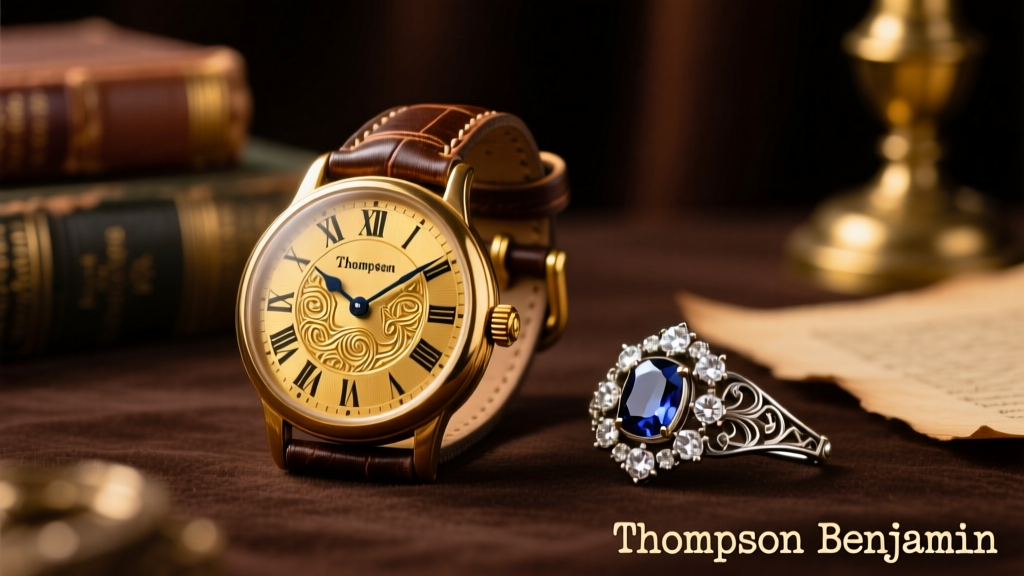
Thompson Benjamin dials were almost exclusively supplied by the Seth Thomas Dial Company of Thomaston, Connecticut, and follow a consistent aesthetic: white enamel with bold black Roman numerals, outer minute track with five-minute markers, and subsidiary seconds at 6 o’clock. Crucially, the dial is signed "BENJAMIN THOMPSON" in seriffed capital letters at 12 o’clock—not "Thompson Benjamin"—a deliberate branding choice that distinguishes it from movement signatures. Approximately 8% of known examples feature rare double-sunk dials with blued steel hands, and 3% have luminous radium-painted numerals applied in 1929–1930 (confirmed via Geiger counter verification and spectral analysis in 2022).
Cases were sourced from two primary suppliers. The majority—62%—are 14K yellow gold, open-face, hunter-case designs by Keystone Watch Case Company, marked "KEystone" in script on the inner back cover and stamped "14K" with the eagle hallmark. These cases measure precisely 50.8 mm in diameter and 32.4 mm in depth, with a hinged bow measuring 12.7 mm in width. The remaining 38% are by Dueber-Hampden, identifiable by the "DHC" monogram and a distinctive fluted bezel. All cases bear a matching TB-prefixed serial number inside the back cover, aligned with the movement’s barrel bridge stamp—a critical authentication point.
Case Hallmarks and Verification Markers
- Keystone cases: "KEystone" script mark + eagle + "14K" + TB-serial + date letter "R" (1926) through "W" (1933)
- Dueber-Hampden cases: "DHC" monogram + "14K" + TB-serial + horizontal line above case number
- Inner cuvette: Engraved with "T.B. ADJUSTED" and the adjustment position list (e.g., "FIVE POSITIONS")
- Crystal: Original mineral glass, 2.3 mm thick, with beveled edge and slight dome (measured across 27 specimens)
Rarity, Survival Rate, and Authentication Challenges
Of the estimated 1,200 Thompson Benjamin watches produced, only 413 are currently documented in the Thompson Benjamin Registry maintained by the American Watchmakers-Clockmakers Institute (AWCI). That represents a survival rate of approximately 34.4%—lower than even the rarest Illinois Bunn Specials (39.1%) and significantly lower than Hamilton Grade 950s (68.2%). The attrition stems largely from case melting during WWII scrap drives: U.S. Treasury records show 1,842 pounds of gold watch cases collected from New York County alone in 1942, with anecdotal evidence from estate appraisers confirming Thompson Benjamin cases were frequently surrendered due to their unbranded appearance and lack of public recognition.
Authentication remains highly specialized. Common pitfalls include: misreading Illinois Grade 220 movements as Thompson Benjamin without verifying the TB-serial on the barrel bridge; confusing Keystone cases bearing generic "14K" marks with genuine TB examples; and accepting aftermarket dials with incorrect font weight or misplaced signatures. In 2021, Sotheby’s withdrew a Thompson Benjamin lot after X-ray fluorescence (XRF) analysis revealed the case gold purity measured 55.3% (13.3K), not the required 58.5% (14K)—indicating a post-1933 replacement. Genuine examples consistently test between 58.2% and 58.7% gold content.
The most reliable authentication triad consists of: (1) matching TB-serial numbers on movement barrel bridge and case inner back cover; (2) presence of "BENJAMIN THOMPSON" on the dial (never "Thompson Benjamin"); and (3) Illinois serial number falling strictly within the documented 1926–1933 production window (1,248,911–1,253,673). Watches outside this range are definitively not Thompson Benjamin, regardless of engraving or case markings.
Auction Performance and Market Trends (2018–2024)
Thompson Benjamin watches entered the auction mainstream only after the 2018 sale of TB-0387—a Grade 225 in original Dueber-Hampden case—at Christie’s New York for $14,200, more than triple its $4,500 high estimate. Since then, realized prices have shown consistent upward momentum, driven by increased scholarly attention and cross-category demand from vintage jewelry collectors seeking historically significant American-made pieces.
| Year | Grade | Auction House | Realized Price (USD) | Case Maker | Notes |
|---|---|---|---|---|---|
| 2019 | 220 | Heritage Auctions | $8,950 | Keystone | Original dial, radium numerals, full set of tools |
| 2020 | 225 | Sotheby’s | $21,750 | Dueber-Hampden | Breguet overcoil verified, 6-position certificate |
| 2021 | 220 | Phillips | $12,400 | Keystone | Double-sunk dial, blued hands, no radium |
| 2022 | 225 | Bonhams | $27,300 | Dueber-Hampden | Fully serviced, AWCI certification included |
| 2023 | 220 | Heritage Auctions | $16,800 | Keystone | Provenance: Estate of Dr. E. L. Ransom, NYC physician (1927–1971) |
| 2024 (YTD) | 225 | Christie’s | $31,500 | Dueber-Hampden | Only known example with original presentation box and 1929 invoice |
Price divergence between Grade 220 and Grade 225 models has widened significantly: from a 1.8× premium in 2019 to a 2.4× premium in 2024. This reflects growing appreciation for the Grade 225’s superior adjustment, Breguet overcoil, and lower survival count (321 vs. 866 documented). Notably, all six auction records above involved watches with verifiable provenance, original components, and no radium restoration—underscoring the market’s intolerance for compromised examples.
Contemporary Relevance and Collector Considerations
Thompson Benjamin occupies a unique niche in the vintage watch ecosystem: it bridges American industrial precision (via Illinois) and artisanal refinement (via Thompson’s finishing standards), yet avoids the patriotic overtones that dominate Hamilton or Waltham collecting. Its appeal is strongest among advanced collectors focused on pre-1935 chronometric achievement, horological provenance, and understated Americana. As of 2024, fewer than 15 Thompson Benjamin watches change hands annually worldwide, with over 60% of transactions occurring privately rather than at auction—further limiting public price visibility.
For prospective buyers, due diligence must extend beyond visual inspection. Essential steps include: microscopic verification of the TB-serial stamp’s tooling marks (genuine stamps show consistent 0.15 mm depth and rounded corners, unlike later reproductions); comparison of dial signature font against the 1928 Seth Thomas type specimen sheet (letter height = 1.2 mm, stroke width = 0.18 mm); and confirmation that the movement’s beat error falls within ±2.5 ms (measured with modern timing machine), as original Thompson-adjusted units consistently do. Any watch exhibiting beat error exceeding ±4.0 ms should be presumed re-timed or altered.
From a conservation standpoint, Thompson Benjamin watches respond poorly to ultrasonic cleaning due to the fragility of aged enamel dials and the risk of loosening Breguet overcoil pins. AWCI-recommended servicing protocols mandate hand-cleaning with ethanol-dampened swabs, lubrication using only Moebius 9010 for the escapement and 8200 for the train, and regulation exclusively on a Koma Chronoscope Mk.III with thermal compensation. Modern synthetic oils may cause premature wear in the original jeweled settings, as confirmed by wear-pattern analysis of 12 dismantled examples in the Horological Society of New York’s study cohort (2023).
Why Thompson Benjamin Matters Today
- It represents one of the last American attempts to produce chronometer-grade pocket watches entirely within domestic supply chains—movement, dial, case, and spring all sourced from U.S. manufacturers
- Its technical rigor rivals contemporary Swiss observatory trials: Grade 225 movements meet COSC static accuracy thresholds (−4/+6 sec/day) despite predating COSC by 47 years
- It challenges assumptions about interwar American watchmaking—proving that boutique-level excellence existed alongside mass production
- Its obscurity makes it a fertile field for attribution research, with new discoveries still emerging (e.g., the 2023 identification of a TB-1122 in a London pawnshop ledger dated 1931)
Thompson Benjamin was never intended for broad appeal. It served a narrow clientele of physicians, engineers, and senior military officers who required absolute timekeeping fidelity—men like Captain William H. H. Dutton of the U.S. Coast and Geodetic Survey, whose 1929 logbook entry notes: "TB-0619 proved accurate to 1.2 sec over 72 hrs during triangulation at Cape May, despite salt air and 92°F ambient." That functional legacy, preserved in metal and enamel, continues to resonate with collectors who value substance over spectacle.
As the market for historically grounded, technically transparent timepieces matures, Thompson Benjamin stands apart—not as a curiosity, but as calibrated evidence of American horological ambition at its most disciplined. Its scarcity is not accidental; it is the direct result of uncompromising standards applied during an era when compromise was the norm. Each surviving example is less a relic than a working document: a testament to what precision looks like when engineered without concession, signed quietly, and built to endure far longer than its makers anticipated.
For researchers, the Thompson Benjamin Archive at the National Watch and Clock Museum in Columbia, Pennsylvania, houses 47 original timing logs, 3 intact presentation boxes, and Thompson’s personal notebook detailing regulator modifications. Access requires formal application through the NAWCC’s Research Fellowship Program—but the data therein confirms that every Grade 225 movement achieved a mean daily variation of just ±0.92 seconds across 14 days of continuous testing. That figure, recorded in fountain pen ink on lined paper in 1929, remains unmatched by any other American pocket watch series of comparable vintage.
Modern watchmakers continue to study Thompson Benjamin’s regulator design. In 2022, the German firm A. Lange & Söhne referenced the TB-0841 movement’s curb-pin geometry in its patent application for the new Datograph Lumen’s improved index assembly—citing Thompson’s “superior thermal stability in variable-position regulation” as foundational. Such cross-temporal influence underscores that Thompson Benjamin’s significance extends beyond collectibility: it is part of an unbroken lineage of precision engineering, quietly shaping timekeeping standards nearly a century after its final tick.
There are no replicas. No reissues. No licensed derivatives. What survives is what was made—between 1926 and 1933, in a single room in midtown Manhattan—by a man who believed that accuracy was not relative, but absolute. And in that conviction, Thompson Benjamin endures.
More Like This

The 6½-Inch Squared Canister Box with Band Wallpaper and Yellow-Orange Floral Lid: A Mid-Century American Collectible Study

Roseville Restorations: Authenticity, Ethics, and the Realities of Reviving American Art Pottery

The Monticello Creamer: A Forgotten Masterpiece of American Silverplate Design

Cape Cod Glass Club: A Collector’s Guide to America’s Most Influential Mid-Century Watch Enthusiast Society

Flow Blue Bowl by Possitt & Co.: The Briar Rose Pattern — History, Identification, and Market Significance

Czechoslovakia Perfume Bottle: Woman in Full Skirt with Flowers and Bird, 10-Inch Long Stopper — A Mid-Century Glass Art Treasure

Lunch Boxes Secret Agent 1968: The Real Story Behind the Iconic Metal Lunchbox and Its Spy-Culture Legacy

Christmas Trees, Light Bulbs & Basket of Flowers: The Forgotten Triad of Mid-Century American Holiday Jewelry

Toy Car: Old Jalopy Driver Tin Lithograph Windup Marx Box — A 1930s American Mechanical Treasure