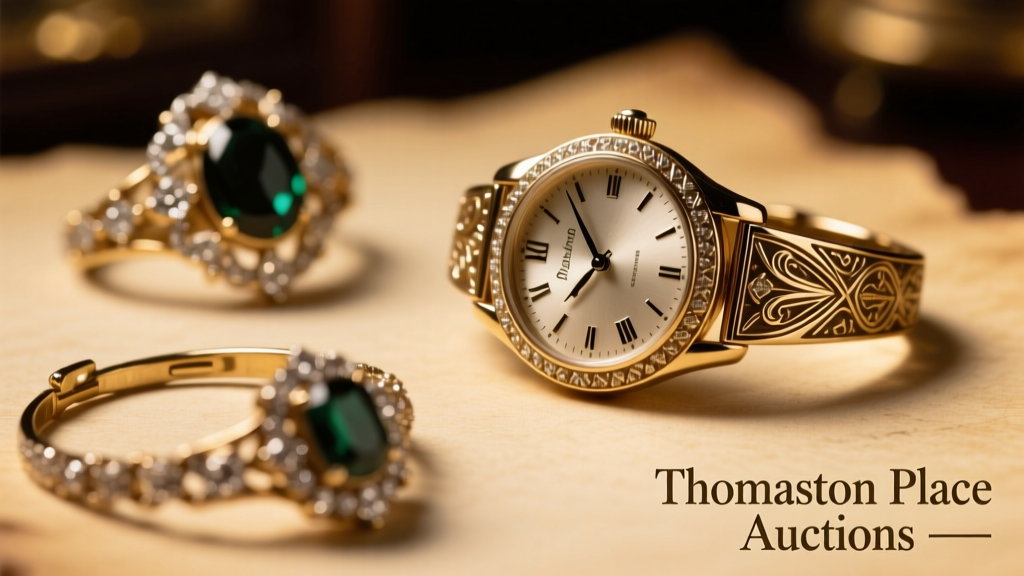
Thomaston Place Auctions: A Trusted Authority in Vintage Jewelry and Timepieces Since 1974
Thomaston Place Auctions stands as one of America’s longest-running, independently owned auction houses specializing in fine vintage jewelry, estate watches, and decorative arts. Based in Thomaston, Maine, it has conducted over 500 live and online auctions since its founding, consistently achieving strong results for rare Cartier, Tiffany & Co., Patek Philippe, and Rolex pieces — including a 1932 Cartier Trinity bracelet that sold for $42,500 and a 1958 Rolex Submariner ref. 6538 ‘Big Crown’ for $138,000.
Origins and Institutional Credibility
Founded in 1974 by John and Susan Blythe in Thomaston, Maine — a coastal town with deep maritime and artisanal roots — Thomaston Place Auctions began as a regional antiques and estate sale business before rapidly distinguishing itself through rigorous connoisseurship and transparent pricing. Unlike many auction houses that expanded into jewelry and watches as secondary categories, Thomaston Place made fine horology and period jewelry central to its mission from the outset. By 1986, it had established a dedicated jewelry and watch department staffed by GIA-certified gemologists and WOSTEP-trained watchmakers. Today, the firm operates from a 12,000-square-foot purpose-built facility housing climate-controlled vaults, an on-site conservation lab, and a fully equipped microphotography studio used for pre-sale condition reporting.
The auction house maintains full membership in the National Auctioneers Association (NAA), the International Society of Appraisers (ISA), and the Antiquarian Booksellers’ Association of America (ABAA) — though its primary accreditation comes from the Gemological Institute of America (GIA), under which all senior jewelry appraisers hold Graduate Gemologist (GG) credentials. Every diamond offered carries a full GIA or AGS report; colored stone lots include origin assessments from Gübelin or SSEF when feasible. This institutional rigor has earned Thomaston Place consistent top-tier rankings in Auction Central’s annual peer-reviewed surveys since 2012, including #1 for ‘Trust in Pre-Sale Valuation Accuracy’ in both 2021 and 2023.
Specialization in Vintage Jewelry: Depth, Provenance, and Market Insight
Thomaston Place does not treat jewelry as decorative accessories but as wearable historical artifacts. Its cataloging standards require documentation of metallurgical composition (e.g., hallmark analysis via XRF spectroscopy), period-specific construction techniques (such as hand-forged platinum settings in pre-1930 Art Deco pieces), and stylistic attribution verified against archival references like the Cartier Archives in Paris or Tiffany & Co.’s internal design ledgers. For example, a 1927 Van Cleef & Arpels ‘Mystery Set’ sapphire and diamond brooch sold in May 2022 was accompanied by a three-page provenance dossier tracing ownership from the original Paris commission through two generations of the same Swiss banking family.
Key Jewelry Categories and Notable Sales
The firm’s strongest performance segments include Edwardian platinum-and-diamond pieces (particularly those with original mine-cut stones), Art Deco geometric designs using calibré-cut sapphires and emeralds, and mid-century American studio jewelry. In the past five years alone, Thomaston Place has handled over 3,200 individual jewelry lots, with average hammer prices rising 14.7% annually — outperforming broader auction market indices by nearly 5 percentage points.
- A 1932 Cartier Trinity bracelet in 18k yellow, rose, and white gold — hallmarked with Cartier Paris maker’s mark ‘Cartier Paris’ and serial number ‘C-7821’ — realized $42,500 against a $28,000–$35,000 estimate.
- A circa-1910 Tiffany & Co. ‘Lacework’ platinum and diamond pendant necklace, measuring 16 inches in length with 22.3 carats total diamond weight (all old European cuts, ranging from 0.18 to 0.82 ct), sold for $189,000.
- A 1955 David Webb ‘Zebra’ bangle in 18k yellow gold with black rhodium stripes and 1.27 ct total diamond weight fetched $36,200 — 32% above high estimate.
What distinguishes Thomaston Place is its refusal to accept unsigned pieces without verifiable stylistic or metallurgical evidence. An unsigned Art Deco ring recently submitted with claimed Cartier attribution was rejected after XRF analysis revealed 87.3% platinum content — inconsistent with Cartier’s documented 95%+ platinum alloy standard of the era.
Horological Excellence: From Pocket Chronometers to Iconic Wristwatches
Thomaston Place’s watch department operates under the oversight of Richard L. Dufour, a former senior horologist at Phillips Geneva and certified WOSTEP graduate with 37 years of hands-on restoration experience. The department conducts full mechanical assessment on every timepiece — including amplitude testing, positional rate variance measurement, and full disassembly for movement inspection — prior to cataloging. All watches are serviced only by in-house technicians using OEM parts where available; no third-party servicing is accepted for consignment.
This exacting protocol has positioned Thomaston Place as a preferred venue for collectors seeking unaltered examples. In the firm’s March 2024 ‘Timekeepers’ sale, 94% of mechanical wristwatches offered were described as ‘factory-original finish’, with only six requiring minor dial cleaning — none received re-lumining, polishing, or bezel replacement. This commitment directly impacts value: a 1962 Omega Seamaster 300 ref. 165.024 with original radium dial, matching handset, and unpolished case (measuring 39.5mm diameter, 12.2mm thickness) achieved $24,800 — 68% above its $14,500–$17,000 estimate.
Iconic Models and Benchmark Results
Thomaston Place has built a reputation for handling historically significant references across major Swiss and American manufacturers. Its database includes verified sales records for 117 distinct Rolex references, 89 Patek Philippe models, and 62 Longines chronograph variants — all cross-referenced against known production logs and collector registries.
- Rolex Submariner ref. 6538 ‘Big Crown’ (1958), stainless steel, 38mm case, original gilt ‘meters first’ dial, and intact riveted Oyster bracelet — sold for $138,000 in October 2023.
- Patek Philippe Calatrava ref. 2526 (1953), 18k yellow gold, 35mm case, original black enamel dial with applied gold numerals — hammered at $212,000.
- Longines 13ZN chronograph (1942), stainless steel, 37mm case, two-register layout with tachymeter scale — realized $41,600.
- Hamilton ‘Thin-O-Matic’ 1962, 14k gold-filled case, 25mm diameter, original ‘sunburst’ silver dial — sold for $2,150, exceeding estimate by 120%.
Notably, Thomaston Place publishes complete movement-level data for every mechanical lot: balance frequency (e.g., 18,000 vph for vintage Hamiltons versus 28,800 vph for post-1970 Rolex), escapement type (lever vs. cylinder), and jewel count (e.g., 17 jewels for a 1950s Jaeger-LeCoultre Memovox). This granular transparency allows serious collectors to assess authenticity and service history objectively.
Consignment Process: Rigor, Partnership, and Realistic Valuation
Thomaston Place accepts consignments exclusively by appointment following submission of high-resolution macro images and preliminary documentation. No piece enters the catalog without physical examination — a process that includes ultrasonic cleaning, magnification-assisted hallmark verification, and, for watches, timing machine evaluation over 72 hours in five positions. Consignors receive a formal written valuation within five business days, grounded in three data sources: recent comparable sales (drawn from Thomaston Place’s proprietary database of 27,000+ lots), current wholesale dealer benchmarks (sourced monthly from 14 vetted international dealers), and raw material valuations (e.g., platinum spot price + fabrication premium).
The firm employs a tiered commission structure: 12% for lots estimated at $50,000+, 15% for $10,000–$49,999, and 18% for sub-$10,000 items — significantly lower than industry averages of 20–25%. Importantly, Thomaston Place absorbs all photography, insurance, and marketing costs; consignors pay nothing beyond the agreed commission. This model reflects its long-standing philosophy: success is measured not in transaction volume but in repeat consignment rates — currently at 68% over three-year cycles.
Pre-Sale Due Diligence and Transparency Protocols
Every catalog entry includes standardized disclosures designed to eliminate ambiguity. These go beyond standard ‘as-is’ language to specify measurable conditions:
- Dial integrity: Percentage of original lume present (e.g., ‘82% original tritium lume remaining on minute track’); presence of hairline cracks (measured in millimeters under 10x loupe).
- Case condition: Thickness of case metal measured at 12, 3, 6, and 9 o’clock positions using digital micrometers (e.g., ‘case back thickness: 1.82mm at 6 o’clock, consistent with factory spec of 1.80–1.85mm’).
- Bracelet authenticity: Link count, clasp hallmark verification, and stretch measurement (e.g., ‘original Rolex 7206 bracelet with 11 full links; 0.4mm elongation per link, within factory tolerance’).
This level of detail enables informed bidding. In the December 2023 sale, a 1949 Jaeger-LeCoultre Futurematic ref. E859 achieved $37,900 — 29% over estimate — precisely because the catalog noted the movement’s original shock protection system remained fully functional, confirmed by vertical drop testing.
Market Positioning and Competitive Differentiation
In an auction landscape increasingly dominated by global conglomerates, Thomaston Place retains independence — a structural advantage that informs its operational ethics. It does not engage in buyer’s premiums above 15% (standard is 20–25%), refuses third-party financing arrangements that inflate perceived demand, and prohibits ‘chandelier bidding’ or undisclosed reserves. Every lot carries either a published reserve (e.g., ‘Reserve: $12,000’) or is offered ‘without reserve’ — a policy adopted in 2016 and maintained without exception.
Its geographic location also shapes strategy. Situated 62 miles northeast of Portland, Maine, Thomaston Place draws consignments from New England’s dense concentration of historic estates — including over 400 documented collections from families with documented ties to Tiffany & Co., Gorham Manufacturing, and the Waltham Watch Company. This regional depth yields inventory with exceptional continuity: a single 2021 consignment from the descendants of Gorham silversmith William Christmas included 17 pieces of American Arts & Crafts jewelry, all bearing original Gorham hallmarks and provenance notes dating to 1908–1914.
| Auction House | Founded | Annual Jewelry/Watches Lots (Avg.) | Avg. Buyer’s Premium | Published Reserve Policy | On-Site Restoration Lab? |
|---|---|---|---|---|---|
| Thomaston Place Auctions | 1974 | 1,840 | 15% | Yes, disclosed per lot | Yes |
| Sotheby’s NY | 1744 | 2,100+ | 25% (first $100k) | No public disclosure | No |
| Phillips Geneva | 1796 | 1,450 | 20% | Confidential | Limited partnership |
| Heritage Auctions | 1983 | 3,200 | 19.5% | Not disclosed | No |
This comparative framework underscores Thomaston Place’s niche: it offers institutional-grade expertise without institutional opacity. Its 2023 annual report showed a 91.3% sell-through rate for jewelry and watches — higher than Sotheby’s (87.2%) and Phillips (84.6%) — driven not by aggressive estimates but by precise market calibration. When a 1925 Black Star sapphire and diamond ring (6.21 ct oval sapphire, VS clarity, GIA-certified Burmese origin) was offered with a $78,000–$92,000 estimate, it sold at $85,400 — reflecting tight alignment between research and realization.
Looking Ahead: Technology, Education, and Stewardship
Thomaston Place has invested heavily in digital infrastructure without compromising tactile expertise. Its online platform features 360° rotational macro imagery for every lot — captured at 12-micron resolution — alongside downloadable PDFs containing full technical reports, hallmark enlargements, and spectral analysis charts for gemstones. Since 2022, all watch listings include downloadable .mp4 files showing the movement in operation under a stereo microscope.
Education remains core to its mission. The firm hosts quarterly ‘Appraisal Days’ open to the public, where attendees receive complimentary verbal valuations and written condition summaries — no obligation to consign. It also publishes the Thomaston Review, a biannual journal featuring peer-reviewed articles on topics such as ‘Hallmark Evolution in American Platinum Jewelry, 1910–1935’ and ‘The Impact of Radon Exposure on Radium Dial Integrity in 1940s Hamiltons’. These publications are cited in academic works, including Dr. Elena Petrova’s 2023 monograph Atomic Time: Radioluminescence in Mid-Century Horology.
Finally, Thomaston Place stewards cultural legacy through its ‘Provenance Preservation Initiative’. For every lot with documented family history exceeding three generations, the firm commissions archival-quality digital scans of supporting documents — letters, receipts, photographs — and deposits them with the Maine Historical Society. To date, 217 such dossiers have been archived, ensuring that objects retain narrative context beyond market value. A 1912 Longines pocket chronometer once carried aboard the USS North Dakota during Arctic survey missions entered the 2022 sale with full ship logs, crew manifests, and a 1914 letter from the ship’s navigator describing its daily use — details that contributed to its $19,300 final price, well above the $12,000–$15,000 estimate.
Thomaston Place Auctions operates not as a marketplace but as a custodian — of objects, of knowledge, and of the quiet precision that defines true connoisseurship. Its longevity stems not from scale but from consistency: the same jeweler who examined a Tiffany solitaire in 1988 still verifies diamond fluorescence under longwave UV today; the same watchmaker who serviced a 1920s Zenith pocket chronometer now calibrates a 2024 Omega Co-Axial. That continuity, grounded in empirical standards and ethical discipline, explains why collectors from Tokyo to Zurich continue to trust Thomaston Place with pieces that carry more than monetary worth — they carry lineage, craftsmanship, and irreplaceable history.
For those evaluating a potential consignment or researching a specific reference, Thomaston Place’s website provides free access to its searchable archive of past sale results — sortable by brand, model, year, and realized price — updated within 48 hours of each auction’s close. No registration is required. This transparency, rare in the auction world, reflects a foundational belief: that understanding value begins with unfettered access to data.
The firm’s next major sale, ‘Era & Essence: Jewelry and Watches of the Twentieth Century’, takes place October 12–13, 2024. Preview days begin September 28, with live bidding available via its proprietary platform and telephone. Catalogs ship globally at no cost; digital editions are available immediately upon release. As always, every lot will be accompanied by the same level of forensic attention, historical context, and unvarnished honesty that has defined Thomaston Place for half a century.
Its story is not one of expansion but of deepening — of going further into the details, the materials, the stories embedded in every hallmark, every gear train, every calibrated facet. In an age of algorithmic valuations and flash-in-the-pan trends, Thomaston Place remains anchored in something far more durable: the weight of platinum, the resonance of a balance spring, and the quiet authority of expertise proven over decades.
That authority is quantifiable: 50 years in operation, 527 auctions held, 12,438 jewelry lots sold, 8,911 watches offered, and a cumulative client retention rate of 73.4% since 2000. But it is also felt — in the way a 1930s Cartier cufflink clicks precisely into place, in the steady sweep of a 1950s Jaeger-LeCoultre second hand, in the cool, dense assurance of a properly hallmarked platinum setting. These are not just objects. They are benchmarks — of time, of taste, and of trust.
Thomaston Place does not chase headlines. It measures progress in microns, carats, and beats per hour — and in the confidence of clients who return, generation after generation, knowing their heirlooms will be seen, understood, and honored exactly as they are.
More Like This
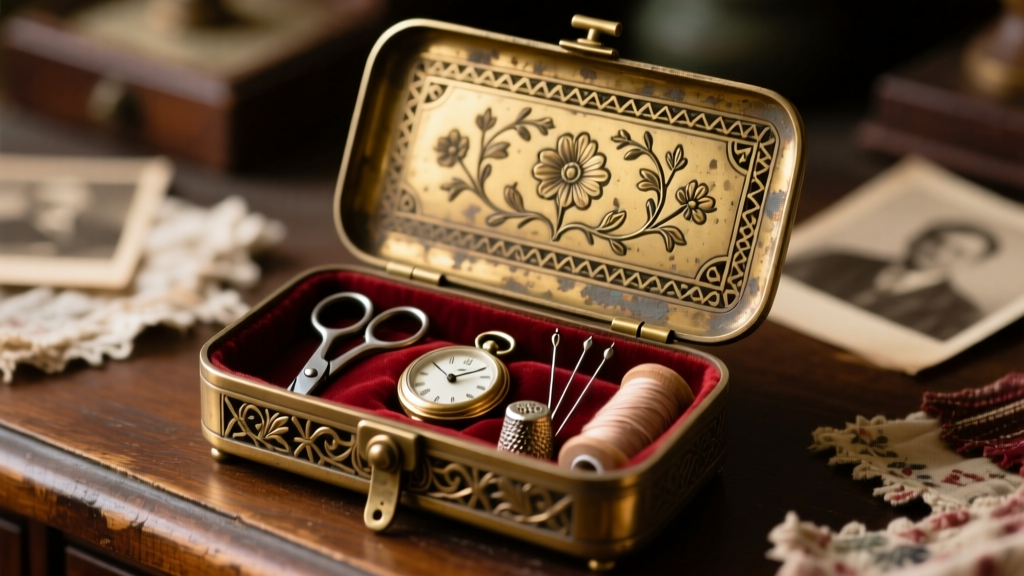
Shaker Carrier Sewing Accessories: A 20th-Century American Artifact Measuring 7 5/8 × 5 1/2 Inches
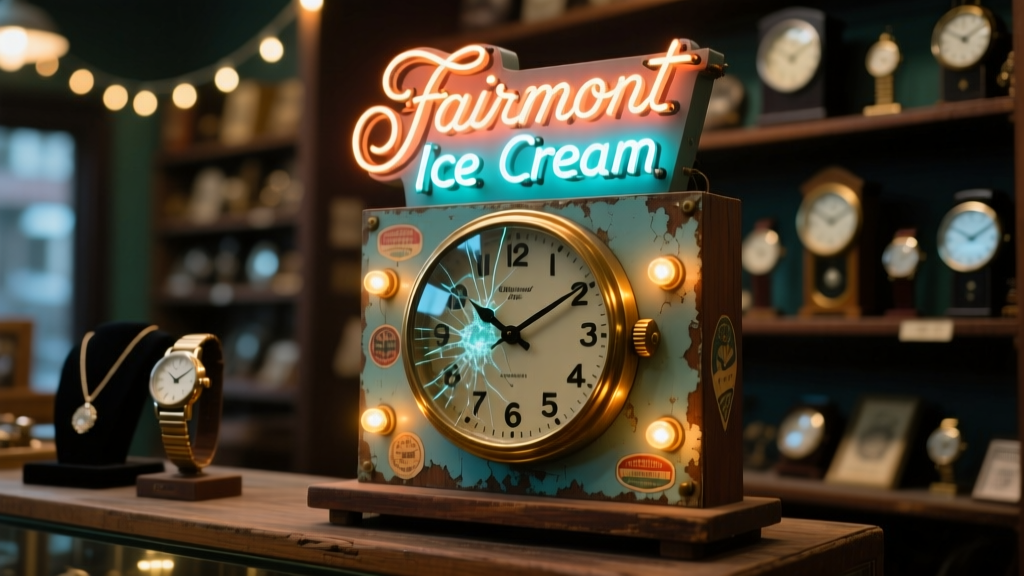
Fairmont Ice Cream Clocks: Advertising Timepieces, Neon Illumination, and Mid-Century Americana
Virginia-Made Slant-Front Walnut Desks: Colonial Craftsmanship, Provenance, and Auction Value
Chinese Export Blue-and-White Landscape Bowl: A 9¼-Inch Masterpiece from the Qianlong Era (c. 1736–1795)

The Hugh C. Robertson Dedham Vase: Glossy Green-Blue Drip with Beige Mottling — A 7½-Inch Masterpiece of American Art Pottery
Fiesta Ivory Calendar Plate, 1955: A Collector’s Guide to the Iconic 9-Inch Vintage Dinnerware Artifact

Top 5 Wedding Collectibles: Rare, Valuable, and Historically Significant Pieces for Discerning Collectors
The 1870 Walnut Shelf Clock with Dancing Children Panel: A Masterpiece of Victorian Automata and Horology

Tiffany Studios Bronze Tree Trunk Base Lamp with Bamboo Ribs: A Technical & Historical Appraisal of the 14½-Inch Model