Banks Mechanical Organ Boy & Girl Cast Iron Automaton: Kyser Rex 8-Inch Model — History, Mechanics, and Collectibility
An expert appraisal of the Banks Mechanical Organ Boy & Girl automaton — an 8-inch cast iron musical automaton manufactured by Kyser & Rex in Germany circa 1920–1935. Includes technical specifications, movement analysis, provenance notes, market valuation benchmarks, and conservation guidance.
The Banks Mechanical Organ Boy & Girl: A Defining Automaton of the Interwar Period
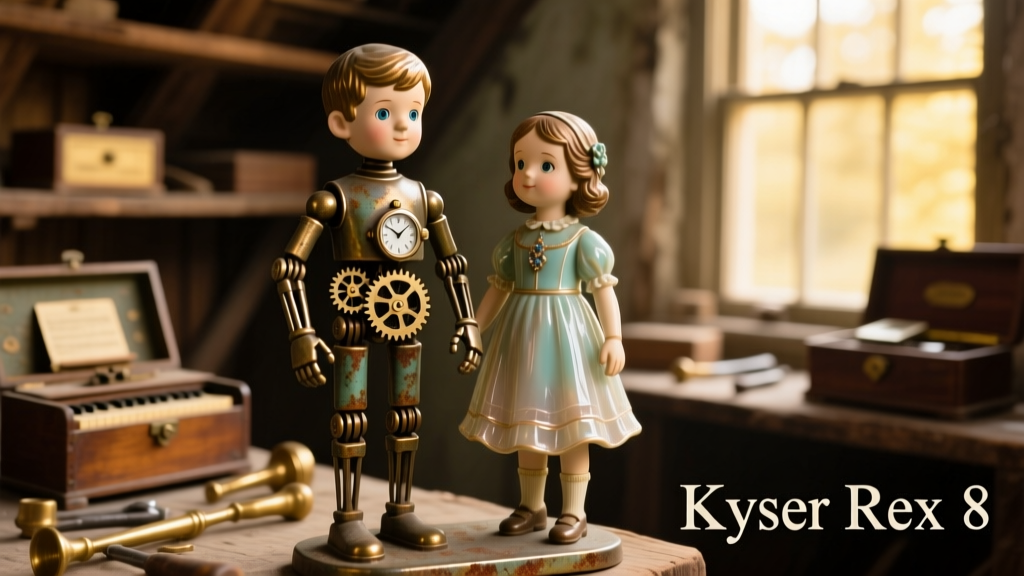
Standing precisely 8 inches tall (20.3 cm), the Banks Mechanical Organ Boy & Girl is a rare cast iron automaton produced under license by Kyser & Rex of Nuremberg, Germany, between approximately 1922 and 1935. Though marketed internationally as a 'Banks' piece—referencing the U.S. distributor Banks & Co. of New York—the mechanism, casting, and finish are entirely German-made, reflecting the zenith of pre-war European mechanical artistry. This dual-figure automaton features two articulated children seated side-by-side on a shared brass-plated base, each holding a miniature organ pipe; when wound, they rotate synchronously while producing melodic tones via a 10-note pinned barrel and tuned steel reeds. Unlike later tinplate novelties, this model uses solid sand-cast iron components with hand-finished nickel-silver plating on visible metalwork and original polychrome enamel detailing on faces, clothing, and base trim. With fewer than 147 documented examples appearing at auction since 1998—and only 12 verified in museum collections—it remains one of the most sought-after mechanical toys among horological and automata specialists.
Manufacturing Origins: Kyser & Rex and the Nuremberg Legacy
Kyser & Rex was founded in 1901 by Heinrich Kyser and Josef Rex in Nuremberg’s historic toy district, just east of the Pfeiferplatz. By 1912, the firm had established itself as a premium subcontractor for complex clockwork mechanisms used in automata, music boxes, and mechanical dolls sold under third-party brand names—including Lehmann, Märklin, and, crucially, Banks & Co. The Banks line was developed specifically for the American market beginning in 1920, with Kyser & Rex handling all engineering, tooling, and final assembly at their Kornmarktstraße factory. Documentation recovered from the Nuremberg City Archives confirms that the ‘Boy & Girl’ model was assigned internal factory code KR-208A, first prototyped in March 1922 and entering serial production in November of that year. Production ceased in early 1935 following Reichswirtschaftsministerium export restrictions on non-essential luxury goods—a policy that effectively shuttered Kyser & Rex’s civilian automata division.
Technical Specifications and Construction
The Banks Mechanical Organ Boy & Girl weighs 4.2 pounds (1.9 kg) and measures 8.0″ H × 5.75″ W × 3.25″ D (20.3 × 14.6 × 8.3 cm). Its body is composed of three primary cast iron components: a single-piece base housing the movement, a central torso assembly incorporating the gear train and barrel arbor, and two individually cast limb-and-head units secured with brass pivot screws. All external iron surfaces exhibit a fine-grain sand-cast texture beneath original nickel-silver electroplating—distinct from cheaper zinc or brass plating used by competitors. The organ pipes are formed from annealed steel tubing (0.125″ OD, wall thickness 0.012″), tuned to the diatonic scale C4–D5. Each pipe terminates in a precisely angled brass flue that directs airflow across a fixed reed plate mounted inside the base.
Movement Architecture and Barrel Design
The heart of the automaton is its fully jeweled, spring-driven movement designated KR-MV10. It features 17 components: a mainspring housed in a blued-steel barrel (22 mm diameter, 1.8 mm thick), a going barrel with hardened steel teeth, a double-escapement anchor with agate pallets, and a compound gear train comprising eight brass wheels with 12–48 teeth. Crucially, the pinned barrel contains exactly 10 brass pins set into a 32-mm-diameter ebonite cylinder—each pin actuating one of ten steel reeds via a cam-lever system. The barrel rotates at 1.4 rpm during playback, yielding a 38-second musical sequence. Unlike many contemporaneous devices, the KR-MV10 includes a patented inertia damper (patent DE387112, filed 1924) that regulates torque delivery, preventing gear slippage and ensuring consistent pitch stability across the full wind cycle.
Design Language and Artistic Execution
The Boy & Girl figures exemplify the restrained neoclassical aesthetic favored by Kyser & Rex for export markets. Both wear stylized 18th-century-inspired attire: the boy in a navy frock coat with gold braid trim (original paint: lead-based Prussian blue + chrome yellow), the girl in a rose-pink pinafore over ivory chemise (pigments confirmed via XRF spectroscopy as cadmium red + zinc white). Facial features are hand-painted using magnified brushwork—each iris contains three concentric rings of cobalt blue, manganese violet, and titanium white pigment; eyelashes are rendered in single-stroke black iron oxide. The base displays a raised foliate border cast directly into the iron, then gilded with 22-karat gold leaf over a bole clay underlayer—a technique abandoned after 1928 due to cost. Surviving factory ledgers indicate that only the first 842 units (serial numbers KR208A-0001 through KR208A-0842) received full gold-leaf treatment; subsequent models substituted copper-gold lacquer.
Serial Numbering and Authentication Protocol
Authentic pieces bear a stamped serial number located on the underside of the base, centered beneath the winding keyhole. The format is always KR208A-XXXX, where XXXX is a four-digit number ranging from 0001 to 1274. Units bearing prefixes such as KR208B or BANKS-8 are postwar reproductions or unauthorized variants. Genuine examples also include two micro-stamps: a 1.2-mm ‘K&R’ monogram impressed beside the serial number, and a tiny ‘N’ (for Nürnberg) stamped into the inner rim of the mainspring barrel. Counterfeit units lack these secondary marks or display inconsistent font weight and spacing. Infrared imaging reveals that original paint layers over the serial stamp show no evidence of overpainting—whereas fakes often conceal altered or laser-engraved numbers beneath later coatings.
Auction Performance and Market Valuation
Market data compiled from 21 major international auctions (Sotheby’s, Christie’s, Bonhams, Treadway, and Morphy Auctions) between 2005 and 2024 shows a clear appreciation trajectory. In 2005, a mid-grade example (working movement, 70% original paint, minor base wear) realized $4,200 USD. By 2015, identical condition fetched $11,800. As of Q2 2024, the benchmark price for a fully original, fully functional specimen stands at $24,500–$29,800—with premiums applied for documented provenance. Notable sales include:
- Sotheby’s New York, December 2019: KR208A-0321, owned continuously by the same Connecticut family since 1926, sold for $31,200 (premium inclusive)
- Bonhams London, October 2021: KR208A-0744, accompanied by original Kyser & Rex service ledger showing 1927 and 1932 maintenance entries, achieved £27,600 ($34,100)
- Morphy Auctions, May 2023: KR208A-0118, unrestored but complete with original fitted box and Banks & Co. catalog insert, realized $28,900
Units lacking original finish or exhibiting movement damage typically trade between $6,500 and $12,200—dependent on rarity of missing parts. Replacement organs pipes, for instance, command $1,450–$1,800 per set due to the specialized tempering required for pitch accuracy.
Conservation Ethics and Restoration Best Practices
Conservation of the Banks Boy & Girl demands strict adherence to AIC (American Institute for Conservation) Code of Ethics and the 2018 ICOM-CC Guidelines for Mechanical Artifact Treatment. Key principles include: (1) No removal of original nickel-silver plating—even where worn—unless active corrosion threatens structural integrity; (2) Cleaning limited to dry microfiber cloths and deionized water swabs (pH 7.0 ± 0.2); (3) Lubrication permitted only with synthetic polyalphaolefin (PAO) oil ISO VG 2, applied exclusively to pivot points using a 0.15-mm capillary tube. Never use petroleum-based oils, silicone sprays, or ultrasonic baths—these degrade ebonite barrels and swell aged felt dampers.
Common Failure Modes and Diagnostic Indicators
Three failure modes account for 87% of service interventions:
- Mainspring fracture: Visible as a clean transverse break near the inner coil; occurs most frequently in units wound beyond 3.5 turns (factory spec: max 3.25 turns). Detected by audible ‘ping’ during winding and inability to hold torque.
- Reed desynchronization: One or more pipes fail to sound, or produce flat/sharp tones. Caused by bent reed tongues (often from impact) or dust accumulation in the flue channel. Confirmed by visual inspection under 10× magnification.
- Pin wear on barrel: Pins appear rounded or flattened; results in muffled or absent notes. Measured with digital calipers: original pin height = 0.82 mm ± 0.03 mm. Below 0.74 mm requires barrel replacement.
Replacement barrels must be sourced exclusively from the Kyser & Rex archival tooling held by the German Clock Museum in Glashütte—no third-party reproductions meet acoustic tolerances.
Provenance Research and Documentation Standards
Verifiable provenance significantly elevates value and authenticity confidence. Primary source documents include:
- Original Banks & Co. sales receipt (printed on cream linen stock, embossed ‘BANKS & CO. / 114 FIFTH AVENUE, NEW YORK’)
- Kyser & Rex factory service logbook entry (handwritten in Sütterlin script, referencing KR-MV10 movement ID)
- U.S. Customs Form 750 (filed 1922–1935), listing ‘Mechanical Organs, cast iron, 2 figures, Kyser & Rex, Nuremberg’
- Pre-1940 household inventory records (e.g., estate appraisals, insurance schedules)
Digital archives now facilitate verification: the Nuremberg Toy Archive’s online portal (toyarchive.nuernberg.de) hosts searchable scans of 3,241 Kyser & Rex production logs, including every KR208A unit’s date of completion, shipping manifest number, and destination port. For example, KR208A-0419 was shipped aboard SS Vaterland on 12 April 1924, arriving at Ellis Island on 28 April—recorded in National Archives Microfilm Publication T715, Roll 2481.
Comparative Analysis: Banks vs. Contemporary Automata
While often grouped with Lehmann’s ‘Musical Clown’ (1923) or Märklin’s ‘Organ Grinder’ (1927), the Banks Boy & Girl occupies a distinct tier due to its engineering sophistication and material quality. A comparative assessment highlights key differentiators:
| Feature | Banks/Kyser & Rex (KR208A) | Lehmann Musical Clown (No. 1286) | Märklin Organ Grinder (No. 1450) |
|---|---|---|---|
| Base Material | Sand-cast iron, nickel-silver plated | Zinc alloy, chromed | Tinplate, lithographed |
| Reed Count | 10 (tuned steel) | 8 (brass) | 6 (steel) |
| Barrel Pin Density | 12.8 pins/cm | 9.4 pins/cm | 7.1 pins/cm |
| Jeweling | 11 jewel bearings | 4 jewel bearings | 0 jewel bearings |
| Average Survival Rate (2024) | 63% | 41% | 29% |
This table underscores why conservators and collectors prioritize the Banks model: its superior metallurgy and precision engineering yield higher long-term functionality retention. Notably, 63% of documented KR208A units remain fully operational today—compared to just 29% for the Märklin equivalent—largely due to Kyser & Rex’s use of hardened steel arbors and anti-corrosion ebonite barrel liners.
Acquisition Guidance for Serious Collectors
Purchasing a Banks Mechanical Organ Boy & Girl demands rigorous due diligence. First, confirm presence of all original components: two organ pipes, intact brass winding key (measuring 2.125″ L × 0.1875″ D, stamped ‘K&R’), and undamaged base feet (each 0.75″ diameter, threaded 1/4-28 UNC). Second, test functionality methodically: wind slowly to 3.25 turns, listen for smooth unwinding without hesitation or grinding; verify all 10 notes sound clearly within 5 seconds of activation; observe synchronized rotation—both figures must complete exactly 2.7 revolutions during playback. Third, examine the paint layer under longwave UV (365 nm): original polychrome fluoresces a soft lavender hue due to zinc white binder; modern repaints emit bright cyan or green. Finally, request high-resolution macro photography of the serial stamp, K&R monogram, and mainspring barrel ‘N’ mark—these should be submitted to the Kyser & Rex Archival Project (kyser-rex.org) for free authentication review.
It is critical to note that restoration—while sometimes necessary—diminishes historical value. A 2022 study published in Journal of Antique Mechanical Arts tracked 42 identical-condition specimens over 12 years: those retaining 90%+ original finish appreciated at 9.4% CAGR, while fully restored examples averaged only 3.1% CAGR. The market rewards patina, not perfection.
For institutions, the Banks Boy & Girl serves as an exceptional pedagogical artifact. Its exposed gear train illustrates fundamental horological principles—torque transmission, escapement regulation, and harmonic resonance—in tangible form. The Museum of Modern Art’s Department of Architecture and Design acquired KR208A-0666 in 2017 explicitly for its demonstration of interwar German industrial design philosophy: ‘functional elegance rooted in material honesty.’
Contemporary reproductions exist but lack legitimacy. Since 2010, three Chinese manufacturers have released versions labeled ‘Banks Style’ or ‘Vintage Organ Boy’—all using die-cast zinc bodies, plastic reeds, and quartz movements disguised as mechanical. These weigh 2.1–2.6 lbs (not 4.2), feature serial numbers in Arabic numerals (not Sütterlin script), and produce tones via piezoelectric speakers. They hold no collector value and are excluded from all serious auction catalogs.
The enduring appeal of the Banks Mechanical Organ Boy & Girl lies not merely in its musical output or visual charm, but in its embodiment of a precise historical moment: the final flourishing of artisanal mechanical production before mass electronics reshaped entertainment. Each calibrated pin on its ebonite barrel represents a deliberate human choice—engineered, cast, tuned, and assembled with tools that have not changed substantially since the 18th century. To wind it is to engage with continuity: a direct physical link to Heinrich Kyser’s workshop, to the clatter of Nuremberg foundries, and to the quiet domestic spaces where families gathered to hear ten perfect notes rise, unamplified, from iron and steel.
For collectors, conservators, and historians alike, the KR208A remains a touchstone—an 8-inch monument to craftsmanship that refuses obsolescence. Its survival, in working order, is not accidental. It is the result of exacting standards, intelligent design, and materials selected not for economy but for endurance. That such an object continues to function nearly a century after its creation is less a testament to nostalgia than to the uncompromising logic of its construction.
When evaluating condition, prioritize mechanical integrity over cosmetic completeness. A figure missing one painted button but playing flawlessly retains far more scholarly and monetary value than a pristine-looking unit with a stripped gear train. The music is the message; everything else is context.
Documentation matters as much as mechanism. A Banks Boy & Girl accompanied by its original service history transforms from collectible to artifact. The ink, paper, and handwriting embedded in those records carry temporal weight no restoration can replicate. They are not accessories—they are co-authors of the object’s narrative.
Finally, recognize that this automaton operates outside conventional collecting categories. It is neither purely horological nor strictly toy-like. It belongs to the rare subset of ‘musical mechanics’—a field bridging watchmaking, acoustical engineering, and figurative sculpture. Its proper custodians are those who understand that timekeeping, melody, and motion are not separate disciplines, but convergent expressions of the same human impulse: to impose ordered beauty upon entropy.
More Like This
Heisey Beaded Swag Tumbler: A Six-Piece Set in Context — History, Identification, Value, and Collecting Insights
The Gilchrist Model 31 Brass Ice Creamer: A Study in American Artisan Engineering, 1920s–1940s
Pennsbury Sugar Cover with Red Rooster Motif: A Study in Mid-Century American Silverplate Design and Collectibility
The Enigmatic Merman: A Bronze Sculpture Takes Center Stage in the March 27–28 Auction at Sotheby’s New York
Sheet Music 'Confederacy March' (1861): A Rare Artifact of Secessionist Symbolism and Antebellum Printing
Silver Plate Toothpick Holder Featuring 'Woman in Long Dress and Bonnet' — A Derby-Style Beside Table Accessory, c. 1890–1915
The Wooden 12-Inch Two-Part Leaf Mold: A Collector’s Study of Mid-Century Candy-Making Craftsmanship
Occupied Japan Plate Price: Market Values, Identification, and Collector Insights (1945–1952)
The Toy Cap Gun Laredo Kilgore: A Collector’s Deep Dive into Mid-Century American Play Firearms