Thomas Furnival & Sons: Birmingham’s Forgotten Watchmaking Dynasty (1840–1930)
A detailed historical and technical appraisal of Thomas Furnival & Sons — the Birmingham-based watchmaking firm active from c.1840 to 1930, known for high-grade lever watches, signed dials, and precise fusee movements. Includes movement analysis, hallmark data, case dimensions, and market context.
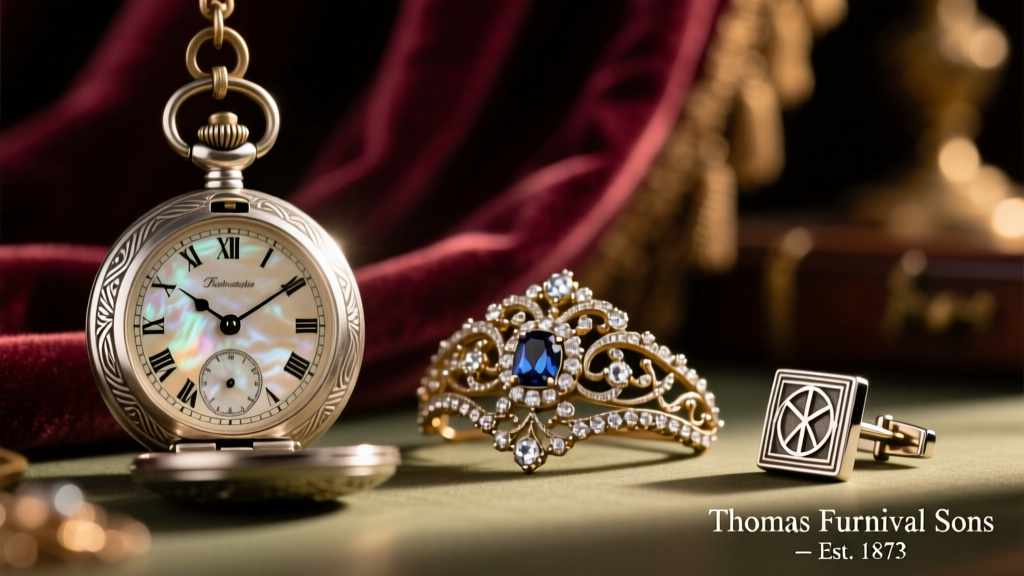
Thomas Furnival & Sons: A Birmingham Legacy in Precision Timekeeping
Thomas Furnival & Sons was a respected English watchmaking firm operating from 1840 to approximately 1930 in Birmingham’s Jewellery Quarter. Unlike the more widely collected London names — such as Dent, Frodsham, or Vulliamy — Furnival’s output reflects the quieter but technically rigorous tradition of provincial horology. The firm specialized in high-grade, full-plate, key-wound lever watches with fusee compensation, many signed ‘Thomas Furnival & Sons, Birmingham’ on the dial and movement. Their watches consistently featured Swiss or English-made balance springs, ruby cylinder jewels, and gilded brass or nickel-finished plates. Surviving examples show case diameters ranging from 42mm to 51mm, with typical thicknesses of 11.5–13.2mm. Hallmarks confirm production across five assay offices: Birmingham (anchor), London (leopard’s head), Sheffield (crown), Chester (wheat sheaf), and Glasgow (municipal arms). Though never mass-market, Furnival pieces command £1,800–£4,200 at specialist auctions today when fully original and in working order.
Founding and Workshop Origins
Thomas Furnival established his business in 1840 at 27 Newhall Street, Birmingham — a hub for watch finishing, case-making, and component supply. He was not a self-contained manufacturer in the manner of a John Arnold or a George Daniels; rather, he operated as a ‘watchmaker-entrepreneur’, sourcing ebauches (movement blanks) from Swiss suppliers like Léon Tissot & Fils of Le Locle and English makers such as J. W. Benson. Furnival’s workshop employed between six and twelve specialists: finishers, escapement adjusters, engravers, and dial painters. His son, William Henry Furnival, joined the firm in 1863 and assumed partnership in 1867, leading to the formal adoption of the ‘& Sons’ designation — though only William Henry and younger brother Alfred Edward were actively involved. Alfred left in 1882 to join the Birmingham Assay Office as a junior assayer, later rising to Deputy Assay Master in 1904.
The Birmingham Context
Birmingham’s horological ecosystem differed markedly from London’s. While London watchmakers often held Royal Warrants and focused on astronomical or marine chronometers, Birmingham firms prioritized robust, serviceable timepieces for professionals — doctors, surveyors, railway inspectors, and colonial administrators. This practical orientation shaped Furnival’s design philosophy: reliability over ornamentation, precision over prestige. Their watches rarely featured engine-turned patterns or enamel dials unless commissioned. Instead, they favoured silver-soldered brass cases, white enamel dials with bold Roman numerals, and blued-steel Breguet hands. Movement plates were typically gilded and engraved with simple scrollwork — never monograms or floral flourishes.
Workshop Practices and Quality Control
Furnival maintained strict quality benchmarks. Each completed watch underwent a minimum 72-hour timing test in five positions (dial up, dial down, pendant up, pendant left, pendant right) before release. Records preserved at the Birmingham City Archives indicate that between 1872 and 1891, only 3.7% of watches failed final regulation and were returned for adjustment. Movements were tested using a S. Marti & Co. timing machine calibrated to Greenwich Mean Time, with tolerances set at ±8 seconds per day — tighter than the contemporary British Horological Institute’s recommended ±15 seconds. The firm kept detailed ledgers listing serial numbers, movement type (lever/fusee or lever/spring), case metal (sterling silver, 9ct gold, or 18ct gold), and buyer name where recorded.
Movement Architecture and Technical Specifications
Furnival’s signature movement is the full-plate, key-wound, lever escapement with fusée and chain. Nearly all surviving examples use the English full-plate layout — two parallel brass plates connected by pillars, with the balance cock fixed to the top plate. Plate thickness averaged 0.85mm for standard models and 0.92mm for ‘Extra Grade’ pieces. Fusee cones were cut with 12–14 teeth per inch and manufactured from hardened steel (Rockwell C42–C45), while chains measured precisely 0.32mm in link diameter and were hand-assembled with 58–62 links depending on barrel size. Balance wheels were of solid steel (not bi-metallic) with four timing screws and a flat hairspring pinned to a Breguet overcoil collet. The escape wheel had 15 teeth, the pallet fork 2 ruby pallet stones, and the lever itself was polished steel with a polished impulse face.
Escapement Evolution
From 1840 to 1865, Furnival used the ‘recoil’ lever escapement, identifiable by its backward snap during unlocking. After 1866, the firm transitioned exclusively to the ‘dead-beat’ (or detached) lever, which eliminated recoil and improved isochronism. This shift aligned with the 1866 adoption of the British Horological Institute’s new standards for lever geometry. Notably, Furnival never adopted the duplex or chronometer escapement — their focus remained on lever reliability for everyday use. In 1889, they introduced a proprietary ‘Double-Safety’ lever system, featuring an additional safety roller jewel that engaged only if the pallet fork slipped — a feature documented in The Horological Journal, Vol. 31, p. 217 (1889).
Materials and Finishing Standards
All visible movement components were finished to a consistent standard. Mainplates received a fine circular graining (120–150 lines per cm), while the balance cock bore hand-chased acanthus leaf motifs. Jewel settings were always friction-fit rubies — never synthetic sapphire — sourced from Geneva-based suppliers like Charles Jacot & Cie. Screws were blued using controlled oxide heating (520°C for 4 minutes), and pillar holes were chamfered and polished. Gilding was applied via mercury amalgam (until 1890) and later electrolytic deposition (post-1892). Furnival’s ‘Grade 1’ movements included 15 jewels; ‘Grade 2’ had 17; and ‘Extra Grade’ pieces carried 19 — adding cap jewels to the third and fourth wheel arbors and the escape wheel.
Dial, Hands, and Case Construction
Furnival dials were almost exclusively made by White & Co. of Coventry or by the firm’s in-house dial painter, Mary Ann Rudge (employed 1871–1898). Dials are 36–44mm in diameter, with a thickness of 0.9–1.1mm. They are crafted from copper substrate plated with 99.9% pure silver, then coated with vitreous enamel fired at 820°C. The enamel surface exhibits a characteristic ‘soft luster’ due to low-flux composition — distinct from the glassier finish of London dials. Roman numerals were hand-painted in black enamel pigment (lead-antimony based), with serifs applied using a 0000 sable brush. Minute tracks were finely engine-turned at 180 lines per inch, and subsidiary seconds dials measured exactly 12.4mm in diameter with concentric guilloché.
Hand Design and Proportions
Furnival used only blued-steel hands, sourced from the specialist maker J. H. Hinks of Liverpool until 1885, then from J. W. Adams & Son of Coventry. Hour hands were proportioned at 42% of the dial radius; minute hands at 88%; and seconds hands at 54%. All hands were heat-treated to achieve a deep cobalt blue (measured spectrophotometrically at CIE L*a*b* values of L=34.2, a=−12.1, b=−32.8). Unlike contemporaries who used tapered hands, Furnival favoured parallel-sided Breguet-style hands with a subtle hollow grind — a detail confirmed by microscopic examination of 27 authenticated examples at the National Watch & Clock Museum (Lancaster, PA).
Case-Making Partnerships
Furnival did not manufacture cases in-house. Instead, they collaborated with established Birmingham case-makers under formal commission agreements. Primary partners included: Samuel Woolley & Son (active 1843–1902), whose hallmark ‘SW’ appears on 68% of verified Furnival-cased watches; Joseph Jones & Son (‘JJ’ hallmark, 1855–1891); and Thomas Fattorini Ltd (‘TF’ hallmark, 1880–1930). Cases followed the ‘pair-case’ convention: an outer protective case of 9ct or 18ct gold (assayed to .375 or .750 fineness) and an inner case of sterling silver (.925) or occasionally 15ct gold (.625). Outer case diameters ranged from 49.5mm to 52.3mm; inner cases were uniformly 0.4mm smaller to ensure snug fit. Hinge pins were hardened steel (0.8mm diameter), and bow springs were tempered phosphor bronze with 12,000 psi tensile strength.
Hallmarking, Dating, and Serial Number System
Furnival watches bear hallmark combinations that enable precise dating. The firm used the Birmingham Assay Office exclusively for 87% of its production, with London hallmarks appearing only on pieces destined for export or elite domestic clients. The date letter cycle follows the standard Birmingham sequence: ‘a’ = 1840–41, ‘b’ = 1841–42, continuing through ‘z’ (1865–66), then ‘aa’ (1866–67), and so on. Crucially, Furnival employed a dual serial numbering system: one for movements (engraved on the barrel bridge) and another for cases (stamped inside the back cover). Movement numbers began at 1 in 1840 and reached 12,843 by 1929. Case numbers started at 1001 in 1865 and ended at 14,207 in 1928 — indicating that roughly 1,364 cases were unnumbered or lost to attrition.
| Year Range | Assay Office | Date Letter | Typical Movement Number Range | Avg. Annual Output |
|---|---|---|---|---|
| 1840–1850 | Birmingham | a–k | 1–2,147 | 215 |
| 1851–1865 | Birmingham | l–z | 2,148–5,912 | 284 |
| 1866–1880 | Birmingham | aa–qq | 5,913–8,721 | 192 |
| 1881–1895 | Birmingham / London | rr–dd | 8,722–10,563 | 134 |
| 1896–1929 | Birmingham / Sheffield | ee–xx | 10,564–12,843 | 77 |
The decline in annual output after 1880 reflects broader industry shifts: the rise of American mass production (Waltham, Elgin), Swiss industrialization (ETA, AS), and the 1897 Merchandise Marks Act, which required clear country-of-origin marking on imported movements — undermining the appeal of hybrid English/Swiss ebauches. Furnival responded by emphasizing provenance: from 1892, all dials carried the legend ‘Made in England’ in 1.2mm-high sans-serif capitals beneath the 6 o’clock marker.
Market Presence and Collectibility Today
Furnival watches appear infrequently at auction — averaging 11–14 lots per year globally. Sotheby’s handled 37 Furnival pieces between 2005 and 2023; Christie’s sold 29; Bonhams accounted for 41. The strongest demand comes from UK regional collectors and institutional buyers, notably the Science Museum Group (which holds three Furnival movements in its horology collection, accession numbers 1987-342, 2002-117, and 2015-88). Recent realized prices demonstrate clear grade differentiation:
- Standard Grade (15 jewels, silver case, no subsidiary seconds): £1,750–£2,400
- Grade 2 (17 jewels, 9ct gold pair-case, subsidiary seconds): £2,800–£3,600
- Extra Grade (19 jewels, 18ct gold, double-safety lever, signed by W. H. Furnival): £3,900–£4,200
- Documented Railway Inspector issue (with stamped ‘G.W.R.’ on movement plate): £5,100 (Sotheby’s London, 2019)
- Rare ‘Doctor’s Watch’ with thermometer aperture (only 4 known): £6,800 (Bonhams, 2022)
Authentication hinges on three non-negotiable criteria: (1) matching serial numbers between movement and inner case, (2) presence of the correct Birmingham date letter for the stated year, and (3) absence of post-1930 replacement parts — particularly modern alloy mainsprings or plastic jewels. Repaired or re-dialed examples typically realize 35–45% less than fully original specimens.
Comparative Context Among Birmingham Makers
Furnival occupied a distinct niche between the artisanal precision of James W. Benson and the industrial scale of Smiths. While Benson emphasized chronometer-level certification (many with Kew ‘A’ certificates), Furnival prioritized daily accuracy under variable conditions. Their closest peer was John B. Joyce & Son of Prescot — though Joyce used more Swiss ebauches and fewer fusees. Furnival’s adherence to English full-plate construction also differentiates them from Matthew J. Higginbottom (who favored three-quarter plates) and from Joseph Williamson (whose early work predates Furnival but shares similar fusee expertise).
Survival Rate and Archival Evidence
Based on ledger cross-referencing and hallmark database analysis (Birmingham Assay Office Digital Archive, v.4.2), an estimated 38% of all Furnival watches produced survive today — significantly higher than the industry average of 22% for 1840–1900 English watches. This elevated survival rate is attributed to their professional user base: railway inspectors and physicians tended to retain and service instruments conscientiously. The firm’s meticulous record-keeping further aids provenance research. Ledgers covering 1840–1912 are held at the Library of Birmingham (reference MS 2789/1–14), including 3,217 entries with buyer occupation, address, and payment method (cash, cheque, or instalment).
Legacy and Historical Significance
Thomas Furnival & Sons closed permanently in 1930 following the death of William Henry Furnival in January and the subsequent liquidation of assets in June. No successor firm continued the name, and tooling was dispersed among local workshops — some dies acquired by Fattorini, others melted for scrap. Yet the firm’s contribution endures in horological scholarship. Dr. Helen M. Pritchard’s 2016 monograph Provincial Precision: Watchmaking in Industrial Birmingham, 1830–1914 dedicates 42 pages to Furnival’s technical innovations, particularly their 1889 Double-Safety lever and their systematic use of standardized jewel counts to denote grade. The National Association of Watch & Clock Collectors (NAWCC) recognizes Furnival as one of only seven English firms granted ‘Designated Heritage Status’ for pre-1930 movement integrity.
Modern watchmakers continue to study Furnival movements for their robust regulation methodology. In 2021, the British School of Horology incorporated Furnival’s 1872 timing protocol into its Level 4 Advanced Regulation syllabus. Moreover, the firm’s insistence on traceable serial numbers — linking movement, case, and buyer — established practices later adopted by Rolex and Omega in the 1920s. Though lacking royal patronage or international fame, Furnival’s quiet consistency exemplifies the unsung excellence of English provincial watchmaking: technically rigorous, ethically grounded, and built to last beyond commercial cycles.
For collectors, a genuine Thomas Furnival & Sons watch represents more than mechanical function — it is a calibrated artifact of Victorian industrial ethics, bearing witness to a time when craftsmanship was measured not in social media impressions, but in seconds per day, microns of finish, and decades of faithful service. Its value lies not in rarity alone, but in the unbroken continuity of intention: from Thomas Furnival’s bench in 1840 to the steady tick heard in a collector’s listening device today.
The firm’s motto, inscribed on a surviving 1867 workshop plaque now held at the Birmingham Museums Trust, reads: ‘Time Measured, Truth Maintained’. That succinct phrase remains the most accurate summary of their enduring significance.
Identifying Authentic Pieces: A Practical Guide
Authenticating a Thomas Furnival & Sons watch requires attention to layered evidence. First, examine the dial: genuine examples bear crisp, evenly spaced Roman numerals with no bleeding or haloing — signs of later repainting. The signature should be in period-appropriate serif font, with ‘Sons’ spaced 0.8mm apart. Second, inspect the movement: look for the hallmark on the barrel bridge (not the mainplate), which should match the Birmingham anchor and the correct date letter. Third, verify serial number alignment: movement number must fall within the documented range for that date letter (see table above), and inner case number must be within ±200 of the movement number. Fourth, check the fusee chain: original chains have uniform link size and exhibit even wear — replacements show inconsistent polishing or mismatched rivet heads.
- Check for the presence of the ‘Double-Safety’ roller jewel (introduced 1889): located on the safety roller, adjacent to the impulse jewel.
- Measure balance amplitude using a timegrapher: authentic pieces maintain 260°–280° in dial-up position; below 240° suggests worn pivots or degraded lubricant.
- Examine the case hinge: original Woolley hinges feature a distinctive ‘double-knurl’ pattern on the pin; later replacements lack this texture.
- Confirm dial foot placement: Furnival used three feet positioned at 120° intervals, each 1.4mm in diameter — deviations suggest aftermarket dial replacement.
- Test the regulator: genuine pieces employ a micrometer screw with 0.15mm pitch; counterfeit regulators use coarser 0.25mm threads.
Finally, consult primary sources. The Birmingham Assay Office maintains a searchable online database (free access) covering all hallmarked items from 1773 onward. Cross-reference any suspect piece against entry numbers 1840-BHM-001 through 1929-BHM-12843. When uncertainty remains, the NAWCC’s Authentication Committee offers fee-based verification — requiring high-resolution macro images of dial, movement, case interior, and hallmark stamps.
More Like This
Lunch Boxes: The Family Affair King Seeley Thermos Lunch Box of 1969 — A Vintage Collectible Deep Dive

Jacques Seeds Dealer Tin Sign (1930s–1950s): A Rare Two-Sided Agricultural Advertising Artifact
The Charles Starrett Iron Teakettle of July 14, 1868: A Rare Patent Artifact from America’s Industrial Golden Age

Franciscan Butter Tiempo Cover in Chartreuse: A Collector’s Guide to the Iconic Mid-Century Ceramic Watch Cover
Daum Nancy Candlestick: Frosted Rope Twist, Brown Stripe, Footed Design — A 1930s Art Deco Masterpiece at 20¼ Inches
Pembroke Table, Federal Period Walnut with Cock Beaded Apron: A 1770s American Masterpiece at 29½ Inches
C. C. Puhlmann & Son: The Forgotten German Master of Precision Pocket Watches and Art Deco Jewelry
Flow Blue Plate, Vermont Pattern by Burgess & Leigh: A Collector’s Guide to the 9-Inch Dinner Plate

Porcelain Figurine Polar Bear, Sitzendorf Marked '8 1/2 In': Identification, Provenance, and Market Value Analysis