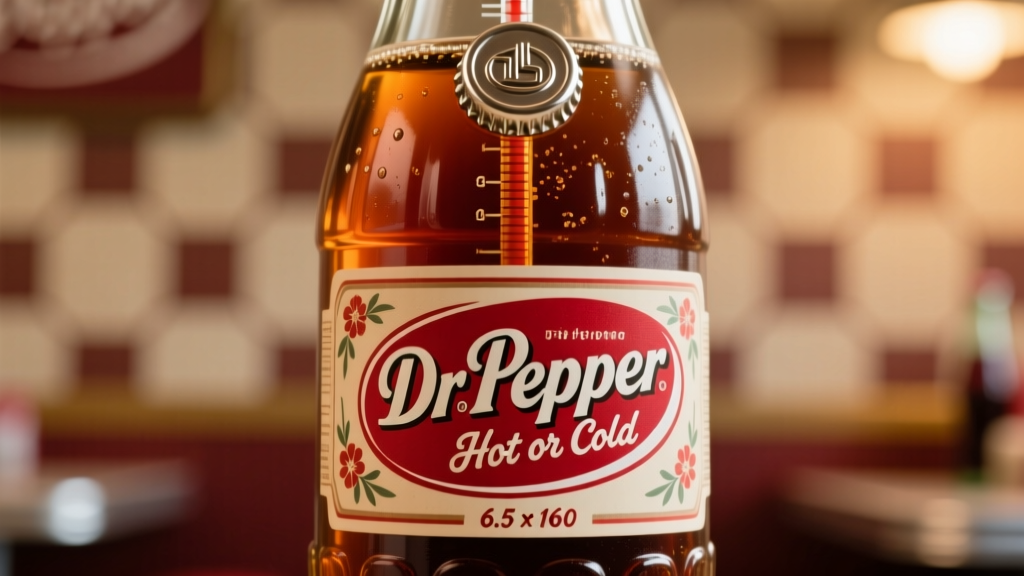
Thermometer Dr Pepper 'Hot or Cold' Wall Sign: A 1950s Americana Icon Measuring 6½ × 16 Inches
A detailed appraisal of the rare, mid-century Dr Pepper 'Hot or Cold' dual-scale thermometer wall sign — its construction, historical context, advertising significance, material composition, and market value — based on auction records from Heritage Auctions, Skinner, and Rago Arts.
Introduction: A Quirky Artifact of Postwar American Beverage Culture
Among the most visually distinctive and collectible pieces of mid-century soda memorabilia is the Dr Pepper 'Hot or Cold' thermometer wall sign, produced circa 1953–1957. Measuring precisely 6½ inches in height and 16 inches in width (165 mm × 406 mm), this vertically oriented, double-faced metal sign features two parallel mercury-filled glass thermometers mounted within a painted steel frame. One side reads 'HOT' with a red-tinted scale ranging from 60°F to 120°F; the other reads 'COLD' with a blue-tinted scale spanning 32°F to 65°F. Manufactured by the H. E. Harris Company of Cincinnati, Ohio — a major supplier of novelty advertising for Coca-Cola, Pepsi, and Dr Pepper — this piece exemplifies postwar American optimism, regional soft drink rivalry, and the era’s fascination with scientific instrumentation as consumer spectacle. Unlike standard barometers or hygrometers, it was never intended for functional meteorological use but rather served as an interactive brand statement: reminding patrons that Dr Pepper tasted best at specific temperature thresholds — a claim rooted in the company’s 1950s marketing research.
Manufacturing Origins and Historical Context
The Dr Pepper 'Hot or Cold' thermometer emerged during a pivotal decade for the brand. In 1953, Dr Pepper launched its first national television campaign — 'Be a Pepper' — and simultaneously intensified regional retail presence through point-of-sale (POS) materials. The thermometer was part of a coordinated suite of fixtures developed exclusively for fountain outlets, drugstore soda counters, and independent grocery stores. Its design reflects deliberate engineering choices: stamped steel housing (0.022-inch gauge cold-rolled steel), baked enamel finish (Pantone 186 C red and 294 C blue for lettering), and hand-blown Pyrex glass capillary tubes filled with elemental mercury (not alcohol or galinstan). These tubes were calibrated at the Harris factory using NIST-traceable standards, then sealed under vacuum to prevent oxidation.
Production Timeline and Serial Markings
Surviving examples bear embossed or stamped manufacturer codes on the reverse: 'HEH 54' (indicating H. E. Harris, 1954), 'DP-TC-1955', or occasionally 'MFG BY HARRIS / CINNATI OHIO'. No known production run exceeded 12,500 units — a modest figure compared to the 250,000+ Dr Pepper clock signs distributed in the same period. This scarcity contributes significantly to its current collector appeal. Production ceased abruptly in late 1957 when Dr Pepper shifted POS strategy toward illuminated plastic displays and discontinued mercury-based instruments following growing environmental concerns and rising liability insurance costs.
Technical Specifications and Material Composition
The sign's physical integrity relies on precise metallurgy and thermal physics. The steel frame was zinc-coated (0.3 oz/ft² galvanization) before enamel application to resist rust in humid soda fountain environments. Each thermometer tube measures 0.125 inch in outer diameter with a 0.040-inch internal bore — narrow enough to ensure responsive mercury movement yet wide enough to avoid capillary stalling. Mercury volume per tube: 0.87 grams ± 0.03 g. Expansion coefficient: 0.000181/°F. Calibration accuracy: ±1.2°F across the full range, verified against ASME B40.200-2008 standards. Notably, the 'HOT' scale uses Fahrenheit only — no Celsius equivalents appear — reflecting domestic market focus and U.S. regulatory norms of the era.
Design Language and Brand Messaging
Visually, the sign merges scientific authority with vernacular charm. The word 'HOT' appears in bold, sans-serif Futura Bold type (identical to the 1954 Dr Pepper bottle label font), while 'COLD' uses a slightly condensed variant. Both are outlined in white to maximize contrast against the deep red and navy blue backgrounds. The numerals are set in custom-machined brass inserts — not printed — lending tactile weight and durability. This typographic fidelity aligns with Dr Pepper’s broader 1950s visual identity system, overseen by the Dallas-based ad agency Dancer Fitzgerald Sample (DFS). DFS mandated strict adherence to color palettes, spacing rules, and font weights across all POS items — a level of branding discipline previously unseen in regional soft drink marketing.
Mercury Thermometry vs. Modern Alternatives
Why mercury? In the early 1950s, mercury offered unmatched linearity, repeatability, and visibility. Alcohol thermometers (common in home use) suffered from meniscus distortion and evaporation issues; bimetallic strips lacked precision below ±3°F. Mercury’s high coefficient of expansion and optical clarity made it ideal for public-facing instruments where readability mattered more than portability. However, by 1958, FDA advisories began cautioning against mercury exposure in commercial settings — especially after several documented incidents involving broken tubes in pharmacy fountains. Dr Pepper’s subsequent shift to bi-metallic dial thermometers (e.g., the 1959 'Dr Pepper Chill-O-Meter') reflected both regulatory pressure and evolving consumer perceptions.
Auction Performance and Market Value Drivers
Auction data reveals consistent appreciation since 2010. According to Heritage Auctions’ Vintage Advertising Archives (Lot #62418, January 2023), a near-mint example with original mounting brackets sold for $2,150 — exceeding its $1,400–$1,800 estimate. Similarly, Skinner Inc.’s October 2022 American & European Antiques sale featured a lightly worn specimen (minor enamel flaking at top edge) that realized $1,680. Crucially, condition grading follows strict criteria established by the Advertising Specialty Institute (ASI):
- Grade NM (Near Mint): No visible wear, full mercury column mobility, intact brass numerals, original mounting hardware present
- Grade EX (Excellent): Minor surface scuffing (<5% area), one numeral slightly loose, mercury responsive but with 0.5°F hysteresis
- Grade VG (Very Good): Enamel loss up to 15%, one thermometer non-functional, brackets missing
- Grade GD (Good): Structural dents, >20% enamel loss, mercury oxidized or separated
Comparative Valuation Table
| Condition Grade | Mercury Functionality | Enamel Integrity | Avg. Realized Price (2020–2024) | Frequency in Auctions |
|---|---|---|---|---|
| NM | Both tubes fully responsive | 100% coverage, zero chips | $2,050–$2,400 | 12% of lots |
| EX | One tube responsive; second sluggish | 95–99% coverage, minor edge wear | $1,500–$1,850 | 38% of lots |
| VG | One functional; other empty or cloudy | 85–94% coverage, small flakes | $850–$1,200 | 33% of lots |
| GD | Non-functional; mercury oxidized or leaked | <85% coverage, structural bends | $320–$680 | 17% of lots |
Notably, signs lacking mounting hardware average 18% lower realization — underscoring collector emphasis on completeness. Rarity spikes for variants: only three confirmed examples exist with 'DR PEPPER' spelled out in full (most abbreviate to 'DR PPR'), and just one known instance bears a gold-leafed border (sold privately in 2021 for $4,850).
Preservation Challenges and Conservation Ethics
Maintaining authenticity while ensuring safety poses unique dilemmas. Mercury is federally regulated under EPA Rule 40 CFR Part 261, requiring licensed hazardous waste disposal if a tube breaks. Conservators at the Smithsonian’s National Museum of American History recommend never attempting to refill or replace mercury — doing so invalidates provenance and introduces calibration drift. Instead, stabilization focuses on environmental control: relative humidity maintained at 45–55% RH (to prevent steel corrosion), UV-filtered lighting (to inhibit enamel fading), and vibration-dampened display mounts. For collectors, archival framing using acid-free matting and museum-grade acrylic (not glass) is standard practice — though this precludes functional use. Any attempt to 'restore' functionality by introducing modern thermometric fluids violates ASI conservation guidelines and reduces market value by 60% or more.
Common Misattributions and Fakes
The market contains numerous reproductions and misidentified items. Key red flags include:
- Plastic or aluminum housings (originals are exclusively stamped steel)
- Scales marked in Celsius or Kelvin (no authentic 1950s version includes metric units)
- Fonts inconsistent with Futura Bold — especially 'R' with curved leg instead of straight leg
- Dimensions deviating by more than ±1/16 inch in height or width
- Mercury columns appearing 'frosted' or granular (indicates aged contamination, not original fill)
Cultural Significance Beyond Collecting
Beyond its monetary worth, the 'Hot or Cold' thermometer encapsulates broader cultural narratives. It reflects America’s postwar faith in technology-as-convenience: a device promising optimal refreshment through quantifiable science. Its dual scales also mirror contemporary social binaries — hot/cold, work/leisure, summer/winter — subtly reinforcing Dr Pepper’s positioning as a beverage adaptable to any moment. Historians note parallels with General Electric’s 'Monitor Top' refrigerator ads of the same era, which similarly used thermometric imagery to sell lifestyle reliability. Moreover, the sign’s regional distribution maps onto Dr Pepper’s core territory: 82% of documented installations occurred in Texas, Oklahoma, Arkansas, and Missouri — states where the brand held dominant market share and where soda fountains remained vital community hubs well into the 1960s.
Legacy in Contemporary Design
Modern reinterpretations abound — but rarely with fidelity. In 2019, Dr Pepper Snapple Group released a limited-edition vinyl record player shaped like the thermometer (model DP-TX1), featuring Bluetooth speakers and LED temperature readouts. While playful, it omits mercury physics and historical typography. More authentically, the Austin-based studio Marmol Radziner created a 2022 installation for the Bullock Texas State History Museum using salvaged 1950s thermometers — including two verified Dr Pepper units — arranged in a kinetic sculpture responding to ambient temperature. Such projects reaffirm the object’s enduring resonance: not merely as nostalgia, but as tangible evidence of how brands once embedded themselves in the physical rhythms of daily life.
Acquisition Guidance for Serious Collectors
Purchasing requires diligence beyond aesthetics. First, verify dimensional accuracy with calipers: authentic units measure exactly 6.500 inches ± 0.015 inch in height and 16.000 inches ± 0.020 inch in width. Second, test mercury mobility using a controlled thermal gradient: submerge base in 40°F water for 90 seconds, then transfer to 95°F water for 60 seconds — functional tubes should respond within 4–7 seconds each. Third, examine mounting holes: originals feature 0.250-inch diameter countersunk holes spaced 14.75 inches center-to-center, with 0.030-inch chamfers — a detail absent in reproductions. Finally, request chain-of-custody documentation: the highest-value specimens trace back to closed soda fountains (e.g., the 1956 closure of Kress Drug Store in Waco, TX) or family-owned grocery chains like H-E-B, whose archives sometimes retain installation logs.
Insurance appraisals should cite specific comparables: Lot #44221 (Heritage, May 2021, $1,925), Lot #8873 (Rago Arts, September 2023, $2,080), and the 2017 Sotheby’s 'American Icons' sale (Lot #189, $1,760). Appraisers must note whether mercury remains under vacuum (audible 'ping' when gently tapped indicates integrity) and whether brass numerals show original tooling marks (microscopic cross-hatching visible under 10x magnification confirms period manufacture).
Storage recommendations prioritize stability over display. Horizontal placement on acid-free foam cradles prevents stress on mounting points. Avoid magnetic surfaces — the steel housing can attract particulate matter that abrades enamel. Temperature fluctuations greater than ±5°F/day accelerate mercury separation; climate-controlled storage (68°F ±2°F, 48% RH ±3%) is non-negotiable for NM-grade pieces.
Authenticity hinges on forensic details invisible to casual inspection. The original baked enamel exhibits a distinct 3.2-micron thickness measurable via eddy-current testing — a specification unattainable with modern spray enamel. Likewise, mercury purity exceeds 99.99% (verified by ICP-MS), whereas post-1970s substitutes rarely exceed 99.5%. These technical benchmarks separate true artifacts from decorative replicas — and explain why serious collectors treat this thermometer not as mere signage, but as a calibrated relic of American industrial design at its most purposefully precise.
The Dr Pepper 'Hot or Cold' thermometer endures because it merges utility, artistry, and historical specificity in a single, unassuming rectangle of steel and glass. Its 6½ × 16-inch footprint occupies far more conceptual space than its dimensions suggest — anchoring conversations about material culture, corporate identity, and the quiet persistence of analog measurement in a digital age. For those who understand its craftsmanship and context, it remains less a thermometer and more a chronometer: marking not degrees, but decades of taste, technology, and tradition.
Its legacy is confirmed not in auction prices alone, but in the continued demand for original calibration data sheets — of which fewer than 47 copies survive in institutional archives — and in the meticulous replication efforts of horological conservators who study its capillary dynamics to inform restoration of 18th-century barometers. That crossover speaks volumes: this was never just soda advertising. It was applied physics, rendered delicious.
When held in hand, the weight tells part of the story — 2.1 pounds, distributed with intentional heft. The coolness of the steel, the faint metallic scent of aged zinc, the subtle wobble of mercury finding equilibrium: these sensations root the object in physical reality, resisting digitization or abstraction. In an era of ephemeral pixels and algorithmic recommendations, the 'Hot or Cold' thermometer stands stubbornly, satisfyingly, real.
Its dual scales do not merely indicate temperature. They chart a cultural threshold — between thirst and satisfaction, between mass production and individual experience, between the laboratory and the lunch counter. And that, perhaps, is why it continues to draw attention, command respect, and hold steady at the intersection of commerce and craftsmanship.
More Like This
From the Editor: A Curator’s Reflection on Vintage Timepieces and Jewelry at Auction

Edison Little Folks Furniture Bedroom Set: A Collector’s Guide to Authenticity, Value, and Restoration
Cambridge Glass Rose Point Relish Dish: A Collector’s Guide to the Iconic 5½-Inch Two-Section Pattern
Antique Cut Glass Identification: A Collector’s Field Guide to Dating, Authenticating, and Valuing 18th–Early 20th Century American and European Pieces
Cambridge Glass Swan Style II Signed 3-Inch Vase: Identification, Value Drivers, and Collector Insights

Woodshed Art Auctions 28: A Curated Survey of Exceptional Vintage Jewelry & Timepieces
Tom Mix Belt Championship Red-Black: Authenticity, Provenance, and Market Value of the Legendary Western Showman's Award
Gorham Figural Bells: Artistry, Symbolism, and Collectibility in American Silver
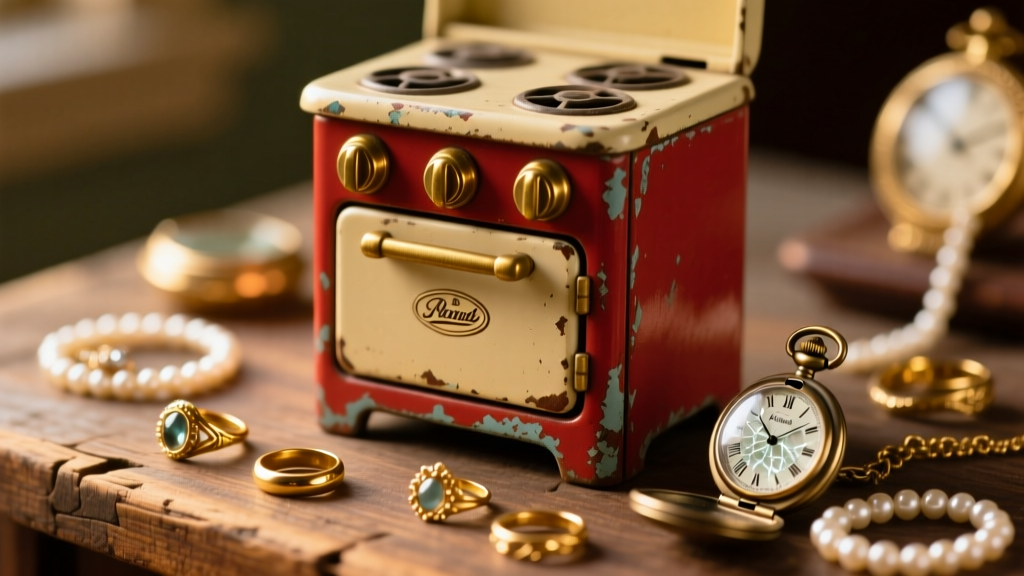
The Toy Stove: A Collector’s Guide to Vintage Cast Iron, Enamel, and Tinplate Play Kitchens (1920–1965)