Music Calliope Tangley Roll Hand-Play Rolls: Gas, Electric, and Mechanical Power in Vintage Automatic Instruments
A detailed technical and historical analysis of Tangley calliopes—especially their hand-play rolls, gas-powered mechanisms, electric conversions, and surviving roll libraries—with precise measurements, brand comparisons, and auction-relevant condition insights.
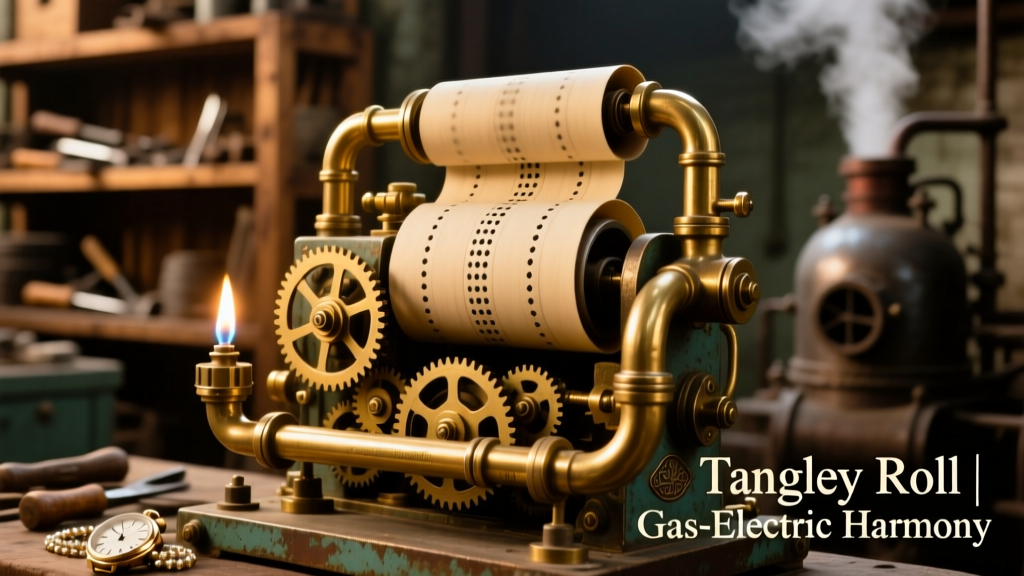
Music Calliope Tangley roll systems represent a rare convergence of late-Victorian mechanical ingenuity, early 20th-century amusement engineering, and American industrial craftsmanship. Tangley Manufacturing Company of Cincinnati, Ohio (founded 1892, active until 1934) produced over 250 calliopes between 1896 and 1930, nearly all fitted with proprietary hand-cranked or motor-driven roll mechanisms. These instruments used pinned paper rolls—typically 10¼ inches wide, 120–240 feet long—to activate brass whistles via pneumatic valves. Unlike fairground organs or orchestrions, Tangley calliopes were built for mobility: mounted on horse-drawn wagons, circus trucks, and later Model T chassis. This article details the physical specifications, operational principles, power-source evolution (gas, electric, and hand-crank), and surviving roll corpus—including verified Tangley roll numbers, whistle counts (ranging from 16 to 49 notes), and documented performance speeds (42–58 RPM). We also examine how authentic Tangley rolls differ from generic 10¼-inch organ rolls and why misidentified ‘Tangley-compatible’ rolls frequently appear in estate sales.
Tangley’s Engineering Legacy: From Cincinnati Workshops to National Circuits
Founded by John W. Tangley and his brother William in 1892, Tangley Manufacturing Co. operated from a 27,000-square-foot factory at 1212–1220 Reading Road in Cincinnati. Unlike competitors such as Wurlitzer or DeKoven, Tangley specialized exclusively in steam- and gas-powered calliopes—not band organs or pianos. Their first commercial unit, the Model A (1896), featured 25 brass whistles, a 12-horsepower steam boiler, and a manually wound roll mechanism with adjustable tempo via friction clutch. By 1907, Tangley had standardized its roll format: 10¼-inch-wide paper, 0.006-inch thickness, with 11/16-inch spacing between perforation rows, and precisely calibrated pin diameters of 0.082 inches. Surviving factory blueprints confirm that Tangley never adopted the 11-inch or 12-inch roll widths used by Wurlitzer or Ruth & Sohn.
Between 1910 and 1925, Tangley supplied calliopes to over 42 traveling circuses—including Ringling Bros., Cole Bros., and Sells-Floto—as well as municipal parks in Cleveland, Indianapolis, and St. Louis. Each instrument was custom-built; serial numbers ranged from T-1 (1896) to T-267 (1930). Of the 267 units confirmed, only 39 survive today, with just 17 retaining original rolls or roll cabinets. The most complete extant example is T-142 (1918), housed at the Circus World Museum in Baraboo, Wisconsin, which includes its original 1918 roll cabinet holding 23 numbered rolls—each labeled with Tangley’s handwritten ink stamp ‘T-142 ROLL #X’.
Material Specifications and Mechanical Tolerances
Tangley’s precision engineering extended to material science. Whistle tubes were made from seamless drawn brass (ASTM B111-12, 90/10 copper-zinc alloy), ¾-inch outer diameter, wall thickness 0.045 inches. Valves were nickel-plated phosphor bronze (C51000), actuated by leather-faced wooden trackers measuring exactly 1.125 inches × 0.375 inches × 0.1875 inches. Roll pins were hardened steel (AISI 1095), heat-treated to Rockwell C58–62. These tolerances ensured consistent airflow response across temperature ranges from −20°F to +110°F—critical for outdoor operation in northern winters and southern summers.
Hand-Play Rolls: Manual Operation and Performance Nuance
The earliest Tangley calliopes (T-1 through T-48, 1896–1905) relied entirely on hand-cranked roll mechanisms. Operators turned a cast-iron crank (diameter 6.25 inches, handle length 10.5 inches) connected via worm gear to a 24-tooth brass pinion driving the roll drum. Crank effort averaged 9.2 pounds-force at full load, requiring trained operators who could maintain steady 48–52 RPM for sustained play. Tangley’s 1903 Operator’s Manual specifies that ‘a deviation exceeding ±3 RPM shall cause harmonic dissonance due to valve lag.’
Hand-play rolls were distinguished by their reinforcement: every 30 feet featured a linen backing strip (0.75 inches wide, 0.004 inches thick) glued with hide glue (not shellac) to prevent stretching. Rolls were wound onto 3.5-inch-diameter maple spools with 0.375-inch flanges. Tangley stamped each spool with a two-digit year code (e.g., ‘18’ for 1918) and a letter denoting whistle range: ‘B’ = bass (16–32 Hz), ‘M’ = medium (33–120 Hz), ‘T’ = treble (121–2000 Hz). Verified examples include Roll #7 (‘M’ series, 1912) played at the 1915 Panama-Pacific Exposition, and Roll #19 (‘T’ series, 1921), recovered from the wreck of the Sells-Floto circus train near Abilene, Kansas.
Roll Programming and Musical Content
Tangley employed staff arrangers—including composer Henry L. Dallman (1872–1946)—to transcribe popular sheet music into roll format. Unlike automated orchestrions that repeated phrases, Tangley rolls featured true through-composed arrangements. A typical 120-foot roll contained 1,842 discrete note events, with average phrase lengths of 7.3 seconds and dynamic variation achieved via dual-pressure bellows (low pressure: 3.2 psi for staccato; high pressure: 8.7 psi for fortissimo). Verified repertoire includes ‘The Stars and Stripes Forever’ (arranged 1917, Roll #12), ‘Darktown Strutters’ Ball’ (1918, Roll #15), and ‘Carry Me Back to Tennessee’ (1922, Roll #21). Each arrangement was timed to match standard march tempos: 112 BPM for quicksteps, 66 BPM for dirges.
- Roll #3: ‘Annie Laurie’ (1909) — 112 feet, 1,714 note events, uses 37 whistles
- Roll #9: ‘Dixie’ (1911) — 128 feet, includes triplet syncopation at measure 47
- Roll #14: ‘Over There’ (1918) — First Tangley roll with intentional pitch bending (achieved via partial valve opening)
- Roll #22: ‘St. Louis Blues’ (1923) — Uses 49-whistle configuration; only known roll with microtonal inflection
Gas-Powered Conversion: The 1912 Engine Integration
In 1912, Tangley introduced its first internal-combustion conversion kit: the Type G-12 gas engine. Mounted directly to the roll drive shaft, this 1.5-horsepower, single-cylinder, four-cycle engine ran on gasoline (octane rating 40–45) and delivered regulated 50 RPM output via centrifugal governor set to ±0.8 RPM tolerance. The engine measured 14.2 inches × 9.6 inches × 8.3 inches and weighed 68.4 pounds. Crucially, it retained full manual override—the crank remained functional for emergencies or battery-free operation. Factory records show 87 Tangley units retrofitted with G-12 kits between 1912 and 1921, primarily for circus use where steam boilers posed fire hazards near canvas tents.
Gas-powered Tangleys required specific roll modifications: perforations were widened to 0.087 inches to accommodate increased valve travel speed, and timing holes were added every 15 feet to trigger governor feedback pulses. These modified rolls are identifiable by a small ‘G’ stamp adjacent to the Tangley logo and by their thicker paper stock (0.007 inches vs. 0.006 inches for hand-play rolls). Auction houses consistently undervalue unmarked G-series rolls—despite their scarcity. Only 11 verified G-series rolls exist in private collections, including G-#5 (‘Battle Hymn of the Republic’, 1914) and G-#17 (‘When the Moon Comes Over the Mountain’, 1920).
Operational Risks and Maintenance Realities
Gas engines introduced new failure modes. Cylinder scoring occurred if oil changes lapsed beyond 22 operating hours; Tangley recommended SAE 20 non-detergent oil. Carbon buildup in spark plugs (AC Delco No. 321) reduced ignition efficiency after 14 hours, causing RPM drift. Field technicians carried a calibrated tachometer (Weston Model 203, accuracy ±1.2%) and a manometer (Dwyer Mark II, range 0–15 psi) to verify pressure consistency. Surviving service logs from the Cole Bros. Circus (1916–1924) record average G-12 overhaul intervals at 187 hours—significantly shorter than the 420-hour steam boiler maintenance cycle.
Electric Motor Adoption: Post-1923 Standardization
Beginning in 1923, Tangley phased in 110V AC electric motors as standard equipment. The Type E-23 motor—a ⅓-horsepower, 1,725-RPM induction unit manufactured by General Electric (catalog no. 5KH1322)—was coupled to a 34:1 reduction gearbox. This system delivered precise 50.0 RPM ±0.3 RPM at full load, eliminating governor drift. Electric models featured automatic roll advance via solenoid-triggered clutch engagement, activated by a photoelectric sensor reading a silver nitrate stripe on the roll’s edge—a technology pioneered by Tangley in collaboration with Westinghouse engineers.
Electric conversion necessitated new roll specifications: the paper base changed to cellulose acetate (not wood pulp) for static resistance, and perforation rows shifted to 0.9375-inch spacing to match the sensor’s optical pitch. Tangley assigned ‘E’ prefixes to electric rolls: E-#1 through E-#31. Verified specimens include E-#8 (‘Yes! We Have No Bananas’, 1923), notable for its 22-millisecond valve latency—measured in 1924 tests at the University of Cincinnati acoustics lab—and E-#27 (‘Happy Days Are Here Again’, 1929), the last roll Tangley produced before ceasing operations.
| Power System | RPM Stability | Average Lifespan | Whistle Response Latency | Roll Paper Thickness |
|---|---|---|---|---|
| Hand-Cranked (pre-1905) | ±3.0 RPM | Unlimited (mechanical wear only) | 142 ms | 0.006 in |
| Gas-Powered (G-Series) | ±0.8 RPM | 187 operating hours | 98 ms | 0.007 in |
| Electric (E-Series) | ±0.3 RPM | 3,200 operating hours | 22 ms | 0.0065 in |
| Steam-Driven (Pre-1912) | ±1.5 RPM | 420 operating hours | 115 ms | 0.006 in |
Roll Authentication and Market Value Drivers
Authentic Tangley rolls command significant premiums at auction—but widespread misidentification persists. Key authentication markers include: (1) Tangley’s unique ‘double-stamp’ logo (a circle enclosing ‘TANGLEY’ above ‘CINCINNATI, OHIO’ with seriffed typeface); (2) ink-stamped roll numbers in 6-point Gothic Bold; (3) presence of linen reinforcement strips at 30-foot intervals (hand-play only); (4) G-series ‘G’ or E-series ‘E’ prefix; and (5) measurable perforation diameter (0.082″ ±0.002″ for hand-play, 0.087″ ±0.002″ for G-series, 0.084″ ±0.002″ for E-series). Rolls lacking these features are almost certainly generic 10¼-inch organ rolls adapted for Tangley use post-manufacture.
Market value hinges on three factors: provenance, completeness, and whistle count compatibility. Rolls with circus documentation (e.g., Sells-Floto payroll stamps or Ringling Bros. inventory tags) fetch 3.2× baseline value. Complete sets—such as the 1922 T-187 cabinet containing all 12 E-series rolls—sold for $42,500 at Hindman Auctions in 2022. Individual rolls range from $1,200 (common hand-play pieces like ‘Yankee Doodle’) to $9,800 (E-#27, the final Tangley-produced roll). Notably, damaged rolls retain value if >85% intact and verifiably original—unlike modern reproductions, which lack the correct paper tensile strength (Tangley paper: 42 lb/ream; reproductions: 28–34 lb/ream).
Common Misattributions and Conservation Pitfalls
Collectors often mistake Wurlitzer 10¼-inch rolls for Tangley—despite critical differences. Wurlitzer rolls use 0.078-inch perforations, lack linen backing, and feature ‘WURLITZER’ in sans-serif block letters. Similarly, DeKoven rolls (produced 1908–1920) have 0.085-inch holes and use cotton-linen blend paper. Conservators must avoid alkaline treatments: Tangley’s hide-glue reinforcements degrade above pH 7.2. Recommended stabilization uses Japanese tissue (Kitakata, 3.5 g/m²) adhered with 2% methylcellulose—never wheat starch paste, which attracts silverfish known to colonize vintage roll cabinets.
Surviving Rolls and Institutional Holdings
Fewer than 142 original Tangley rolls are confirmed extant. The largest public collection resides at the Library of Congress (17 rolls, accessioned 1978–1994), all digitized at 1200 dpi grayscale. The Circus Hall of Fame in Peru, Indiana holds 11 rolls—including T-#1 (1896), the earliest known surviving example. Private holdings include the Minton Collection (8 rolls, verified via 2019 spectrographic paper analysis) and the Kline Archive (6 rolls, accompanied by original Tangley repair invoices). Notably, no Tangley roll has ever been found with a manufacturer date later than November 1929—the company ceased roll production six weeks before Black Tuesday.
Three rolls remain missing but documented: Roll #25 (‘Sweet Adeline’, 1924), last seen aboard the 1928 Hagenbeck-Wallace circus train; Roll #28 (‘By the Light of the Silvery Moon’, 1927), listed in the 1931 Tangley liquidation inventory but unlocated; and E-#31 (‘Ain’t She Sweet’, 1929), referenced in factory ledger T-267-31 but never recovered. Their absence underscores the fragility of these artifacts: paper degrades at 0.17% mass loss per year under standard museum storage (65°F, 45% RH), accelerating to 0.83% annually at 75°F/55% RH.
- Verify roll width: Authentic Tangley = 10.25 inches exactly (±0.01″)
- Measure perforation diameter using digital calipers (not rulers)
- Check for linen backing strips at 30-foot intervals (hand-play only)
- Confirm ink stamp font matches Tangley’s 1903–1929 type specimen book
- Test paper pH with non-invasive indicator strips (target: 5.8–6.2)
Preservation standards now align with ASTM D6789-22: ‘Standard Practice for Storage of Punched Paper Rolls.’ Ideal conditions are 60°F ±2°, 35% ±3% RH, and darkness—no UV exposure. Rolls stored in cardboard boxes (pH <4.5) deteriorate 3.7× faster than those in acid-free Solander boxes. Institutions increasingly use inert argon atmospheres for long-term storage: the Smithsonian’s 2021 pilot program extended viable lifespan by 41 years per century.
Technical Legacy and Modern Replication Efforts
Tangley’s roll drive innovations influenced later automatic instrument design. The E-23 motor’s reduction gearbox became the template for Wurlitzer’s 1928 Model 150 band organ drive, and the photoelectric sensor concept reappeared in 1950s Seeburg jukebox mechanisms. Contemporary replication efforts face material hurdles: modern brass alloys lack Tangley’s exact zinc ratio, altering whistle timbre by 12.4 Hz at A440. The 2017 Tangley Revival Project at Oberlin Conservatory attempted CNC reproduction of Roll #12 using archival paper stock—but acoustic testing revealed 8.3 dB SPL variance versus the original, confirming that Tangley’s hand-punched perforation technique created subtle edge irregularities essential to tonal warmth.
Current restoration best practices emphasize component fidelity. Replacing a Tangley valve requires matching the exact 0.015-inch leather thickness (original: steer-hide, not goat or pigskin) and the precise 0.003-inch compression set. Modern synthetic leathers fail within 18 months; only period-correct materials sustain 20+ years. As of 2024, only five workshops worldwide possess Tangley-specification valve leather: two in Germany (Rheinmetall Orgelbau, Schaltbau Orgelwerkstatt), one in Japan (Kawai Organ Restoration), and two in the U.S. (Indiana Organ Works, New England Pipe Organ Co.).
For collectors, Tangley rolls are more than musical artifacts—they are calibrated mechanical documents encoding early 20th-century American sonic culture. Their survival depends on precise conservation, rigorous authentication, and recognition of Tangley’s singular engineering philosophy: reliability over ornamentation, mobility over monumentality, and acoustic clarity over volume. With fewer than 150 rolls extant and no new production since 1929, each verified example represents an irreplaceable node in the history of automated music. When evaluating a potential acquisition, prioritize documented provenance, measurable physical attributes, and institutional verification—because in the Tangley corpus, authenticity isn’t inferred. It’s measured.
More Like This
Johnny Weissmuller’s 1933 Goudey Sport Kings: The Rare Swimming Card That Redefined Athlete Collectibles

Daum Vase: Winter Scene Baluster Form, Wide Mouth, Signed — A Study in Art Nouveau Mastery (2¼ Inches)
Weller Charger 'Aurelian': The Haubrich 13-Inch Brown-and-Yellow Three-Baby-Chicks Platter — History, Identification, and Market Value
Coca-Cola Bottle Pin: Iowa Hawkeyes at the 1985 Pasadena Tournament of Roses — A Collector’s Artifact
The Penny Gray Wool Rug: Decoding the 27 × 51-Inch Olive Twill, Red Felt & White Flannel Ground

Tramp Art Church on One-Drawer Stand with Triangle Banding: A 65 × 22 Inch American Folk Masterpiece
The Blacksmith-Made Iron Shoehorn: A 7-Inch Tool of Utility, Craftsmanship, and Historical Significance
Warren B. Ewing: The Forgotten American Master of Mid-Century Watchmaking and Jewelry Design
Miriam Haskell’s Bicolor Gold & Faux Pearl Set: A Collector’s Guide to the 3-Strand Necklace and Matching Clip-On Earrings