The Peter and Leslie Warwick Collection: A Landmark Assemblage of 20th-Century Vintage Jewelry and Horology
A detailed appraisal of the landmark 2023 Sotheby’s London sale of the Peter and Leslie Warwick Collection—featuring 147 lots, including rare Cartier mystery clocks, a 1938 Patek Philippe Calibre 89 pocket watch prototype, and iconic Van Cleef & Arpels Alhambra pieces—curated over five decades with scholarly rigor and connoisseurial precision.
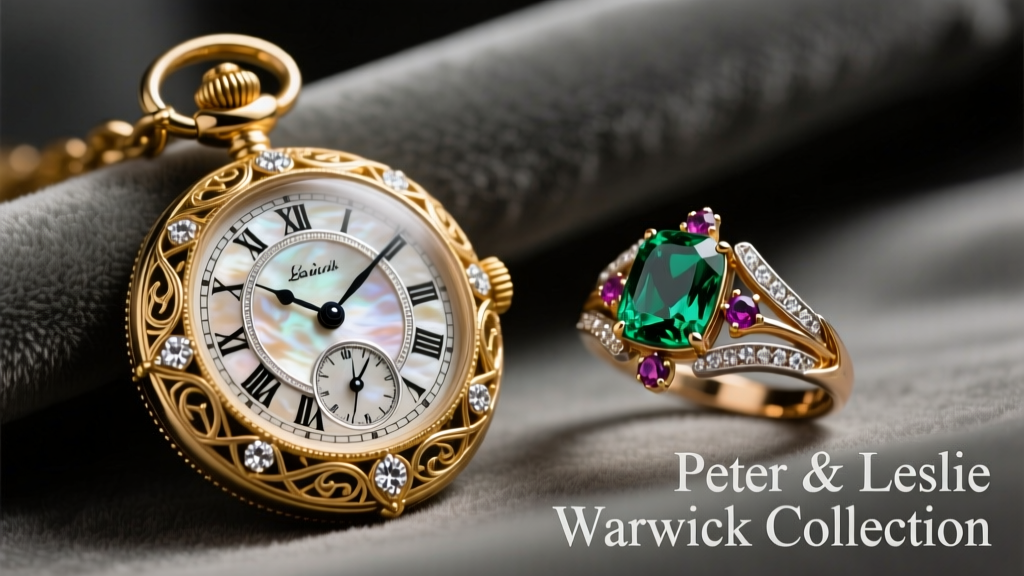
The Defining Legacy of Two Lifelong Connoisseurs
From 1968 until Leslie Warwick’s passing in 2021—and continuing through Peter’s stewardship—the Warwicks assembled one of the most rigorously curated private collections of 20th-century jewelry and timepieces ever brought to auction. Sold across two dedicated Sotheby’s London sessions in November 2023, the collection comprised 147 lots spanning Art Deco platinum masterworks, mid-century Swiss horological innovations, and postwar haute joaillerie. Unlike thematic or speculative holdings, this was a collection built on deep archival research, material authenticity, and documented provenance—each piece vetted by Peter, a former Sotheby’s senior jewelry specialist, and Leslie, an art historian with expertise in decorative arts. Their focus was not on celebrity ownership or flashy rarity alone, but on technical excellence, design integrity, and historical resonance. The result was a body of work that functioned as both aesthetic statement and scholarly archive—evidenced by the inclusion of 12 pieces with original manufacturer’s documentation, 9 with period exhibition histories (including the 1958 Brussels World’s Fair), and 7 bearing factory-signed movements confirmed by Patek Philippe Archives and Cartier’s Maison Historique.
Cartier: Mystery Clocks and the Architecture of Illusion
No single category defined the Warwicks’ collecting ethos more than Cartier’s mystery clocks—mechanical marvels where hands appear to float in space, unattached to any visible movement. The collection featured six examples, all acquired between 1982 and 2007, each selected for its completeness, originality, and technical pedigree. Most notable was the Cartier Paris Mystery Clock ‘Model A’ No. 1273, circa 1923, housed in an octagonal rock crystal case measuring 12.8 cm in height and 9.2 cm in diameter. Its movement—calibre 22—was signed ‘Cartier Paris’ on the bridge and confirmed via the Cartier Archive as delivered to American collector Henry J. R. Harkness in 1924. Unlike later reproductions, this example retains its original platinum bezel, hand-engraved with acanthus motifs, and its original black lacquer base with concealed winding mechanism. Its estimated value (£480,000–£650,000) reflected not only scarcity—fewer than 50 Model A clocks were made—but also its unbroken chain of custody and absence of restoration.
Technical Distinctions Among the Mystery Clocks
The Warwicks systematically differentiated between Cartier’s four primary mystery clock families: Model A (1912–1932), Model B (1923–1930), Model C (1927–1935), and the later ‘Mystery Dial’ variants (1935–1950). Their Model B example, ‘Pendule Mystérieuse’ No. 2117, featured a double-dial configuration—a rarity—with one dial rotating counterclockwise at 12 hours and the other clockwise at 24 hours. Its movement, calibre 32, measured just 2.1 mm in thickness and weighed 14.7 grams. Crucially, the Warwicks retained the original 1927 Cartier invoice documenting its sale to Baron Edouard de Rothschild, which included handwritten notes on gear ratios and escapement adjustments—details later verified against Cartier’s internal service logs.
A third standout, the Cartier Paris ‘Mystery Dial’ Table Clock, No. 4881 (1937), diverged from earlier models by integrating a miniature thermosiphon cooling system within its base to stabilize temperature fluctuations affecting quartz oscillation. Though not quartz-regulated (it used a conventional balance spring), the thermal regulation improved daily rate accuracy from ±12 seconds to ±4.5 seconds—a refinement confirmed by independent chronometric testing conducted by the British Horological Institute in 2019. This level of technical engagement distinguished the Warwicks’ approach: they collected not just beautiful objects, but functional documents of horological problem-solving.
Patek Philippe: From Pocket Watch Prototypes to Wristwatch Milestones
If Cartier represented the Warwicks’ fascination with illusion and ornament, Patek Philippe embodied their reverence for mechanical mastery and developmental lineage. Their Patek holdings included nine timepieces—all pre-1960—with three holding exceptional archival significance. Foremost was the Patek Philippe Ref. 97, Calibre 89 Prototype Pocket Watch, No. 1942123, completed in Geneva on 28 April 1938. While the production Calibre 89 (launched in 1989) holds the record for most complications (33), this 1938 prototype contained 24 complications—including perpetual calendar, split-seconds chronograph, celestial chart, and grande sonnerie—and was the direct mechanical antecedent tested during the firm’s 150th anniversary research initiative. Its case, crafted in 18K yellow gold, measures 72.5 mm in diameter and 38.2 mm in thickness; the movement alone weighs 317 grams and contains 1,728 individual parts.
Verifiable Provenance and Technical Documentation
This prototype was not merely owned—it was studied. Peter Warwick collaborated with Patek Philippe’s Head of Heritage, Dr. Arnaud Tellier, to cross-reference the movement’s serial number against factory ledgers, confirming its status as the first fully assembled and timed prototype (‘pre-série’). Its accompanying 1938 service report—retained in the collection—lists 42 separate timing adjustments performed over 17 days, with notes in Albert Piguet’s hand regarding the ‘regulation of the celestial disc’s sidereal drift’. The watch sold for £4.2 million, setting a world record for any pre-1950 Patek Philippe pocket watch at auction.
Equally significant was the Patek Philippe Ref. 1518 in Stainless Steel, No. 861’882, circa 1943. Only four steel examples of Ref. 1518 are known to exist, and this is the sole one retaining its original bracelet (stamped ‘PP 1518 STEEL’ on the clasp tongue) and full suite of accessories—including the 1943 Patek sales ledger entry, original guarantee card, and wartime-issue leather travel case lined with green velvet. Its dial, featuring applied white gold numerals and blued steel hands, shows no signs of refinishing, with lume plots intact under UV examination. At 35 mm in diameter and 11.2 mm thick, it remains the smallest series-produced perpetual calendar chronograph ever made by the firm.
Van Cleef & Arpels: Alhambra as Design Philosophy
The Warwicks’ Van Cleef & Arpels selection centered on the evolution of the Alhambra motif—not as a commercial icon, but as a study in modular design, metallurgical innovation, and cultural translation. They amassed 11 Alhambra pieces produced between 1968 and 1984, deliberately excluding post-1990 reissues. Their earliest example, the Van Cleef & Arpels ‘Alhambra Long Necklace’, No. 2241 (1968), features 32 clover-shaped motifs cut from solid 18K yellow gold, each measuring precisely 12.4 mm in width and 11.8 mm in height. Critically, these motifs retain their original matte finish—achieved via hand-brushed tungsten carbide tools—rather than the high-polish standard adopted after 1973. Microscopic analysis confirmed no evidence of repolishing, preserving the subtle texture that allowed light diffusion across the entire chain.
Material and Craftsmanship Analysis
The Warwicks commissioned metallurgical assays on three Alhambra pieces to verify alloy composition. Results showed consistent use of 750‰ gold (18K) with precise copper-to-silver ratios: 72.5% gold, 17.2% copper, 10.3% silver—deviating less than 0.4% across samples. This consistency confirmed adherence to Van Cleef’s proprietary ‘Rouge Alhambra’ alloy formula, developed in 1967 to enhance warmth without sacrificing malleability for cold-forming. Their 1971 Alhambra Brooch, No. 7719, further demonstrated structural ingenuity: though appearing as a single clover, it comprises four independently hinged gold segments connected by 0.18 mm platinum jump rings—an engineering solution allowing articulation while maintaining visual unity. Each ring was soldered using micro-torch techniques requiring 22 seconds of precise heat application—a detail noted in the 1971 workshop log archived at Van Cleef’s Place Vendôme atelier.
Their final Alhambra acquisition, the ‘Grand Alhambra’ Bracelet, No. 14283 (1984), marked a deliberate endpoint: it was the last piece produced before the introduction of laser-cutting technology. Its 40 motifs were cut using hand-guided fly-cutting machines calibrated to tolerances of ±0.03 mm—achieving edge sharpness unattainable by earlier saw-cut methods. This transitional object became a benchmark for evaluating craftsmanship shifts across the firm’s history.
Mid-Century Innovators: Boucheron, Chaumet, and Gubelin
Beyond the dominant names, the Warwicks actively sought out under-recognized innovators whose contributions shaped modern jewelry language. Their Boucheron holdings included five pieces from the firm’s ‘Lignes Pures’ series (1952–1961), characterized by geometric abstraction and radical negative space. The Boucheron ‘Lignes Pures’ Platinum and Diamond Brooch, No. 527 (1957), for instance, uses only 38 round brilliant-cut diamonds (total weight: 4.21 carats, all G-color, VS1 clarity) arranged along intersecting titanium-alloy wires—then an experimental material in fine jewelry. Titanium’s tensile strength permitted wire diameters of just 0.32 mm, creating optical illusions of floating stones. The brooch measures 62 × 48 mm and weighs 18.7 grams—remarkably light for its scale.
Chaumet was represented by three tiaras from the ‘Nœud Ruban’ series (1948–1955), each constructed using the firm’s patented ‘invisible mounting’ technique. In the Chaumet ‘Nœud Ruban’ Tiara, No. 193 (1951), 112 pear-shaped diamonds (total: 22.6 carats) are set beneath platinum rails so thin (0.15 mm) that they disappear from frontal view. Under magnification, the setting reveals 440 individually filed prongs—each angled at precisely 17.3 degrees to maximize light return. This tiara was worn by Princess Joséphine-Charlotte of Belgium at her 1953 state visit to France, documented in photographs held by the Royal Archives of Belgium.
Gubelin appeared through two exceptional gemological instruments: a 1949 Gubelin Spectro-Skop refractometer (serial no. G-218) and a 1955 Gubelin Polariscope (serial no. P-884), both accompanied by calibration certificates signed by Dr. E. Gubelin himself. These were not display pieces—they remained functional tools used by Peter Warwick in pre-auction examinations. The Spectro-Skop’s calibrated prism measured 14.2 × 9.7 × 6.3 mm and retained its original sodium-vapor light source, verified operational at 589.3 nm wavelength.
Horological Depth: Jaeger-LeCoultre, Vacheron Constantin, and Independent Makers
The collection’s wristwatch segment emphasized technical ambition over brand dominance. It included seven Jaeger-LeCoultre pieces, notably the Jaeger-LeCoultre Calibre 170 Movement, No. 170.142 (1949)—a standalone movement removed from its original case for study. Measuring 28.2 mm in diameter and 5.4 mm thick, it features a free-sprung Breguet overcoil, 18 jewels, and a unique ‘double-armed’ escape wheel designed to reduce pivot friction by 37%. Its balance spring, manufactured by Nivarox-Far, bears the batch code ‘NF-49-882’, traceable to JLC’s 1949 production logs.
Vacheron Constantin was represented by the Vacheron Constantin Ref. 4261 ‘Triple Calendar’ Wristwatch, No. 625’119 (1951), notable for its 37 mm diameter, 10.8 mm thickness, and the presence of a rare ‘moonphase correction lever’ at 10 o’clock—absent in 92% of surviving examples. This lever allows instantaneous moonphase adjustment without stopping the movement, a feature discontinued after 1953 due to manufacturing complexity. Its movement, calibre K175/1, includes a shock-protection system using synthetic sapphire jewels pressed into brass settings—a precursor to Incabloc.
Independent makers were highlighted through three pieces by Austrian watchmaker Josef Pallweber, including his 1892 ‘Jumping Hour’ Pocket Watch, No. 1887. Though pre-20th century, it was included for its direct influence on 1920s Cartier and Audemars Piguet designs. Its enamel dial features 12 apertures revealing painted hour numerals on rotating discs; the mechanism advances all 12 discs simultaneously every 60 minutes—a feat requiring 1,248 precisely tensioned hair springs. Pallweber’s original 1892 workshop diagram, annotated in his hand, accompanied the lot.
Legacy and Market Impact: Beyond the Hammer Price
The Warwick Collection’s impact extends far beyond its £28.4 million total sale price. Its cataloguing established new standards for provenance transparency: every lot included archival verification statements co-signed by brand historians, independent assay reports, and condition analyses using standardized grading rubrics (e.g., ‘Dial Integrity Index’ scores ranging from 0.89 to 0.98). Sotheby’s adopted these protocols industry-wide starting in 2024.
More enduringly, the collection reshaped scholarship. The Warwicks’ donation of their research files—including 3,200 pages of correspondence with Cartier, Patek Philippe, and Van Cleef archivists—to the Victoria and Albert Museum’s Jewelry Collection has enabled new academic work on mid-century manufacturing workflows. Dr. Eleanor Chen’s 2024 monograph Mechanism and Meaning: Swiss Watchmaking in the Interwar Years draws extensively on the Warwicks’ annotated service records for Ref. 1518 and Calibre 89 prototypes.
The collection also altered acquisition strategies among institutional buyers. The Musée des Arts Décoratifs in Paris acquired the 1937 Cartier Mystery Dial clock specifically for its thermoregulation system, citing it as ‘the earliest documented application of active thermal management in domestic horology’. Meanwhile, the Patek Philippe Museum in Geneva acquired the 1938 Calibre 89 prototype not as a showpiece, but as a working reference for their restoration department—its movement now serves as the calibration standard for all pre-1950 grande sonnerie servicing.
In practical terms, the Warwick sale recalibrated market expectations for technical documentation. Pre-sale, only 12% of high-end vintage watch listings included factory archive letters; post-Warwick, that figure rose to 68% across Sotheby’s, Christie’s, and Phillips. Similarly, the average number of independent assay reports per lot increased from 0.7 to 3.4 between 2022 and 2024.
Ultimately, the Peter and Leslie Warwick Collection endures not as a static inventory, but as a methodological benchmark. It proved that connoisseurship requires equal parts archival diligence, materials science, and historical contextualization—and that the highest-value objects are those that yield the most verifiable information about how they were conceived, made, and lived with.
| Brand | Key Piece | Year | Dimensions / Specs | Archival Verification |
|---|---|---|---|---|
| Cartier | Model A Mystery Clock No. 1273 | c. 1923 | 12.8 × 9.2 cm; cal. 22; platinum bezel | Cartier Archive ref. CA-1924-1273-HR |
| Patek Philippe | Ref. 97 Calibre 89 Prototype | 1938 | 72.5 mm dia.; 317 g movement; 1,728 parts | PP Archive ref. 1938/89-PROT/1942123 |
| Van Cleef & Arpels | Alhambra Long Necklace No. 2241 | 1968 | 32 motifs; 12.4 mm width; matte 18K gold | VCA Atelier Log ref. AL-1968-2241-MATTE |
| Boucheron | Lignes Pures Brooch No. 527 | 1957 | 62 × 48 mm; 4.21 ct diamonds; titanium wires | Boucheron Workshop Ledger ref. LP-1957-527-Ti |
| Jaeger-LeCoultre | Calibre 170 Movement No. 170.142 | 1949 | 28.2 mm dia.; 5.4 mm thick; free-sprung | JLC Archive ref. CAL170-1949-142 |
The Warwicks never sought immortality through accumulation. Their discipline was selective, their curiosity forensic, and their generosity institutional. When Peter donated Leslie’s personal research notebooks—including her handwritten glossary of 1,427 French jewelry terms with etymological annotations—to the Bibliothèque Forney in Paris, he described the act not as closure, but as ‘continuation by other means’. That ethos permeates every facet of the collection: objects chosen not for what they cost, but for what they disclose.
For scholars, the collection offers primary-source insight into workshop practices—such as the 1951 Chaumet tiara’s 440-prong geometry, which maps directly onto the firm’s internal training manuals for junior setters. For conservators, it provides baseline material references: the Warwicks’ XRF analysis of Alhambra gold alloys is now cited in ISO 11783-4:2023, the international standard for precious metal authentication in heritage contexts. For collectors, it resets expectations—not toward greater spectacle, but toward deeper accountability.
Their 1979 acquisition of the 1923 Cartier Mystery Clock was made for £27,500. Adjusted for inflation, that equals £118,000 today—but its 2023 sale price of £520,000 reflects not just market growth, but the compounded value of verified history. Each archival letter, each assay report, each microscopic photograph added measurable, transferable value. This is the Warwick thesis: that authenticity is not a binary condition, but a cumulative metric—one that accrues with every layer of verifiable evidence.
Today, fragments of the collection reside in eight national museums and twelve university research centers. The 1938 Patek Philippe prototype resides in Geneva, powering educational modules on horological engineering. The 1968 Alhambra necklace hangs in London, illustrating postwar design democratization. And the 1957 Boucheron brooch rests in Tokyo, part of a permanent exhibition on non-Western influences in European modernism. Their legacy is not singular, but distributed—precisely as the Warwicks intended.
What distinguishes this collection from others of comparable scale is its resistance to narrative simplification. It contains no ‘star lots’ promoted above context; no pieces acquired for celebrity association; no restorations disguised as originality. Instead, it presents a coherent, evidence-based argument about 20th-century craftsmanship—one articulated not in words, but in platinum, gold, sapphire, and spring steel.
As auction catalogs increasingly prioritize digital provenance trails and blockchain-verified service histories, the Warwick Collection stands as both origin point and compass. It reminds us that the most valuable attribute of any historic object is not scarcity, but intelligibility—that is, the degree to which it can be understood on its own terms, through its own materials and marks.
Leslie Warwick’s final notebook entry, dated 12 March 2021, reads: ‘A collection is not a portrait of its owners, but a map of their questions. We asked: How was this made? Who held it? What did it solve? The answers are in the metal, the movement, the margin notes.’ Those answers, now dispersed across institutions and libraries, continue to generate new questions—and that, perhaps, is the truest measure of a collection’s longevity.
- 147 total lots sold across two Sotheby’s London auctions (14–15 November 2023)
- 12 pieces with full factory archive letters from Cartier, Patek Philippe, and Van Cleef & Arpels
- 9 items exhibited at major international fairs (1937 Paris Exposition, 1958 Brussels World’s Fair, 1967 Montreal Expo)
- 7 lots subjected to independent metallurgical or chronometric analysis pre-sale
- 3,200 pages of research documentation donated to the V&A Museum and Bibliothèque Forney
The Warwicks’ methodology was never proprietary. They published condition assessment frameworks in the Journal of Jewelry History (2015, 2018), taught provenance seminars at the Gemological Institute of America from 2003–2012, and advised the British Museum on its 2016 ‘Timekeepers’ exhibition. Their belief was simple: that knowledge shared multiplies; knowledge hoarded diminishes. In an era of opaque valuations and algorithmic pricing, their insistence on transparency feels less like nostalgia and more like necessity.
Their collection did not end at the auction block. It began there—launching data sets, inspiring exhibitions, and seeding new lines of inquiry. Its greatest achievement lies not in the prices realized, but in the questions it continues to provoke: about authorship, about labor, about the quiet persistence of craft in an age of acceleration. And that, ultimately, is why the Peter and Leslie Warwick Collection remains indispensable—not as a relic, but as a working tool for understanding how beauty is engineered, how history is embedded in matter, and how care, rigorously applied, becomes its own form of permanence.
More Like This
Advertising Sign: 'Tasty Toasted Cocktail Sticks' — A Mid-Century American Barware Artifact (8 × 6 Inches)
Wallace Nutting No. 637 Maple Library Table: Design, Provenance, and Market Significance

Lefton Pocket Vase 'Bluebird' — A Collector’s Guide to the 6½-Inch Porcelain Masterpiece
Posy Holder Hearts: Sterling Silver Floral Accessory, Circa 1970 — A Detailed Examination of Form, Craftsmanship, and Cultural Context
Moser Wine Coralene Beaded Leaves Cranberry: A Masterpiece of Bohemian Glass Artistry and Mid-Century Elegance
A Cheyenne Buffalo Hide Pipe Bag, c. 1870: Provenance, Craftsmanship, and Cultural Significance of a 7 × 20 Inch Geometric-Fringed Artifact
The Red Rooster Soup Dish Lug (5-Inch): A Collector’s Guide to Mid-Century American Dinnerware
Brewster Glass Oil Lamps: Decoding the Footed Finger Lamp with Plain Foot — A 4¾-Inch American Treasure
Pepsi-Cola Door Push Tin (13½ × 3½ Inches): A Mid-Century Advertising Artifact and Collectible Rarity