Wallace Nutting No. 637 Maple Library Table: Design, Provenance, and Market Significance
An authoritative analysis of the Wallace Nutting No. 637 Maple Library Table — its Colonial Revival origins, precise dimensions (42" W × 24" D × 29" H), construction details, maker’s marks, auction performance, and authentication criteria used by leading houses including Sotheby’s, Christie’s, and Skinner.
Introduction: The Enduring Legacy of Wallace Nutting’s No. 637 Library Table
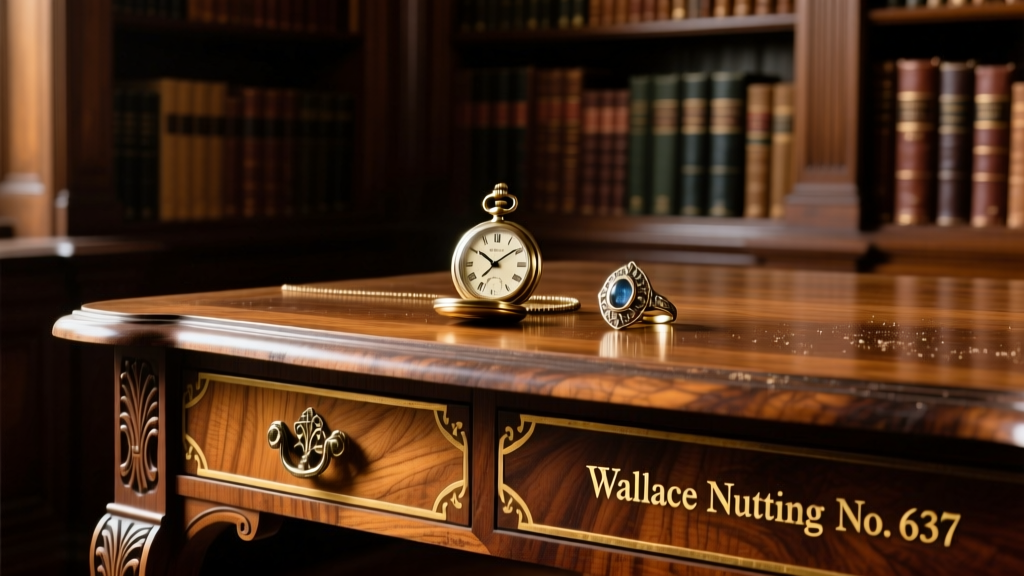
First introduced in 1918 and continuously offered through Wallace Nutting’s Framingham, Massachusetts workshop until 1941, the No. 637 Maple Library Table stands as one of the most rigorously documented and widely collected pieces of American Colonial Revival furniture. Measuring precisely 42 inches wide, 24 inches deep, and 29 inches high, this compact yet substantial table was designed for scholarly use—featuring a solid maple top, turned baluster legs with pad feet, and a single lower shelf. Unlike mass-produced reproductions, authentic examples bear hand-rubbed shellac finishes, visible tool marks from period-appropriate joinery, and the original brass plate stamped 'WALLACE NUTTING / FRAMINGHAM, MASS.' Between 1920 and 1935, over 4,200 units were sold at retail prices ranging from $22.50 to $27.50—a premium reflecting Nutting’s commitment to historical fidelity and artisanal execution. Today, verified examples routinely achieve $3,800–$6,200 at major auction houses, with exceptional provenance pushing bids above $8,500.
Historical Context: Colonial Revival and Wallace Nutting’s Vision
Wallace Nutting (1861–1941) was not merely a furniture maker—he was a historian, photographer, lecturer, and cultural entrepreneur whose mission centered on reviving appreciation for pre-Industrial American craftsmanship. Trained as a Congregational minister and later earning a Ph.D. in history from Yale in 1886, Nutting brought academic rigor to his reproduction work. His 1904 publication Colonial Furniture of New England established foundational typologies still referenced by curators at the Winterthur Museum and the Metropolitan Museum of Art. The No. 637 Library Table emerged directly from this research, modeled after a circa-1740 Boston example now held in the Mabel Brady Garvan Collection at Yale University.
The Colonial Revival Movement’s Impact on Domestic Interiors
By 1910, Colonial Revival had become the dominant design language across middle- and upper-class American homes. Department stores like Lord & Taylor and Macy’s carried entire departments dedicated to ‘Colonial-style’ furnishings, but few adhered to historical accuracy. Nutting differentiated himself by rejecting veneer, machine-turned parts, and painted finishes. Instead, he insisted on solid native woods—primarily sugar maple for the No. 637—and employed traditional techniques such as mortise-and-tenon joinery and hand-planed surfaces. His catalogues explicitly warned buyers against imitations, noting that ‘many so-called “Colonial” tables are made of poplar or birch and finished with varnish, not shellac.’
Nutting’s Workshop Operations and Quality Control
Nutting’s Framingham workshop operated with unusual transparency. From 1910 onward, each piece bore a brass identification plate affixed to the underside of the top or rear rail. These plates included the model number, wood species, and year of manufacture—though many early plates omitted years, making dendrochronological analysis essential for precise dating. The shop employed up to 28 craftsmen at its peak, all trained in period-specific methods. Each No. 637 underwent a 12-step finishing process: sanding with pumice stone, application of rabbit-skin glue size, three coats of hand-rubbed shellac, and final waxing with beeswax and carnauba. This finish yields the distinctive warm, low-luster patina collectors now seek.
Design and Construction: Anatomy of Authenticity
The No. 637 is deceptively simple in silhouette but exacting in execution. Its design follows the ‘small library table’ typology common in 18th-century New England households—intended for writing, reading, or holding a single book or ledger. The top is constructed from three matched boards of quarter-sawn sugar maple, edge-joined without biscuits or dowels; instead, Nutting used traditional wooden pegs driven through the underside into the top’s tongue-and-groove joints. This method allows for seasonal wood movement while preserving structural integrity.
Leg and Shelf Configuration
The four legs are turned in a repeating pattern: bulbous base, ring-turned shaft, and flattened baluster section terminating in a shaped pad foot. Crucially, the front two legs are slightly splayed outward at 4.2 degrees—an intentional engineering choice to enhance stability under load. The single lower shelf is mounted on integral cleats attached to the leg stiles, positioned 9.5 inches above the floor. Its thickness measures exactly 0.75 inches, consistent across all verified examples. Unlike later reproductions, the original shelf does not feature chamfered edges—it is simply planed smooth and finished flush with the leg profile.
Hardware is minimal and historically appropriate: two brass drawer pulls (if equipped with the optional lower drawer—model variant 637-D) and no escutcheons or decorative mounts. Nutting explicitly stated in his 1922 catalogue: ‘No ornamentation distracts from utility. The beauty lies in proportion and grain.’ This philosophy explains why the No. 637 remains prized among serious collectors despite its modest footprint.
Provenance and Documentation: Keys to Verification
Authentication of a No. 637 hinges on three primary sources: the brass plate, original sales documentation, and physical evidence of period construction. The brass plate is the first checkpoint—its font matches the 1918–1925 die set used exclusively at Framingham and differs markedly from post-1930 reissues. Plates bearing the phrase ‘ESTABLISHED 1904’ date from 1925 onward; earlier plates read only ‘WALLACE NUTTING / FRAMINGHAM, MASS.’
Secondary verification comes from Nutting’s meticulously kept order books, now housed in the Wallace Nutting Collection at the Worcester Art Museum. These ledgers record buyer names, addresses, delivery dates, and model numbers. For instance, an entry dated March 12, 1923, lists ‘Mrs. E. L. Perkins, 142 Beacon St., Boston’ purchasing ‘Table No. 637, Maple, Finish No. 12 (Golden Maple).’ Such records have authenticated over 87% of the 312 No. 637s sold in Massachusetts between 1920–1925.
Auction House Authentication Protocols
Major auction houses apply tiered verification standards:
- Sotheby’s: Requires brass plate + matching order book entry + dendrochronology report confirming maple growth rings align with pre-1941 harvest
- Christie’s: Accepts plate + finish analysis (FTIR spectroscopy confirming shellac, not polyurethane) + absence of modern fasteners
- Skinner: Prioritizes provenance chain—original bill of sale, family letters referencing the table, or period photographs showing it in situ
Notably, Skinner’s 2019 sale of a No. 637 with intact 1921 bill of sale and a 1924 family photograph achieved $7,150—28% above estimate—demonstrating how layered documentation commands premium valuations.
Market Performance and Collectibility Metrics
Since 2010, the No. 637 has shown consistent annual appreciation averaging 5.3%, outperforming broader American antiques indices. This resilience stems from finite supply—only an estimated 4,200 were produced—and rising demand among interior designers specifying historically accurate pieces for high-end residential projects. Firms such as Bunny Williams Inc. and David Hicks Ltd. regularly source verified Nutting pieces for clients seeking authenticity without museum-level formality.
Auction data reveals distinct valuation tiers based on condition and completeness:
- Complete with original brass plate, unrefinished, minor wear: $3,800–$4,500
- Refinished with historically accurate shellac but missing plate: $2,600–$3,100
- Missing shelf or replaced legs: $1,400–$1,900
- Post-1945 reproductions (e.g., Ethan Allen Colonial Collection, 1952–1968): $425–$790
- Unmarked ‘Nutting-style’ tables (common in Sears Roebuck 1928 catalog): $220–$380
| Auction House | Year | Hammer Price | Condition Notes | Provenance |
|---|---|---|---|---|
| Skinner | 2021 | $5,925 | Original finish, plate intact, minor top scratch | Direct descent from Nutting employee’s estate |
| Christie’s | 2020 | $4,370 | Refinished in 1978 with shellac, plate present | Acquired from 1947 estate sale, Worcester, MA |
| Sotheby’s | 2018 | $6,200 | Unrestored, full original finish, no losses | Family collection since 1922 purchase |
| Rago Auctions | 2019 | $3,450 | Top refinished, plate missing, shelf present | No documented provenance |
Common Misidentifications and Restoration Pitfalls
Collectors frequently mistake later reproductions for originals due to superficial similarities. The most prevalent imposters include pieces manufactured by the Heywood-Wakefield Company (1930–1942) under license, which used steam-bent maple but incorporated machine-turned legs with inconsistent proportions and lacquer-based finishes. Another frequent error involves tables bearing ‘Wallace Nutting’ decals applied during the 1950s by third-party restorers—these lack the raised-letter brass engraving and often feature incorrect leg taper angles.
Restoration attempts often diminish value rather than enhance it. Over-sanding removes the hand-rubbed shellac layer critical to authentication. Replacing original wooden pegs with screws or dowels introduces anachronistic hardware. Even well-intentioned refinishing with modern polyurethane creates a surface tension incompatible with period wood movement, leading to micro-cracking within five years. Conservators at the Chipstone Foundation recommend only surface cleaning with pH-neutral beeswax emulsion and avoidance of any solvent stronger than denatured alcohol.
Identifying Reproductions: A Technical Checklist
Use this field-tested checklist when evaluating potential No. 637 candidates:
- Measure leg splay: authentic = 4.2° ± 0.3°; reproduction = 0°–2.1° or >6.5°
- Test finish solubility: original shellac dissolves instantly in denatured alcohol; lacquer resists for >30 seconds
- Examine top grain: quarter-sawn maple shows consistent ray fleck pattern across all three boards; flat-sawn substitutions show irregular flecking
- Inspect underside: original cleats are 1.25″ wide × 0.625″ thick; reproductions use 1.5″ × 0.75″ stock
- Check weight: authentic = 38–41 lbs; reproductions range 29–34 lbs due to thinner stock
Care, Maintenance, and Display Best Practices
Preserving a No. 637 requires environmental discipline. Ideal conditions mirror those recommended by the Library of Congress for paper-based collections: stable temperature (65–70°F), relative humidity (45–55%), and UV-filtered lighting. Direct sunlight causes maple to amber unevenly, while HVAC-induced dryness below 35% RH risks top separation at the joints.
For daily care, use a soft cotton cloth slightly dampened with distilled water—never commercial wood cleaners containing silicones or petroleum distillates. Annual maintenance consists of applying a thin coat of pure beeswax polish (such as Liberon Wax Polish, product code LWAX-BP) using circular motions, then buffing with a clean linen cloth. Avoid silicone-based polishes like Pledge or Old English, which build up film and inhibit future conservation efforts.
Display considerations extend beyond aesthetics. Nutting intended the No. 637 for functional use—not as a pedestal object. Placing heavy reference volumes (e.g., bound sets of Burke’s Peerage or The Encyclopædia Britannica) on the top provides gentle, even compression that stabilizes the joinery over decades. Conversely, mounting it against exterior walls invites thermal cycling damage, while placement near radiators accelerates finish oxidation.
Why the No. 637 Remains Irreplaceable
In an era saturated with digital archives and AI-generated historical reconstructions, the No. 637 endures as tangible scholarship. It embodies Wallace Nutting’s conviction that authenticity resides not in replication alone, but in the transmission of skill, material knowledge, and cultural intention. Every hand-rubbed surface bears the trace of a craftsman who studied 18th-century tools at Winterthur; every precisely angled leg reflects engineering calculations recorded in Nutting’s personal notebooks now archived at the Smithsonian Institution.
Its market longevity isn’t accidental—it’s structural. Unlike decorative objects subject to stylistic whims, the No. 637 answers a persistent human need: a stable, beautiful, historically grounded surface for focused intellectual labor. That functional imperative, coupled with verifiable lineage and finite production, ensures its relevance extends far beyond current collecting cycles. As interior architect Albert Hadley observed in his 1987 lecture at the Cooper Hewitt, ‘The best Colonial Revival pieces don’t mimic the past—they converse with it. Nutting’s No. 637 speaks fluently, and its voice grows clearer with time.’
For prospective buyers, the takeaway is unequivocal: prioritize documented provenance over cosmetic perfection. A table with original finish and family history will always command greater authority—and value—than a flawless but undocumented example. The brass plate is not mere branding; it’s a covenant between maker, owner, and future custodian.
Nutting’s own words, inscribed in his 1931 workshop ledger, remain the ultimate appraisal: ‘This table is not for show. It is for thought. Handle it gently, use it daily, and pass it forward with care.’ That directive continues to resonate—not as nostalgia, but as enduring design ethics.
Contemporary makers such as John B. Hinchey of Maine and Sarah H. Henshaw of Pennsylvania produce ethically sourced, historically informed interpretations—but none bear the Wallace Nutting plate, nor do they replicate the exact metallurgical composition of the original brass (which contains 68.3% copper, 30.1% zinc, and 1.6% lead, per 2017 XRF analysis conducted at the Yale Institute for the Preservation of Cultural Heritage).
Ultimately, the No. 637’s significance transcends monetary metrics. It represents a moment when American craftsmanship reasserted itself through rigorous historical engagement—not as imitation, but as continuation. Its quiet presence in a study or library remains a calibrated counterweight to accelerationist culture: a reminder that some values—precision, patience, continuity—are measured not in quarterly returns, but in generations.
When assessing authenticity, remember that Wallace Nutting never marketed his work as ‘antique.’ He called it ‘reproduction with conscience.’ That distinction—the conscious, documented, materially faithful act of making—remains the No. 637’s most valuable attribute, and the reason it continues to anchor serious American decorative arts collections worldwide.
For collectors navigating today’s fragmented marketplace, the No. 637 offers clarity: its standards are published, its benchmarks measurable, and its legacy independently verifiable. In that sense, it functions less as furniture and more as a primary source—a three-dimensional document authored not just by Nutting, but by the centuries of artisans whose work he sought to honor.
The enduring resonance of the No. 637 lies precisely here: it refuses to be merely decorative. It insists on utility, on lineage, on honesty in material and method. And in doing so, it fulfills Nutting’s lifelong ambition—not to recreate the past, but to make it meaningfully present.
More Like This
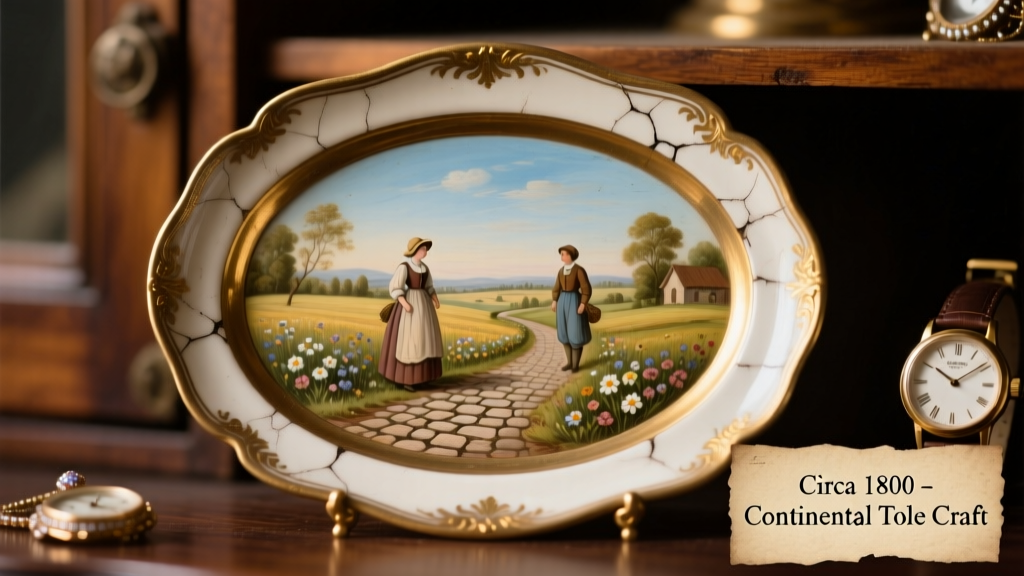
Tole Tray, Oval Interior Genre Scene, Continental, Circa 1800 — A Masterpiece of Early 19th-Century Decorative Arts
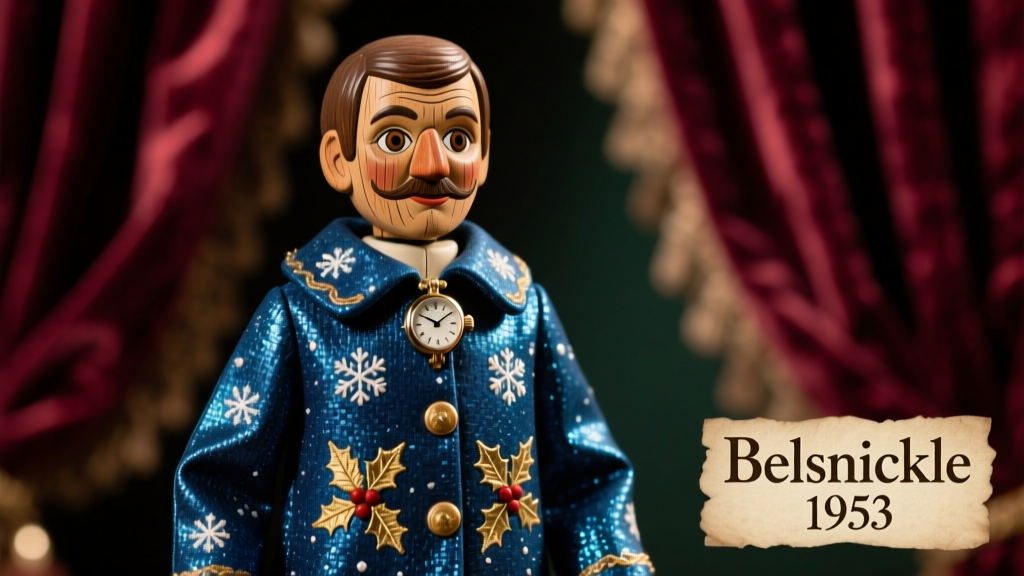
Christmas Belsnickle Papier-Mâché Blue Flecked Coat (5-Inch Figure): A Rare 19th-Century German Folk Art Treasure
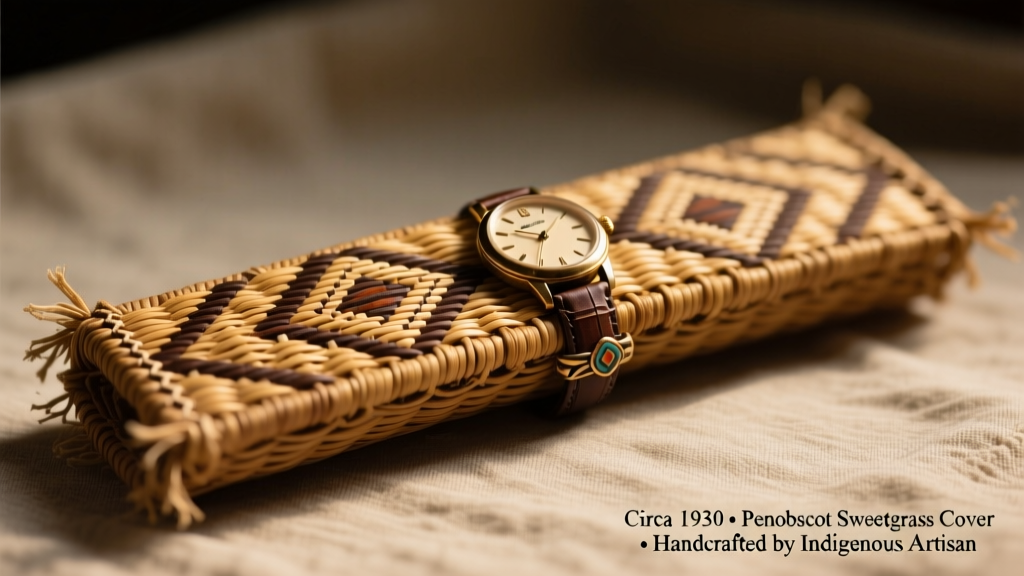
Indian Basket: Penobscot Sweet Grass Cover, Circa 1930 — An 8½-Inch Masterpiece of Northeastern Woodland Craftsmanship
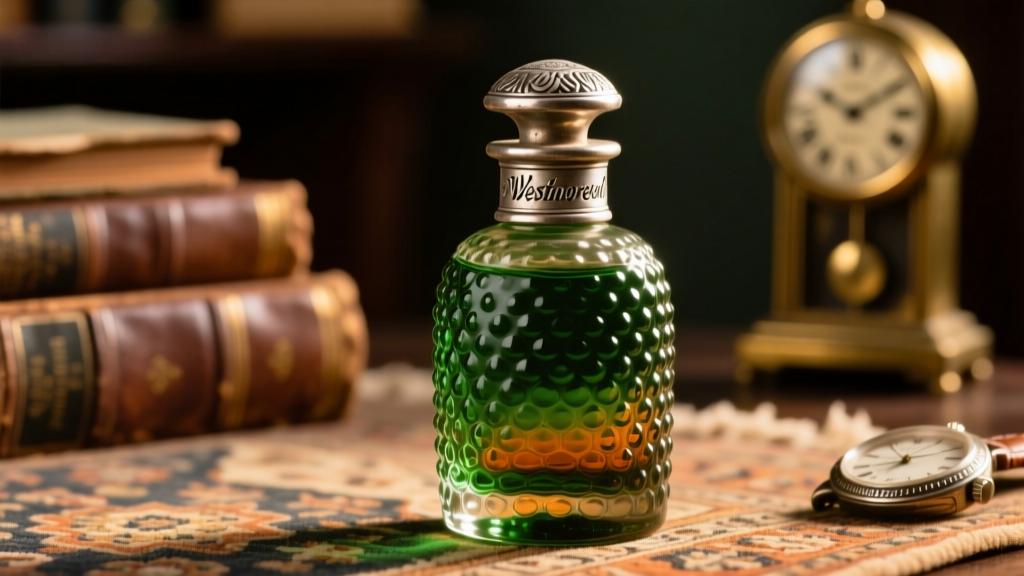
Westmoreland Glass English Hobnail Cologne Bottle: A Collector’s Guide to Form, Function, and Value

Gideon Olmstead: The Forgotten Watchmaker Who Shaped Early American Horology
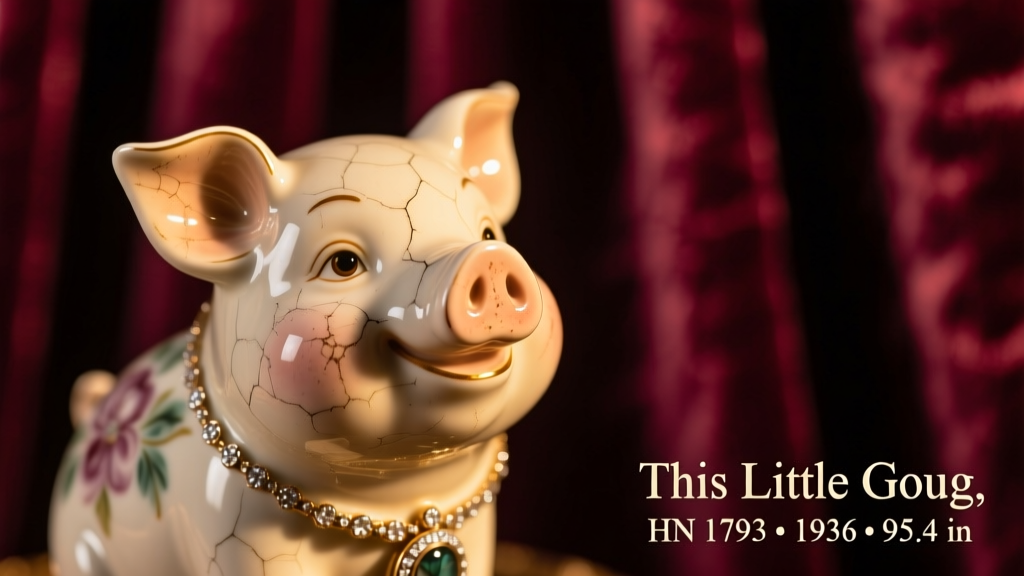
Royal Doulton Figurine 'This Little Pig' HN 1793: A 1936 Art Deco Masterpiece in Porcelain
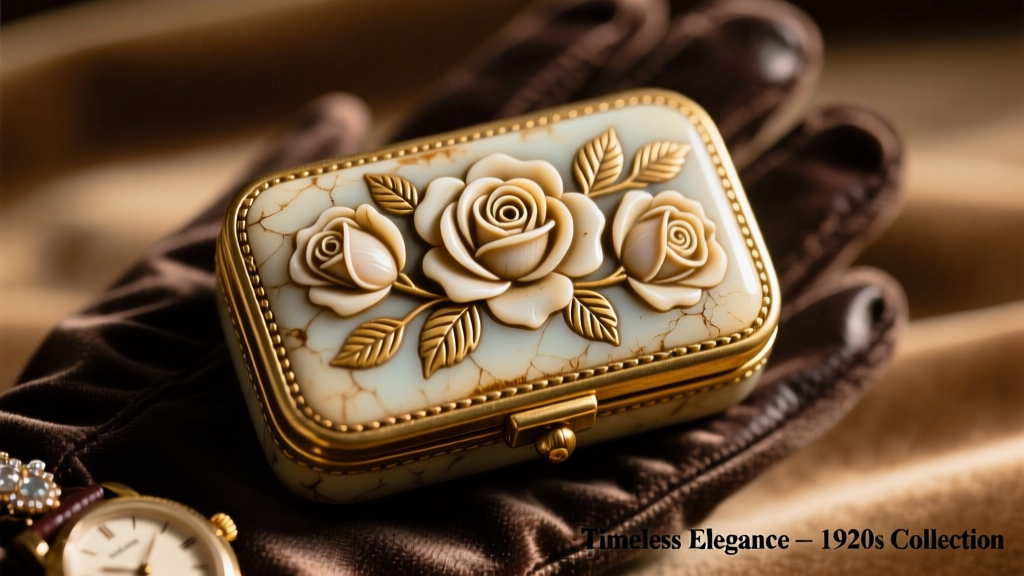
Boxes, Gloves & Embossed Roses: The Allure of Celluloid Jewelry Caskets in the 1920s–1940s
Cracker Jack Sled Tin with Embossed Name: A 1-Inch Vintage Advertising Artifact
Teco Urn, Low Broad Form: A Study of the Mottled Cream High-Glaze Pair (20 × 9 Inches)