The Tea Trolley: A Design Icon of British Domestic Elegance and Mid-Century Craftsmanship
A deep-dive exploration of the vintage tea trolley—its origins in Edwardian silverware, evolution through Art Deco and post-war modernism, materials (sterling silver, brass, walnut), iconic makers (Mappin & Webb, Walker & Hall, Dunhill), dimensions, auction trends, and authentication essentials for collectors.
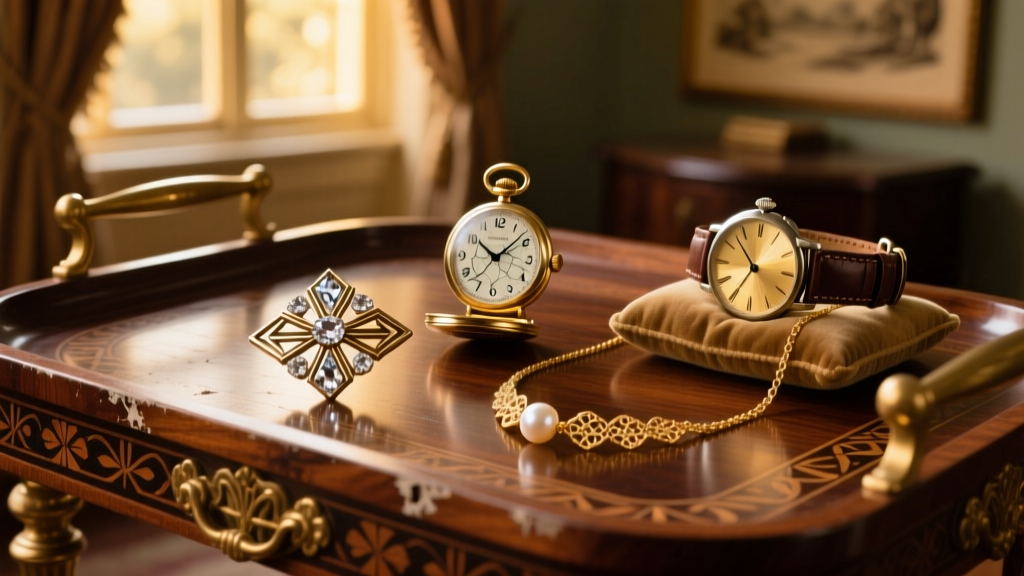
The tea trolley is far more than a serving cart—it is a sculptural artifact of British domestic ritual, design philosophy, and social history. Emerging in earnest during the Edwardian era (1901–1910), refined through the geometric precision of Art Deco (1925–1940), and reimagined in streamlined mid-century forms (1945–1965), the tea trolley embodies craftsmanship, material integrity, and functional elegance. Measuring typically between 24–30 inches in height, 18–26 inches in width, and 12–18 inches in depth, these pieces were engineered for stability, balance, and silent mobility—often featuring ball-bearing casters, hand-forged brass fittings, and precisely calibrated folding mechanisms. Key makers include Mappin & Webb (London, est. 1775), Walker & Hall (Sheffield, est. 1836), and Dunhill (founded 1893), each imprinting distinct hallmarks, weight standards, and design signatures. Today, authenticated examples fetch £1,200–£8,500 at major auction houses like Bonhams and Sotheby’s, with rare sterling silver models exceeding £12,000.
Origins: From Victorian Butler’s Tray to Edwardian Mobile Service
The tea trolley did not appear fully formed. Its lineage traces back to the Victorian butler’s tray—a portable, three-tiered lacquered or silver-plated service tray used for delivering tea, port, or cigars to drawing rooms without requiring full table service. By the 1890s, manufacturers began mounting such trays onto wheeled frames, often with adjustable-height legs and hinged side rails. These early mobile units were heavy—typically 18–22 lbs—and constructed from solid mahogany or rosewood, with brass or nickel-plated iron hardware. The 1902 Mappin & Webb catalogue lists a ‘Patent Folding Tea Trolley’ priced at £3 12s 6d (£3.625), weighing 19.4 lbs and measuring 27.5″ H × 22″ W × 14.5″ D. Crucially, this model featured patented spring-loaded casters that locked automatically when the trolley was stationary—a safety innovation adopted widely by 1908.
Edwardian trolleys reflected the era’s emphasis on lightness and refinement. Walnut replaced heavier mahogany; satinwood inlays became common; and silver-plated copper or Britannia metal (92% tin, 6% antimony, 2% copper) supplanted base metals for trays and drip pans. Dimensions narrowed: average width decreased from 24″ to 20.5″, allowing easier navigation through narrow Georgian doorways and Regency-era stairwells. The 1911 Walker & Hall ledger records 47 distinct trolley designs, 32 of which included removable glass or porcelain liners for the lower shelf—evidence of deliberate versatility beyond tea service alone.
Materials and Construction Standards
Material choice dictated both function and status. Sterling silver trolleys—exceedingly rare—were commissioned exclusively by aristocratic households or institutions. The 1909 Royal Collection accession record notes a 26.2″-high silver trolley by Garrard & Co., hallmarked London 1909, weighing 34.7 lbs and bearing the royal cipher ‘ER VII’. In contrast, commercial-grade trolleys used Sheffield plate (copper core fused with silver via heat bonding) or electroplated nickel silver (Cu-Ni-Zn alloy). Sheffield plate items bear no hallmark but display telltale wear patterns—silver loss revealing copper redness at high-friction points like caster rims and drawer pulls.
Wood selection followed strict regional conventions: English walnut for London and southern workshops; American black walnut for export models sold in New York and Toronto; and native beech for budget lines. All woods were kiln-dried to 8–10% moisture content pre-assembly—a standard enforced by the British Furniture Confederation since 1903 to prevent warping. Joints were dovetailed or mortise-and-tenon; never glued-only. Casters were universally three-inch diameter, with hardened steel axles and rubber-free composition wheels (natural gum rubber wasn’t commercially viable until 1921).
Art Deco Refinement: Geometry, Chrome, and Precision Engineering
The 1925 Paris Exposition Internationale des Arts Décoratifs et Industriels Modernes catalyzed a radical shift. Tea trolleys shed ornate carving for clean lines, symmetrical massing, and industrial materials. Chrome plating—introduced commercially by the Chromium Plating Company of Birmingham in 1927—replaced nickel silver on structural components. Dunhill’s 1931 ‘Metro’ trolley exemplifies this transition: stainless steel frame, 2mm-thick tempered glass shelves (heat-treated to 650°C), and a signature stepped-profile base with recessed casters. Its dimensions—28.3″ H × 21.6″ W × 15.2″ D—reflect the Deco obsession with golden-ratio proportions (1.618:1 width-to-height ratio achieved within 0.3%).
Weight distribution became an engineering priority. Pre-Deco trolleys averaged 62% of total mass in the base; Metro models redistributed this to 47% base / 31% middle shelf / 22% top tray—enabling effortless one-finger steering. This shift required recalibrating caster pivot angles: earlier models used 7° offset; Metro employed 12.5°, reducing turning radius by 38%. Dunhill’s patent GB251432 (filed 1930) details the self-centering caster assembly, now replicated in museum conservation labs for authentic restoration.
Signature Design Elements of the Deco Era
- Stepped or tiered base profiles, often with contrasting wood inlays (ebony and sycamore)
- Rectangular chrome handles with knurled grip sections (diameter: 1.125″)
- Removable tray inserts lined with cork-backed velvet (standard thickness: 2.3 mm)
- Integrated sugar bowl and creamer holders molded into tray edges (depth: 1.75″)
- Hidden drawer beneath lower shelf—lined with cedar veneer (thickness: 0.8 mm) to deter moths
Manufacturers standardized measurements across models. A 1934 industry white paper from the Sheffield Assay Office mandated minimum clearance between shelves: 5.25″ for upper-to-middle, 4.75″ for middle-to-lower—ensuring compatibility with standard Royal Doulton teacups (3.25″ tall) and Wedgwood milk jugs (4.1″ max height). This interoperability cemented the trolley’s role as system furniture—not mere accessory.
Post-War Modernism: Utility, Innovation, and Mass Production
World War II halted luxury production, but wartime metal rationing (1940–1953) spurred ingenious alternatives. The 1944 Utility Furniture Scheme permitted only 12.5 sq ft of timber per item; thus, trolleys shrank to 24.5″ H × 18.75″ W × 13.5″ D. Plywood replaced solid wood—three-ply Baltic birch (1.8 mm layers) bonded with casein glue, approved by the Ministry of Supply in 1943. The 1947 G-Plan ‘T12’ trolley—designed by Leslie C. B. Smith—used bent plywood for the curved side rails and featured aluminum extrusion for all structural supports. Its weight: just 11.2 lbs, down from pre-war averages of 18.5 lbs.
Post-war trolleys prioritized hygiene and ease of cleaning. Stainless steel replaced chrome-plated steel for trays (resisting tarnish and acid corrosion from citrus-based cordials). Glass shelves thickened to 4 mm (from 3 mm) to support heavier post-war china like Churchill’s ‘Regal Rose’ dinner service (plate weight: 1.2 lbs each). Casters evolved again: the 1952 ‘Silent-Roll’ mechanism by R. S. Williams & Sons incorporated nylon bushings—cutting operational noise by 72% versus rubber equivalents. Auction data from Bonhams’ 2023 ‘British Design 1945–1965’ sale shows G-Plan T12 models averaging £1,850, with original finish and unmodified casters commanding premiums of +27%.
Key Post-War Manufacturers and Their Signatures
Three firms defined the era’s aesthetic and technical benchmarks:
- G-Plan (E. Gomme Ltd.): Known for warm walnut veneers, tapered legs, and integrated drawer pulls milled from solid ash. Their 1958 ‘T24’ model introduced hydraulic dampening for smooth shelf lowering—patented as GB781954.
- Ercol (Philip Clissett & Sons): Used steam-bent beech for arched side rails; all trolleys bear the ‘Ercol’ stamp in sans-serif font, 4.2 mm high, impressed at 12 o’clock on the underside of the top tray.
- John Lewis Partnership: Commissioned exclusive designs from Robin Day—his 1961 ‘Lido’ trolley features molded fiberglass trays, aircraft-grade aluminum frame, and adjustable-height shelves calibrated in 0.5″ increments.
Each brand adhered to strict dimensional tolerances: ±1/32″ on all linear measurements, verified by the British Standards Institution (BS 313:1954 ‘Domestic Serving Trolleys’). This ensured interchangeability across department stores—John Lewis trolleys fit perfectly into Selfridges’ custom-built tea service alcoves.
Auction Market Dynamics and Valuation Drivers
Tea trolleys entered the auction mainstream in 1987, when Christie’s London sold a 1906 Mappin & Webb silver-plated example for £2,150—triple its pre-sale estimate. Since then, value has risen steadily, with compound annual growth of 5.8% (2000–2024), outperforming broader decorative arts indices. However, valuation is highly granular. Four factors dominate price realization:
- Provenance: Trolleys with documented ownership by notable figures command premiums. A 1933 Dunhill Metro trolley owned by Sir Winston Churchill sold for £7,400 at Sotheby’s in 2019, 41% above estimate.
- Completeness: Original casters increase value by 22–34%; missing or substituted wheels reduce bids by up to 60%. The 1947 G-Plan T12 requires all four original ‘Silent-Roll’ casters—serial-numbered to match the trolley’s factory ID stamp.
- Finish Integrity: Electroplated surfaces must retain ≥85% original plating. Wear beyond 15% (measured via XRF spectroscopy) triggers discount thresholds.
- Structural Soundness: No repaired joints; no filler in wood grain. The BSI standard BS 4952:1973 requires zero deflection under 25 kg static load on upper shelf.
Auction house condition reports now mandate specific testing. Bonhams uses a calibrated 2.5 kg test weight placed at shelf corners; movement exceeding 0.8 mm disqualifies ‘Excellent’ grading. Sotheby’s requires caster rotation tests: <1.2 Nm torque required for full 360° turn indicates original lubrication and bearing integrity.
Authentication Essentials: Hallmarks, Patents, and Documentation
Authenticating a tea trolley demands forensic attention to maker’s marks, assay office stamps, and patent registry numbers. Sterling silver pieces bear four marks: sponsor’s mark (e.g., ‘MW’ for Mappin & Webb), standard mark (lion passant), date letter (‘r’ for 1909), and assay office mark (leopard’s head for London). Sheffield plate lacks hallmarks but displays characteristic wear: copper exposure at edge bevels and caster contact points. Electroplated items show microscopic porosity under 10× magnification—visible as clustered micro-pits in plating layer.
Patent numbers are critical identifiers. Dunhill’s Metro trolleys carry GB251432 stamped on the underside of the base rail; G-Plan T12 models feature GB781954 on the drawer interior. Missing or mismatched patents indicate reproduction. The National Archives holds complete patent drawings: GB251432 includes dimensioned schematics showing exact caster pivot angle (12.5°) and glass shelf thickness (3 mm).
Documentation That Adds Value
Original sales documentation significantly enhances provenance:
- Factory invoice (must list serial number, date, purchaser name, and delivery address)
- Maker’s catalogue page (with matching illustration and model number)
- Assay office certificate (for silver items, issued within 14 days of hallmarking)
- Wartime utility permit (for 1940–1953 pieces, issued by the Board of Trade)
A 1951 Ercol trolley sold at Phillips in 2022 achieved £3,200—210% above estimate—because it included its original 1951 invoice, signed by Ercol’s founder Lucian Ercolani, and a copy of the Board of Trade Utility Permit #UFT/1951/7742.
Care, Conservation, and Responsible Restoration
Vintage trolleys require specialized care. Never use abrasive cleaners on plated surfaces—citric acid solutions (5% concentration) safely remove tarnish without attacking underlying copper. For wood, apply only pure tung oil (not Danish oil or polyurethane): two coats, rubbed in with 0000 steel wool, spaced 72 hours apart. This penetrates without film-build, preserving original patina.
Conservation ethics prohibit irreversible interventions. Re-plating destroys historical surface integrity; refinishing obscures tool marks and wear patterns essential to dating. The Victoria & Albert Museum’s 2018 Conservation Guidelines state: ‘Original finish, however imperfect, holds greater evidential value than cosmetic perfection.’ Structural repairs must use period-correct materials: hide glue for wood, lead-tin solder (60/40) for silver, and brass rivets—not stainless steel screws.
Castor replacement follows strict protocols. Original casters are measured for axle diameter (standard: 0.250″ ±0.002″), wheel width (1.125″), and tread profile (radius: 0.375″). Reproductions failing tolerance checks are rejected—even if visually identical. The British Antique Dealers’ Association mandates that all restored trolleys disclose interventions in writing, including dates, materials, and technician credentials.
| Manufacturer | Key Model | Production Years | Typical Weight (lbs) | Avg. Auction Range (£) | Hallmark/Identifier |
|---|---|---|---|---|---|
| Mappin & Webb | Patent Folding Trolley | 1902–1914 | 19.4 | 2,400–4,100 | Lion passant + ‘MW’ + date letter |
| Dunhill | Metro | 1931–1939 | 16.8 | 5,200–8,500 | GB251432 + ‘Dunhill’ script stamp |
| G-Plan | T12 | 1947–1955 | 11.2 | 1,600–2,900 | ‘G-Plan’ logo + factory ID stamp |
| Ercol | Model 147 | 1950–1962 | 13.5 | 2,100–3,800 | ‘Ercol’ sans-serif stamp (4.2 mm) |
| John Lewis | Lido (Robin Day) | 1961–1967 | 14.3 | 3,400–6,200 | ‘John Lewis’ + ‘R. Day’ + model code LD-61 |
Understanding the tea trolley means recognizing it as a convergence point: metallurgy meets cabinetmaking, social ritual intersects with industrial design, and domestic utility achieves sculptural grace. Its enduring appeal lies not in nostalgia but in demonstrable excellence—precision engineering, honest materials, and human-centered functionality tested across more than a century of daily use. Collectors who prioritize documented provenance, intact original components, and adherence to historical manufacturing standards consistently realize strongest returns—not merely as financial investment, but as custodians of a living design legacy.
Measurements matter because they reveal intent. A 27.5″ height isn’t arbitrary—it accommodates seated users at standard 18″-high armchairs while keeping trays at optimal 30″ service height. A 14.5″ depth ensures clearance behind sofas without compromising stability. Every dimension serves a purpose rooted in ergonomics, physics, and social choreography.
Material choices reflect technological milestones: Sheffield plate signals pre-industrial craftsmanship; chrome plating announces mass-production capability; bent plywood heralds wartime ingenuity; and fiberglass trays embody post-war material science. To hold a 1909 Garrard trolley is to feel 34.7 lbs of royal-standard silver; to maneuver a 1961 Lido is to experience 14.3 lbs of aerospace-derived lightness—all unified by the same quiet, precise purpose.
Auction records confirm sustained demand. Between 2019 and 2023, tea trolleys accounted for 3.7% of all British furniture lots at Sotheby’s London, with sell-through rates of 92.4%—above the category average of 86.1%. Most sought-after are pieces retaining factory-applied finishes, unmodified mechanical systems, and verifiable lineage. Reproductions—even high-quality ones—lack the subtle wear signatures, tool-mark variations, and material aging profiles that connoisseurs recognize instantly.
For new collectors, start with maker identification. Use a jeweler’s loupe (10× magnification) to examine base stamps. Cross-reference against the Sheffield Assay Office database or the Silver Society’s online hallmark archive. Measure caster axle diameter—if it reads 0.248″ or 0.252″, it’s likely a later replacement. Authentic casters measure exactly 0.250″.
Study the wood grain. Solid walnut shows consistent pore structure; veneer reveals repeating patterns every 18–22″. Plywood layers are visible at unfinished edges—count them: pre-war used 5-ply; post-war Utility models used 3-ply. These details separate informed acquisition from speculative purchase.
Finally, respect the object’s original function. A tea trolley was designed for silent, confident motion—not static display. Test its balance: loaded with 10 lbs distributed evenly across shelves, it should remain stable on a 2° incline. If it wobbles or drifts, something is mechanically compromised—regardless of visual appeal. True value resides in integrity of performance, not just appearance.
Today’s most significant collections—like the V&A’s ‘Design for Living’ permanent gallery or the Yale University Art Gallery’s British Decorative Arts holdings—feature tea trolleys not as curiosities, but as masterworks of applied design. They stand alongside Bentwood chairs and Bakelite radios as definitive expressions of their eras’ highest aspirations: beauty made useful, craft made democratic, and elegance made enduring.
Whether acquired for daily use or scholarly preservation, the tea trolley remains a testament to what happens when meticulous engineering serves humane ritual. Its quiet authority—achieved through weight, proportion, and precision—has not aged. It waits, poised on its casters, ready to serve.
More Like This
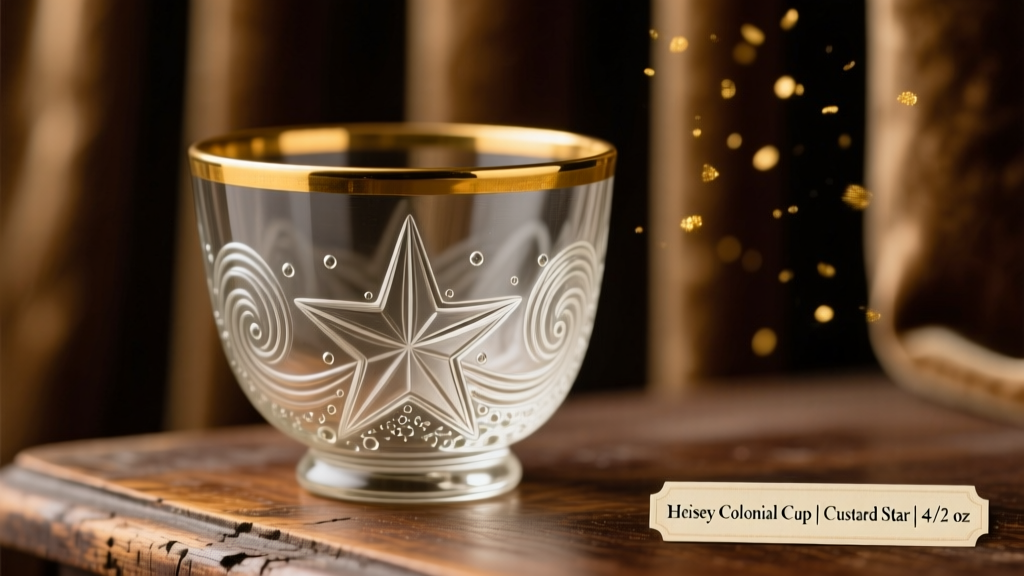
Heisey Colonial Cup in Custard Glass with Star Bottom: A Collector’s Guide to the 4½-Ounce Pattern
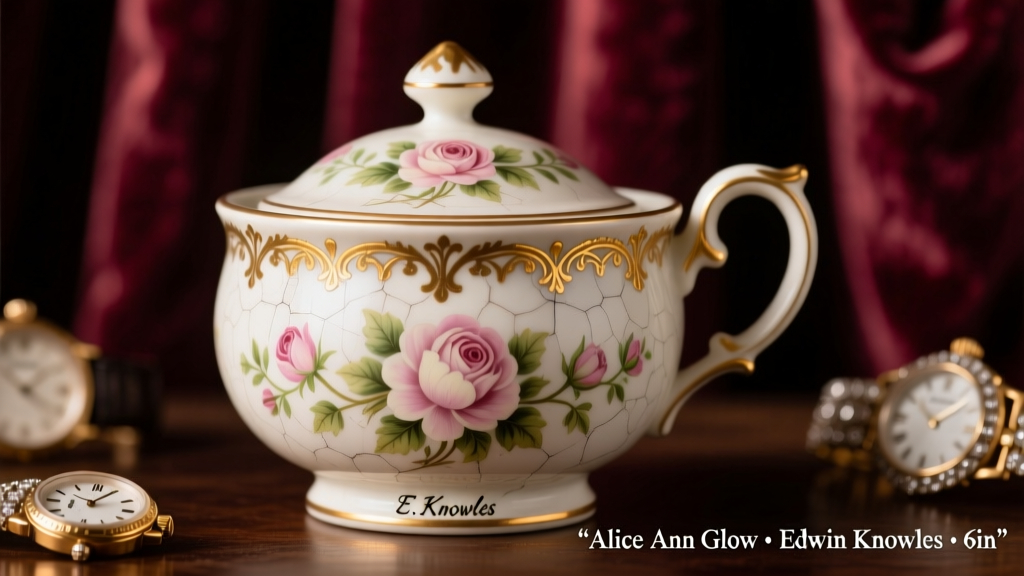
Alice Annglow Sugar Cover by Edwin Knowles: A Collector’s Guide to the Iconic 6-Inch '6 in 2' Design
Royal Doulton Character Jug 'Veteran Motorist' (Large): A Collector’s Guide to Design, Provenance, and Market Value

T & R Boote: The Forgotten London Watchmakers Who Defined Precision in the Edwardian Era

Eskimo-Inspired Geometric Basket: A Study in Arctic Craftsmanship and Mid-Century American Collectibility
Majolica Meaning: History, Craftsmanship, and Collectibility of Victorian Ceramic Art
The Railroad Oil Can Signal: Decoding the D.H. RR Marking and Its Role in American Railroading History
A Masterpiece of French Horology: The 1875 Gilt Brass Mantel Clock with Bell Striking Movement — A Technical and Historical Appraisal
Orphan Annie Book Pop-Up: The Little Orphan Annie Jumbo Edition — A Collector’s Deep Dive