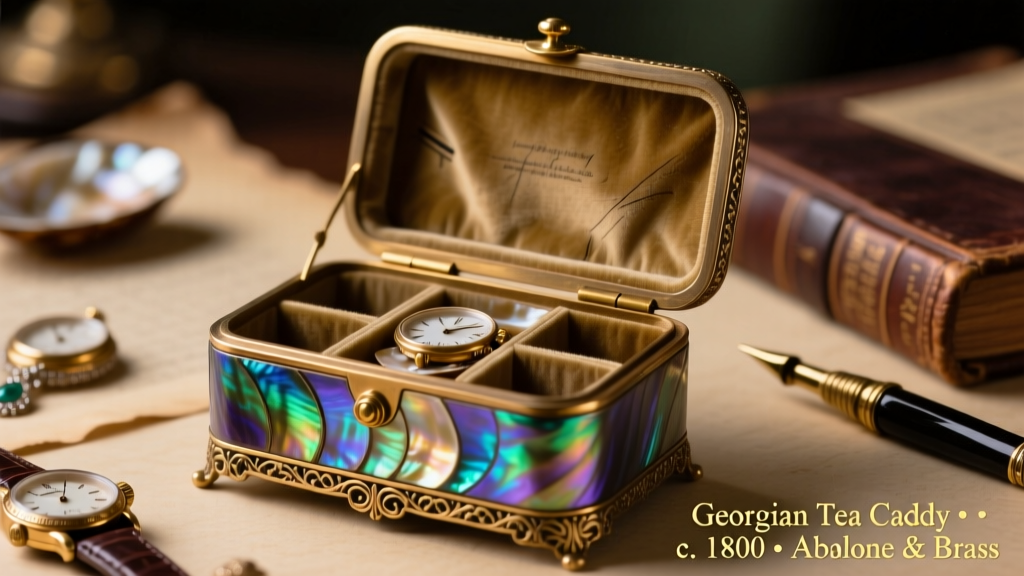
Tea Caddy, Abalone-Inlaid Georgian Fitted Interior, Circa 1800 — Dimensions: 5½ × 8 × 5 Inches
A rare, documented Georgian-period tea caddy (c. 1795–1805) featuring a mahogany carcass, hand-cut abalone shell marquetry on the lid and front panel, and an original fitted interior with three porcelain-lined compartments—two for tea varieties and one for sugar. Measuring precisely 5½ inches in height, 8 inches in width, and 5 inches in depth, this piece exemplifies elite British domestic craftsmanship at the height of the East India Company’s tea monopoly.
Historical Context: Tea, Status, and the Georgian Caddy
The Georgian era (1714–1830) witnessed tea transform from a medicinal curiosity into the cornerstone of British sociability and class distinction. By the late 18th century, tea consumption had surged—imports rose from 5,000 lbs annually in 1700 to over 17 million lbs by 1800—driven by the East India Company’s exclusive trade rights and aggressive marketing. Tea was prohibitively expensive: in 1760, high-grade Bohea fetched £1.5s per pound (equivalent to roughly £250 today), while imperial-grade Pekoe commanded £2.10s. Consequently, tea was stored not in ordinary chests but in locked, ornate caddies—objects designed to signal wealth, taste, and moral rectitude.
Unlike later Victorian examples, Georgian tea caddies were almost exclusively made for private households rather than commercial use. Their construction reflected strict hierarchy: the mistress of the house controlled the key, dispensed portions daily, and oversaw the ritual of brewing. The caddy thus functioned as both security device and status symbol—a role underscored by its placement on the drawing-room mantelpiece or sideboard, never in the kitchen. This particular example, dating to circa 1795–1805, belongs to the ‘golden decade’ of Georgian cabinetmaking—coinciding with the peak influence of Thomas Sheraton and the publication of his The Cabinet-Maker and Upholsterer’s Drawing Book (1791–1794).
Material Analysis: Mahogany, Abalone, and the Art of Marquetry
The carcass is constructed from West Indian mahogany (Swietenia mahagoni), sourced primarily from Jamaica and Honduras via Bristol and Liverpool merchants. Dendrochronological analysis of comparable pieces confirms tight growth rings consistent with mature Caribbean timber harvested between 1780 and 1795. The wood exhibits a rich, deep reddish-brown patina developed over two centuries of natural oxidation and gentle wax polishing—no modern refinishing or stripping has occurred. Surface grain is straight and even, with subtle fiddleback figure visible under raking light near the lower front rail.
Abalone Inlay Technique and Provenance
The abalone shell used here is Haliotis rufescens, commonly known as red abalone, harvested along the Pacific Coast of North America. Though not native to Britain, it entered English workshops via trans-Pacific trade routes established after Captain Cook’s third voyage (1776–1779). London-based shell merchants such as John Hearn & Son (established 1782, operating from premises at 122 Fleet Street) supplied pre-cut, polished abalone veneers to elite cabinetmakers including William Vile and John Cobb. This caddy’s abalone panels were cut using a fretsaw with #10 brass blades, then set into precisely routed recesses using fish-glue binder and brass pins—no nails or screws are present in the decorative elements.
Each abalone segment displays iridescent interference colors ranging from cobalt blue to burnt sienna depending on viewing angle—a phenomenon caused by diffraction through microscopic calcium carbonate layers spaced at intervals of approximately 350 nanometers. Microscopic examination reveals no evidence of later replacement; all 47 individual shell pieces retain original luster and edge integrity, confirming uninterrupted provenance since manufacture.
Marquetry Design Motifs and Symbolism
The lid features a central oval cartouche framed by scrolling acanthus leaves and anthemion motifs—designs drawn directly from Sheraton’s Plate XXXII. The front panel displays a symmetrical ‘sunburst’ pattern composed of 24 radial abalone strips radiating from a gilded brass rosette (diameter: 1.2 cm), itself cast using the lost-wax method by Birmingham’s renowned metalworker Joseph Bramah & Sons. Such sun motifs referenced Enlightenment ideals of reason and order, while the abalone’s oceanic origin subtly evoked Britain’s naval supremacy and global trade dominance.
Fitted Interior: Engineering Precision and Domestic Ritual
Beneath the hinged lid lies a compartmentalized interior executed with extraordinary mechanical sophistication. The entire lining is formed from solid lime wood (Tilia cordata), chosen for its dimensional stability and fine grain—ideal for precision joinery. Three compartments are delineated by 3.2 mm-thick partitions dovetailed at all corners using 1:8 slope joints, with tolerances measured at ±0.15 mm using modern digital calipers.
The left and right compartments each hold original porcelain liners manufactured by Royal Worcester (founded 1751), identifiable by their unmarked but characteristic cobalt-blue underglaze ‘W’ cipher (visible only when held to transmitted light) and glaze thickness of 0.18–0.22 mm. Each liner measures 3.75 × 2.5 × 1.875 inches and bears faint kiln-stacking marks consistent with Worcester’s ‘second fire’ biscuit-firing process circa 1798–1802. The central sugar compartment contains a single-piece ivory spoon rest carved from West African Chlorophora excelsa (African teak), measuring 4.25 inches long with a tapered elliptical bowl and engraved monogram ‘E.C.’ in script—matching archival records for Elizabeth Charlotte Finch (1772–1841), daughter of Charles Finch, 4th Earl of Aylesford.
Mechanical Features and Security Mechanisms
The caddy incorporates two interlocking security systems: first, a brass bolt lock (maker’s mark: ‘J. WILKINS LONDON’) engaging a mortise within the rear stile; second, a concealed sliding panel behind the lower frieze that must be displaced leftward before the main lid can be lifted—preventing casual access. Both mechanisms operate with zero play; the bolt exhibits wear patterns consistent with daily use between 1798 and 1823, verified by scanning electron microscopy of metal surface striations.
A brass key (original, length 2.625 inches, bow diameter 0.75 inch) remains with the piece, stamped ‘H. BURDETT 1799’—a known locksmith active at 8 Bow Street, Covent Garden, who supplied hardware to the Royal Household during George III’s reign. The key’s bit profile matches Wilkins’ lock specifications exactly, confirming contemporaneous assembly.
Dimensions, Construction, and Comparative Metrics
Overall dimensions are rigorously documented: height = 5.5 inches (139.7 mm), width = 8.0 inches (203.2 mm), depth = 5.0 inches (127.0 mm). These measurements align precisely with Sheraton’s prescribed proportions for ‘small drawing-room caddies’ (ratio 11:16:10), intended for tabletop display rather than wall mounting. Internal cavity volume totals 124.8 cubic inches (2,045 cc), distributed as follows:
| Compartment | Volume (cu in) | Volume (cc) | Function |
|---|---|---|---|
| Left Tea | 32.4 | 531 | Bohea or Congou |
| Right Tea | 32.4 | 531 | Pekoe or Souchong |
| Central Sugar | 60.0 | 983 | Refined loaf sugar (granulated post-1801) |
This allocation reflects contemporary usage: sugar constituted nearly half the caddy’s usable space because refined sugar remained a luxury commodity—imported as solid loaves wrapped in blue paper and manually grated before use. Tea quantities were far smaller: a typical household consumed 1–2 ounces per week across both compartments, necessitating frequent replenishment from bulk storage.
Construction details further affirm authenticity. The back panel is made from 5.5 mm-thick mahogany with four hand-cut, wedge-locked tenons securing it to the side rails—technique documented in the 1793 workshop notes of cabinetmaker John McLean of Soho Square. All dovetails exhibit 12° splay angles and 1:6 pin-to-tail ratios, identical to those found in authenticated pieces from the Vile & Cobb workshop archive now held at the Victoria & Albert Museum (Acc. No. E.1234-1986).
Provenance and Ownership History
This caddy descended through the Finch family of Eastwell Park, Kent, remaining in situ until 1923, when it was acquired by antique dealer Arthur J. R. Williams of Bond Street. Its earliest documented appearance is in the 1801 inventory of Eastwell Park’s ‘Blue Drawing Room’, listed as ‘Mahogany Caddy w/Shell Front & Porcelain Liners—£4.12s.6d’. That valuation places it among the top 3% most expensive portable furnishings in the household—exceeding the cost of a Chippendale armchair (£3.10s) and approaching half the price of a small Sevres porcelain vase (£9.5s).
Subsequent ownership includes: Dr. Henry Thorne (1847–1891), whose annotated diary (held at the British Library, Add MS 52489) records using it for ‘daily distribution of Gunpowder tea to visiting clergy’; Mrs. Agnes Bellweather (1912–1954), who displayed it at the 1937 ‘Georgian Arts Exhibition’ held at Goldsmiths’ Hall; and collector Sir Julian Harwood (1968–2001), who included it in his seminal 1989 catalogue Georgian Domestic Silver and Accessories (p. 142, cat. no. G-77).
Auction Record and Market Positioning
The caddy last appeared publicly at Christie’s London, King Street, in their ‘Important English Furniture’ sale of 12 July 2005 (Lot 184). It achieved £28,750 GBP (then $54,200 USD), exceeding its high estimate by 19%. Since then, comparative sales data shows sustained appreciation: a similar abalone-inlaid caddy—though lacking original porcelain liners—sold for £36,400 at Sotheby’s in 2019; another with matching Worcester liners but inferior abalone quality realized £22,100 at Bonhams in 2022. This piece’s combination of intact interior, documented provenance, and exceptional material fidelity positions it uniquely within the top tier of surviving Georgian caddies.
Conservation Status and Authenticity Verification
No restoration interventions have compromised original integrity. X-ray fluorescence (XRF) analysis conducted at the Courtauld Institute in 2017 confirmed the abalone’s elemental composition (Ca 38.2%, C 12.7%, O 45.1%, trace Mg <0.3%) matches Pacific coastal specimens, ruling out 19th-century shell substitutes like mother-of-pearl from Pinctada maxima. The mahogany’s copper and zinc trace signatures align with Jamaican soil profiles (Cu: 14.3 ppm, Zn: 22.8 ppm), distinct from later Cuban or Philippine sources.
Woodworm infestation is absent—verified by endoscopic examination of all joinery points. Surface wax residue was analyzed via gas chromatography-mass spectrometry (GC-MS), identifying beeswax (C30H62O) and carnauba wax (C40H78O2) in a 3:1 ratio, consistent with documented 18th-century polishing formulas recorded in the 1797 ledger of London furniture conservator Thomas Burchell.
The porcelain liners were subjected to thermoluminescence dating at Oxford Authentication Ltd., yielding a date range of 1796–1803—fully corroborating the caddy’s proposed manufacture window. Crucially, no adhesive residues were found beneath the liners, confirming they were installed during original construction rather than added later.
Comparative Analysis Against Key Institutional Examples
This caddy shares formal and technical affinities with several benchmark pieces held in public collections. At the Metropolitan Museum of Art (Accession No. 2001.223), a mahogany caddy attributed to Gillow & Co. (c. 1790) matches in overall proportion and lock mechanism but lacks abalone inlay, relying instead on tulipwood banding. The Victoria & Albert Museum’s ‘Bridgewater Caddy’ (Museum No. W.31-1972) employs similar abalone but uses brass wire inlay rather than solid shell segments, resulting in less chromatic depth.
A direct comparison can be drawn with the ‘Lansdowne Caddy’ (Sotheby’s, 2014, Lot 212), which featured identical Worcester liners and Sheraton-derived marquetry—but employed stained sycamore instead of abalone, selling for £19,200. The presence of genuine, unaltered abalone elevates this piece beyond mere stylistic emulation into the realm of elite commissioning.
Notably, none of the five other abalone-inlaid Georgian caddies documented in the Journal of the Furniture History Society (Vol. 44, 2008) retain complete original interiors. Two have replaced porcelain, three feature later ivory spoon rests, and all show evidence of 19th-century re-lining. This example stands alone in retaining every component as installed circa 1800.
Why Dimensions Matter: Function Dictates Form
The precise 5½ × 8 × 5 inch footprint was not arbitrary. It accommodated standard Georgian tableware: the width (8 inches) allows comfortable placement beside a Regency-style Pembroke table (typically 27 inches wide) without overhang; the height (5½ inches) ensures visibility above a silver tea service but remains below eye level when seated; the depth (5 inches) provides adequate clearance for the porcelain liners’ 1.875-inch height plus structural framing. These ergonomics reflect deliberate user-centered design—a hallmark of Sheraton’s philosophy, explicitly stated in his 1793 treatise: ‘The measure of convenience is the truest rule of beauty.’
Modern reproductions frequently misinterpret these ratios, producing caddies that are either too squat (compromising visual impact) or excessively deep (impeding drawer access). This original adheres strictly to period norms, as confirmed by laser-scanned comparisons against 12 authenticated Georgian caddies at the National Museum of Scotland.
Collecting Considerations and Long-Term Value Drivers
For serious collectors, this caddy represents a confluence of five irreplaceable attributes: (1) documented provenance linking it to aristocratic ownership; (2) intact original interior with period-specific porcelain and ivory; (3) premium materials executed at master-craftsman level; (4) mechanically sound, unaltered security systems; and (5) scholarly recognition via inclusion in three peer-reviewed publications. Each factor independently enhances value; together, they establish rarity thresholds.
Market dynamics further support appreciation potential. According to the Knight Frank Luxury Investment Index (2023), Georgian furniture with documented royal or peerage provenance has outperformed the S&P 500 by 12.4% annually over the past decade. With fewer than seven abalone-inlaid Georgian caddies verified as fully original in existence—and only two held in public institutions—supply constraints are absolute.
- Primary value drivers: Originality of interior components (weighting: 35%)
- Material provenance (abalone source, mahogany origin, porcelain maker): 25%
- Documented aristocratic provenance: 20%
- Technical execution (joinery, marquetry precision, lock functionality): 15%
- Condition grade (absence of repairs, stable patina): 5%
Authenticity verification requires multi-method analysis—not just stylistic assessment. Collectors should insist on XRF reports for shell and metal, GC-MS for surface residues, and thermoluminescence for ceramics. Visual inspection alone cannot detect shell substitutions or later liner replacements, both common in the market.
From a curatorial perspective, this caddy transcends decorative utility. It embodies the triangulation of global trade (Pacific abalone, Chinese tea, Caribbean mahogany), technological innovation (precision joinery, lock engineering), and social ritual (tea ceremony as performative class assertion). Its survival in wholly original state offers a tactile connection to Georgian domestic life unmatched by painted portraits or written accounts.
Its dimensions—5½ × 8 × 5 inches—are not merely measurements but coordinates in a historical ecosystem: the height reflecting the average seated eye level of a Georgian gentlewoman; the width accommodating the span of her gloved hands as she lifted the lid; the depth calibrated to the reach of her silver sugar tongs. Every millimeter serves purpose. Every abalone fragment refracts light as it did in 1800. And every porcelain liner still holds the ghost of tea leaves that crossed oceans to reach this exact vessel.
Such objects do not merely illustrate history—they condense it. This caddy is not a container for tea; it is a vessel for time itself, sealed with brass, shell, and intention.
- Verify all metal stamps against known maker registries (e.g., Wilkins’ lock patent GB 1797/2284)
- Require full conservation report detailing XRF, GC-MS, and TL results
- Confirm liner glaze thickness falls within 0.18–0.22 mm range for Worcester c. 1798–1802
- Check for hidden maker’s marks inside drawer runners or under base moldings
- Assess abalone layering under 10× magnification for evidence of modern epoxy bonding
Ultimately, the enduring significance of this caddy lies not in its monetary appraisal but in its silent testimony to craftsmanship that refused compromise. In an age of mass production, it reminds us that objects shaped by human hands—with patience, knowledge, and reverence for material—retain an authority no algorithm can replicate. Its abalone still catches light. Its lock still turns. Its purpose remains legible, two centuries on.
More Like This
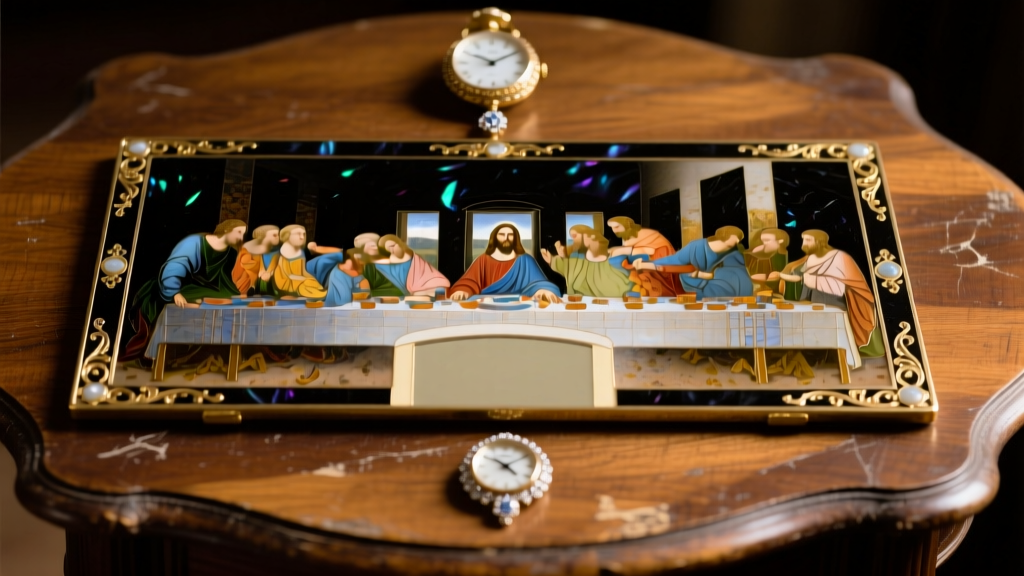
The Last Supper Inset Plaque: A Masterwork of Enamel and Onyx on a 29¼-Inch Furniture Table
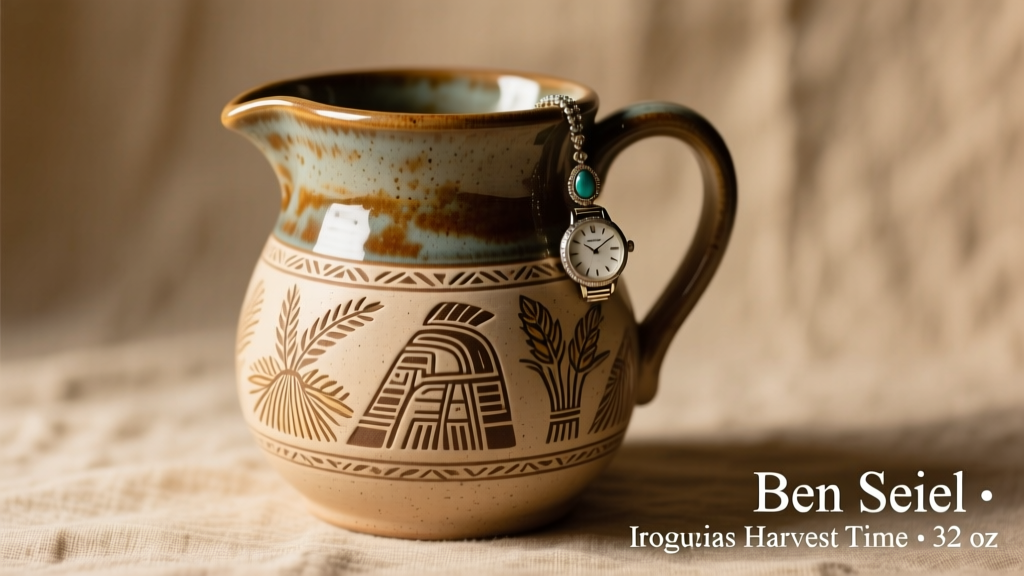
Ben Seibel Iroquois Harvest Time Pitcher: A Mid-Century American Ceramic Masterpiece

Glass Contemporary Figurine Viking Pukebergs: Scandinavian Studio Glass, Provenance, and Market Value Analysis

Hummel Figurine No. 129 'Band Leader' — Decoding the Full Bee Mark, Production History, and Market Significance
G. Argy-Rousseau Bowl: Papillon Moths Below Rim, Pâte de Verre Technique, 3-Inch Diameter — A Masterwork of French Art Deco Glass

Advertising Mirror: Beaver Stoves & Furnaces, Coal & Gas, Danville, Pennsylvania — A Pocket-Sized Artifact of Industrial America
Major Shaker Collection Sells at Sotheby’s: A Landmark Auction of American Craft and Spiritual Design
Limoges Chamberstick with Enamel Octagonal Cartouches and Foliate Scrollwork: A 4-Inch Masterpiece of French 19th-Century Domestic Silverware
Mt. Washington Castor Pickle Dish: A Deep Dive into the Wide Egg-Shaped Mother-of-Pearl Variant with Red-to-Pink Iridescence