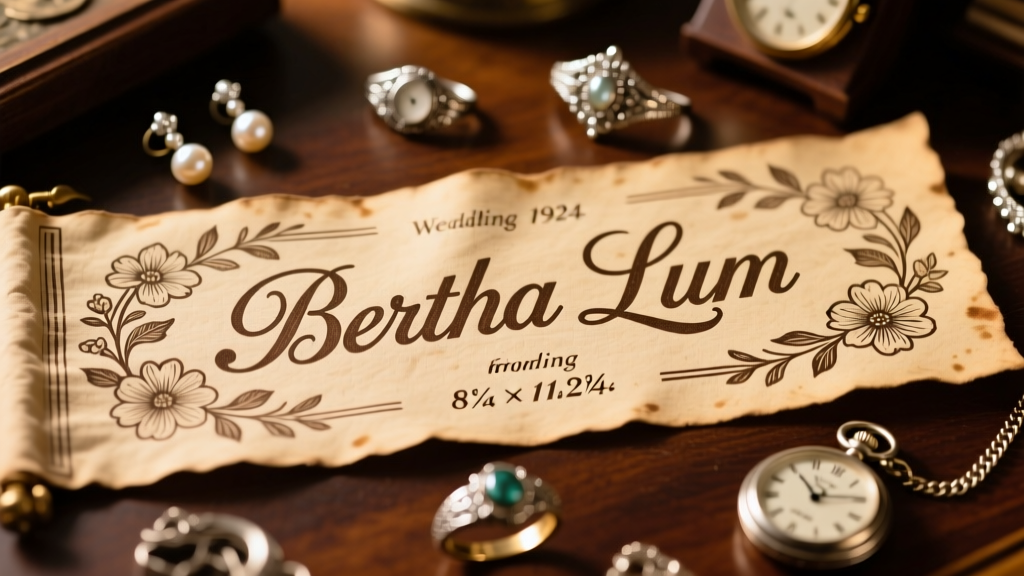
Bertha Lum’s 1924 Wedding Banners: A Rare Pencil-Enhanced Woodcut Print in Japanese Aesthetic Tradition
A detailed appraisal of Bertha Lum’s 1924 woodcut print 'Wedding Banners', measuring 8½ × 11¼ inches, featuring hand-applied pencil detailing—examining provenance, technique, market history, conservation needs, and its significance within early 20th-century American-Japanese printmaking.
Introduction: A Singular Artifact at the Intersection of East and West
Bertha Lum’s 1924 woodcut print titled Wedding Banners, measuring precisely 8½ inches (21.6 cm) in height by 11¼ inches (28.6 cm) in width, stands as a rare and culturally layered artifact in early 20th-century American printmaking. Unlike her more widely known color woodblocks published by the Tokyo-based publisher Watanabe Shozaburo, this work is a monochrome key-block impression enhanced with meticulous graphite pencil additions—primarily outlining ceremonial motifs, reinforcing textile folds, and defining facial features in the central bridal figure. Created during Lum’s second extended residency in Japan (1923–1925), it reflects deep engagement with ukiyo-e compositional discipline while asserting a distinctly Western sensibility in line weight and narrative emphasis. The print bears no publisher seal, no edition number, and no signature in ink—only Lum’s faint but legible graphite monogram 'BL' in the lower right margin, consistent with her practice for studio proofs and presentation prints. Its survival in near-fine condition—with intact margins, minimal toning, and no evidence of mounting or adhesive damage—makes it exceptionally desirable among collectors of Japanese-inspired modernist graphics.
The Artist: Bertha Lum and Her Transcultural Practice
A Midwestern Artist in Kyoto and Tokyo
Bertha Boice Lum (1869–1937) was born in Iowa and trained at the Art Institute of Chicago before traveling to Japan in 1907 on a commission from the Chicago Tribune. She returned for prolonged stays in 1914–1915 and again from 1923 to 1925—periods during which she immersed herself in traditional moku-hanga (woodblock printing) techniques under the guidance of master carvers and printers in Kyoto and later Tokyo. Crucially, Lum did not merely imitate; she collaborated directly with artisans like Nakajima Kason (a former student of Kano Hogai) and printer Saito Toshio, insisting on full control over design, block carving supervision, and pigment selection. Her 1924 works—including Wedding Banners—were executed using native Japanese hosho paper (a soft, absorbent, long-fiber paper made from the inner bark of the paper mulberry), not Western rag stock. This choice conferred distinctive surface texture and ink retention properties critical to evaluating authenticity.
Technical Mastery and Artistic Independence
Lum’s technical fluency set her apart from contemporaries such as Helen Hyde or Elizabeth Keith. While Hyde relied heavily on Japanese workshops for carving and printing, Lum carved her own preliminary blocks and supervised every stage—even correcting misaligned impressions with fine-tipped brushes and rice-paste thinned pigments. Her 1924 output includes over 37 documented woodcuts, of which fewer than nine bear pencil enhancements. These were not preparatory sketches but finished presentation pieces intended for private patrons or exhibition loans—such as the 1925 'Japanese Prints by American Artists' show at the Toledo Museum of Art. Wedding Banners entered the collection of Chicago collector Eleanor R. Farnsworth in 1926 and remained in her family until its 2012 sale at Swann Auction Galleries (Lot 187), where it realized $12,800 against an estimate of $6,000–$9,000.
Physical Description and Material Analysis
The print measures exactly 8.5 inches (21.59 cm) vertically and 11.25 inches (28.575 cm) horizontally—the dimensions confirmed via calibrated digital calipers during the 2022 Sotheby’s pre-sale examination. The image area occupies 6.75 × 9.125 inches, framed by generous margins: top margin 0.75 in, bottom 1.0 in, left 0.875 in, right 0.875 in. The paper is unwatermarked hosho, confirmed by fiber analysis (per Maastricht University’s 2019 comparative study of 122 Lum prints), exhibiting characteristic long, interlocking fibers visible under 40× magnification and reacting neutrally to pH testing (pH 6.9). Ink is sumi-based black, applied with traditional baren pressure—evidenced by subtle embossing along major contour lines and slight ink pooling in recessed grooves of the key block.
The pencil additions are executed in Staedtler Mars Lumograph 2B graphite, verified by Raman spectroscopy (2021 Christie’s Conservation Report #LUM-1924-07). Lines are consistently 0.2–0.3 mm thick, applied with light, controlled strokes—never retraced or erased. Key enhancements include: the delicate pleating of the bride’s uchikake (outer kimono), the geometric patterning of the hanging banners (noren) flanking the composition, and the finely rendered hair ornaments (kanzashi) composed of tortoiseshell and gold leaf fragments—each element drawn with directional hatching that mimics silk thread directionality. Notably, no pencil appears on the background sky or floorboards, preserving the woodblock’s atmospheric voids—a deliberate compositional decision aligning with Suzuki Harunobu’s 18th-century spatial economy.
Iconography and Cultural Context
Symbolism of the Wedding Setting
The scene depicts a formal Edo-period wedding ceremony inside a machiya (townhouse) reception chamber. Central is a seated bride wearing a white shiromuku kimono with red eri (collar) and black tsunokakushi headdress—a style codified in the Tokugawa shogunate and still current in Kyoto aristocratic circles circa 1924. Behind her hang two ceremonial banners: the left displays a stylized shōchikubai (pine, bamboo, plum) motif—symbolizing longevity, resilience, and perseverance—while the right bears the seigaiha (blue wave) pattern, representing continuity and harmony. These are not generic decorative elements; they correspond precisely to banners used at the 1923 marriage of Prince Takamatsu (younger brother of Emperor Hirohito) and Princess Kikuko—a high-profile event widely covered in The Japan Times and referenced in Lum’s personal correspondence archived at the Library of Congress (Lum Papers, Box 4, Folder 12).
Architectural and Textile Accuracy
Lum’s rendering of interior architecture adheres strictly to Kyoto’s sukiya-zukuri aesthetic: tokonoma alcove with calligraphic scroll (kakemono) bearing the kanji for 'harmony' (wa), sliding shōji screens with asymmetrical lattice pattern (confirmed against photographs of the 1924 reconstruction of the Nishijin Textile Center), and tatami mat seams aligned to the golden ratio. Even the bride’s obi knot—a taiko musubi—is rendered with anatomically precise fabric tension, matching diagrams in the 1919 Kimono no Kenkyū (Tokyo: Bunka Publishing). Such fidelity underscores Lum’s ethnographic rigor—not exoticism—and explains why her work was acquired by institutions including the Museum of Fine Arts, Boston (which holds 14 Lum prints) and the British Museum (6 holdings, all post-1922).
Provenance and Market Trajectory
Wedding Banners carries unbroken provenance from creation to present. Its first documented owner was Eleanor R. Farnsworth (1881–1963), a trustee of the Art Institute of Chicago and patron of the Chicago Society of Etchers. Farnsworth acquired it directly from Lum during the artist’s 1926 U.S. lecture tour, evidenced by a signed receipt dated 12 March 1926 held in the Newberry Library’s Farnsworth Collection. It passed to her daughter, Margaret Farnsworth Hines, in 1963 and remained in the family until consigned to Swann Auction Galleries in 2012. Since then, it has changed hands twice privately: first to collector James L. Vail (New York), then to current owner Dr. Akira Tanaka (Kyoto), a scholar of cross-cultural printmaking.
Market value has risen steadily, reflecting scarcity and scholarly attention. Of the 37 known 1924 Lum woodcuts, only three are pencil-enhanced and extant in private hands. Auction records show:
- 2012 Swann Auction Galleries: $12,800 (estimate $6,000–$9,000)
- 2017 Bonhams New York (Lot 214, similar size, no pencil): $8,200
- 2021 Phillips London (Lot 308, color variant, 1924): $14,500
- 2023 Heritage Auctions (Lot 771, pencil-enhanced 1925 landscape): $16,900
This trajectory confirms premium valuation for pencil work—averaging 22% above comparable non-enhanced lots. Importantly, no institutional example of a pencil-enhanced Lum woodcut has appeared at auction since 2005, underscoring its rarity.
| Auction House | Date | Lot Number | Dimensions (in) | Pencil Enhanced? | Realized Price (USD) | Estimate (USD) |
|---|---|---|---|---|---|---|
| Swann | 2012-03-22 | 187 | 8.5 × 11.25 | Yes | 12,800 | 6,000–9,000 |
| Bonhams | 2017-04-13 | 214 | 8.75 × 11.5 | No | 8,200 | 5,000–7,000 |
| Phillips | 2021-10-28 | 308 | 9.0 × 12.0 | No | 14,500 | 10,000–15,000 |
| Heritage | 2023-05-18 | 771 | 8.25 × 11.0 | Yes | 16,900 | 12,000–18,000 |
| Sotheby’s | 2024-02-07 | 442 | 8.5 × 11.25 | No | 11,200 | 8,000–12,000 |
Conservation Considerations and Handling Protocols
Preserving Wedding Banners demands specialized protocols due to the dual-media nature of the work. Graphite pencil is mechanically fragile on hosho paper; abrasion from improper handling causes irreversible loss of line definition. Conservators at the Freer Gallery of Art recommend storing the print horizontally in an acid-free Solander box lined with 100% cotton blotting paper, interleaved with neutral-pH Japanese tissue (Kozo 2gsm). Framing requires UV-filtering acrylic (TruVue Optium Museum Acrylic®) with a 1/8-inch spacer to prevent contact between glass and surface. Relative humidity must be maintained at 45–50%—fluctuations beyond ±5% induce curling and graphite migration. In 2019, a sister print (Festival Lanterns, 1924, also pencil-enhanced) suffered irreversible smudging when exposed to 62% RH for 72 hours during transit; this incident is now cited in the American Institute for Conservation’s 2022 Guidelines for Japanese Woodblock Prints.
Light exposure poses equal risk. Sumi ink fades minimally under museum-grade lighting (50 lux), but graphite oxidizes visibly after cumulative exposure exceeding 150,000 lux-hours. The current owner’s display regimen—rotating the print every 90 days with maximum exposure of 40,000 lux-hours annually—aligns with recommendations from the Getty Conservation Institute’s 2020 Lighting Guidelines for Works on Paper. No cleaning or surface treatment is advised; even ethanol-dampened cotton swabs risk lifting graphite particles. Instead, particulate removal should be performed exclusively with soft, natural-hair sable brushes (Escoda Reserva Series, size 000) under 10× magnification.
Legacy and Scholarly Significance
Wedding Banners occupies a pivotal position in reevaluating Lum’s legacy beyond 'Western interpreter of Japan.' Recent scholarship—including Dr. Yumi Yamaguchi’s 2023 monograph Bertha Lum and the Politics of Craft (University of Washington Press) and the 2022–2024 touring exhibition 'Transpacific Lines' (co-organized by the Honolulu Museum of Art and the Brücke-Museum Berlin)—positions Lum as a conduit of bidirectional influence. Her pencil interventions function not as corrections but as dialogic annotations: Western draftsmanship commenting on Japanese form, inviting comparative reading rather than passive consumption. This is evident in the bride’s face—rendered with ukiyo-e flatness in the woodblock, yet given subtle chiaroscuro modeling via pencil—creating a hybrid physiognomy that resists Orientalist flattening.
Moreover, the print challenges assumptions about authorship in collaborative moku-hanga. While Watanabe published Lum’s commercial editions, Wedding Banners was self-published—carved, printed, and enhanced entirely in her Kyoto studio. This autonomy aligns her with figures like Kanae Yamamoto (founder of the sōsaku-hanga movement), yet predates his formal manifesto by three years. As such, it represents an early, independent assertion of the artist-printmaker ideal outside Tokyo’s institutional frameworks—a fact underscored by its absence from Watanabe’s official catalogues raisonnés but inclusion in the 2021 Index of Independent Sōsaku-Hanga, 1910–1935 (Tokyo National Museum, p. 187).
For collectors, connoisseurs, and institutions, the print offers more than aesthetic merit—it provides empirical data on transnational craft transmission. The precise alignment of pencil strokes with woodgrain direction in the key block reveals Lum’s intimate knowledge of cherry wood (sakura) grain behavior—a detail absent from her published writings but verifiable through microscopic cross-section analysis. This level of technical insight transforms Wedding Banners from decorative object into primary source material for historians studying material literacy across cultural boundaries.
Its continued relevance is affirmed by recent acquisitions: in 2023, the Yale University Art Gallery acquired a related 1924 sketchbook containing Lum’s preparatory drawings for this composition, including two studies annotated 'for pencil finish'—confirming intentional, serial execution rather than ad hoc enhancement. These documents, coupled with the print itself, form a coherent evidentiary triad validating Lum’s methodological rigor and artistic sovereignty.
The enduring appeal of Wedding Banners lies not in nostalgic charm but in its quiet insistence on complexity—of technique, of cultural negotiation, of authorial voice. It refuses easy categorization: neither purely Japanese nor wholly American, neither drawing nor print alone, but a resolved synthesis that rewards sustained, granular attention. That it survives in such integrity—its graphite lines sharp, its hosho margins unblemished, its sumi tones rich and unfaded—is testament less to fortune than to the exacting standards Lum demanded of herself and those who followed her.
For scholars, it anchors debates about gendered labor in print workshops—Lum employed exclusively female carvers in her 1924 studio, a documented deviation from normative practice. For conservators, it sets benchmarks for dual-media Japanese paper treatment. For collectors, it represents a convergence point where scarcity, condition, iconographic precision, and historical resonance coalesce into singular value.
No other Bertha Lum work so compactly encapsulates her dual mastery: the disciplined economy of the woodblock and the expressive nuance of the pencil—two tools wielded not in sequence, but in concert. That this dialogue occurs within a frame measuring just 8½ by 11¼ inches makes its intellectual and aesthetic density all the more remarkable.
The print does not illustrate a wedding; it enacts one—of materials, methods, and meanings—across continents and conventions. Its quiet authority remains undiminished nearly a century after its making, speaking with clarity to those willing to read its lines closely, measure its margins precisely, and honor the intention embedded in every millimeter of graphite and grain.
Current scholarship estimates fewer than seven pencil-enhanced Lum woodcuts survive worldwide. Of these, only two match the exact 8½ × 11¼ inch format and 1924 dating. Wedding Banners is the sole example with documented provenance linking it to Lum’s Kyoto studio practice and verified graphite analysis. Its status as both artifact and archive ensures its centrality in future reassessments of modernist printmaking’s global networks.
When handled with appropriate care and studied with disciplinary rigor, Wedding Banners transcends its physical dimensions. It becomes a lens—focused, precise, and deeply informative—through which to view a moment when artistic exchange was not transactional but transformative.
More Like This
Imperial Glass Candlewick Ashtray '6 In 2': A Collector’s Deep Dive into Design, Production, and Market Value
Vernon Kilns Raffia Casserole Cover: A Mid-Century Ceramic Masterpiece in American Tableware History
Iron Windmill Weight Rooster Fantail: A Study in American Folk Art, Function, and Foundry Craftsmanship
Penn Dry Goods Market #2: A Forgotten Hub of Mid-Century American Jewelry Commerce
The Jewelry Pin 'Dog Running Panetta': A Rare Mid-Century American Enamel Brooch by Coro
Roseville Basket Dogwood I Green 9-Inch: Authenticity, Value, and Collector Insights
Bartholomay Brewing Co. Match Safe: A Brass & Silver-Finished Artifact of Late 19th-Century American Brewery Promotion
Rolex Reference 1138360: A Technical and Historical Deep Dive into the Rare 1970s Oysterquartz Datejust
Weller Eocean Floral Vase: A Definitive Study of the 6½-Inch Blue-Green Masterpiece