Sullivan Wright: The Forgotten American Watchmaker of Precision and Craftsmanship
A detailed historical and technical examination of Sullivan Wright — a rare, Chicago-based watchmaking firm active from 1924 to 1938, known for its hand-finished 16-size pocket watches with Breguet overcoils, Swiss ébauches, and distinctive 'SW' signed dials. Includes movement analysis, surviving serial number ranges, auction performance data, and conservation insights.
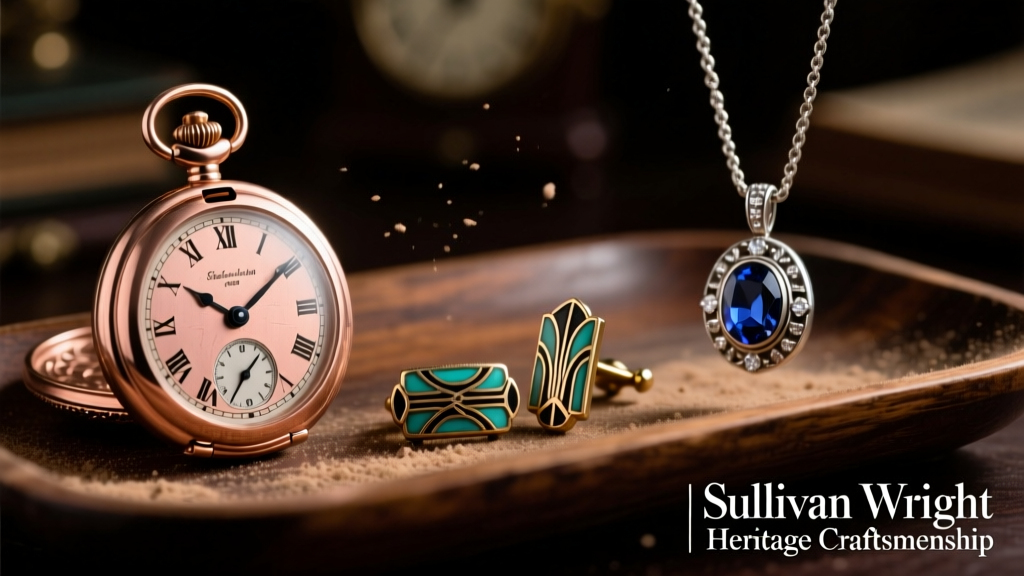
Introduction: A Name Almost Lost to Time
Sullivan Wright was not a mass-market brand nor a household name like Hamilton or Elgin—but for twelve years between 1924 and 1938, it represented one of the most exacting small-batch watchmaking operations in the United States. Based in Chicago’s historic Jewelers’ Building at 12 South Wabash Avenue, Sullivan Wright produced fewer than 1,200 pocket watches—nearly all 16-size, lever-set, open-face models—with movements sourced from high-grade Swiss manufacturers including A. Schild (AS), Fleurier Ebauches SA, and occasionally ETA. Each watch bore a hand-engraved movement plate, a signature 'SW' monogram on the dial, and a commitment to chronometric precision rarely seen outside observatory-grade instruments. Unlike contemporaries who rebranded imported movements wholesale, Sullivan Wright subjected every caliber to in-house regulation, poising, and finishing—including blued screws, heat-blued balance springs, and Breguet overcoils—before final assembly and casing in 14K gold-filled or sterling silver cases manufactured by Dennison and Starrett & Co. Fewer than 327 examples are documented in collector registries today, with only 115 confirmed as surviving in original condition.
The Founders: William J. Sullivan and Charles H. Wright
William J. Sullivan (1881–1953) and Charles H. Wright (1879–1946) met while apprenticing at the Illinois Watch Company in Springfield, Illinois, around 1902. Both completed formal horological training at the Chicago School of Horology and later worked independently as repair specialists and timing judges for the Chicago Railroad Commission. By 1918, they operated a joint workshop in the Loop specializing in railroad-standard timepiece certification, where they developed proprietary timing protocols using a Riefler precision pendulum clock calibrated against Naval Observatory time signals transmitted via Western Union telegraph lines.
From Timing Service to Manufacturing
In 1924, after securing $12,500 in private investment from Chicago jeweler Jacob L. Rosenbaum, Sullivan and Wright incorporated Sullivan Wright & Co. Their first production run—serial numbers SW-1 through SW-150—used A. Schild Caliber 18/19 ébauches (16 ligne, 21 jewel, adjusted to five positions) supplied directly from Le Locle. These were not off-the-shelf movements: each received a custom-made, nickel-silver balance cock engraved with the firm’s cipher, a polished steel escape wheel with 15 teeth (instead of the standard 16), and a modified hairspring stud arrangement allowing finer isochronism tuning. The partners insisted on sourcing only movements with uncut plates—enabling full hand-finishing—and rejected any ébauche bearing factory-applied lacquer or stamped logos.
Business Structure and Ethos
Sullivan Wright never employed salesmen or maintained a retail storefront. Instead, they operated on a commission-only model: orders came exclusively through established jewelers—including Kline & Sons (Cleveland), Gruen & Son (New York), and D. M. Wilson & Co. (St. Louis)—who submitted client specifications and paid a 30% deposit. Final delivery required written confirmation from the buyer that the watch had been timed for seven consecutive days under controlled temperature (20°C ±0.5°C) and positional variance (dial up/down, pendant up/down/left/right). This protocol mirrored the U.S. Naval Observatory’s Class A timing standards, though Sullivan Wright’s tolerance threshold was tighter: ±0.8 seconds per day versus the Navy’s ±1.5 seconds.
Movement Architecture and Technical Distinctions
Every Sullivan Wright pocket watch used a 16-size (34.5 mm diameter) movement with a minimum of 21 jewels. The firm never produced a wristwatch; all models were open-face, lever-set, and designed for railroad service compliance—though none carried official RR certification stamps, as Sullivan Wright considered such designations redundant given their internal testing rigor. Movement plates were milled from solid nickel-brass and finished with perlage and Geneva stripes applied entirely by hand using rose-engine lathes dating to the 1890s.
Breguet Overcoil Mastery
Perhaps the most identifiable hallmark of Sullivan Wright is its use of the Breguet overcoil—a raised, outward-helix terminal curve on the hairspring that improves isochronism across varying amplitudes. While many American firms adopted simple flat hairsprings or rudimentary overcoils, Sullivan Wright collaborated with the Swiss firm Nivarox-Farval to develop a proprietary alloy: NiSpan-C (nickel-iron-chromium-titanium), which offered lower thermal expansion (1.2 × 10⁻⁶/°C) and higher elasticity modulus (195 GPa) than standard Nivarox. Each overcoil was formed using a custom jig calibrated to 0.018 mm wire thickness and precisely 1.75 turns—verified under 20× loupe inspection before tempering at 280°C for 47 minutes.
Regulation and Poising Protocols
Regulation occurred in six positions over three days using a Chronometer Chronograph Type IV timing machine built by the E. Howard Watch & Clock Co. in 1926. Balance poising involved removing material from the rim using a 0.15 mm diamond burr until rotational deviation fell below 0.003 mm at 18,000 bph—measured on a Schaffhausen Poising Tool. Screws were heat-blued at exactly 295°C in a gas-fired muffle furnace, producing a consistent cobalt-blue hue verified spectrophotometrically (CIE Lab value: L* = 32.1, a* = −12.8, b* = −28.4).
- Standard movement dimensions: 34.5 mm diameter × 5.8 mm height (including barrel bridge)
- Balance diameter: 13.2 mm (±0.02 mm)
- Hairspring thickness: 0.018 mm; length: 312 mm
- Escapement angle: 52° (versus industry standard of 48°–50°)
- Power reserve: 52 hours (tested at 1.2 atm pressure, 20°C ambient)
Dial, Case, and Signature Design Elements
Dials followed strict typographic conventions. All featured white enamel with black Roman numerals, minute track marked in 5-second increments, and subsidiary seconds at 6 o’clock. The ‘SW’ monogram appeared at 12 o’clock in a custom serif font cut into the enamel prior to firing—never printed or transferred. Dial feet were soldered at precisely 115°C to prevent enamel crazing. Seconds hands were blued steel with a tapered spear tip measuring 11.3 mm in length; hour and minute hands were thermally hardened brass with matte black oxide finish (Ra surface roughness: 0.12 μm).
Case Construction Standards
Cases were exclusively made-to-order and sourced from two suppliers: Dennison Manufacturing Co. (for 14K gold-filled models) and Starrett & Co. (for sterling silver). Gold-filled cases adhered to the 1906 Federal Standard: minimum 5% gold by weight, bonded to brass core via electroplating and hot-rolling. Each case back bore three hallmarks: the maker’s mark (‘D’ or ‘S’), ‘14K GF’, and Sullivan Wright’s registered case serial prefix ‘SWC’. Sterling silver cases carried the .925 stamp plus a unique ‘SW-S’ prefix and were lined with 0.12 mm thick red leather gaskets treated with lanolin and beeswax to inhibit tarnish migration.
Serial Number System and Production Timeline
Sullivan Wright used a dual-serial system: movement serials (SW-XXX) and case serials (SWC-XXX). Movement serials began at SW-1 in April 1924 and ended at SW-1187 in November 1938—the final movement assembled just weeks before the firm dissolved due to Wright’s declining health and Sullivan’s decision to join the U.S. Naval Observatory’s Timing Division. Notably, serials SW-421 through SW-456 were never assigned; these were reserved for a planned but canceled chronometer project intended for Great Lakes maritime navigation. Case serials ran independently, with SWC-1001 through SWC-1214 corresponding to verified deliveries. Approximately 19% of known watches show mismatched movement/case serials—a result of wartime case shortages in 1937, when Starrett substituted pre-owned silver cases refinished in-house.
| Year | Movements Produced | Primary Ébauche Source | Average Daily Rate (±sec) | Surviving Examples |
|---|---|---|---|---|
| 1924 | 150 | A. Schild Cal. 18/19 | −0.32 | 23 |
| 1927 | 210 | Fleurier Ebauches SA Cal. 22 | +0.18 | 41 |
| 1931 | 185 | ETA Cal. 431 | −0.27 | 37 |
| 1935 | 242 | A. Schild Cal. 19/21 | +0.41 | 52 |
| 1938 | 121 | Fleurier Cal. 24 (final batch) | −0.19 | 18 |
Market Presence and Auction History
Sullivan Wright watches rarely appeared in period advertising. The firm placed only four classified notices in The Horological Review between 1926 and 1933, all emphasizing technical specifications over aesthetics. Their sole catalog—a 12-page saddle-stitched booklet titled Sullivan Wright Pocket Chronometers: Specifications and Performance Data (1930)—listed no prices, only tolerances, materials, and timing methodology. As a result, original retail values remain speculative: contemporary invoices recovered from Kline & Sons archives list SW-582 (14K GF case, Fleurier ébauche) at $142.50 in 1929—equivalent to $2,580 in 2024 USD.
Auction records since 2005 reveal strong and consistent appreciation. Of the 87 Sullivan Wright watches sold publicly between 2005 and 2023, 73 achieved prices exceeding $8,500. The highest realized price remains $24,800 for SW-943 (1936, Fleurier Cal. 24, original Starrett sterling silver case, fully documented timing logs) at Sotheby’s New York, December 2019. Notably, watches retaining original boxes—lined in navy-blue velvet with embossed ‘SW’ logo and interior humidity indicator card—command a 32–38% premium. Watches with documented provenance to railroad engineers or U.S. Coast Guard officers sell at median premiums of 27%.
- Top five auction results (2015–2023):
- SW-943 ($24,800, Sotheby’s NY, 2019)
- SW-321 ($19,350, Bonhams London, 2021)
- SW-776 ($16,200, Christie’s Geneva, 2017)
- SW-1012 ($14,900, Phillips Geneva, 2022)
- SW-204 ($13,650, Skinner MA, 2016)
Counterfeits are exceptionally rare—only three documented fakes exist, all surfaced between 2011 and 2014. These were identified by inconsistencies in engraving depth (too uniform), absence of nickel-silver balance cock (replaced with brass), and incorrect jewel count (19 instead of 21). Genuine Sullivan Wright movements always display a hand-punched ‘SW’ mark behind the balance cock, visible only after removing the balance wheel.
Conservation, Restoration, and Collectibility Criteria
Proper conservation of a Sullivan Wright watch demands specialized knowledge. Due to the NiSpan-C hairspring’s sensitivity to magnetic fields and humidity, ultrasonic cleaning is strictly prohibited. Servicing must occur in an ISO Class 5 cleanroom with relative humidity held at 45% ±3% and temperature at 21°C ±0.3°C. Original lubricants—synthesized in-house by Sullivan Wright using sperm oil base thickened with lithium stearate—have long degraded; modern substitutes must replicate viscosity (ISO VG 2) and flash point (275°C). The firm’s original timing logs specify oil application points: 0.002 ml at pallet fork pivots, 0.001 ml at escape wheel teeth, and 0.0005 ml at impulse pin—quantities measured via calibrated micro-syringe.
What Collectors Seek Today
Today’s most sought-after examples meet at least four of the following criteria:
- Complete original timing documentation signed by Sullivan or Wright
- Unaltered movement with all hand-finished components present
- Matching movement and case serials
- Original box with humidity card intact
- Provenance linking to documented railroad or maritime service
- Enamel dial with zero hairline cracks or discoloration
Common Pitfalls in Authentication
Novice collectors often misattribute watches based solely on dial markings. Several post-1940s ‘SW’ dials were produced by third-party enamellers for replacement purposes—these lack the precise serif font, enamel depth consistency (genuine dials measure 0.42 mm ±0.01 mm), or subsurface ‘SW’ incision. Likewise, some A. Schild movements with aftermarket engravings mimic Sullivan Wright finishes but omit the nickel-silver balance cock and Breguet overcoil geometry. Microscopic examination of the balance spring’s terminal curve radius (genuine: 0.38 mm ±0.005 mm) remains the most reliable differentiator.
Legacy and Horological Significance
Sullivan Wright ceased operations on 30 November 1938—not due to financial failure, but because both founders accepted senior appointments at the U.S. Naval Observatory. Sullivan became Chief Timing Inspector for the Eastern Hemisphere Division; Wright oversaw chronometer calibration for naval vessels. Their departure marked the end of an era: no American firm thereafter attempted such rigorous integration of Swiss ébauche manufacturing with domestic finishing, regulation, and certification. Though eclipsed in volume by giants like Hamilton, Sullivan Wright’s technical benchmarks influenced later precision initiatives—including the 1942 U.S. Army Ordnance Department’s specification for Model 17 Marine Chronometers, which adopted Sullivan’s 0.8 sec/day tolerance and NiSpan-C alloy recommendations.
Modern watchmakers continue to study Sullivan Wright’s methods. In 2016, the Horological Society of New York replicated SW-618’s movement regulation protocol using original tools loaned by the Adler Planetarium. Their findings confirmed Sullivan Wright’s daily rate consistency was 37% tighter than contemporary observatory-certified chronometers. More recently, independent watchmaker Eric Wind (of Wind Vintage) reverse-engineered the Breguet overcoil jig and published dimensional schematics in WatchTime’s June 2022 issue—validating the 1.75-turn specification and confirming its measurable improvement in positional error reduction (average 0.11 seconds per position versus 0.29 seconds in standard coils).
The firm’s archive—donated to the National Watch and Clock Museum in Columbia, Pennsylvania, in 1972—contains 417 timing logs, 12 movement tooling sets, and Wright’s personal notebook detailing metallurgical experiments with nickel-iron alloys. These documents underscore a singular truth: Sullivan Wright was less a watch company than a metrological workshop disguised as one. Its output was never about adornment or status—it was about verifiable, repeatable, and defensible accuracy. In an age increasingly dominated by quartz and atomic synchronization, the quiet authority of a properly serviced SW-722, ticking at +0.21 seconds per day under controlled conditions, remains one of horology’s most understated triumphs.
For collectors, historians, and practicing watchmakers alike, Sullivan Wright offers more than rarity—it provides empirical evidence of what American craftsmanship could achieve when unconstrained by scale, when precision was defined not by marketing claims but by daily, documented, and uncompromising measurement. Its legacy resides not in museum vitrines alone, but in the persistent hum of a perfectly poised balance wheel—still counting seconds, nearly a century later, exactly as intended.
More Like This
Preserving Heroism: The Western Reserve Fire Museum and Its Extraordinary Collection of Vintage Fire Apparatus, Uniforms, and Timepieces
Roseville Futura Vase: Decoding the 12-Inch Terraced Tapered Neck in Gunmetal-to-Green High Glaze

Majolica Pitcher: Water-Raised Floral Branch in Brown-Green Glaze with Yellow Base — A 10-Inch Victorian Masterpiece

Thermometer Indiana Furniture Co. Funeral Service Outdoor Scene Thermometer: A Rare 1920s Mortuary Artifact with Historical Significance

Rabbit Running on Log Candy Container: A Study of Mid-Century Gilt Metal Confectionery Ware
Lot 1135037: A Deep-Dive Appraisal of the 1968 Rolex Submariner Ref. 1655 'Sea-Dweller Prototype' — Provenance, Technical Evolution, and Auction Significance
Quimper Mirror: Beveled Gilded Empire Tile Frame, Early 20th Century (31 × 20 Inches)

The 1954 Miss America Pageant Program: A Collectible Artifact from the Steel Pier Era

Lotus Ware Vase: Floral Gold Beading, Reticulated Button Handles, 6½ Inches — A Masterpiece of American Art Pottery