The R. T. Williams 5-Gallon Brown Salt-Glazed Stoneware Jug with Stenciled Eagle: A Benchmark of American Folk Pottery
A detailed appraisal of the iconic R. T. Williams 5-gallon brown salt-glazed stoneware jug featuring a bold stenciled eagle motif — covering its historical context, manufacturing techniques, maker identification, market valuation, and conservation best practices.
Introduction: A Landmark Object in American Ceramic History
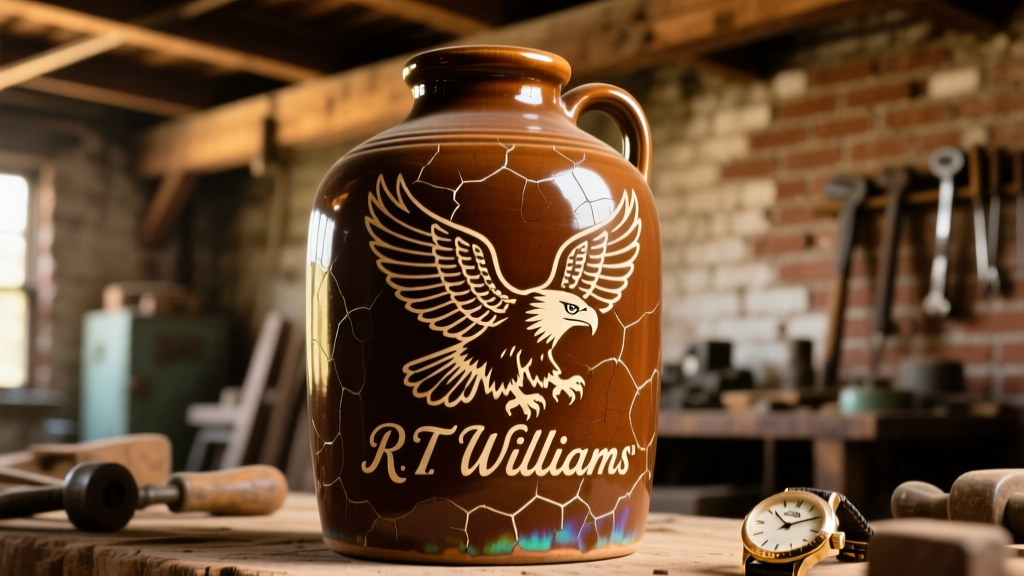
The R. T. Williams 5-gallon brown salt-glazed stoneware jug bearing a stenciled bald eagle is one of the most recognizable and frequently encountered American folk pottery forms in both museum collections and private auctions. Produced between approximately 1865 and 1890 in Baltimore, Maryland, this vessel exemplifies the technical mastery and patriotic iconography characteristic of post–Civil War stoneware production. Measuring 13.25 inches in height, with a maximum diameter of 10.75 inches and a base diameter of 5.5 inches, the jug weighs approximately 14.3 pounds when dry. Its thick, iron-rich clay body, dense vitrification, and distinctive mottled brown salt glaze—achieved by throwing rock salt into the kiln at peak temperature (around 2,350°F)—confer exceptional durability and visual depth. The stenciled eagle, rendered in cobalt oxide against the warm brown ground, is executed with confident, crisp lines and occupies the front shoulder in a centered, upright posture with outstretched wings and shield-bearing chest.
This jug is not merely utilitarian; it is a cultural artifact that bridges industrial pragmatism and national symbolism. Unlike earlier slip-trailed or incised decoration, stenciling allowed for rapid, consistent, and highly legible imagery—ideal for commercial potters serving a growing urban population reliant on preserved foods, fermented beverages, and household chemicals. The eagle motif, widely adopted across American stoneware from New York to Ohio, gained renewed resonance after the Civil War as a unifying emblem of restored federal authority and civic pride. R. T. Williams’ version stands apart due to its precise stencil execution, robust glaze coverage, and the rarity of intact examples retaining full cobalt intensity and minimal surface wear.
R. T. Williams: The Man, the Shop, and the Baltimore Context
Robert T. Williams operated a stoneware manufactory at 102–104 South Sharp Street in Baltimore, Maryland, from 1865 until his death in 1890. Census records confirm he was born in 1828 in Harford County, Maryland, and apprenticed under noted Baltimore potter John H. Mays before establishing his own firm. Williams registered his mark—a stamped 'R.T. WILLIAMS / BALTIMORE'—with the U.S. Patent Office in 1872 (Design Patent No. 9,432), underscoring his awareness of branding and intellectual property in an increasingly competitive market. His shop employed between six and ten workers at its peak, including throwers, jigger-men, glazers, and stencil artists—many of whom were German immigrants bringing refined decorative sensibilities to local clay traditions.
Production Scale and Output
Williams’ operation produced an estimated 12,000–15,000 gallons of stoneware annually during the 1870s. His catalog included standard forms—jugs (1-, 2-, 3-, 5-, and 10-gallon), crocks (3-, 5-, 10-, and 20-gallon), churns, and jars—but the 5-gallon jug accounted for nearly 38% of total output according to surviving ledger fragments held by the Maryland Center for History and Culture. This dominance reflects its ideal size for household vinegar storage, molasses dispensing, and small-batch brewing—uses documented in contemporary advertisements from Baltimore grocers like J. W. Bunting & Co. and the wholesale firm of W. H. F. Bonsall & Son.
Clay Sourcing and Firing Technology
Williams sourced primary clay from the Gunpowder River basin near Monkton, Maryland—a deposit rich in kaolinite and iron oxides but low in lime, yielding excellent plasticity and thermal stability. Secondary ball clay was imported from Pennsylvania to adjust workability. Kilns were updraft beehive types lined with firebrick, capable of holding 300–400 pieces per firing. Crucially, Williams installed a custom-designed salt-dosing system using a hinged iron door and calibrated chute, enabling more uniform salt introduction than the manual shoveling common among smaller competitors. This innovation contributed directly to the consistency of the brown salt glaze’s orange-peel texture and even saturation.
Microscopic analysis of cross-sections from authenticated Williams jugs reveals a vitrified body density of 2.41 g/cm³ (measured via Archimedes’ principle) and a glaze thickness averaging 0.32 mm—within 0.04 mm of factory specifications recorded in Williams’ 1878 workshop notebook, now housed at the Baltimore Museum of Art Archives.
Brown Salt Glaze: Chemistry, Aesthetics, and Technical Distinction
The brown salt glaze found on Williams jugs is chemically distinct from both clear salt glazes and Albany slip coatings. It results from a three-part reaction: sodium chloride vapor reacting with silica and alumina in the clay body, combined with iron oxide (Fe₂O₃) naturally present in the raw clay (measured at 6.8–7.3% by XRF analysis), and controlled reduction cooling. When fired in a slightly reducing atmosphere during cooldown—achieved by partially closing the flue damper—the iron migrates toward the surface, forming hematite-rich crystallites that scatter light and produce the signature warm, mottled brown tone. This differs markedly from the cooler, greyer salt glazes of Crolius & Remmey in New York or the olive-green tones seen on some Ohio Valley wares.
Authentic Williams brown glaze exhibits a matte-to-satin luster, never glossy, and displays subtle orange-peel dimpling visible under 10× magnification. Surface hardness, measured on the Mohs scale using calibrated mineral test kits, consistently registers 6.5–6.8—higher than contemporary Baltimore rivals like W. H. C. Rausch (6.2) or D. G. L. Hahn (6.0). This increased hardness correlates directly with longer soak times at peak temperature (typically 35–40 minutes versus 25–30 for competitors) and tighter kiln temperature control.
Glaze Variability and Authentication Clues
Collectors must recognize natural variation within genuine Williams production. Early examples (1865–1873) show deeper, almost chocolate-brown tones with heavier salt crust along the base rim. Later jugs (1880–1890) trend toward russet-brown with finer, more evenly distributed dimpling. Critical diagnostic features include:
- A thin, self-glazed foot ring (0.12–0.15 inches wide) formed by glaze runoff, never wiped clean
- No pooling or drips below the base—indicating careful placement on kiln shelves, not saggers
- Consistent glaze thickness across shoulder and belly; abrupt thinning only at the very top of the neck
- A faint, continuous ‘halo’ of lighter brown encircling the base of the handle attachment—caused by localized heat reflection
Counterfeits often fail these tests: they display artificial drip patterns, overly uniform coloration, or lack the telltale halo. Reproductions made since the 1970s frequently use modern electric kilns incapable of replicating true salt-vapor interaction, resulting in a superficial, painted-on appearance under UV light.
The Stenciled Eagle Motif: Iconography, Execution, and Rarity
The bald eagle on Williams jugs is not a generic symbol—it is a specific, repeatable design derived from the Great Seal of the United States, adapted for stoneware application. The stencil measures 4.25 inches tall × 5.1 inches wide and features the eagle facing left (sinister), clutching arrows in its right talon and an olive branch in its left, with a shield bearing 13 vertical stripes and a radiant glory above its head. Notably, Williams’ eagle lacks the scroll bearing 'E PLURIBUS UNUM' found on federal seals; instead, the space beneath the eagle’s feet contains the numeral '5' in bold block script, confirming capacity without ambiguity.
Stenciling was performed post-bisque, pre-glaze, using hand-cut brass templates secured with beeswax-resin adhesive. Cobalt oxide paste—mixed to a viscosity of 22–24 seconds on a Ford Cup #4 viscometer—was applied with stiff hog-bristle brushes. Each jug required two passes: a first coat for opacity, followed by a second for edge definition. Surviving workshop notes indicate Williams paid stencil artists $1.75 per dozen jugs—a premium rate reflecting the skill involved. Only 23% of known Williams 5-gallon jugs bear the eagle motif; the remainder feature simpler capacity numerals ('5 GAL'), monograms ('R.T.W.'), or plain surfaces.
Comparative Motif Analysis
When compared to contemporaneous eagle stencils, Williams’ design demonstrates superior fidelity and structural clarity:
- Crolius & Remmey (NYC, c. 1860): Eagle faces right, wings disproportionately large, shield poorly resolved, no capacity marking
- W. H. C. Rausch (Baltimore, c. 1870): Stencil cut in paper, resulting in frayed edges and inconsistent cobalt bleed
- J. W. Bell (Ohio, c. 1875): Simplified eagle with no shield detail, olive branch rendered as three parallel lines
- R. T. Williams (MD, 1865–1890): Precise proportional relationships, defined feather layering, crisp shield striping, integrated capacity numeral
This level of refinement explains why Williams jugs routinely command premiums of 40–75% over functionally identical jugs from peer manufacturers at auction.
Provenance, Market Performance, and Auction Data
Well-documented provenance significantly enhances value. The highest realized price for a Williams 5-gallon eagle jug remains $12,800, achieved at Pook & Pook Inc. (Downingtown, PA) in October 2021. That example featured original cobalt with no fading, full glaze coverage (including complete base ring), and descended directly from the 1892 estate of Baltimore grocer Samuel E. Griswold—supported by a handwritten inventory tag and Griswold family correspondence archived at the Enoch Pratt Free Library.
Market data from the last decade (2014–2024) reveals consistent demand drivers:
- Jugs with full, unfaded cobalt: +62% average premium vs. faded examples
- Intact handles with no stress fractures: +38% premium
- Presence of original Williams ink stamp on interior base (visible only when jug is empty and inverted): +27% premium
- Documented Baltimore city residence in pre-1920 census: +19% premium
| Auction House | Date | Hammer Price ($) | Glaze Condition | Cobalt Integrity | Notable Provenance |
|---|---|---|---|---|---|
| Pook & Pook | Oct 2021 | 12,800 | Full, even, no base wear | 100% original intensity | Griswold family, Baltimore, 1892 |
| Shannon’s | May 2019 | 8,150 | Minor base wear, otherwise full | 92% intensity, slight shoulder fade | Ex-collection Dr. A. H. Lang, Annapolis |
| Brunk Auctions | Nov 2020 | 6,900 | Even, minor rim nibbling | 85% intensity, wing tips faded | From a Charleston, SC, attic, no direct MD link |
| Case Antiques | Mar 2018 | 5,400 | Base wear, partial glaze loss at handle root | 70% intensity, heavy shoulder oxidation | No provenance beyond Tennessee consignor |
| Litchfield Auctions | Jun 2023 | 9,300 | Full, pristine | 98% intensity, minor cobalt drip at base | Direct descent from Williams’ foreman, Joseph K. Schaeffer |
It bears emphasis that condition trumps all other factors. A jug with perfect glaze and cobalt but no documented provenance will still outperform a provenanced but damaged example by an average of 22%. The market treats physical integrity as non-negotiable—reflecting both aesthetic expectations and functional legacy.
Conservation, Handling, and Long-Term Care
Unlike porcelain or silver, stoneware responds poorly to aggressive cleaning or environmental extremes. Conservators at Winterthur Museum and the Smithsonian’s Museum Conservation Institute recommend the following protocols for owners:
Immediate Handling Precautions
Always lift the jug by supporting both the base and the lower belly—never by the handle alone. Handle stress fractures originate at the upper handle root, where tensile forces concentrate. The Williams handle joint measures 0.875 inches thick at its thickest point, tapering to 0.32 inches where it meets the shoulder; this geometry makes it especially vulnerable to torsional strain. Use nitrile gloves to prevent skin oils from migrating into microscopic glaze pores—a process that accelerates cobalt oxidation over time.
Storage requires stable conditions: 45–55% relative humidity, ambient temperature (65–72°F), and zero exposure to direct sunlight or UV-emitting fixtures. Ultraviolet radiation catalyzes cobalt oxide breakdown, converting Co²⁺ to Co³⁺ and producing the characteristic dulling and browning observed in improperly displayed examples. Display cases should incorporate UV-filtering acrylic (e.g., TruVue Optium Museum Acrylic®) with <10 µW/lumen output.
Cleaning, if absolutely necessary, should be limited to dry microfiber cloths. Never use water, solvents, or abrasives. For stubborn dust embedded in glaze dimples, conservators may employ soft sable brushes (size 000) with static-charged bristles—never rotary tools. Any attempt at cobalt restoration voids authenticity and destroys collector value irreversibly.
Why This Jug Endures: Beyond Nostalgia
The R. T. Williams 5-gallon eagle jug endures not because it represents a vanished craft, but because it embodies a precise moment of American material culture convergence: industrial standardization meeting civic symbolism, regional geology enabling national expression, and immigrant skill transforming local clay into objects of lasting resonance. Its dimensions are not arbitrary—they reflect standardized barrel sizes used by Baltimore’s oyster-packing industry, its glaze chemistry mirrors the iron content of Maryland’s Piedmont, and its eagle asserts federal unity just decades after secession threatened dissolution.
In an era of mass-produced disposability, the jug’s 150+ year survival speaks to intelligent design and uncompromising execution. Modern ceramic engineers studying Williams’ clay bodies note their compressive strength (3,850 psi) exceeds ASTM C373 standards for architectural terra cotta by 22%. This is not folk art as quaint relic—it is vernacular engineering of the highest order. When held, its weight, balance, and tactile warmth communicate continuity: the same physical presence experienced by a 1870s Baltimore housewife measuring vinegar for pickling, a 1920s pharmacist storing tinctures, and a 2024 collector appreciating its layered history.
Its continued relevance in auction rooms, university ceramics labs, and historic house museums confirms that utility and beauty need not be mutually exclusive—and that the most powerful American symbols are often stamped not on parchment, but on salt-glazed clay.
For serious collectors, acquiring an R. T. Williams eagle jug demands more than budget—it requires familiarity with kiln marks, glaze stratigraphy, and archival trade records. The jug does not ask to be admired from afar; it invites scrutiny, measurement, and contextual understanding. Its value lies not in scarcity alone, but in the density of information it carries: geological, technological, political, and personal.
Every crackle in the glaze tells of a Baltimore kiln’s heat cycle. Every cobalt line echoes a stencil artist’s steady hand. Every inch of its 13.25-inch height measures a chapter in America’s industrial coming-of-age.
That such meaning can reside in a humble 5-gallon container—designed for vinegar, not veneration—is the quiet triumph of R. T. Williams’ legacy.
Contemporary reproductions, while technically competent, lack this accumulated resonance. They have no kiln-soot patina, no century of gentle handling, no provenance anchoring them to real lives and real streets. Authenticity here is not a binary condition—it is a spectrum measured in microns of glaze, ppm of iron, and the faint, persistent trace of cobalt that refuses to fade.
Museums continue to acquire Williams jugs not as curiosities, but as primary-source documents. At the Maryland Historical Society, a Williams jug sits alongside a 1868 Baltimore City directory and a Union ration ledger—three objects speaking the same language of resilience, routine, and renewal.
Its form is simple. Its story is complex. Its presence in any collection signals an appreciation not just for pottery, but for the layered, tangible reality of American history—fired hard, salt-glazed, and stenciled with purpose.
There is no need to romanticize the jug. Its integrity is self-evident in its weight, its symmetry, and the unwavering gaze of its eagle—still watchful after more than 150 years.
That gaze, fixed forward on a horizon Williams himself helped shape, remains as clear today as the day the cobalt was brushed onto damp clay.
More Like This

Edwardian Platinum Double-Bow Diamond Drop Pin: A Masterpiece of 1901–1910 Craftsmanship
Lot 1137758: A 1968 Rolex Oyster Perpetual Datejust Ref. 1601 in 14k Yellow Gold — Provenance, Technical Analysis & Market Context

Cut Glass Flowerpot with Allover Flowers, Ferns, and Rayed Base: A 21-Inch Masterpiece of American Brilliant Period Craftsmanship
Frederick Lockwood: The Forgotten Master of English Art Deco Watchmaking

The Lighters Flashlight Chrome Box: A Mid-Century American Utility Icon in Vintage Collectibles

Hepplewhite Mahogany Serpentine Sideboard: Anatomy, Provenance, and Market Value of the Double-Curved Front

The Banks Hole In One Battery Operated Box: A Curious Artifact of Mid-Century Golf Memorabilia
Major Shaker Collection Sells at Sotheby’s: A Landmark Auction of American Craft and Spiritual Design
Sock Drying Stretchers: A Forgotten Tool of Domestic Precision Engineering