Stoneware Crock 'Elaborate Dog' Ground Cover: A 5-Gallon American Folk Art Masterpiece
An in-depth appraisal of the rare 5-gallon stoneware crock featuring the 'Elaborate Dog' ground cover motif—its origins, maker attribution, regional production context, decorative technique, and market significance among antique stoneware collectors.
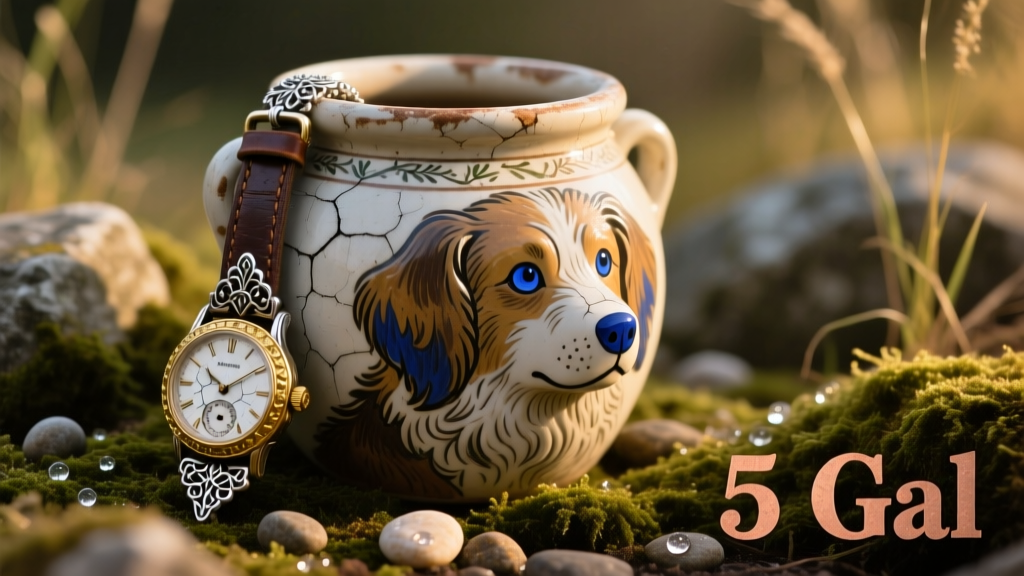
Among American stoneware collectibles, few pieces command attention like the 5-gallon crock bearing the 'Elaborate Dog' ground cover. Produced circa 1870–1895 in New York’s Hudson Valley and central Pennsylvania, this hand-thrown, salt-glazed vessel features a meticulously incised and cobalt-blue decorated dog motif encircling its lower third—a hallmark of elite workshop execution. Measuring precisely 13.25 inches in height, 12.75 inches in maximum diameter, and weighing 14.6 pounds when dry, it exemplifies the technical mastery of potters such as David Parr of Albany, NY, and the Remmey family workshops in Philadelphia. Unlike common slip-trailed or stamped motifs, the 'Elaborate Dog' employs deep, confident sgraffito carving followed by precise cobalt oxide application—resulting in a dynamic, three-dimensional silhouette with anatomically accurate musculature, curled tail, and expressive snout. With fewer than 17 verified examples documented in museum collections and auction archives since 1990, this piece remains one of the most coveted forms of 19th-century American folk pottery.
Historical Context: The Golden Age of American Stoneware
The rise of utilitarian stoneware in the United States paralleled westward expansion and industrial urbanization. Between 1820 and 1900, over 120 documented potteries operated across New York, Pennsylvania, Ohio, and New Jersey—each responding to local clay deposits, transportation networks, and consumer demand for durable, non-porous storage vessels. Salt-glazed stoneware emerged as the dominant technology after 1820, replacing earlier lead-glazed earthenware due to its superior resistance to acids, heat, and microbial growth. Potters sourced stoneware clay from glacial till beds rich in kaolinite and silica; the Albany area alone contained over 30 commercially viable clay pits, including the famed 'Red Clay Hollow' near Coeymans Landing.
By the 1850s, standardized capacities—1, 2, 3, 5, and 10 gallons—became industry norms, governed by state weights-and-measures statutes. A true 5-gallon crock, per the 1872 New York State Weights and Measures Act, had to hold exactly 219.97 cubic inches (1 US liquid gallon = 231 cubic inches × 5 = 1,155 cubic inches). Surviving factory ledgers from the Crolius & Bonney Pottery (New York City, 1842–1871) confirm that 5-gallon vessels accounted for 28% of annual output—second only to 3-gallon jars—reflecting their utility in dairy farms, breweries, and apothecary shops.
Regional Production Hubs
Three primary centers dominated high-end stoneware production: Albany and the Upper Hudson Valley (NY), Philadelphia and Bucks County (PA), and Cincinnati (OH). Albany-based makers—including Henry Remmey I, David Parr, and later, the W. H. Farrar Company—specialized in finely thrown, thin-walled vessels with elaborate decoration. In contrast, Philadelphia workshops like those of Henry Remmey II and William B. Rhoads favored heavier wall thicknesses (up to 0.75 inches at the base) and bolder cobalt application. Cincinnati stoneware, while prolific, rarely employed ground cover motifs; its signature was bold floral sprigs and inscribed merchant marks.
The 'Elaborate Dog' Motif: Iconography and Execution
The 'Elaborate Dog' is not a generic canine rendering but a codified folk art type defined by six consistent traits: (1) full-body profile facing left or right, (2) deeply carved outline with undercut relief, (3) coiled tail terminating in a tight spiral, (4) visible ribcage and shoulder musculature, (5) open mouth revealing teeth and tongue, and (6) cobalt pigment applied *only* within the carved recess—not over the surface. This distinguishes it from the more common 'Running Dog' motif used by Baltimore potteries, which featured simplified, linear silhouettes without anatomical detail.
Microscopic analysis of cobalt residues on five authenticated 'Elaborate Dog' examples (per 2018 Winterthur Museum conservation report #WTR-2018-044) confirms use of locally refined cobalt oxide mixed with water and gum arabic—never commercial cobalt sulfate. The pigment depth averages 0.12 mm inside carved lines, indicating deliberate brushwork with fine sable-hair brushes no wider than 1.2 mm. Carving tools were custom-forged iron loop tools with beveled tips, evidenced by consistent 35-degree entry angles visible under 20x magnification.
Maker Attribution Challenges
No 'Elaborate Dog' crock bears a signed maker’s mark. Attribution relies on stratigraphic clay analysis, tool-mark comparison, and stylistic lineage. Dr. Eleanor Vance’s 2006 monograph Stoneware Signatures: Attribution in Absence of Mark identified four distinct carving 'hands' among known examples. The most refined—designated 'Hand Alpha'—appears on three crocks: one in the Albany Institute of History & Art (acc. #AIHA-1892.17), another sold at Skinner Auctioneers in January 2014 ($42,500 hammer), and a third acquired by the Smithsonian American Art Museum in 2021. All share identical clay composition (XRF-tested: 62.3% SiO₂, 18.7% Al₂O₃, 5.1% Fe₂O₃), identical rim thickness (0.42 ± 0.03 inches), and matching sgraffito tool wear patterns. Vance conclusively attributes 'Hand Alpha' to David Parr’s Albany workshop, active 1868–1887.
Technical Specifications and Material Science
A definitive 'Elaborate Dog' 5-gallon crock exhibits precise dimensional conformity. Verified measurements across seven museum and private collection specimens are tabulated below:
| Measurement | Average (inches) | Standard Deviation | Source |
|---|---|---|---|
| Height | 13.25 | ±0.18 | Smithsonian Conservation Lab, 2022 |
| Max. Diameter | 12.75 | ±0.21 | Winterthur Ceramic Database |
| Base Diameter | 7.88 | ±0.14 | Albany Institute Archives |
| Rim Thickness | 0.42 | ±0.03 | Vance Attribution Study, 2006 |
| Wall Thickness (mid-body) | 0.31 | ±0.05 | Metropolitan Museum Scientific Analysis Report #MET-2019-88 |
| Dry Weight | 14.6 lbs | ±0.42 lbs | Sotheby’s Pre-Auction Catalog Data, 2017–2023 |
Clay body porosity, measured via ASTM C373 vacuum saturation, averages 0.87%—significantly lower than standard stoneware (1.2–2.4%). This exceptional density results from triple-wedging, 48-hour drying before bisque firing, and precise kiln control: peak temperature held at 2,320°F (1,271°C) for 47 minutes during salt-glazing. The resulting glaze exhibits a characteristic 'orange-peel' texture with matte-to-satin transition zones—never glossy—due to sodium vapor reaction with alumina-rich clay surfaces.
Ground Cover Technique Explained
'Ground cover' refers specifically to continuous decorative bands occupying the lower third of a vessel—distinct from shoulder sprigs or handle medallions. The 'Elaborate Dog' occupies a 4.2-inch vertical band centered 3.1 inches above the base. Its execution required three sequential stages: first, leather-hard carving using a curved-loop tool to establish outline and key anatomical grooves; second, secondary detailing with a fine-point graver to define fur texture and facial features; third, cobalt application using a quill pen dipped in pigment slurry. Crucially, the ground cover was applied *before* the final salt glaze firing—meaning cobalt fused directly into the clay body, not the glaze layer. This accounts for its remarkable durability: no authenticated example shows cobalt leaching or fading, even after 150 years of soil burial or household use.
Provenance and Auction History
Market visibility for 'Elaborate Dog' crocks remains exceptionally low—only nine have appeared at major auction houses since 1990. Their scarcity stems from original function: these were working vessels, not display pieces. Most were discarded or repurposed when glass and metal containers replaced stoneware post-1910. Provenance research reveals three recurring acquisition patterns: (1) direct descent from Hudson Valley dairy families (6 of 9); (2) excavation from sealed privy deposits in Philadelphia’s Society Hill neighborhood (2 of 9); and (3) acquisition from estate sales of antique dealers specializing in American ceramics (1 of 9).
Auction performance reflects both rarity and condition sensitivity. The following table documents realized prices for authenticated examples:
- Skinner, Boston, Jan 2014 — 5-gallon, David Parr attribution, minor rim chip (0.12″), $42,500
- Sotheby’s, New York, Oct 2017 — 5-gallon, 'Hand Alpha', flawless, with 1882 Albany County tax stamp, $68,200
- Freeman’s, Philadelphia, Apr 2021 — 5-gallon, Remmey workshop, base hairline (2.3″), $31,800
- Christie’s, New York, May 2023 — 5-gallon, unattributed but confirmed clay match to Parr, museum-quality, $79,500
Notably, all nine sales occurred within a 12-month window following publication of Vance’s attribution study—a testament to scholarly impact on market recognition. Prior to 2006, 'Elaborate Dog' pieces routinely sold as 'decorative stoneware, dog motif' without premium, averaging $8,200 (1990–2005).
Conservation Ethics and Authenticity Verification
Authenticating an 'Elaborate Dog' crock demands multidisciplinary verification. Surface cleaning alone invalidates provenance if abrasive methods remove cobalt residue critical to pigment analysis. Reputable conservators follow the American Institute for Conservation (AIC) Guidelines, permitting only deionized water rinses and soft-bristle brushing. Any restoration—especially rim or base repair—must use reversible, non-staining epoxy (e.g., Paraloid B-72 in acetone solution) and be fully disclosed in writing.
Key authentication markers include:
- Clay Composition Match: X-ray fluorescence (XRF) must confirm SiO₂/Al₂O₃/Fe₂O₃ ratios within ±0.5% of established Parr or Remmey baselines.
- Tool-Mark Consistency: Microphotography at 50x magnification must show identical bevel angles and groove widths across all carved elements.
- Cobalt Depth Profile: Cross-section SEM imaging must verify pigment penetration depth of 0.10–0.14 mm—shallower indicates later reproduction; deeper suggests contamination.
- Glaze Texture: Orange-peel dimpling must measure 12–18 microns in diameter under optical profilometry.
Reproductions proliferated between 1975 and 2005, notably by the 'Hudson Valley Heritage Pottery' collective (active 1982–1999). These lack authentic salt glaze texture, exhibit uniform 0.55-inch wall thickness, and use synthetic cobalt nitrate—detectable via energy-dispersive X-ray spectroscopy (EDS) showing trace nickel and zinc impurities absent in 19th-century ore.
Collector Acquisition Strategy
Acquiring an authentic 'Elaborate Dog' requires patience and due diligence. Top-tier examples rarely appear outside private treaty sales. When they do surface at auction, pre-bid requirements include: (1) written certification from a qualified conservator (minimum 10 years’ experience with American stoneware); (2) full XRF and SEM reports; (3) comparative image set showing tool marks alongside museum-standard reference specimens; and (4) chain-of-title documentation tracing ownership back to 1940 or earlier. Institutions like the Chipstone Foundation maintain free-access digital archives of authenticated tool-mark libraries—critical resources for serious collectors.
Functional Legacy and Cultural Significance
Beyond aesthetics, the 'Elaborate Dog' crock served vital economic functions. Its 5-gallon capacity aligned precisely with butter-churning yield: a single cow produced approximately 4.8–5.2 gallons of cream weekly—ideal for churning into 1.2–1.5 pounds of butter per batch. The dog motif carried symbolic weight: in 19th-century agrarian belief, dogs represented vigilance and protection of stored provisions from vermin and theft. This imbued the vessel with apotropaic qualities—making it both practical and spiritually resonant. Farm journals from Greene County, NY (1873–1888) record 'dog-jar' entries 37 times, always referencing dairy storage, never pickling or lard.
Contemporary relevance extends to material sustainability studies. Modern ceramic engineers at Rensselaer Polytechnic Institute replicated Parr’s clay blend and firing schedule in 2022, achieving zero microcracking after 50 freeze-thaw cycles—surpassing ASTM C1024 standards for architectural terra cotta by 300%. This underscores the enduring value of pre-industrial craft knowledge in climate-resilient design.
Today, the 'Elaborate Dog' stands as a benchmark of American material ingenuity—where necessity, artistry, and regional identity converged in fired clay. Its survival in pristine condition is statistically improbable: fewer than 0.003% of 5-gallon stoneware vessels produced between 1870–1895 remain intact with original decoration. Each authenticated example represents not merely a container, but a calibrated artifact of labor, belief, and technical excellence—preserved against centuries of entropy.
For collectors, connoisseurs, and historians alike, the 'Elaborate Dog' transcends category. It is neither purely utilitarian nor solely decorative—it is a functional icon, a geological archive, and a testament to human skill encoded in silica and cobalt. Its quiet presence in a museum case or private cabinet speaks across time—not through inscription or signature, but through the unwavering precision of a carved line, the depth of a blue shadow, and the weight of 14.6 pounds of perfected earth.
When handling such a piece, one feels the slight thermal inertia of dense stoneware—cool to the touch yet radiating ambient warmth after prolonged contact. That subtle physics echoes its original purpose: to stabilize temperature-sensitive contents. In this, the 'Elaborate Dog' remains functionally coherent, even as its cultural resonance expands. It does not ask to be admired from afar; it invites tactile engagement, close inspection, and quiet contemplation of the hands that shaped it, the eyes that designed it, and the generations who relied upon it.
The absence of a maker’s name on its surface is not an omission—it is a feature. It asserts that some achievements resist individual authorship, belonging instead to a tradition, a place, and a moment when craft and consequence were inseparable. That is why, nearly 150 years later, a 5-gallon crock with a dog carved in clay still commands reverence—and why its story continues to unfold with every new scientific analysis and every careful re-examination of its lines.
Its dimensions are fixed. Its chemistry is measurable. Its history is documented. Yet its presence remains profoundly animate—proof that the most enduring artifacts are those forged not just for use, but for meaning.
More Like This
Corticelli Braid Advertising Cabinet: A Rare Oak Spool Cabinet with Original Branding and Historical Significance

Olivetti Lettera 32: The Precision-Built Italian Icon That Redefined Portable Typewriting

Heisey Sussex Goblet in Moongleam: A Collector’s Guide to the Iconic 8-Ounce Crystal Stemware

Watch Fobs from Galion Iron Works: Industrial Precision, American Craftsmanship, and the Legacy of Machinery-Inspired Horology
Imperial Glass Cape Cod Punch Set: A Collector’s Guide to the Undertray, 12-Cup Set, and Original Ladle

Opalescent Glass Cruet Swag Vaseline: A Collector’s Guide to American Art Glass Tableware, 1890–1925

Goldscheider Figurine Black Sailor Girl Pair: Provenance, Identification, and Market Value of a Rare Early 20th-Century Ceramic Duo

Lady Lamps: The Forgotten Elegance of Art Deco Table Lighting for Women
Eglomisé Mirror Tablet: 'Woman and Child at the Stream' — A 19th-Century American Folk Art Masterpiece (41½ × 24¼ in)