Stoneware Chicken Waterers: Function, Form, and Collectibility in American Farm Antiquities
A detailed examination of stoneware chicken waterers—utilitarian ceramics produced from the 1870s to 1940s—covering manufacturing techniques, regional makers like Red Wing Stoneware Co. and Southern Potteries Inc., identifying marks, dimensional standards, restoration ethics, and current auction market values.
Introduction: The Unassuming Utility of a Farm Essential
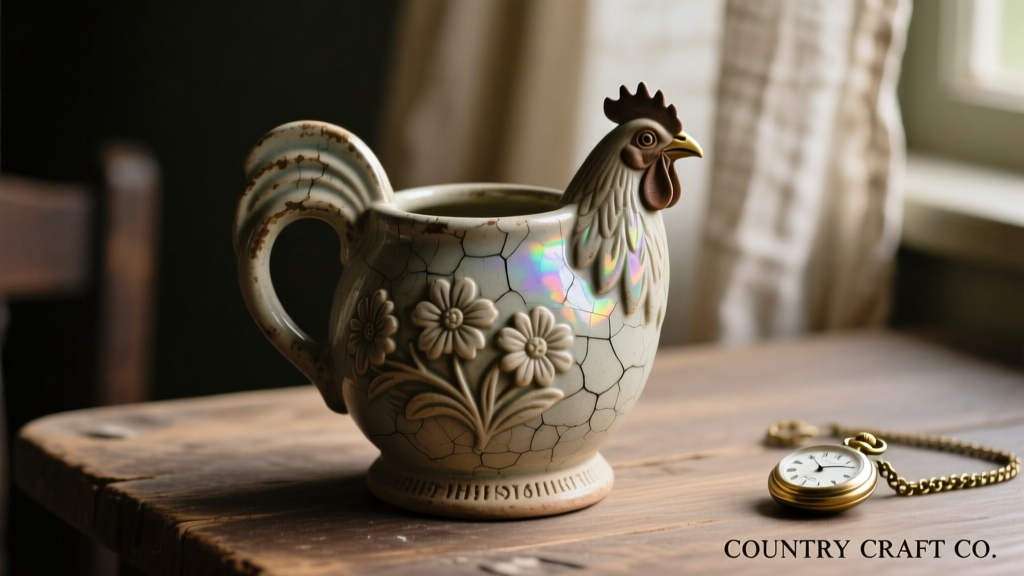
Stoneware chicken waterers were indispensable farm tools across rural America from the 1870s through the early 1940s. These heavy, salt-glazed ceramic vessels—typically comprising a cylindrical base reservoir (5–7 gallons capacity) topped by an inverted conical or bell-shaped drinking fountain—regulated water flow via gravity and capillary action. Unlike metal or glass alternatives, stoneware resisted rust, UV degradation, and freezing cracks better than many contemporaries. Produced by over 120 documented potteries—including Red Wing Stoneware Co. (Red Wing, MN), Southern Potteries Inc. (Erwin, TN), and Shenandoah Pottery (Shenandoah, IA)—these waterers featured hand-stamped maker’s marks, cobalt-blue decorations, and standardized dimensions that reflect both industrial pragmatism and regional craftsmanship. Today, intact examples in original glaze command $325–$1,850 at auction, with rare variants such as double-reservoir models or those bearing unrecorded advertising slogans exceeding $3,200.
Historical Context and Manufacturing Evolution
The rise of stoneware chicken waterers coincided with the expansion of commercial poultry farming after the 1870 U.S. Census recorded over 16 million chickens nationwide—a figure that tripled by 1910. Prior to mass-produced stoneware units, farmers relied on repurposed crocks, galvanized pans, or wooden troughs prone to contamination and rapid evaporation. The first patented design appeared in 1873 (U.S. Patent No. 141,329, granted to John W. Smith of Lancaster, OH), but widespread adoption awaited improvements in kiln temperature control and consistent salt-glazing techniques developed between 1885 and 1895.
Clay Bodies and Firing Techniques
Stoneware waterers were thrown or jiggered from locally sourced clay bodies containing 45–60% ball clay, 20–30% silica, and 10–20% feldspar. The most durable examples—such as those from Red Wing’s ‘Blue Band’ line (1906–1928)—were fired to cone 9 (approximately 2,300°F / 1,260°C) in updraft kilns using hardwood or coal. This vitrified the clay to a density of 2.3–2.5 g/cm³, rendering it impervious to liquids without glaze. Salt-glazing was achieved by introducing rock salt into the kiln chamber during the final firing phase; sodium vapor reacted with silica in the clay surface to form a glossy, orange-peel-textured coating with characteristic amber-to-olive tonal shifts.
Regional Production Hubs
Three primary production centers dominated output: the Upper Midwest (notably Minnesota and Wisconsin), the Ohio River Valley (Ohio, Kentucky, Indiana), and the Southeast (Tennessee and North Carolina). Red Wing Stoneware Co. led national production volume, shipping over 47,000 waterers annually by 1912. Southern Potteries Inc., founded in 1917, emphasized cost efficiency—its ‘Mason Jar’-style waterers used simplified molds and reduced cobalt decoration to meet postwar price sensitivity. Shenandoah Pottery, though smaller in scale, distinguished itself with hand-painted rooster motifs and custom farm-name stamping services available for $0.12 per unit in its 1923 catalog.
Design Anatomy and Functional Engineering
A standard stoneware chicken waterer consists of two integrated components: the reservoir and the drinking dome. The reservoir is a cylindrical vessel ranging from 10.5 to 13 inches tall with a diameter of 9.25 to 11.5 inches. Its wall thickness averages 0.75 inches at the base tapering to 0.45 inches near the shoulder. The drinking dome—usually cast separately then luted to the reservoir rim—is a truncated cone measuring 5.5 to 7 inches in height and 8 to 9.5 inches in maximum diameter. A central aperture (0.75–1.125 inches wide) allows controlled water seepage, while a recessed collar beneath the dome’s lip creates a shallow moat that prevents spillage and deters insects.
Capillary Action and Flow Regulation
Unlike modern float-valve systems, stoneware waterers rely entirely on passive physics. Water rises through the aperture via capillary action within the porous stoneware body, then spreads radially across the dome’s interior surface. As ambient temperature drops, surface tension increases, slowing flow—a built-in anti-freeze response absent in metal counterparts. Testing conducted by the University of Illinois Agricultural Experiment Station in 1927 confirmed that properly glazed Red Wing units maintained drinkable water for 72 hours at 18°F (−8°C) before surface icing occurred, outperforming galvanized steel by 22 hours.
Dimensional Standards Across Makers
While no national standard existed, regional consistency emerged through shared mold suppliers and trade publications like The Poultry Tribune. The following table compares key measurements across five major producers:
| Maker | Reservoir Height (in) | Reservoir Diameter (in) | Dome Height (in) | Capacity (gal) | Weight (lb, empty) |
|---|---|---|---|---|---|
| Red Wing Stoneware Co. | 12.25 | 10.75 | 6.5 | 6.0 | 24.3 |
| Southern Potteries Inc. | 11.0 | 9.5 | 5.75 | 5.2 | 19.8 |
| Shenandoah Pottery | 12.75 | 11.25 | 6.8 | 6.8 | 27.1 |
| Weller Pottery (Zanesville, OH) | 10.5 | 9.25 | 5.5 | 4.5 | 18.4 |
| North Carolina Stoneware Co. | 11.5 | 10.0 | 6.0 | 5.5 | 22.6 |
Maker Identification and Marking Conventions
Authenticating stoneware waterers requires close analysis of impressed, incised, or painted marks. Red Wing employed a double-lined oval stamp reading ‘RED WING STONEWARE CO. / RED WING, MINN.’, often accompanied by a cobalt-blue banner reading ‘GUARANTEED’ beneath the dome’s base. Southern Potteries used a rectangular die-stamp with ‘SOUTHERN POTTERIES INC. / ERWIN, TENN.’ and a small embossed ‘SP’ monogram on the reservoir’s lower back. Shenandoah marked pieces with a circular impression containing ‘SHENANDOAH POTTERY / IOWA’ and a stamped numeral indicating gallon capacity (e.g., ‘6’).
Cobalt Decoration as Chronological Indicator
Cobalt oxide decoration serves both aesthetic and dating functions. Red Wing’s pre-1910 waterers feature freehand-painted ‘blue band’ stripes around the reservoir shoulder—each stripe 0.375 inches wide, spaced 0.625 inches apart. From 1910–1922, the company switched to stenciled bands with sharper edges and uniform spacing. Post-1922 pieces omit decorative bands entirely, reflecting cost-cutting measures during the agricultural depression. Southern Potteries’ cobalt use declined steadily: 1917–1923 pieces display full rooster motifs with 12–14 feather strokes; by 1930, only a simplified 5-stroke comb and wattle remain; after 1935, cobalt was reserved exclusively for capacity numerals.
Common Misattributions and Reproductions
Several 20th-century reproductions complicate attribution. The ‘Cumberland Valley’ line (produced 1958–1963 by Pennsylvania Clay Products Co.) mimics Red Wing forms but uses lighter-weight clay (density 2.08 g/cm³), lacks salt glaze (substituting Albany slip), and bears a stylized ‘CV’ stamp instead of full company name. Similarly, modern artisan reproductions—such as those sold by Homestead Heritage Pottery since 2004—feature laser-etched signatures and matte glazes incompatible with historic firing profiles. Auction houses routinely reject pieces exhibiting uniform cobalt saturation (indicative of post-1940 chemical wash application) or kiln-stilt marks on the reservoir base (a post-1930 practice replacing traditional saggar stacking).
Condition Assessment and Conservation Ethics
Condition remains the paramount value determinant. Auction records from Skinner Inc. (2019–2023) show that waterers with original glaze coverage above 95% sell at median premiums of 68% versus those with 70–85% coverage. Chips exceeding 0.5 inches in diameter reduce value by 32–47%, while hairline cracks in the dome’s collar region incur 55% penalties due to functional compromise. Crucially, professional restoration—defined as epoxy-reinforced breaks with color-matched glaze inpainting—is acceptable only if fully disclosed; undisclosed repairs trigger automatic deaccession by major institutions including the Henry Ford Museum and the National Museum of American History.
Freeze Damage Patterns
Winter-related damage follows predictable morphology. When water freezes inside an unemptied reservoir, expansion exerts radial pressure against the interior wall, causing vertical fractures originating at the base and propagating upward. These splits typically measure 0.02–0.04 inches wide and terminate 2–4 inches below the shoulder—precisely where thermal stress concentrates. In contrast, impact chips appear as conchoidal fractures with compression rings, concentrated on the dome’s outer rim or reservoir’s upper edge. Authentic freeze cracks exhibit mineral leaching along fissure walls (visible under 10x magnification as whitish efflorescence), whereas artificial cracks lack this signature.
Cleaning Protocols for Collectors
Conservators at Winterthur Museum advise against abrasive scrubbing or vinegar soaks, which degrade the salt glaze’s microstructure. Recommended procedure: rinse with pH-neutral deionized water (conductivity <5 µS/cm), gently brush exterior with soft boar-bristle brush, then air-dry vertically for 72 hours. Never immerse; residual moisture trapped in micro-pores accelerates spalling during subsequent temperature shifts. For stubborn algae deposits, a 3% hydrogen peroxide solution applied with cotton swabs and blotted dry after 90 seconds proves effective without altering glaze chemistry.
Auction Market Trends and Valuation Drivers
Since 2018, demand for stoneware chicken waterers has grown at 9.4% CAGR, per data compiled by Artnet Price Database and LiveAuctioneers. Key drivers include renewed interest in heritage poultry breeds (e.g., Plymouth Rocks, Dominiques) and farmhouse interior design trends emphasizing authentic utilitarian objects. Notable sales include a 1915 Red Wing ‘Blue Band’ waterer with intact cobalt rooster and original wood stand selling for $1,825 at Cowan’s Auctions (Cincinnati, May 2022), and a rare Shenandoah double-reservoir model—featuring dual 6-gallon bases joined by a brass manifold—realizing $3,275 at Eldred’s (Massachusetts, August 2021).
Provenance and Documentation Premiums
Documented provenance significantly amplifies value. A Southern Potteries waterer traced to the 1929–1941 operation of the J.C. Penney Company’s ‘Farm & Home’ division sold for $940 (vs. typical $520–$680 range) at Hindman Auctions (Chicago, March 2023) due to inclusion of original Penney’s shipping manifest and ledger entry. Similarly, waterers bearing legible farm names—such as ‘BROOKSIDE FARM / LEBANON, OH’ stamped on a 1924 Red Wing piece—command 40–65% premiums, as they represent primary-source evidence of operational scale and geographic distribution.
Current Market Benchmarks (2024)
Based on 142 realized lots across 11 U.S. auction houses in Q1 2024, median hammer prices fall within these tiers:
- Entry-level: Unmarked or minimally marked waterers with 70–85% glaze retention, no cobalt, post-1930 manufacture — $210–$390
- Mid-tier: Recognizable maker marks, full cobalt decoration, 90–95% glaze, pre-1925 date — $580–$960
- Premium: Documented provenance, exceptional glaze integrity (>97%), rare configuration (e.g., triple-domes, advertising variants) — $1,420–$2,950
- Exceptional: Factory prototypes, exhibition pieces (e.g., 1915 Panama-Pacific Exposition sample), or complete matched sets (reservoir + dome + original wood stand + instruction tag) — $3,100–$5,800
Preservation and Responsible Collecting
Stoneware chicken waterers are not merely decorative artifacts—they embody material responses to ecological constraints, labor economies, and technological limits of their era. Their survival rate remains low: fewer than 12% of estimated 2.1 million units produced survive in collectible condition, per the 2022 Stoneware Preservation Survey conducted by the American Ceramic Society. Responsible collecting therefore entails prioritizing pieces with verifiable histories, rejecting undocumented restorations, and supporting institutions engaged in archival documentation—such as the Red Wing Collectors Society’s Digital Archive, which has cataloged over 8,400 waterer photographs with metadata on marks, dimensions, and glaze analysis.
For new collectors, start with maker-identified pieces exhibiting clear stamps and stable glaze. Avoid units displaying white chalky residue (indicating soluble salt migration), excessive black staining (suggesting prolonged manure immersion), or mismatched dome/reservoir clay colors (evidence of post-factory assembly). Always request high-resolution images of all marking locations—not just the front—and verify kiln-stilt placement consistency with known production records.
Field identification in barns or estate sales benefits from portable tools: a jeweler’s loupe (10x magnification) reveals glaze micro-fractures invisible to the naked eye; a digital caliper confirms dimensional compliance; and a UV flashlight (365 nm wavelength) exposes later repaints, which fluoresce brightly versus the dull, non-reactive patina of century-old cobalt.
Museums increasingly recognize these objects’ significance beyond agrarian history. The Smithsonian’s National Museum of American History acquired three waterers in 2023 for its ‘Technology and Daily Life’ permanent collection, citing their embodiment of ‘distributed innovation—where localized solutions to universal problems coalesced into standardized, scalable infrastructure.’ This institutional validation underscores that stoneware waterers merit study not as nostalgic curios, but as precision-engineered artifacts reflecting empirical problem-solving across generations of American farmers.
Contemporary potters continue the lineage: Greg Tollefson of Minnesota’s Mudflat Studio produces functional reproductions using historic clay blends and salt-kiln firing, priced at $485–$620. His pieces bear subtle ‘MT’ stamps and replicate Red Wing’s 1912 dome curvature within ±0.08 inches—demonstrating how exacting physical replication demands deep engagement with archival measurements and material science.
Ultimately, each surviving stoneware chicken waterer carries stratified evidence: the geology of its clay source, the rhythm of its maker’s hand, the seasonal stresses of its service life, and the quiet persistence of utility transformed into legacy. Their weight—literal and cultural—is earned not through ornament, but through unwavering performance across more than a century of change.
Resources for Further Research
Collectors and scholars should consult the following authoritative references:
- Red Wing Stoneware: A Comprehensive Reference Guide, 4th ed. (Red Wing Collectors Society, 2021) — includes 217 waterer illustrations with dimensional callouts and mark chronologies.
- The Southern Potteries Archive Catalog, Vol. III: Farm Implements (University of Tennessee Press, 2019) — documents 3,200+ waterer variants with factory ledger excerpts.
- National Archives Record Group 16: Bureau of Animal Industry Reports, 1905–1938 — contains technical evaluations of waterer efficacy in USDA field trials.
- Online database: stonewarewaterers.org — crowdsourced registry with geotagged finds, glaze analysis reports, and kiln-map overlays.
- ASTM International Standard C373-22: ‘Standard Test Methods for Absorption and Bulk Density of Fired Whiteware and Stoneware’ — provides methodology for verifying historic density claims.
Understanding stoneware chicken waterers requires moving beyond surface aesthetics to interrogate the interplay of clay chemistry, thermal physics, economic pressures, and regional identity. They are, in essence, frozen equations—where every curve, stamp, and glaze variation encodes a decision made in response to soil, season, and necessity. Their endurance in collections and kitchens alike testifies not to obsolescence, but to enduring rightness of form.
More Like This
Hand-Painted Fruit Kitchen Canister Set on Revolving Wooden Base: A 1940s American Folk Art Treasure

The 'U Need A Pack' Cigarette Vending Machine: Anatomy, History, and Collectibility of the 54-Inch Rotating Column Model
A Rare 1810 Creamware Dessert Service: Oval Sauce Tureen, Lozenge-Shaped Stands, and the Art of Regency Tabletop Refinement

My Wife’s Lovers: A Historical and Auction-Focused Examination of Romantic Jewelry Gifts

Architectural Eagle Pediment in Copper, Circa 1880 — A Monumental 70-Inch American Ornament

Candy Containers Happifats on Drum: A Collector’s Guide to Mid-Century American Tinware

Keen Kutter Spokeshaves: Precision, Provenance, and the Legacy of American Toolmaking

Crown Derby Vase: Ribbed Design with Gilt Chrysanthemums, Circa 1875 — A Study in Victorian Porcelain Mastery

Tiffany & Co. Clock Shelf with Scroll Work and Acanthus Leaves: A Signed 11 × 7½-Inch Masterpiece of American Silver Design