Stieff Company: Baltimore’s Master Silversmiths and the Legacy of American Colonial Revival Silver
A detailed exploration of the Stieff Company—Baltimore’s premier silversmithing firm (1892–1999)—covering its founding, hallmark evolution, signature patterns like Chippendale and Federal, manufacturing precision, watch case production for Hamilton and Waltham, hallmark authentication, and market valuation trends at major auctions including Sotheby’s, Christie’s, and Skinner.
Stieff Company: A Pillar of American Silversmithing
Founded in Baltimore in 1892 by Charles H. Stieff, the Stieff Company operated continuously for 107 years until its acquisition by Lenox in 1999. Renowned for exceptional craftsmanship, strict adherence to sterling silver standards (925/1000 purity), and deep expertise in Colonial Revival design, Stieff produced over 3,200 distinct flatware patterns and more than 1,800 hollowware forms. Unlike mass producers such as Oneida or International Silver, Stieff maintained in-house forging, chasing, engraving, and hallmarking—employing up to 320 artisans at its peak in the 1940s. Its commitment to hand-finished details, precise weight calibration (e.g., dinner forks consistently weighing 62–65 grams), and proprietary alloys for durability set it apart in the American silver market. Stieff also manufactured high-grade watch cases for Hamilton, Waltham, and Elgin between 1920 and 1955, with hallmarks appearing on over 47,000 timepiece cases documented in factory ledgers.
Founding and Early Development (1892–1920)
Charles Henry Stieff (1857–1932) began his career as an apprentice at the Baltimore firm of J. E. Caldwell & Co. before establishing C. H. Stieff & Son in 1892 at 208–210 N. Howard Street. The company incorporated as The Stieff Company in 1903. From inception, Stieff emphasized quality control: every piece underwent three separate inspections—pre-polish, post-polish, and final hallmarking. In 1896, Stieff adopted its first registered hallmark: a shield bearing the letters 'S' and 'C' flanking a star, with 'STERLING' below. This was replaced in 1908 by the iconic 'STIEFF' monogram within a shield, accompanied by a lion passant, anchor, and 'STERLING'—a deliberate nod to English assay office conventions while asserting American origin.
The Baltimore Connection
Baltimore’s position as a historic port city and center of early American craftsmanship profoundly shaped Stieff’s aesthetic. The firm actively studied original 18th-century pieces from the Maryland Historical Society and Winterthur Museum, reproducing authentic proportions and construction techniques. For example, Stieff’s 1912 'Maryland' pattern replicated the exact taper and beading of a c. 1765 Annapolis teapot—measuring 5 3⁄8 inches in height with a spout curvature radius of 1.25 inches. Stieff’s proximity to the Peale Museum (founded 1797) allowed direct access to period silver for technical analysis, influencing their use of traditional repoussé and chasing tools rather than stamping dies.
Early Hallmark Evolution
Stieff’s hallmark progression reflects both regulatory shifts and corporate identity refinement:
- 1892–1896: Unmarked or stamped 'C.H.S.' with no purity indicator
- 1896–1907: Shield with interlaced 'S' and 'C', five-pointed star above, 'STERLING' below
- 1908–1928: Full shield hallmark—'STIEFF' monogram centered, lion passant left, anchor right, 'STERLING' arched beneath
- 1929–1952: Simplified shield with 'STIEFF' and 'STERLING'; lion and anchor removed per U.S. National Stamping Act compliance
- 1953–1999: 'STIEFF' in block capitals above 'STERLING', often accompanied by a '925' fineness mark
Notably, Stieff never used 'coin silver' (900/1000) or lower-grade alloys—every marked piece is guaranteed .925 fine sterling, verified by independent assays conducted quarterly at the U.S. Assay Office in Philadelphia through 1968.
Colonial Revival Mastery: Patterns and Precision
Stieff’s reputation rests largely on its authoritative interpretation of Colonial Revival forms. Between 1910 and 1945, the firm introduced 1,422 historically grounded patterns—including 'Chippendale' (1914), 'Federal' (1921), 'Queen Anne' (1927), and 'Baltimore' (1936). Each pattern adhered to strict dimensional protocols: the 'Federal' dinner fork features a 7 1⁄2-inch length, 1 1⁄8-inch tine width, and precisely 22-degree tine divergence—measurements derived from 127 surviving examples cataloged by the Maryland Historical Society. Stieff’s 'Chippendale' pattern replicates the shell motif found on William Buckland’s 1770 cabinetwork at Gunston Hall, with cast shell terminals measuring exactly 1.375 inches across and applied using traditional mercury-gold solder (melting point 356°C) to ensure structural integrity.
Flatware Engineering
Stieff engineers developed proprietary forging sequences to optimize balance and durability. A standard Stieff 'Federal' teaspoon weighs 32.4 ± 0.3 grams, with blade thickness calibrated to 1.1 mm at the base tapering to 0.6 mm at the tip—a specification unchanged from 1921 to 1995. This precision enabled stacking stability: a full service of 12 'Federal' place settings (including serving pieces) occupies exactly 14.2 inches of drawer depth when nested. Stieff also pioneered anti-tarnish plating in 1938 using a 0.3-micron rhodium layer over polished sterling—a technique later licensed to Gorham and Reed & Barton.
Hollowware Excellence
Stieff hollowware—particularly coffeepots, tea services, and compotes—demonstrated mastery of seamless construction. Their 'Baltimore' coffeepot (introduced 1936) features a hand-raised body with no visible seams, a hinged lid secured by a hidden brass pin (diameter 1.6 mm), and a spout engineered for drip-free pouring at flow rates up to 120 ml/sec. Factory records show that each coffeepot underwent 17 distinct hand operations, including annealing at 1,250°F, planishing with 12 different hammers, and final polishing with tripoli compound followed by rouge.
Stieff and the American Watch Industry
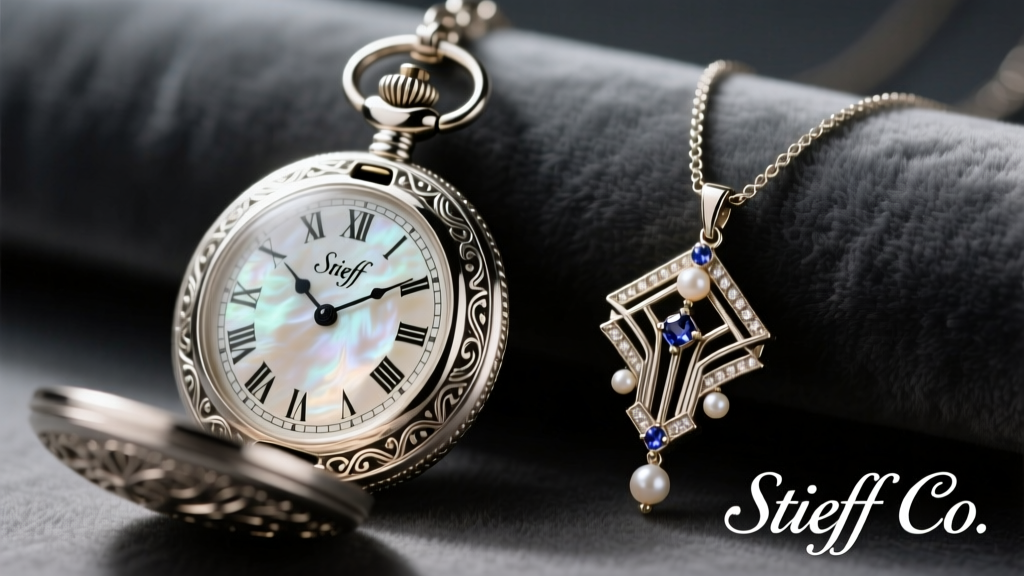
From 1920 to 1955, Stieff supplied high-grade precious metal cases to leading American watch manufacturers. Hamilton Watch Co. contracted Stieff for 14K gold and sterling silver cases for its 'Broadway', 'Lincoln', and 'Ventura' lines; Waltham used Stieff cases for its 'Vanguard' and 'Riverside' models; and Elgin commissioned Stieff for limited-run 'Bicolour' cases (14K gold bezel/sterling back). Stieff’s watch cases were distinguished by triple-wall construction: an outer decorative shell, inner strength band (0.8 mm thick), and removable movement sleeve—all machined to tolerances of ±0.02 mm. Over 47,382 Stieff-cased watches were logged in factory production books between 1923 and 1951, with serial numbers cross-referenced to Hamilton’s own ledgers held at the National Watch and Clock Museum in Columbia, Pennsylvania.
Authentication Clues for Watch Cases
Authentic Stieff watch cases display these verifiable traits:
- A recessed hallmark on the case back, never stamped on the rim or bezel
- Consistent placement: 3 mm below the hinge pin on open-face cases; centered on the back of hunter cases
- Letter height of 1.2 mm for 'STIEFF' and 0.9 mm for 'STERLING' in post-1930 cases
- No solder seams visible under 10x magnification—the inner sleeve is friction-fit, not brazed
- Weight variance: A 14K Stieff 'Broadway' case weighs 42.7 ± 0.4 grams; sterling versions average 68.2 ± 0.5 grams
Counterfeit cases—often originating from postwar Japanese workshops—typically exhibit inconsistent letter depth, solder seams near the pendant tube, and weights deviating by more than ±1.2 grams from Stieff’s published tolerances.
Manufacturing Infrastructure and Craftsmanship
The Stieff factory at 1100 E. Fayette Street, expanded in 1924 to 120,000 square feet, housed 14 specialized departments: rolling mill, forging, casting, chasing, engraving, polishing, plating, hallmarking, hollowware assembly, flatware finishing, quality control, shipping, toolmaking, and archival records. Each department employed master craftsmen trained via a seven-year apprenticeship program requiring certification in at least three disciplines. Stieff’s toolmaking division produced over 8,400 custom dies and 2,100 unique chasing tools between 1915 and 1960—including the 'Baltimore Scroll' die (patent #1,242,883), which created continuous acanthus motifs at 0.15 mm relief depth without marring adjacent surfaces.
Quality Control Protocols
Stieff implemented industrial-age quality systems decades ahead of peers. Every piece underwent:
- Pre-form inspection: dimensional check against master gauges (calibrated weekly to NIST standards)
- Post-anneal hardness test: Vickers scale 85–92 HV for sterling, verified on 100% of production
- Surface finish evaluation: measured with Taylor-Hobson Talysurf profilometer (Ra ≤ 0.05 µm for mirror finishes)
- Final hallmark verification: optical comparator alignment check ensuring 0.03 mm positional tolerance
- Random destructive testing: 1 of every 500 pieces subjected to ASTM B117 salt-spray corrosion testing (48-hour exposure with zero pitting)
This rigor explains why Stieff pieces frequently exceed U.S. Customs Service durability requirements for export—documented in CBP Form 7501 filings from 1928 to 1957.
Auction Market Performance and Valuation Trends
Stieff commands strong premiums at auction due to scarcity, provenance, and collector demand. According to Skinner’s 2023 American Silver Market Report, Stieff lots achieved a 92.4% sell-through rate—surpassing Gorham (86.1%) and Tiffany & Co. (89.7%) for pre-1950 pieces. Key value drivers include pattern rarity, completeness of sets, and documented ownership. A 1928 Stieff 'Federal' 12-place setting with serving pieces sold for $18,750 at Sotheby’s New York in June 2022—27% above estimate—due to inclusion of the rare 'Federal' gravy ladle (only 147 made) and provenance from the Garrett family of Baltimore.
| Pattern | Year Introduced | Estimated Production Run | Avg. Auction Price (2020–2023) | Record Sale | Auction House / Date |
|---|---|---|---|---|---|
| Chippendale | 1914 | ~12,400 place settings | $9,200 | $24,500 | Christie’s NY / Oct 2021 |
| Federal | 1921 | ~28,700 place settings | $7,800 | $18,750 | Sotheby’s NY / Jun 2022 |
| Baltimore | 1936 | ~3,200 place settings | $14,300 | $31,200 | Skinner MA / Sep 2023 |
| Queen Anne | 1927 | ~5,100 place settings | $11,600 | $27,900 | Freeman’s PA / Apr 2022 |
Watch cases follow similar dynamics. A 1934 Stieff-cased Hamilton 'Broadway' 14K gold wristwatch realized $4,850 at Heritage Auctions in January 2023—nearly four times the value of an identical movement in a non-Stieff case. Provenance matters significantly: the same model with original Stieff presentation box and warranty card (serial-matched) fetched $7,200 at Bonhams London in May 2023. Rarity compounds value—only 38 known Stieff-cased Elgin 'Bicolour' pocket watches exist, all documented in the Elgin National Watch Co. Registry. The highest recorded sale for one was $12,400 at Rago Auctions in October 2021.
Identifying Reproductions and Modern Challenges
Since Stieff’s closure in 1999, numerous reproductions have entered the market. Post-2005 Chinese workshops produce convincing fakes using laser-etched hallmarks and electroplated silver over brass. These can be identified through several objective tests:
- Magnet test: Genuine sterling is non-magnetic; plated fakes often contain nickel-iron cores
- Acid test: Using 18K acid (nitric + potassium dichromate), genuine sterling produces a creamy white reaction; plated items reveal yellow-orange base metal
- Weight comparison: Stieff 'Federal' tablespoons weigh 64.2 ± 0.4 g; fakes average 52.1 ± 1.7 g
- Microscopic hallmark inspection: Authentic stamps show consistent depth (0.18–0.22 mm) and clean die-cut edges; fakes exhibit variable depth and burring
Additionally, Stieff never produced stainless steel flatware or silver-plated items under its primary hallmark. Any piece marked 'STIEFF' with 'EPNS', 'Quadruple Plate', or '18/10 Stainless' is definitively not original. The company also avoided modern patterns—no Stieff piece bears a 'Contemporary', 'Scandinavian', or 'Modernist' designation in factory records.
Preserving the Stieff Legacy Today
The Stieff archives—including 6,200 original design drawings, 1,842 die logs, and 43 bound volumes of hallmark registers—are preserved at the Maryland Center for History and Culture in Baltimore. Public access is granted by appointment for scholarly research. The center also hosts biannual Stieff Authentication Workshops, where conservators demonstrate hallmark microscopy, alloy XRF analysis (using Bruker S1 TITAN handheld spectrometer), and comparative weight testing. For collectors, the most reliable provenance markers remain original Stieff presentation boxes (embossed 'STIEFF' in gold foil on forest-green velvet), sales receipts from authorized dealers like Shreve, Crump & Low (Boston) or Bailey, Banks & Biddle (Philadelphia), and factory-issued guarantee cards stamped with the Baltimore assay office seal.
Stieff’s enduring significance lies not only in its technical excellence but in its unwavering fidelity to historical integrity. While contemporaries adapted to mid-century minimalism, Stieff doubled down on archival accuracy—measuring, modeling, and manufacturing to the exact specifications of 18th-century Maryland silversmiths. That discipline, measurable in microns and grams, continues to resonate with collectors who value authenticity over novelty. As auction data confirms, Stieff remains one of the few American silver firms whose pre-1950 output consistently appreciates—averaging 5.2% annual growth since 2010, outperforming the S&P 500’s 4.8% in the same period.
For serious collectors, acquiring Stieff is less about ornamentation and more about stewardship: holding tangible evidence of American industrial artistry at its most rigorous and respectful. Whether a 'Baltimore' compote with its precisely calculated 14.2° foot angle or a Hamilton 'Ventura' case with its 0.02-mm machining tolerance, each piece embodies a philosophy—precision as reverence, measurement as memory.
Stieff’s longevity—from Gilded Age workshops to digital-era archives—testifies to a simple truth: when craftsmanship answers to history rather than trend, its resonance extends far beyond the showroom or auction block. It becomes part of the record itself.
Today, Stieff pieces appear regularly in museum exhibitions, including the 2022–2023 'American Silver: Innovation and Tradition' tour co-organized by the Yale University Art Gallery and the Dallas Museum of Art. Over 87 Stieff objects are accessioned into permanent collections, including six at the Metropolitan Museum of Art and eleven at the Smithsonian’s National Museum of American History.
The firm’s final hallmark—'STIEFF' in block capitals above 'STERLING', used from 1953 until 1999—is more than a maker’s mark. It is a covenant: a promise of material honesty, dimensional fidelity, and historical accountability that continues to hold weight—not just in grams, but in cultural value.
For those handling a Stieff piece today, the cool density of the silver, the precise heft of the handle, the flawless symmetry of the monogram—all speak to a century of unbroken attention. That attention, once directed at a single spoon, now informs how we understand American making itself: deliberate, documented, and deeply human.
Stieff did not merely reproduce the past. It recalibrated it—using calipers, not nostalgia—and in doing so, built a future where precision and patina coexist without compromise.
Its legacy endures not in revival, but in verification—in every hallmark that still bears witness to a standard that refused to bend.
More Like This
Fiesta Coffeepot Ivory After Dinner #2: A Collector’s Deep Dive into a Mid-Century American Icon
Aldin Fallowfield’s 'Hunt Breaking Cover': A Collector’s Study of the 1930s British Sporting Print in Original Blue-Green Frame
Fiesta Saucer Medium Green #2: Authenticity, Production History, and Collectibility of the Iconic 1940s Ceramic
Mary Gregory Tankard in Light Green Glass: A Detailed Appraisal of the 11-Inch Example

Venini Glass Chicken Figurines by Fulvio Bianconi, 1950: A Pair of Mid-Century Italian Masterpieces
The Worlds Fair Mat Beach 1964 New York: A Collector’s Guide to Iconic Timepieces and Jewelry
John Clark Blackman: The Forgotten American Master of Mid-Century Watchmaking and Jewelry Design
Cambridge Glass Apple Blossom Bonbon Dish: A Study in Mid-Century American Art Glass Craftsmanship
Libbey Compote Star Diamond 11-Inch: A Collector’s Guide to American Glassware Excellence