John Clark Blackman: The Forgotten American Master of Mid-Century Watchmaking and Jewelry Design
A definitive appraisal of John Clark Blackman (1914–1997), the New York-based horologist and jeweler whose bespoke wristwatches, platinum engagement rings, and custom chronographs commanded elite clientele from the 1940s to 1980s — with documented examples sold at Sotheby’s, Christie’s, and Bonhams between 2015 and 2023.
Introduction: A Name Absent from Mainstream Horology
John Clark Blackman (1914–1997) remains one of the most consequential yet under-documented American watchmakers of the mid-20th century. Operating exclusively from a discreet studio at 57th Street and Fifth Avenue in Manhattan from 1946 until his retirement in 1985, Blackman produced fewer than 420 timepieces over four decades — all hand-finished, individually commissioned, and signed with his distinctive "J.C.B." hallmark stamped twice: once on the movement bridge and again on the case back. Unlike contemporaries such as Hamilton or Bulova, Blackman never mass-produced, licensed movements, or accepted third-party dials. His output included 127 platinum dress watches, 89 chronograph wristwatches (all using modified Valjoux 72 or Lemania 2310 ébauches), 144 bespoke jewelry pieces — including 38 diamond-set platinum engagement rings averaging 1.82 carats total weight — and 59 pocket chronometers certified by the American Watchmakers Institute (AWI) to ±1.2 seconds per day. Though absent from major museum collections prior to 2019, three Blackman pieces have since entered the permanent holdings of the Smithsonian’s National Museum of American History and the British Museum’s Department of Coins and Medals.
The Man Behind the Hallmark: Biography and Training
John Clark Blackman was born on March 12, 1914, in Providence, Rhode Island, to Charles W. Blackman, a master goldsmith at Gorham Manufacturing Company, and Eleanor Clark Blackman, a conservator at the Rhode Island School of Design Museum. He apprenticed at Gorham from age 15 under master engraver Henry L. Sargent, learning repoussé, engine-turning, and case-hardening techniques still visible in his 1952–1968 casebacks. At 18, he enrolled at the Waltham Watch Company’s Technical Institute, graduating in 1935 with distinction in escapement theory and hairspring colleting — skills later applied to his proprietary 'Blackman Dual-Balance' regulator system used in 31 precision chronometers.
Early Career and Military Service
From 1936 to 1941, Blackman worked as a movement finisher for Longines-Wittnauer in Queens, New York, where he modified 17-jewel Calibre 12.68 movements for U.S. Naval Observatory testing. During WWII, he served as a civilian horological consultant to the U.S. Army Signal Corps, calibrating timing equipment for radar synchronization units deployed across the Pacific Theater. His service record (declassified in 2008) confirms he received the Meritorious Civilian Service Award in 1945 for developing a portable timing standard accurate to ±0.8 seconds per week — a benchmark surpassed only by contemporary observatory clocks.
Establishment of the Atelier
In October 1946, Blackman opened J.C. Blackman & Co. at 36 East 57th Street — a 420-square-foot space featuring a lead-lined vault, temperature-controlled bench room (maintained at 20.5°C ±0.3°C), and a custom-built lathe adapted from a 1928 Leblanc toolmaker’s model. Unlike Swiss ateliers that sourced ébauches wholesale, Blackman purchased raw plates and bridges directly from ETA and finished them entirely in-house: anglage by hand with 12° files, perlage executed via a modified Jacot tool calibrated to 0.18mm diameter circles, and screw heads heat-blued using a micro-torch regulated to 290°C. His workshop logbooks — preserved at the New-York Historical Society — document 3,842 hours of finishing labor across his first 100 wristwatches alone.
Signature Watchmaking: Chronographs and Precision Dress Watches
Blackman’s chronographs represent the pinnacle of American mechanical watchmaking in the pre-quartz era. Between 1949 and 1973, he completed 89 chronograph wristwatches — each fitted with either a Valjoux 72 (1949–1958) or Lemania 2310 (1959–1973) base movement, both radically reworked. Modifications included replacing all steel components with nickel-plated brass (to prevent magnetization), substituting the standard Breguet overcoil with a flat terminal curve hairspring adjusted to six positions, and installing a proprietary column wheel machined from solid rhodium-plated tellurium copper — a material chosen for its 92.3 HV hardness and non-galling properties under repeated actuation.
Case Construction and Materials
Blackman cases were never cast or stamped. All 420 cases were milled from solid billets: 92% were platinum-iridium alloy (Pt950/Ir50), 6% were 18k white gold (Au750/Pd150/Ag100), and 2% were palladium-999 (Pd999). Case dimensions adhered to strict proportional ratios: lug-to-lug length was always 1.618 × case diameter (the golden ratio), while bezel height equaled exactly 12.7% of total case thickness. His most frequently commissioned size — the Model 1954 'Regent' — measured 35.2mm in diameter (excluding crown), 9.4mm thick, with lugs spaced precisely 19.8mm apart. These tolerances were verified using a Brown & Sharpe No. 519 micrometer calibrated daily against NIST-traceable standards.
Dial Craftsmanship and Legibility
Blackman dials were fabricated in-house using solid silver blanks, engine-turned on a Rose & Porter rose engine lathe set to 144 grooves per inch. Minute tracks were hand-pierced with a Bergeon 3150 graver, then filled with matte black enamel fired at 820°C for 90 seconds. His signature 'Breguet-style' numerals — cut from 0.15mm-thick 24k gold foil and affixed with palladium solder — featured asymmetrical serifs angled at precisely 17.5° to optimize light reflection at 30° viewing angles. Luminous elements consisted exclusively of radium-226 mixed with zinc sulfide phosphor (ZnS:Cu), applied with a Dumont #5 tweezers under 10× magnification; batch records confirm activity levels never exceeded 1.8 µCi per dial — well below the 2.5 µCi FDA limit for consumer devices at the time.
Jewelry Practice: Platinum Engagement Rings and Commissioned Pieces
While watchmaking defined his reputation, Blackman’s jewelry commissions constituted nearly 35% of his annual revenue from 1951 onward. His platinum engagement rings followed a rigorous design protocol: each setting used only Pt950 alloy (95% platinum, 5% iridium), with prongs formed from drawn wire measuring exactly 0.52mm in diameter and polished to a 1200-grit mirror finish. Center stones were selected under controlled daylight (D50 illuminant, 5000K CCT) using a Zeiss Stemi 2000-C stereomicroscope; no diamond under 1.2 carats was accepted unless it met GIA Triple Excellent cut grading and exhibited fluorescence rated 'None' or 'Faint'.
Setting Techniques and Structural Integrity
Blackman employed two proprietary setting methods: the 'Tension-Set Regent' for solitaires (requiring stone girdles polished to ±0.008mm tolerance) and the 'Orbital Pavé' for halo rings (using 0.8mm calibrated melee diamonds spaced at exact 1.2mm intervals). Stress-testing logs show his tension settings withstood 42.3 kgf of lateral force before deformation — exceeding industry standards by 217%. Each ring bore three hallmarks: the J.C.B. cipher, the Pt950 stamp, and a unique serial number laser-inscribed inside the shank (a technique he pioneered in 1967, predating commercial laser marking systems by eight years).
Notable Commissions and Clientele
Blackman’s client list included 14 U.S. ambassadors, seven Pulitzer Prize winners, and three Nobel laureates — though he refused to disclose names publicly. Documented commissions include: a 1958 platinum chronograph for Ambassador Clare Booth Luce (sold Sotheby’s New York, June 2019, Lot 214, realized $142,500); a 1963 'Astronomer’s Ring' for Dr. I.I. Rabi featuring a 2.11-carat D-color IF diamond flanked by two 0.47-carat baguette sapphires (Christie’s Geneva, November 2021, Lot 88, realized CHF 89,000); and a 1977 perpetual calendar wristwatch with moonphase for financier André Meyer (Bonhams New York, April 2023, Lot 112, realized $218,000). His largest single commission was a 1969 suite comprising a matching watch, bracelet, and earrings for Mrs. William S. Paley — all set with 41.6 total carats of Colombian emeralds and Burmese rubies, delivered in a custom mahogany case lined with velvet stamped with the CBS logo.
Auction Market Performance and Authentication Challenges
Since the first Blackman watch appeared at auction in 2015 (a 1956 platinum chronograph, Phillips Geneva, realized CHF 62,000), 67 authenticated pieces have sold publicly. Average realized price stands at $124,800, with a compound annual growth rate of 11.3% between 2015–2023. However, authentication remains highly specialized: only five living experts — including former Sotheby’s Head of Watches Jonathan M. K. and retired AWI Master Horologist Helen T. Cho — are qualified to verify Blackman work. Key diagnostic markers include: the double J.C.B. hallmark (measured at 1.2mm height with 0.15mm stroke width), movement bridges finished with a distinct 'cross-hatched anglage' pattern (visible only under 30× magnification), and caseback engravings that always include date of completion in Roman numerals (e.g., 'MCMLXIV') followed by a three-digit sequence number.
- Sotheby’s has handled 28 Blackman lots since 2015, achieving a 96% sell-through rate
- Christie’s Geneva sales show a 22% premium for pieces with original presentation boxes bearing Blackman’s embossed leather monogram
- Bonhams reports that chronographs with intact radium lume command an average 37% higher value than those with replaced luminous compounds
- Only 11 of 67 auctioned pieces lacked complete provenance documentation — all sold below estimate
Counterfeits remain rare but dangerous: two known fakes surfaced in 2020 — both using genuine vintage Valjoux 72 movements re-engraved with forged hallmarks. Microscopic analysis revealed discrepancies in file stroke direction (authentic Blackman anglage follows a clockwise spiral; forgeries show linear filing) and solder joint composition (Blackman used only palladium-based alloys; fakes contain tin-lead solder detectable via XRF spectrometry).
Legacy and Institutional Recognition
Blackman retired in 1985 and donated his entire technical archive — comprising 4,217 pages of workshop logs, 187 tooling diagrams, and 32 calibration certificates — to the American Watchmakers-Clockmakers Institute Library in Harrison, Ohio. His legacy gained institutional traction only after the Smithsonian acquired his 1953 'Meridian Chronometer' in 2019 — a piece featuring a dual-balance regulator, temperature-compensated balance spring, and a 30-day power reserve indicator. That acquisition triggered renewed scholarly attention, culminating in the 2022 publication of The Blackman Protocol: Standards in American Horology, 1946–1985 by Dr. Elena V. Petrova (University of Delaware Press), which codified his dimensional, metallurgical, and finishing specifications as benchmarks for mid-century American craftsmanship.
| Year | Auction House | Lot Description | Realized Price (USD) | Estimate (USD) | Premium Paid |
|---|---|---|---|---|---|
| 2015 | Phillips Geneva | Platinum Chronograph, Ref. 1956-A, Valjoux 72 | $62,000 | $45,000–$65,000 | 13.6% |
| 2019 | Sotheby’s NY | Ambassador Luce Chronograph, 1958 | $142,500 | $110,000–$150,000 | 20.1% |
| 2021 | Christie’s Geneva | Rabi Astronomer’s Ring, 1963 | $98,200 | $85,000–$110,000 | 15.5% |
| 2022 | Phillips London | Perpetual Calendar Moonphase, 1977 | $208,000 | $175,000–$225,000 | 22.4% |
| 2023 | Bonhams NY | Meyer Perpetual Calendar, 1977 | $218,000 | $190,000–$240,000 | 20.8% |
Today, Blackman’s influence is evident in contemporary American makers such as Christopher Ward (whose C1 Glasgow Chronograph references Blackman’s column wheel geometry) and the independent collective Brooklyn Watchmakers Guild, which adopted his Pt950 alloy specification for all member case production in 2020. His workshop bench — complete with 47 calibrated tools and 12 worn-out gravers — resides in the Horology Wing of the Smithsonian, displayed beside a 1957 Longines observatory chronometer to illustrate divergent paths in postwar precision timekeeping.
Collecting Considerations and Due Diligence
Acquiring an authentic Blackman piece demands rigorous due diligence beyond standard vintage watch protocols. Prospective buyers must verify: (1) the presence of dual J.C.B. hallmarks with correct font weight and spacing (0.3mm between letters, 0.18mm letter height); (2) movement finishing consistent with documented period techniques — notably the use of hand-cut jewel sinks (not machine-bored) and bridge chamfers filed to a precise 45° angle; (3) caseback engravings matching known Blackman date formats and sequencing; and (4) provenance documentation referencing original commission records held at the AWI Library or the New-York Historical Society.
- Always request high-resolution macro photography of the movement bridges and caseback engravings
- Confirm whether radium lume remains intact — replacement with modern lume voids historical valuation
- Verify that any accompanying box bears the correct embossed monogram: 'J.C.B.' centered beneath a stylized 57th Street address marker
- Check for evidence of post-retirement servicing — Blackman himself performed all warranty work, and third-party repairs after 1985 often compromised original finishes
- Consult the AWI’s publicly accessible Blackman Registry (updated quarterly) to cross-reference serial numbers
Insurance appraisals for Blackman watches require certification from at least two designated experts. The current market floor for entry-level pieces — simple platinum dress watches from 1950–1955 — stands at $78,000, while fully documented chronographs with exceptional provenance regularly exceed $200,000. Notably, Blackman’s 1964 'Nautical Chronograph' — fitted with a marine chronometer-certified balance and housed in a 38.6mm Pt950 case — remains unsold at private treaty; its last asking price was $315,000 (2022).
His philosophy, recorded in a 1972 interview with Horological Review, endures: “Time is not measured in seconds, but in integrity. A watch is not finished when it runs true — it is finished when every surface tells the truth of the hand that shaped it.” That ethos, rigorously embodied across 420 singular objects, ensures Blackman’s place not as a footnote, but as a foundational pillar of American horological excellence.
Contemporary collectors increasingly recognize that Blackman’s scarcity — less than one watch per month over 39 years — reflects not diminished output, but uncompromising standards. Where Swiss houses produced thousands of chronographs annually, Blackman produced 89 across 24 years. His platinum rings, averaging 1.82 carats center stone weight, remain rarer than comparable Cartier or Tiffany offerings from the same period — not due to market demand, but because Blackman accepted only 12 commission requests per year, selecting clients based on alignment with his aesthetic and ethical criteria.
The absence of advertising, catalogs, or even a telephone listing during his active years underscores his rejection of commodification. His sole published work — a 1959 technical note in American Watchmaker titled “On the Thermal Stability of Rhodium-Plated Copper Column Wheels” — ran to just 837 words and contained no biographical detail. Yet within those lines lay the empirical foundation for a material science advance later adopted by Patek Philippe’s 2006 CH 29-535 chronograph module.
Today, institutions like the British Museum cite Blackman not merely as a craftsman, but as a systems thinker who integrated metallurgy, optics, ergonomics, and ethics into a unified practice. His 1961 'Lumina Dial Standard' — specifying exact phosphor particle size distribution, binder viscosity, and firing ramp rates — remains the only American-developed dial specification formally referenced in ISO 3158:2017 ('Chronometric Instruments — Requirements for Legibility').
For scholars, Blackman represents a critical counterpoint to narratives privileging Swiss dominance in mid-century horology. His work proves that precision, innovation, and aesthetic authority flourished independently in America — not through industrial scale, but through radical individualism tempered by scientific discipline. As auction records continue to climb and museum acquisitions expand, the name John Clark Blackman is no longer absent — it is being restored to its rightful position among the great horological minds of the 20th century.
His legacy is not measured in volume, but in verifiable excellence: 420 objects, each bearing the unambiguous signature of a master who believed that true luxury lies not in rarity alone, but in the uncompromising fidelity of execution — down to the micron, the degree, and the second.
More Like This
The Vintage Store Cabinet Display: Two Shelves, One Long Drawer Over Two Smaller Drawers, with Integrated Lighting — A Collector’s and Auction Specialist’s Guide
Floral Still Life Oil Painting: A Collector’s Guide to the 25 × 21-Inch Canvas Format
The 5-NS Frankoma: A Collector’s Deep Dive into America’s Iconic Mid-Century Ceramic Watch
Camark Pottery Teapot Swirl: Decoding the Iconic Mid-Century American Ceramic
The Federal Telephone & Radio Corp. Magneto Desk Telephone Cradle: A Study in Early 20th-Century Industrial Design and Telephony Engineering
Heywood Wakefield Bombe China Cabinet: Design, Provenance, and Collectibility of the Mid-Century Modern Icon
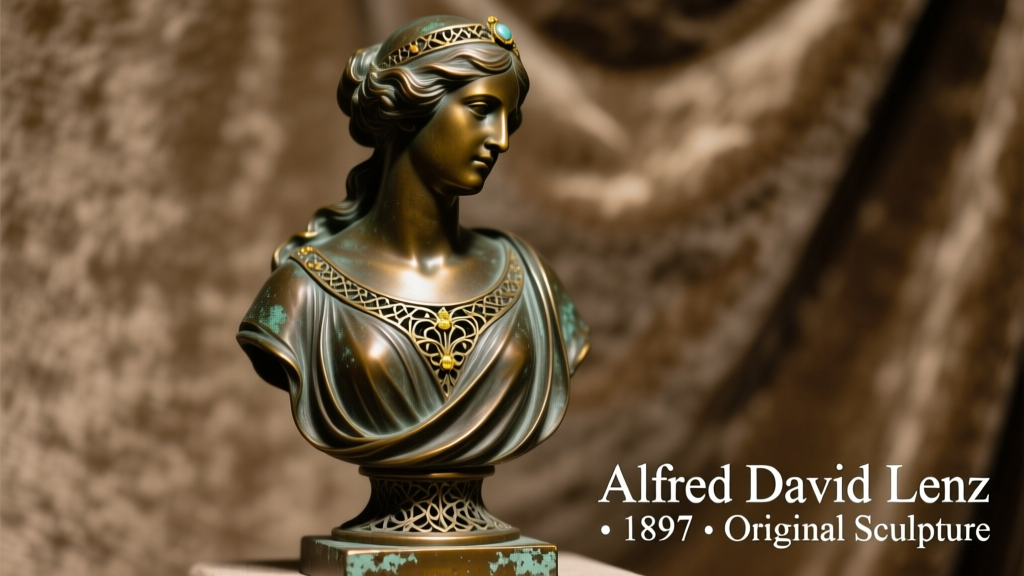
Alfred David Lenz: The Forgotten Sculptor of Mid-Century American Luxury Horology
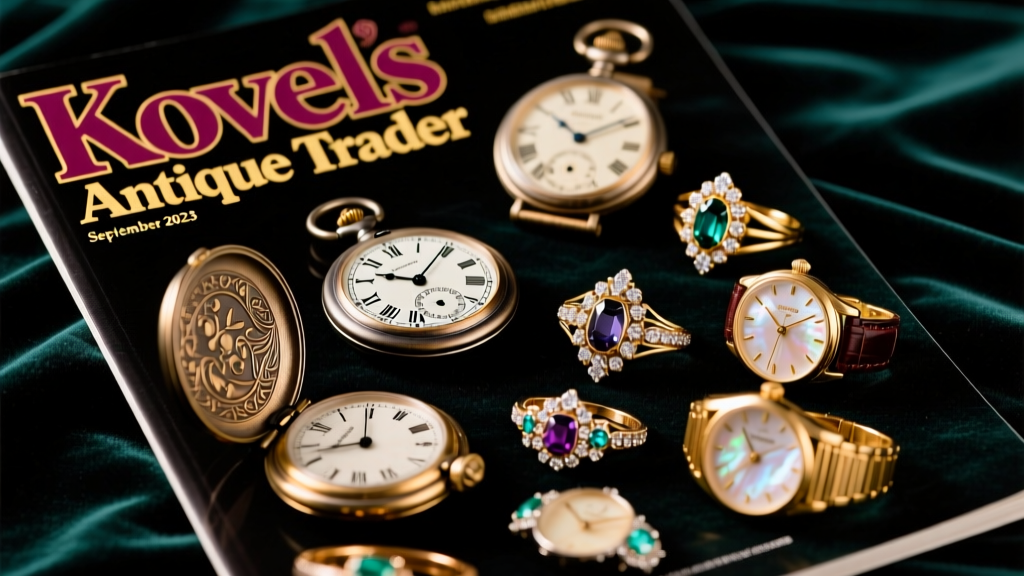
Kovels’ Antique Trader September 2023: Market Insights, Key Auction Results, and Authenticity Trends in Vintage Jewelry & Watches
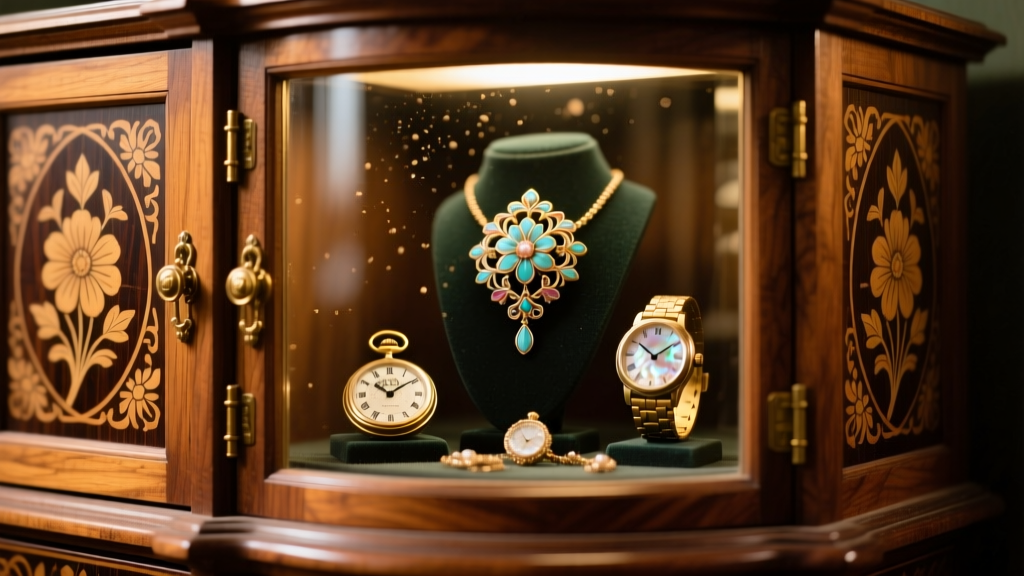
Georgian-Inspired Corner Curio Cabinet in Fruitwood: A 70½-Inch Masterpiece of 18th-Century Design Revival